

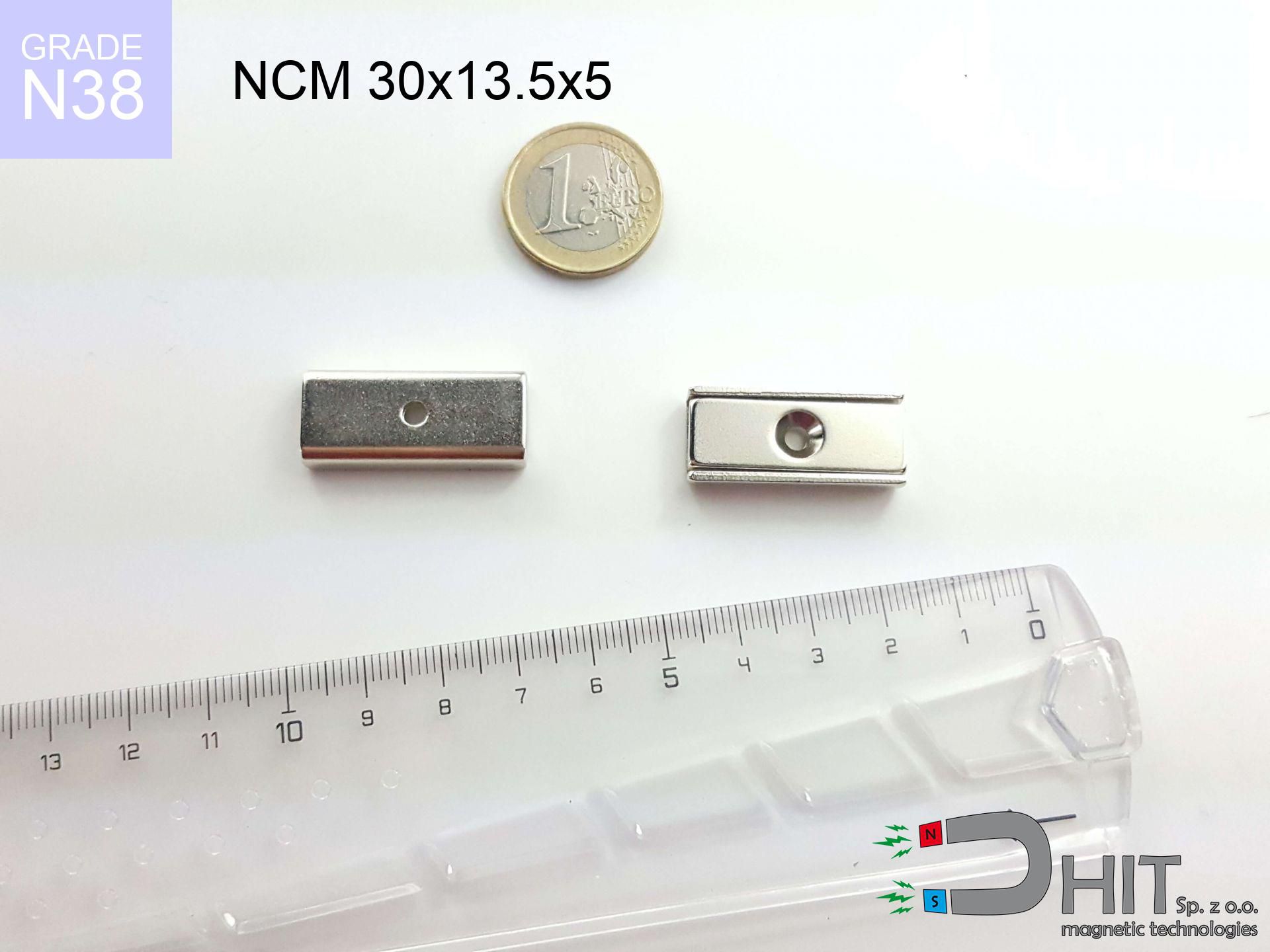
NCM 30x13.5x5 / N38 - channel magnetic holder
channel magnetic holder
Catalog no 360488
GTIN/EAN: 5906301814870
- Diameter Ø
- 30 mm [±1 mm]
- Height
- 13.5 mm [±1 mm]
- Weight
- 14 g
- Magnetization Direction
- ↑ axial
- Coating
- [NiCuNi] Nickel
How we measure these parameters — certificates and measurements
7.64 zł net / pcs
9.40 zł with VAT (23% VAT) / pcs
bulk discounts:
Need more?Frequently asked questions
Which magnetic holder is suitable for moving metal parts in a workshop?
How do I choose a holder for hanging a heavy item and check its real grip?
Which magnetic holders can be used outdoors?
How should I choose a strong threaded holder for field work?
Call us now
+48 888 99 98 98
alternatively let us know using
contact form
the contact section.
Specifications and structure of a neodymium magnet can be estimated using our
power calculator.
Order by 14:00 and we’ll ship today!
Technical details - NCM 30x13.5x5 / N38 - channel magnetic holder
Specification / characteristics - NCM 30x13.5x5 / N38 - channel magnetic holder
| properties | values |
|---|---|
| Cat. no. | 360488 |
| GTIN/EAN | 5906301814870 |
| Production/Distribution | Dhit sp. z o.o. |
| Country of origin | Poland / China / Germany |
| Customs code | 85059029 |
| Diameter Ø | 30 mm [±1 mm] |
| Height | 13.5 mm [±1 mm] |
| Weight | 14 g |
| Magnetization Direction | ↑ axial |
| Load capacity ~ ? | 16.00 kg / 156.91 N |
| Coating | [NiCuNi] Nickel |
| Manufacturing Tolerance | ±1 mm |
Magnetic properties of material N38
| properties | values | units |
|---|---|---|
| Remanence Br ? | 12.2-12.6 | kGs |
| Remanence Br ? | 1220-1260 | mT |
| Coercivity bHc ? | 10.8-11.5 | kOe |
| Coercivity bHc ? | 860-915 | kA/m |
| Intrinsic coercivity iHc | ≥ 12 | kOe |
| Intrinsic coercivity iHc | ≥ 955 | kA/m |
| Energy product BHmax ? | 36-38 | BH max MGOe |
| Energy product BHmax ? | 287-303 | BH max KJ/m |
| Maximum working temperature ? | ≤ 80 | °C |
Physical properties of sintered neodymium magnets Nd2Fe14B at 20°C
| properties | values | units |
|---|---|---|
| Vickers hardness | ≥550 | Hv |
| Density | ≥7.4 | g/cm3 |
| Curie Temperature TC | 310 | °C |
| Curie Temperature TF | 590 | °F |
| Specific resistance | 150 | μΩ⋅cm |
| Bending strength | 250 | MPa |
| Compressive strength | 1000~1100 | MPa |
| Thermal expansion parallel (∥) to orientation (M) | (3-4) x 10-6 | °C-1 |
| Thermal expansion perpendicular (⊥) to orientation (M) | -(1-3) x 10-6 | °C-1 |
| Young's modulus | 1.7 x 10⁴ | kg/mm² |
Material specification
| iron (Fe) | 64% – 68% |
| neodymium (Nd) | 29% – 32% |
| boron (B) | 1.1% – 1.2% |
| dysprosium (Dy) | 0.5% – 2.0% |
| coating (Ni-Cu-Ni) | < 0.05% |
Sustainability
| recyclability (EoL) | 100% |
| recycled raw materials | ~10% (pre-cons) |
| carbon footprint | low / zredukowany |
| waste code (EWC) | 16 02 16 |
Other proposals
![SM 32x500 [2xM8] / N42 - magnetic separator](https://cdn3.dhit.pl/graphics/products/sm-32x500-2xm8-jan.jpg "SM 32x500 [2xM8] / N42 - magnetic separator")

![UI 39x9x7 [BA] - badge holder](https://cdn3.dhit.pl/graphics/products/ui39x9x7-dav.jpg "UI 39x9x7 [BA] - badge holder")
![UMGGZ 66x8.5 [M8] GZ / N38 - rubber magnetic holder external thread](https://cdn3.dhit.pl/graphics/products/umggz-66x8.5-m6-gz-gas.jpg "UMGGZ 66x8.5 [M8] GZ / N38 - rubber magnetic holder external thread")
Advantages as well as disadvantages of neodymium magnets.
Strengths
- They do not lose magnetism, even over around ten years – the reduction in lifting capacity is only ~1% (according to tests),
- They do not lose their magnetic properties even under close interference source,
- In other words, due to the shiny finish of nickel, the element is aesthetically pleasing,
- Magnets have extremely high magnetic induction on the surface,
- Through (appropriate) combination of ingredients, they can achieve high thermal resistance, enabling functioning at temperatures reaching 230°C and above...
- Possibility of detailed machining and adjusting to concrete needs,
- Huge importance in innovative solutions – they are commonly used in computer drives, electric drive systems, medical devices, also other advanced devices.
- Compactness – despite small sizes they generate large force, making them ideal for precision applications
Limitations
- They are prone to damage upon too strong impacts. To avoid cracks, it is worth securing magnets in a protective case. Such protection not only shields the magnet but also increases its resistance to damage
- Do not exceed this material temperature limit: 80°C. Overheating may permanently weaken the magnet.
- When exposed to humidity, magnets usually rust. For applications outside, it is recommended to use protective magnets, such as those in rubber or plastics, which secure oxidation as well as corrosion.
- Due to limitations in realizing nuts and complex forms in magnets, we propose using cover - magnetic holder.
- Possible danger related to microscopic parts of magnets are risky, when accidentally swallowed, which gains importance in the context of child health protection. Furthermore, tiny parts of these magnets can be problematic in diagnostics medical after entering the body.
- Due to complex production process, their price exceeds standard values,
Pull force analysis
Maximum lifting force for a neodymium magnet – what contributes to it?
- with the application of a sheet made of special test steel, guaranteeing full magnetic saturation
- with a cross-section of at least 10 mm
- characterized by even structure
- with total lack of distance (no coatings)
- under vertical force vector (90-degree angle)
- in temp. approx. 20°C
Magnet lifting force in use – key factors
- Clearance – the presence of foreign body (paint, dirt, gap) acts as an insulator, which lowers power rapidly (even by 50% at 0.5 mm).
- Angle of force application – highest force is available only during pulling at a 90° angle. The resistance to sliding of the magnet along the surface is standardly several times lower (approx. 1/5 of the lifting capacity).
- Substrate thickness – for full efficiency, the steel must be sufficiently thick. Paper-thin metal limits the attraction force (the magnet "punches through" it).
- Material type – the best choice is pure iron steel. Hardened steels may generate lower lifting capacity.
- Surface quality – the more even the surface, the larger the contact zone and stronger the hold. Roughness acts like micro-gaps.
- Operating temperature – neodymium magnets have a negative temperature coefficient. When it is hot they lose power, and in frost gain strength (up to a certain limit).
Lifting capacity was assessed with the use of a polished steel plate of optimal thickness (min. 20 mm), under perpendicular pulling force, in contrast under attempts to slide the magnet the holding force is lower. Moreover, even a small distance between the magnet’s surface and the plate reduces the holding force.
Warnings
Fire warning
Drilling and cutting of NdFeB material carries a risk of fire hazard. Magnetic powder oxidizes rapidly with oxygen and is hard to extinguish.
Choking Hazard
Always store magnets out of reach of children. Risk of swallowing is significant, and the consequences of magnets connecting inside the body are fatal.
Impact on smartphones
Be aware: neodymium magnets produce a field that confuses precision electronics. Keep a separation from your mobile, device, and GPS.
Finger safety
Risk of injury: The attraction force is so great that it can cause hematomas, crushing, and even bone fractures. Use thick gloves.
Safe operation
Handle with care. Rare earth magnets act from a long distance and connect with massive power, often faster than you can react.
Skin irritation risks
Certain individuals experience a hypersensitivity to nickel, which is the common plating for NdFeB magnets. Extended handling can result in an allergic reaction. We recommend wear protective gloves.
Shattering risk
NdFeB magnets are ceramic materials, which means they are fragile like glass. Impact of two magnets will cause them breaking into shards.
Maximum temperature
Monitor thermal conditions. Exposing the magnet to high heat will ruin its magnetic structure and strength.
Data carriers
Device Safety: Neodymium magnets can ruin data carriers and delicate electronics (heart implants, hearing aids, mechanical watches).
Warning for heart patients
For implant holders: Strong magnetic fields disrupt electronics. Keep minimum 30 cm distance or ask another person to handle the magnets.
Tabela kosztu i czasu dostawy
Płatność przed wysyłką:

GLS kurier
Przesyłka będzie u Ciebie za 2-3 dni
14.99 ZŁ

InPost Paczkomaty 24/7
Przesyłka będzie u Ciebie za 1-2 dni
12.30 ZŁ
Płatność przy odbiorze (pobranie):
GLS kurier
Przesyłka będzie u Ciebie za 1-2 dni
23.00 ZŁ