

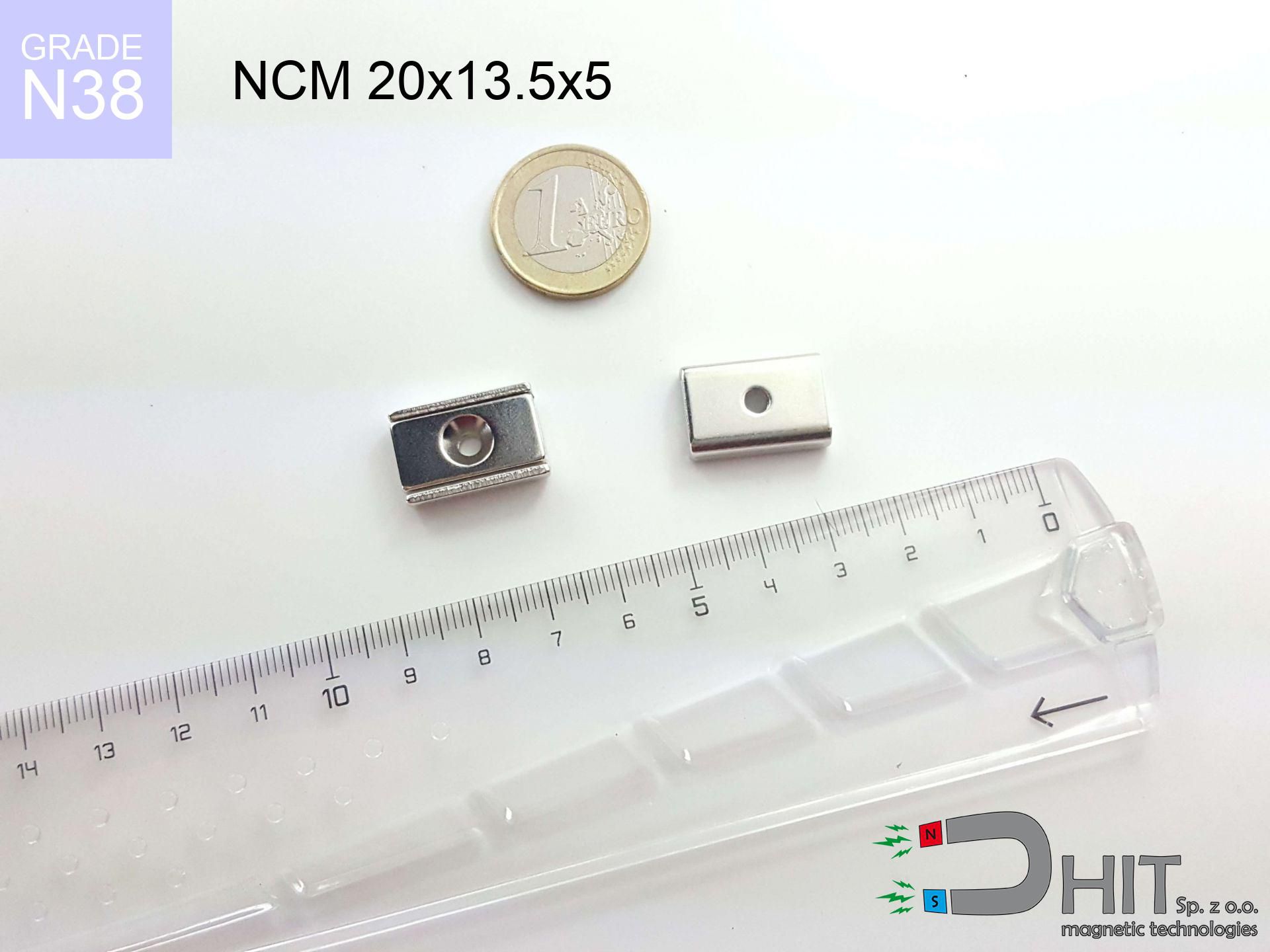
NCM 20x13.5x5 / N38 - channel magnetic holder
channel magnetic holder
Catalog no 360487
GTIN/EAN: 5906301814863
- Diameter Ø
- 20 mm [±1 mm]
- Height
- 13.5 mm [±1 mm]
- Weight
- 9.2 g
- Magnetization Direction
- ↑ axial
- Coating
- [NiCuNi] Nickel
How we measure these parameters — certificates and measurements
5.93 zł net / pcs
7.29 zł with VAT (23% VAT) / pcs
bulk discounts:
Need more?Frequently asked questions
Which magnetic holder is suitable for moving metal parts in a workshop?
How do I choose a holder for hanging a heavy item and check its real grip?
Which magnetic holders can be used outdoors?
How should I choose a strong threaded holder for field work?
Call us now
+48 888 99 98 98
alternatively let us know using
contact form
the contact section.
Specifications and structure of a neodymium magnet can be estimated using our
power calculator.
Order by 14:00 and we’ll ship today!
Product card - NCM 20x13.5x5 / N38 - channel magnetic holder
Specification / characteristics - NCM 20x13.5x5 / N38 - channel magnetic holder
| properties | values |
|---|---|
| Cat. no. | 360487 |
| GTIN/EAN | 5906301814863 |
| Production/Distribution | Dhit sp. z o.o. |
| Country of origin | Poland / China / Germany |
| Customs code | 85059029 |
| Diameter Ø | 20 mm [±1 mm] |
| Height | 13.5 mm [±1 mm] |
| Weight | 9.2 g |
| Magnetization Direction | ↑ axial |
| Load capacity ~ ? | 8.00 kg / 78.45 N |
| Coating | [NiCuNi] Nickel |
| Manufacturing Tolerance | ±1 mm |
Magnetic properties of material N38
| properties | values | units |
|---|---|---|
| Remanence Br ? | 12.2-12.6 | kGs |
| Remanence Br ? | 1220-1260 | mT |
| Coercivity bHc ? | 10.8-11.5 | kOe |
| Coercivity bHc ? | 860-915 | kA/m |
| Intrinsic coercivity iHc | ≥ 12 | kOe |
| Intrinsic coercivity iHc | ≥ 955 | kA/m |
| Energy product BHmax ? | 36-38 | BH max MGOe |
| Energy product BHmax ? | 287-303 | BH max KJ/m |
| Maximum working temperature ? | ≤ 80 | °C |
Physical properties of sintered neodymium magnets Nd2Fe14B at 20°C
| properties | values | units |
|---|---|---|
| Vickers hardness | ≥550 | Hv |
| Density | ≥7.4 | g/cm3 |
| Curie Temperature TC | 310 | °C |
| Curie Temperature TF | 590 | °F |
| Specific resistance | 150 | μΩ⋅cm |
| Bending strength | 250 | MPa |
| Compressive strength | 1000~1100 | MPa |
| Thermal expansion parallel (∥) to orientation (M) | (3-4) x 10-6 | °C-1 |
| Thermal expansion perpendicular (⊥) to orientation (M) | -(1-3) x 10-6 | °C-1 |
| Young's modulus | 1.7 x 10⁴ | kg/mm² |
Material specification
| iron (Fe) | 64% – 68% |
| neodymium (Nd) | 29% – 32% |
| boron (B) | 1.1% – 1.2% |
| dysprosium (Dy) | 0.5% – 2.0% |
| coating (Ni-Cu-Ni) | < 0.05% |
Ecology and recycling (GPSR)
| recyclability (EoL) | 100% |
| recycled raw materials | ~10% (pre-cons) |
| carbon footprint | low / zredukowany |
| waste code (EWC) | 16 02 16 |
Check out more proposals


![SM 32x125 [2xM8] / N42 - magnetic separator](https://cdn3.dhit.pl/graphics/products/sm-32x125-2xm8-pul.jpg "SM 32x125 [2xM8] / N42 - magnetic separator")

Advantages and disadvantages of Nd2Fe14B magnets.
Advantages
- They virtually do not lose power, because even after 10 years the decline in efficiency is only ~1% (based on calculations),
- They are noted for resistance to demagnetization induced by presence of other magnetic fields,
- A magnet with a metallic silver surface has an effective appearance,
- Magnets possess impressive magnetic induction on the outer layer,
- Neodymium magnets are characterized by very high magnetic induction on the magnet surface and can function (depending on the form) even at a temperature of 230°C or more...
- Thanks to flexibility in designing and the ability to modify to complex applications,
- Fundamental importance in high-tech industry – they serve a role in HDD drives, electric motors, advanced medical instruments, and technologically advanced constructions.
- Thanks to concentrated force, small magnets offer high operating force, in miniature format,
Limitations
- Susceptibility to cracking is one of their disadvantages. Upon strong impact they can fracture. We advise keeping them in a steel housing, which not only protects them against impacts but also increases their durability
- Do not exceed this material temperature limit: 80°C. Overheating may permanently weaken the magnet.
- Due to the susceptibility of magnets to corrosion in a humid environment, we advise using waterproof magnets made of rubber, plastic or other material immune to moisture, in case of application outdoors
- We suggest cover - magnetic holder, due to difficulties in producing nuts inside the magnet and complicated forms.
- Possible danger to health – tiny shards of magnets pose a threat, in case of ingestion, which is particularly important in the context of child health protection. Furthermore, small elements of these devices can be problematic in diagnostics medical when they are in the body.
- High unit price – neodymium magnets are more expensive than other types of magnets (e.g. ferrite), which can limit application in large quantities
Pull force analysis
Highest magnetic holding force – what it depends on?
- with the application of a sheet made of low-carbon steel, ensuring maximum field concentration
- with a cross-section no less than 10 mm
- with an polished touching surface
- under conditions of gap-free contact (surface-to-surface)
- for force acting at a right angle (in the magnet axis)
- at room temperature
Determinants of lifting force in real conditions
- Distance – existence of any layer (rust, dirt, gap) interrupts the magnetic circuit, which reduces capacity steeply (even by 50% at 0.5 mm).
- Loading method – declared lifting capacity refers to detachment vertically. When applying parallel force, the magnet holds much less (often approx. 20-30% of maximum force).
- Plate thickness – insufficiently thick plate does not close the flux, causing part of the power to be escaped into the air.
- Steel grade – the best choice is pure iron steel. Cast iron may attract less.
- Surface finish – full contact is possible only on polished steel. Rough texture reduce the real contact area, weakening the magnet.
- Operating temperature – neodymium magnets have a negative temperature coefficient. At higher temperatures they lose power, and at low temperatures gain strength (up to a certain limit).
Lifting capacity was determined using a polished steel plate of optimal thickness (min. 20 mm), under perpendicular detachment force, however under attempts to slide the magnet the holding force is lower. In addition, even a minimal clearance between the magnet’s surface and the plate reduces the holding force.
H&S for magnets
Choking Hazard
These products are not toys. Accidental ingestion of a few magnets may result in them attracting across intestines, which poses a severe health hazard and requires immediate surgery.
Magnets are brittle
NdFeB magnets are ceramic materials, meaning they are very brittle. Clashing of two magnets leads to them cracking into small pieces.
Heat warning
Monitor thermal conditions. Heating the magnet above 80 degrees Celsius will permanently weaken its magnetic structure and pulling force.
Do not drill into magnets
Dust produced during cutting of magnets is self-igniting. Do not drill into magnets without proper cooling and knowledge.
Respect the power
Use magnets consciously. Their powerful strength can surprise even experienced users. Stay alert and do not underestimate their force.
Warning for heart patients
Health Alert: Strong magnets can deactivate pacemakers and defibrillators. Stay away if you have medical devices.
Sensitization to coating
It is widely known that nickel (the usual finish) is a strong allergen. For allergy sufferers, prevent direct skin contact or opt for coated magnets.
Safe distance
Data protection: Neodymium magnets can damage data carriers and sensitive devices (heart implants, hearing aids, timepieces).
Hand protection
Danger of trauma: The attraction force is so immense that it can result in hematomas, pinching, and broken bones. Protective gloves are recommended.
Threat to navigation
GPS units and smartphones are extremely sensitive to magnetic fields. Close proximity with a powerful NdFeB magnet can decalibrate the internal compass in your phone.
Tabela kosztu i czasu dostawy
Płatność przed wysyłką:

GLS kurier
Przesyłka będzie u Ciebie za 2-3 dni
14.99 ZŁ

InPost Paczkomaty 24/7
Przesyłka będzie u Ciebie za 1-2 dni
12.30 ZŁ
Płatność przy odbiorze (pobranie):
GLS kurier
Przesyłka będzie u Ciebie za 1-2 dni
23.00 ZŁ