

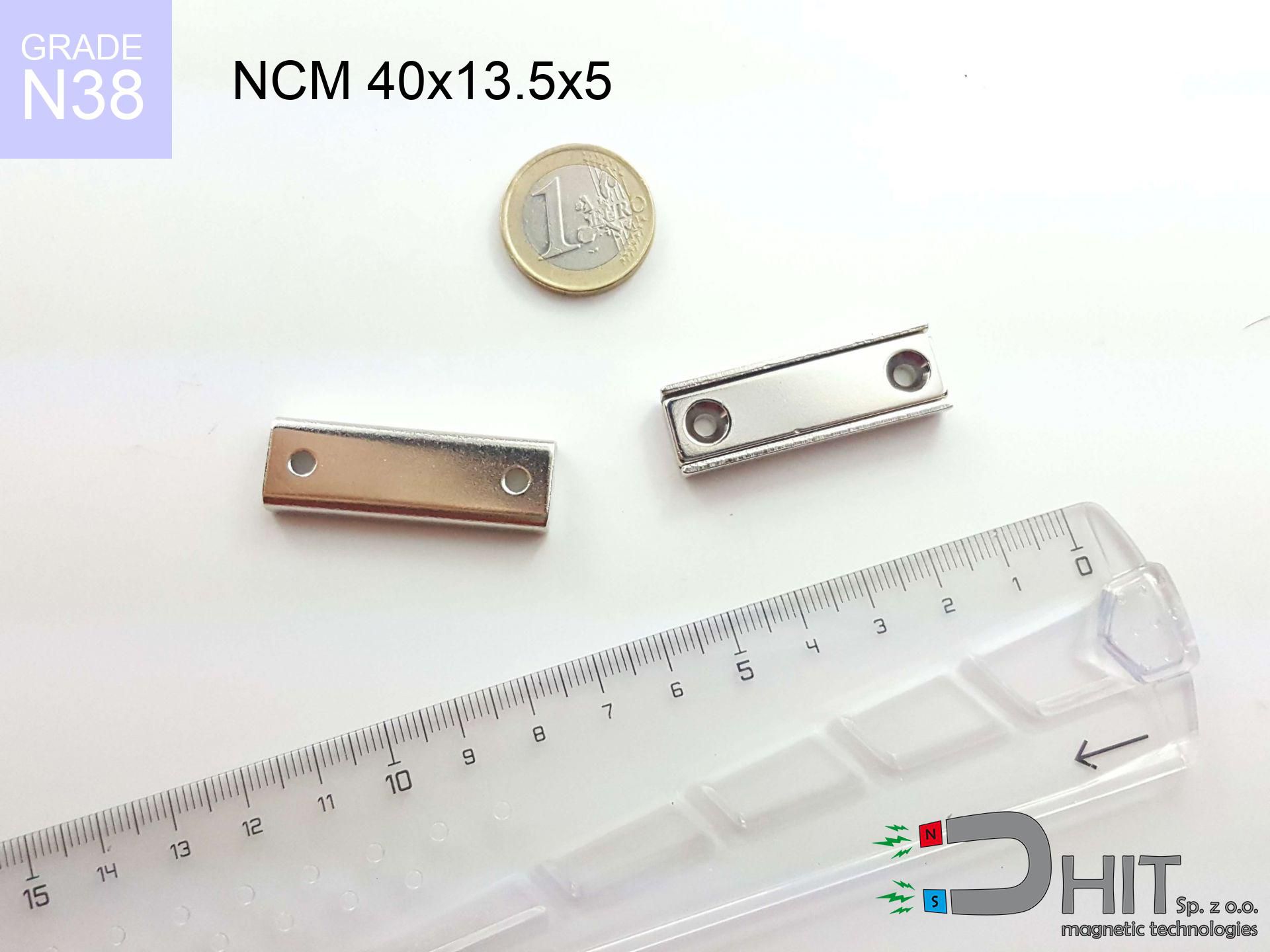
NCM 40x13.5x5 / N38 - channel magnetic holder
channel magnetic holder
Catalog no 360489
GTIN/EAN: 5906301814887
- Diameter Ø
- 40 mm [±1 mm]
- Height
- 13.5 mm [±1 mm]
- Weight
- 18.4 g
- Magnetization Direction
- ↑ axial
- Coating
- [NiCuNi] Nickel
How we measure these parameters — certificates and measurements
11.54 zł net / pcs
14.19 zł with VAT (23% VAT) / pcs
bulk discounts:
Need more?Frequently asked questions
Which magnetic holder is suitable for moving metal parts in a workshop?
How do I choose a holder for hanging a heavy item and check its real grip?
Which magnetic holders can be used outdoors?
How should I choose a strong threaded holder for field work?
Call us now
+48 888 99 98 98
alternatively let us know using
contact form
the contact section.
Specifications and structure of a neodymium magnet can be estimated using our
power calculator.
Order by 14:00 and we’ll ship today!
Technical details - NCM 40x13.5x5 / N38 - channel magnetic holder
Specification / characteristics - NCM 40x13.5x5 / N38 - channel magnetic holder
| properties | values |
|---|---|
| Cat. no. | 360489 |
| GTIN/EAN | 5906301814887 |
| Production/Distribution | Dhit sp. z o.o. |
| Country of origin | Poland / China / Germany |
| Customs code | 85059029 |
| Diameter Ø | 40 mm [±1 mm] |
| Height | 13.5 mm [±1 mm] |
| Weight | 18.4 g |
| Magnetization Direction | ↑ axial |
| Load capacity ~ ? | 17.00 kg / 166.71 N |
| Coating | [NiCuNi] Nickel |
| Manufacturing Tolerance | ±1 mm |
Magnetic properties of material N38
| properties | values | units |
|---|---|---|
| Remanence Br ? | 12.2-12.6 | kGs |
| Remanence Br ? | 1220-1260 | mT |
| Coercivity bHc ? | 10.8-11.5 | kOe |
| Coercivity bHc ? | 860-915 | kA/m |
| Intrinsic coercivity iHc | ≥ 12 | kOe |
| Intrinsic coercivity iHc | ≥ 955 | kA/m |
| Energy product BHmax ? | 36-38 | BH max MGOe |
| Energy product BHmax ? | 287-303 | BH max KJ/m |
| Maximum working temperature ? | ≤ 80 | °C |
Physical properties of sintered neodymium magnets Nd2Fe14B at 20°C
| properties | values | units |
|---|---|---|
| Vickers hardness | ≥550 | Hv |
| Density | ≥7.4 | g/cm3 |
| Curie Temperature TC | 310 | °C |
| Curie Temperature TF | 590 | °F |
| Specific resistance | 150 | μΩ⋅cm |
| Bending strength | 250 | MPa |
| Compressive strength | 1000~1100 | MPa |
| Thermal expansion parallel (∥) to orientation (M) | (3-4) x 10-6 | °C-1 |
| Thermal expansion perpendicular (⊥) to orientation (M) | -(1-3) x 10-6 | °C-1 |
| Young's modulus | 1.7 x 10⁴ | kg/mm² |
Elemental analysis
| iron (Fe) | 64% – 68% |
| neodymium (Nd) | 29% – 32% |
| boron (B) | 1.1% – 1.2% |
| dysprosium (Dy) | 0.5% – 2.0% |
| coating (Ni-Cu-Ni) | < 0.05% |
Environmental data
| recyclability (EoL) | 100% |
| recycled raw materials | ~10% (pre-cons) |
| carbon footprint | low / zredukowany |
| waste code (EWC) | 16 02 16 |
Other deals

![UMGW 42x20x9 [M6] GW / N38 - magnetic holder internal thread](https://cdn3.dhit.pl/graphics/products/um-42x20x9-m8-gw-god.jpg "UMGW 42x20x9 [M6] GW / N38 - magnetic holder internal thread")
![UMGZ 32x18x8 [M6] GZ / N38 - magnetic holder external thread](https://cdn3.dhit.pl/graphics/products/um-32x18x8-m6-gz-jix.jpg "UMGZ 32x18x8 [M6] GZ / N38 - magnetic holder external thread")
Advantages as well as disadvantages of neodymium magnets.
Advantages
- They virtually do not lose strength, because even after ten years the performance loss is only ~1% (in laboratory conditions),
- They feature excellent resistance to weakening of magnetic properties when exposed to opposing magnetic fields,
- Thanks to the metallic finish, the coating of Ni-Cu-Ni, gold, or silver-plated gives an clean appearance,
- The surface of neodymium magnets generates a strong magnetic field – this is a key feature,
- Thanks to resistance to high temperature, they are capable of working (depending on the shape) even at temperatures up to 230°C and higher...
- Thanks to versatility in forming and the capacity to modify to client solutions,
- Fundamental importance in high-tech industry – they find application in data components, electric motors, medical equipment, and other advanced devices.
- Thanks to efficiency per cm³, small magnets offer high operating force, with minimal size,
Cons
- Brittleness is one of their disadvantages. Upon strong impact they can fracture. We recommend keeping them in a special holder, which not only protects them against impacts but also increases their durability
- Do not exceed this material temperature limit: 80°C. Overheating may permanently weaken the magnet.
- They oxidize in a humid environment - during use outdoors we advise using waterproof magnets e.g. in rubber, plastic
- Limited possibility of producing nuts in the magnet and complex forms - preferred is cover - mounting mechanism.
- Health risk resulting from small fragments of magnets can be dangerous, when accidentally swallowed, which becomes key in the context of child health protection. It is also worth noting that small components of these products can be problematic in diagnostics medical after entering the body.
- With budget limitations the cost of neodymium magnets is a challenge,
Holding force characteristics
Detachment force of the magnet in optimal conditions – what it depends on?
- with the application of a yoke made of special test steel, guaranteeing full magnetic saturation
- whose transverse dimension is min. 10 mm
- with a surface cleaned and smooth
- with zero gap (without coatings)
- under perpendicular force direction (90-degree angle)
- at room temperature
What influences lifting capacity in practice
- Gap (betwixt the magnet and the metal), since even a tiny distance (e.g. 0.5 mm) results in a drastic drop in lifting capacity by up to 50% (this also applies to paint, corrosion or debris).
- Pull-off angle – note that the magnet has greatest strength perpendicularly. Under shear forces, the holding force drops drastically, often to levels of 20-30% of the maximum value.
- Substrate thickness – to utilize 100% power, the steel must be sufficiently thick. Paper-thin metal limits the attraction force (the magnet "punches through" it).
- Steel type – mild steel attracts best. Alloy admixtures lower magnetic permeability and holding force.
- Plate texture – smooth surfaces guarantee perfect abutment, which improves field saturation. Uneven metal reduce efficiency.
- Thermal factor – high temperature reduces pulling force. Too high temperature can permanently demagnetize the magnet.
Lifting capacity testing was conducted on plates with a smooth surface of suitable thickness, under perpendicular forces, however under parallel forces the holding force is lower. Moreover, even a slight gap between the magnet’s surface and the plate decreases the holding force.
Warnings
Impact on smartphones
Remember: neodymium magnets produce a field that disrupts sensitive sensors. Keep a separation from your mobile, device, and GPS.
Maximum temperature
Watch the temperature. Exposing the magnet above 80 degrees Celsius will permanently weaken its properties and strength.
Fragile material
Neodymium magnets are sintered ceramics, which means they are very brittle. Impact of two magnets will cause them shattering into shards.
This is not a toy
Absolutely keep magnets away from children. Choking hazard is significant, and the consequences of magnets connecting inside the body are fatal.
Medical implants
Warning for patients: Strong magnetic fields disrupt medical devices. Maintain minimum 30 cm distance or ask another person to handle the magnets.
Nickel coating and allergies
Studies show that the nickel plating (standard magnet coating) is a potent allergen. If your skin reacts to metals, avoid direct skin contact and select encased magnets.
Fire warning
Fire warning: Neodymium dust is explosive. Avoid machining magnets without safety gear as this risks ignition.
Powerful field
Exercise caution. Rare earth magnets attract from a long distance and connect with massive power, often faster than you can move away.
Cards and drives
Do not bring magnets near a wallet, laptop, or TV. The magnetic field can destroy these devices and wipe information from cards.
Bodily injuries
Big blocks can break fingers instantly. Never put your hand between two attracting surfaces.
Tabela kosztu i czasu dostawy
Płatność przed wysyłką:

GLS kurier
Przesyłka będzie u Ciebie za 2-3 dni
14.99 ZŁ

InPost Paczkomaty 24/7
Przesyłka będzie u Ciebie za 1-2 dni
12.30 ZŁ
Płatność przy odbiorze (pobranie):
GLS kurier
Przesyłka będzie u Ciebie za 1-2 dni
23.00 ZŁ