

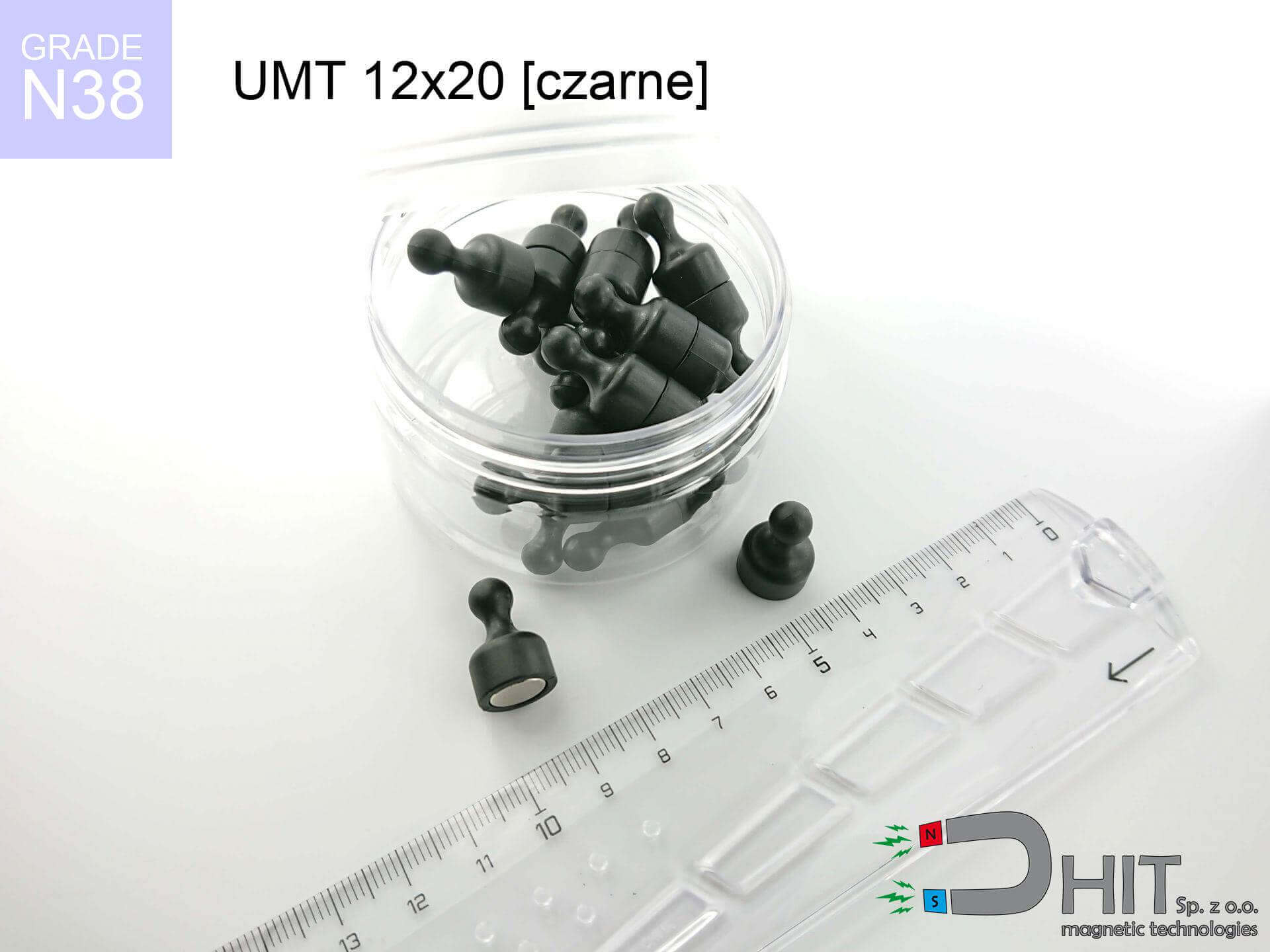
UMT 12x20 black set / N38 - board holder
board holder
Catalog no 230264
GTIN/EAN: 5906301814276
- Diameter Ø
- 12 mm [±1 mm]
- Height
- 20 mm [±1 mm]
- Weight
- 33.5 g
- Coating
- [NiCuNi] Nickel
How we measure these parameters — certificates and measurements
36.58 zł net / pcs
44.99 zł with VAT (23% VAT) / pcs
bulk discounts:
Need more?Frequently asked questions
How many sheets of paper will one magnetic pin hold?
Will a magnetic pin stick to any board - whiteboard, glass, cork?
Will the magnet leave a mark or scratch the board or the fridge?
What is the difference between the 12x20 and 20x25 sizes, and which one suits an office?
Are magnetic pins suitable for large-format maps and plans?
Call us now
+48 888 99 98 98
alternatively let us know using
contact form
the contact section.
Specifications and structure of a neodymium magnet can be estimated using our
power calculator.
Order by 14:00 and we’ll ship today!
Technical specification of the product - UMT 12x20 black set / N38 - board holder
Specification / characteristics - UMT 12x20 black set / N38 - board holder
| properties | values |
|---|---|
| Cat. no. | 230264 |
| GTIN/EAN | 5906301814276 |
| Production/Distribution | Dhit sp. z o.o. |
| Country of origin | Poland / China / Germany |
| Customs code | 85059029 |
| Diameter Ø | 12 mm [±1 mm] |
| Height | 20 mm [±1 mm] |
| Weight | 33.5 g |
| Coating | [NiCuNi] Nickel |
| Manufacturing Tolerance | ±1 mm |
Magnetic properties of material N38
| properties | values | units |
|---|---|---|
| Remanence Br ? | 12.2-12.6 | kGs |
| Remanence Br ? | 1220-1260 | mT |
| Coercivity bHc ? | 10.8-11.5 | kOe |
| Coercivity bHc ? | 860-915 | kA/m |
| Intrinsic coercivity iHc | ≥ 12 | kOe |
| Intrinsic coercivity iHc | ≥ 955 | kA/m |
| Energy product BHmax ? | 36-38 | BH max MGOe |
| Energy product BHmax ? | 287-303 | BH max KJ/m |
| Maximum working temperature ? | ≤ 80 | °C |
Physical properties of sintered neodymium magnets Nd2Fe14B at 20°C
| properties | values | units |
|---|---|---|
| Vickers hardness | ≥550 | Hv |
| Density | ≥7.4 | g/cm3 |
| Curie Temperature TC | 310 | °C |
| Curie Temperature TF | 590 | °F |
| Specific resistance | 150 | μΩ⋅cm |
| Bending strength | 250 | MPa |
| Compressive strength | 1000~1100 | MPa |
| Thermal expansion parallel (∥) to orientation (M) | (3-4) x 10-6 | °C-1 |
| Thermal expansion perpendicular (⊥) to orientation (M) | -(1-3) x 10-6 | °C-1 |
| Young's modulus | 1.7 x 10⁴ | kg/mm² |
Chemical composition
| iron (Fe) | 64% – 68% |
| neodymium (Nd) | 29% – 32% |
| boron (B) | 1.1% – 1.2% |
| dysprosium (Dy) | 0.5% – 2.0% |
| coating (Ni-Cu-Ni) | < 0.05% |
Ecology and recycling (GPSR)
| recyclability (EoL) | 100% |
| recycled raw materials | ~10% (pre-cons) |
| carbon footprint | low / zredukowany |
| waste code (EWC) | 16 02 16 |
Check out also deals
![SM 32x450 [2xM8] / N42 - magnetic separator](https://cdn3.dhit.pl/graphics/products/sm-32x450-2xm8-bex.jpg "SM 32x450 [2xM8] / N42 - magnetic separator")
![BM 510x180x70 [4x M8] - magnetic beam](https://cdn3.dhit.pl/graphics/products/bm-510x180x70-4x-m8-cem.jpg "BM 510x180x70 [4x M8] - magnetic beam")
Pros and cons of Nd2Fe14B magnets.
Advantages
- They virtually do not lose strength, because even after 10 years the decline in efficiency is only ~1% (in laboratory conditions),
- They retain their magnetic properties even under external field action,
- By applying a lustrous coating of nickel, the element has an professional look,
- Neodymium magnets generate maximum magnetic induction on a small surface, which ensures high operational effectiveness,
- Neodymium magnets are characterized by extremely high magnetic induction on the magnet surface and can function (depending on the form) even at a temperature of 230°C or more...
- Thanks to modularity in designing and the ability to customize to unusual requirements,
- Wide application in advanced technology sectors – they find application in mass storage devices, electric motors, medical devices, also multitasking production systems.
- Relatively small size with high pulling force – neodymium magnets offer high power in compact dimensions, which makes them useful in compact constructions
Cons
- Susceptibility to cracking is one of their disadvantages. Upon intense impact they can break. We recommend keeping them in a special holder, which not only protects them against impacts but also increases their durability
- Do not exceed this material temperature limit: 80°C. Overheating may permanently weaken the magnet.
- Magnets exposed to a humid environment can rust. Therefore while using outdoors, we suggest using waterproof magnets made of rubber, plastic or other material resistant to moisture
- Due to limitations in realizing nuts and complicated forms in magnets, we propose using cover - magnetic mount.
- Potential hazard related to microscopic parts of magnets are risky, when accidentally swallowed, which gains importance in the context of child safety. It is also worth noting that small components of these devices are able to disrupt the diagnostic process medical when they are in the body.
- With mass production the cost of neodymium magnets can be a barrier,
Lifting parameters
Optimal lifting capacity of a neodymium magnet – what affects it?
- with the contact of a sheet made of low-carbon steel, ensuring full magnetic saturation
- whose transverse dimension is min. 10 mm
- with an ideally smooth contact surface
- with zero gap (no coatings)
- during detachment in a direction perpendicular to the mounting surface
- in neutral thermal conditions
Magnet lifting force in use – key factors
- Distance – the presence of foreign body (rust, tape, gap) acts as an insulator, which reduces capacity steeply (even by 50% at 0.5 mm).
- Angle of force application – maximum parameter is available only during perpendicular pulling. The resistance to sliding of the magnet along the surface is standardly many times lower (approx. 1/5 of the lifting capacity).
- Steel thickness – insufficiently thick sheet does not accept the full field, causing part of the power to be lost into the air.
- Chemical composition of the base – mild steel gives the best results. Higher carbon content lower magnetic permeability and lifting capacity.
- Smoothness – ideal contact is possible only on polished steel. Any scratches and bumps create air cushions, reducing force.
- Heat – NdFeB sinters have a negative temperature coefficient. When it is hot they are weaker, and in frost gain strength (up to a certain limit).
Holding force was checked on a smooth steel plate of 20 mm thickness, when the force acted perpendicularly, whereas under shearing force the holding force is lower. In addition, even a small distance between the magnet’s surface and the plate reduces the load capacity.
H&S for magnets
Bodily injuries
Large magnets can smash fingers in a fraction of a second. Under no circumstances place your hand between two strong magnets.
Product not for children
Absolutely keep magnets away from children. Choking hazard is significant, and the consequences of magnets clamping inside the body are very dangerous.
Protective goggles
Despite metallic appearance, neodymium is brittle and not impact-resistant. Avoid impacts, as the magnet may crumble into hazardous fragments.
Magnetic interference
GPS units and mobile phones are extremely sensitive to magnetic fields. Close proximity with a strong magnet can permanently damage the sensors in your phone.
Warning for heart patients
Warning for patients: Powerful magnets disrupt electronics. Maintain minimum 30 cm distance or request help to handle the magnets.
Safe distance
Powerful magnetic fields can destroy records on credit cards, HDDs, and storage devices. Stay away of min. 10 cm.
Metal Allergy
Certain individuals have a contact allergy to Ni, which is the typical protective layer for NdFeB magnets. Prolonged contact might lead to skin redness. It is best to wear protective gloves.
Caution required
Be careful. Neodymium magnets act from a distance and snap with huge force, often faster than you can move away.
Do not overheat magnets
Standard neodymium magnets (grade N) lose power when the temperature goes above 80°C. Damage is permanent.
Fire warning
Dust created during machining of magnets is combustible. Do not drill into magnets unless you are an expert.
Tabela kosztu i czasu dostawy
Płatność przed wysyłką:

GLS kurier
Przesyłka będzie u Ciebie za 2-3 dni
14.99 ZŁ

InPost Paczkomaty 24/7
Przesyłka będzie u Ciebie za 1-2 dni
12.30 ZŁ
Płatność przy odbiorze (pobranie):
GLS kurier
Przesyłka będzie u Ciebie za 1-2 dni
23.00 ZŁ