

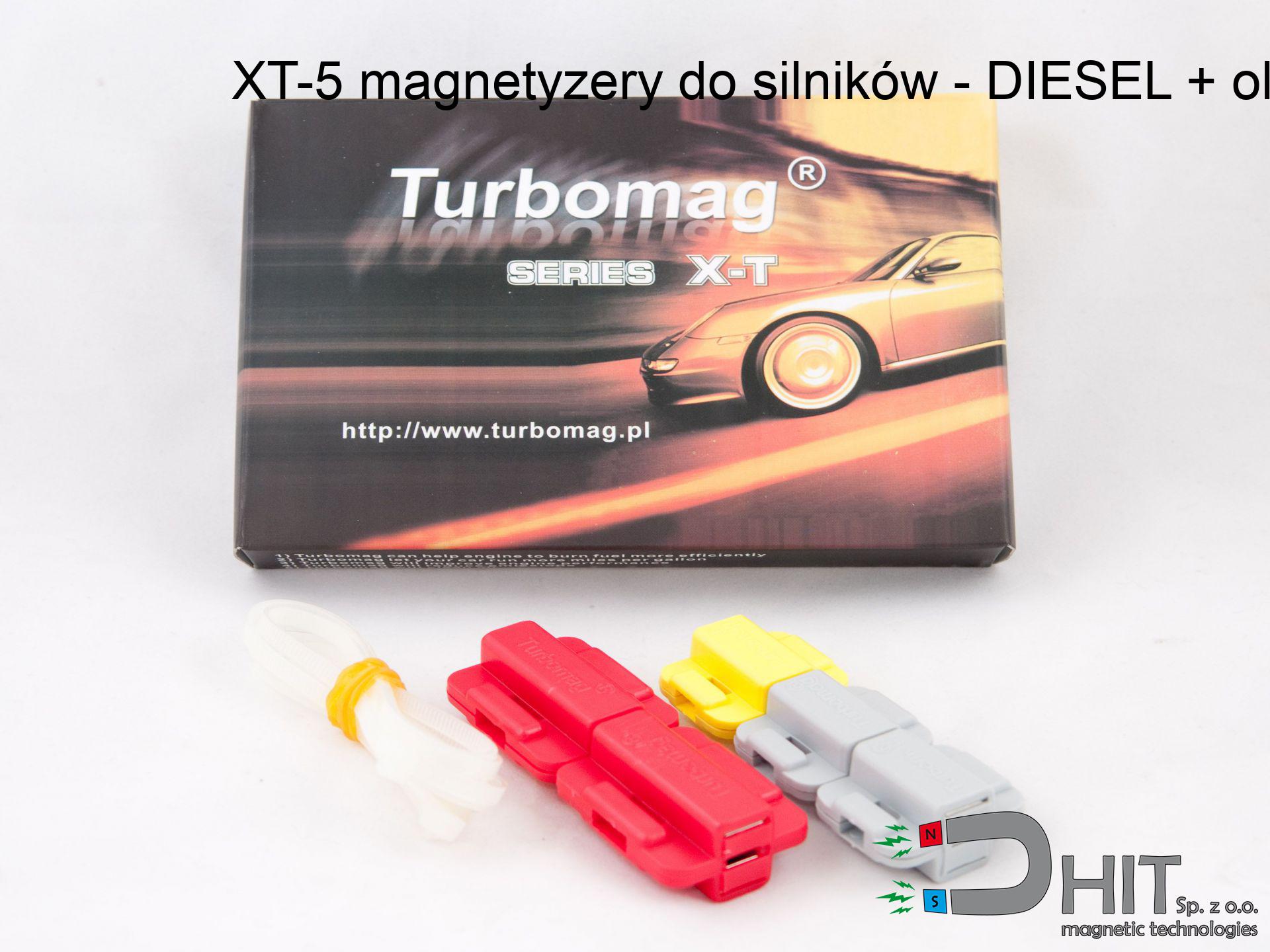
XT-5 magnetyzery do silników - DIESEL + olej - XT-5 magnetizer
XT-5 magnetizer
Catalog no 060247
GTIN/EAN: 5906301812418
80.48 zł net / pcs
98.99 zł with VAT (23% VAT) / pcs
bulk discounts:
Need more?Frequently asked questions
Which Turbomag® model should I choose?
Is a magnetizer used to capture metal swarf?
How do I match a model to an installation?
Where is a magnetizer fitted?
What are the fastening parts made of?
What operating temperature is allowed?
Guides from the knowledge base
Call us now
+48 888 99 98 98
alternatively let us know using
contact form
the contact section.
Specifications and structure of a neodymium magnet can be estimated using our
power calculator.
Order by 14:00 and we’ll ship today!
Detailed specification - XT-5 magnetyzery do silników - DIESEL + olej - XT-5 magnetizer
Specification / characteristics - XT-5 magnetyzery do silników - DIESEL + olej - XT-5 magnetizer
| properties | values |
|---|---|
| Cat. no. | 060247 |
| GTIN/EAN | 5906301812418 |
| Production/Distribution | Dhit sp. z o.o. |
| Country of origin | Poland / China / Germany |
| Customs code | 85059029 |
| Weight | 217 g |
| Manufacturing Tolerance | ±1 mm |
Physical properties of sintered neodymium magnets Nd2Fe14B at 20°C
| properties | values | units |
|---|---|---|
| Vickers hardness | ≥550 | Hv |
| Density | ≥7.4 | g/cm3 |
| Curie Temperature TC | 310 | °C |
| Curie Temperature TF | 590 | °F |
| Specific resistance | 150 | μΩ⋅cm |
| Bending strength | 250 | MPa |
| Compressive strength | 1000~1100 | MPa |
| Thermal expansion parallel (∥) to orientation (M) | (3-4) x 10-6 | °C-1 |
| Thermal expansion perpendicular (⊥) to orientation (M) | -(1-3) x 10-6 | °C-1 |
| Young's modulus | 1.7 x 10⁴ | kg/mm² |
Elemental analysis
| iron (Fe) | 64% – 68% |
| neodymium (Nd) | 29% – 32% |
| boron (B) | 1.1% – 1.2% |
| dysprosium (Dy) | 0.5% – 2.0% |
| coating (Ni-Cu-Ni) | < 0.05% |
Ecology and recycling (GPSR)
| recyclability (EoL) | 100% |
| recycled raw materials | ~10% (pre-cons) |
| carbon footprint | low / zredukowany |
| waste code (EWC) | 16 02 16 |
See also proposals
![SM 32x350 [2xM8] / N52 - magnetic separator](https://cdn3.dhit.pl/graphics/products/sm-32x350-2xm8-fag.jpg "SM 32x350 [2xM8] / N52 - magnetic separator")
![UMGGZ 34x6 [M4] GZ / N38 - rubber magnetic holder external thread](https://cdn3.dhit.pl/graphics/products/umg-34x6-m4-gz-rad.jpg "UMGGZ 34x6 [M4] GZ / N38 - rubber magnetic holder external thread")
![SM 32x100 [2xM8] / N52 - magnetic separator](https://cdn3.dhit.pl/graphics/products/sm-32x100-2xm8-war.jpg "SM 32x100 [2xM8] / N52 - magnetic separator")
Strengths as well as weaknesses of neodymium magnets.
Advantages
- They have constant strength, and over more than 10 years their attraction force decreases symbolically – ~1% (in testing),
- They show high resistance to demagnetization induced by presence of other magnetic fields,
- In other words, due to the metallic layer of silver, the element looks attractive,
- Neodymium magnets deliver maximum magnetic induction on a contact point, which ensures high operational effectiveness,
- Due to their durability and thermal resistance, neodymium magnets can operate (depending on the form) even at high temperatures reaching 230°C or more...
- Thanks to versatility in constructing and the capacity to adapt to specific needs,
- Fundamental importance in future technologies – they are utilized in magnetic memories, brushless drives, precision medical tools, and multitasking production systems.
- Thanks to concentrated force, small magnets offer high operating force, with minimal size,
Disadvantages
- To avoid cracks under impact, we suggest using special steel housings. Such a solution secures the magnet and simultaneously improves its durability.
- Heat sensitivity: observe the temperature specified for this product. Overheating may permanently weaken the magnet.
- Magnets exposed to a humid environment can corrode. Therefore during using outdoors, we suggest using water-impermeable magnets made of rubber, plastic or other material protecting against moisture
- We recommend cover - magnetic mechanism, due to difficulties in realizing nuts inside the magnet and complicated forms.
- Potential hazard related to microscopic parts of magnets can be dangerous, when accidentally swallowed, which is particularly important in the context of child health protection. It is also worth noting that small elements of these devices can complicate diagnosis medical in case of swallowing.
- Higher cost of purchase is one of the disadvantages compared to ceramic magnets, especially in budget applications
Lifting parameters
Optimal lifting capacity of a neodymium magnet – what affects it?
- using a base made of high-permeability steel, serving as a ideal flux conductor
- with a cross-section minimum 10 mm
- with an polished contact surface
- without any clearance between the magnet and steel
- for force acting at a right angle (in the magnet axis)
- in temp. approx. 20°C
Practical lifting capacity: influencing factors
- Distance – existence of any layer (rust, dirt, air) acts as an insulator, which reduces capacity rapidly (even by 50% at 0.5 mm).
- Loading method – catalog parameter refers to detachment vertically. When slipping, the magnet holds significantly lower power (typically approx. 20-30% of maximum force).
- Element thickness – to utilize 100% power, the steel must be adequately massive. Paper-thin metal limits the attraction force (the magnet "punches through" it).
- Metal type – different alloys reacts the same. High carbon content worsen the attraction effect.
- Surface structure – the more even the plate, the larger the contact zone and higher the lifting capacity. Unevenness acts like micro-gaps.
- Temperature – temperature increase causes a temporary drop of force. It is worth remembering the thermal limit for a given model.
Lifting capacity was assessed by applying a smooth steel plate of optimal thickness (min. 20 mm), under perpendicular detachment force, in contrast under attempts to slide the magnet the load capacity is reduced by as much as 75%. Additionally, even a slight gap between the magnet’s surface and the plate decreases the lifting capacity.
Precautions when working with NdFeB magnets
Caution required
Handle magnets consciously. Their immense force can surprise even professionals. Be vigilant and do not underestimate their power.
Allergy Warning
Some people experience a sensitization to Ni, which is the common plating for NdFeB magnets. Extended handling can result in a rash. We suggest use protective gloves.
Shattering risk
NdFeB magnets are sintered ceramics, which means they are prone to chipping. Collision of two magnets will cause them shattering into shards.
Magnetic media
Powerful magnetic fields can destroy records on credit cards, HDDs, and storage devices. Stay away of at least 10 cm.
Life threat
Individuals with a heart stimulator must maintain an absolute distance from magnets. The magnetic field can interfere with the functioning of the life-saving device.
Physical harm
Big blocks can break fingers in a fraction of a second. Never place your hand between two attracting surfaces.
Fire warning
Fire warning: Neodymium dust is highly flammable. Avoid machining magnets in home conditions as this may cause fire.
Do not overheat magnets
Regular neodymium magnets (grade N) undergo demagnetization when the temperature goes above 80°C. The loss of strength is permanent.
Threat to navigation
Remember: neodymium magnets generate a field that interferes with sensitive sensors. Keep a separation from your phone, device, and GPS.
Keep away from children
Only for adults. Tiny parts pose a choking risk, causing intestinal necrosis. Store away from children and animals.
Tabela kosztu i czasu dostawy
Płatność przed wysyłką:

GLS kurier
Przesyłka będzie u Ciebie za 2-3 dni
14.99 ZŁ

InPost Paczkomaty 24/7
Przesyłka będzie u Ciebie za 1-2 dni
12.30 ZŁ
Płatność przy odbiorze (pobranie):
GLS kurier
Przesyłka będzie u Ciebie za 1-2 dni
23.00 ZŁ