

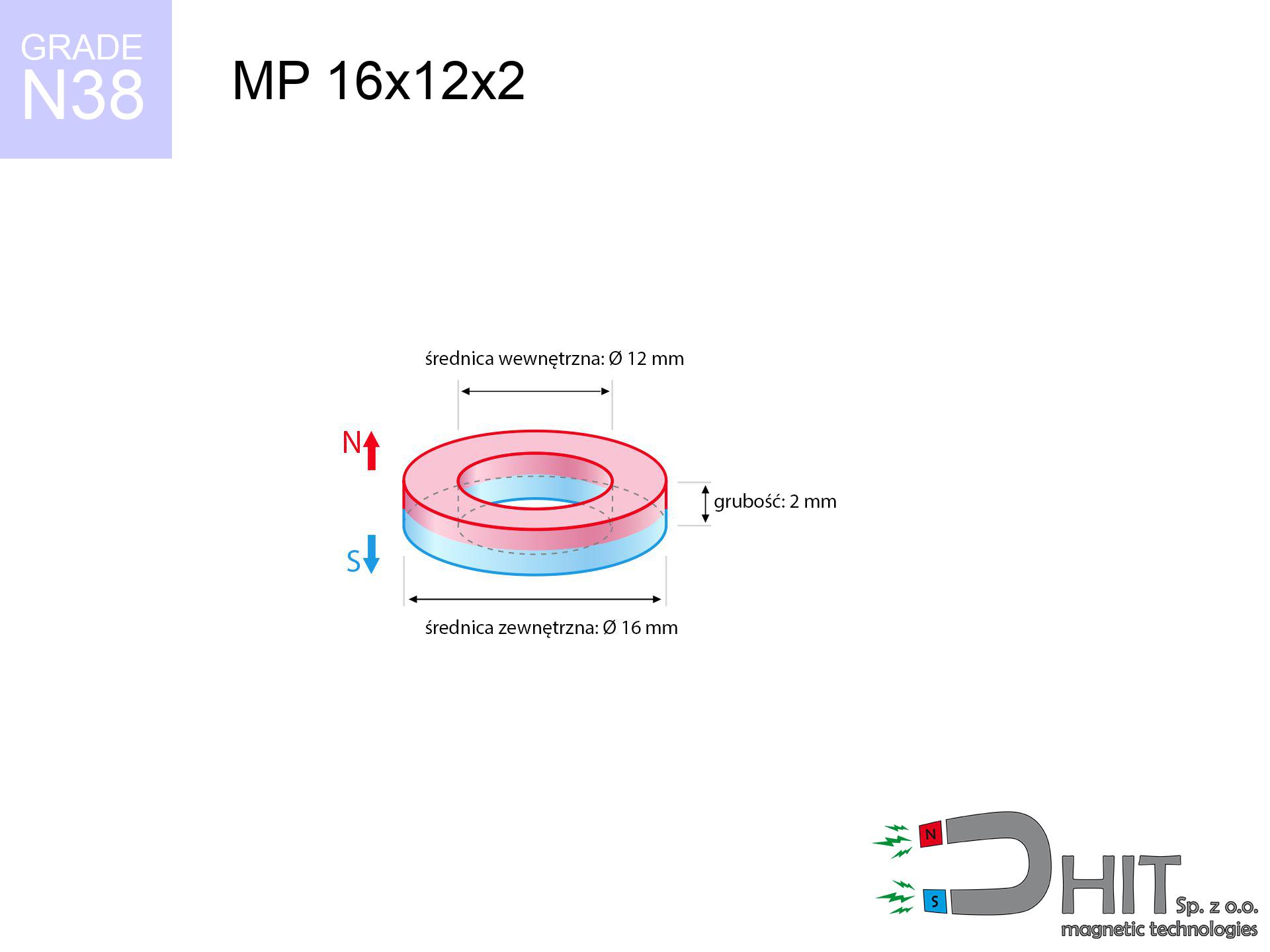
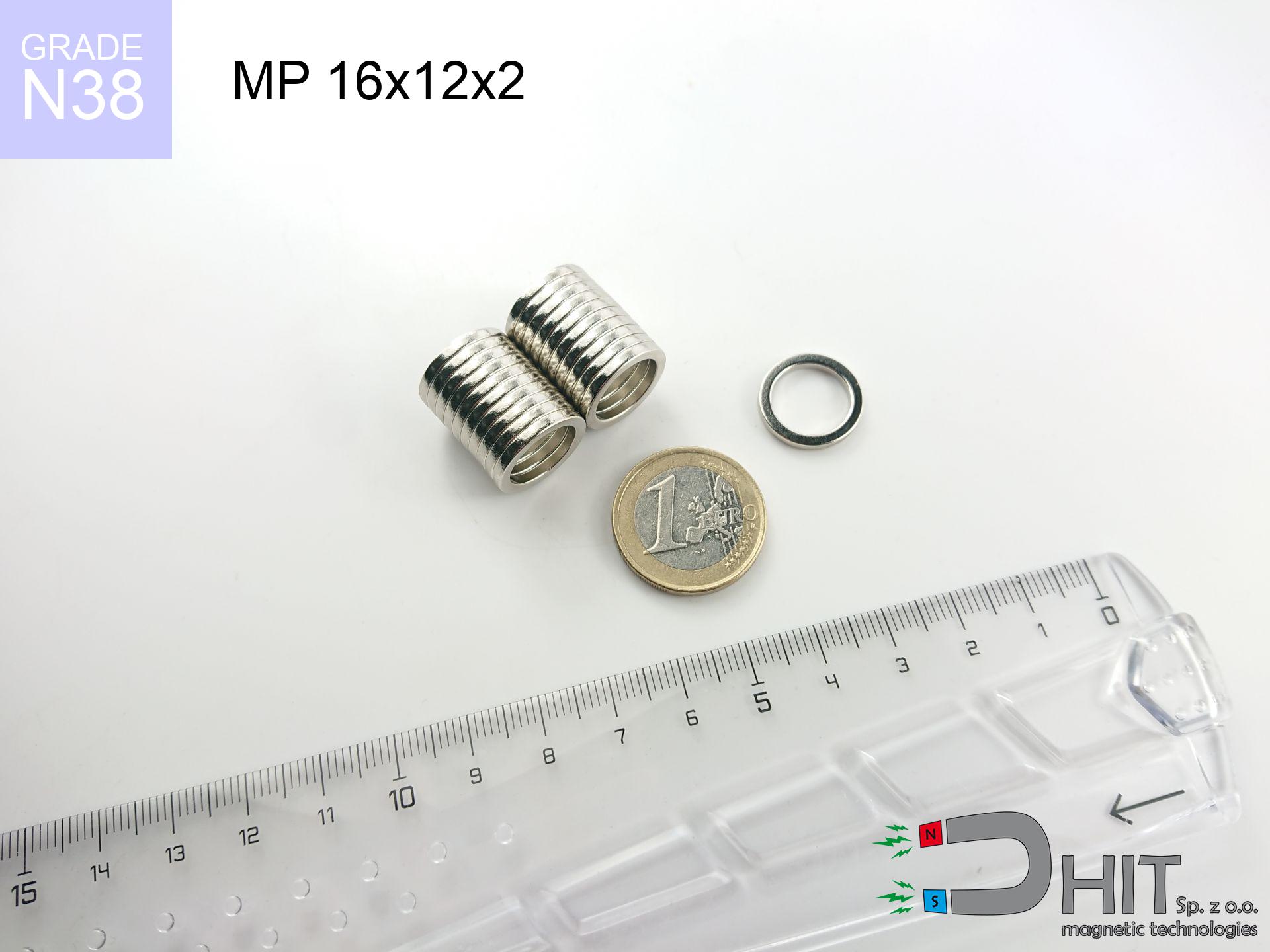
MP 16x12x2 / N38 - ring magnet
ring magnet
Catalog no 030183
GTIN/EAN: 5906301812005
- Diameter
- 16 mm [±0,1 mm]
- internal diameter Ø
- 12 mm [±0,1 mm]
- Height
- 2 mm [±0,1 mm]
- Weight
- 1.32 g
- Magnetization Direction
- ↑ axial
- Coating
- [NiCuNi] Nickel
How we measure these parameters — certificates and measurements
1.060 zł net / pcs
1.304 zł with VAT (23% VAT) / pcs
bulk discounts:
Need more?Frequently asked questions
Where can I compare prices of ring magnets for mounting in Poland?
Are ring magnets resistant to damage?
Which ring magnet is suitable for an outdoor structure?
Where can I check the available sizes of neodymium ring magnets?
Engineering report for this magnet
Full PDF analysis: pull and shear force, effect of distance, temperature and plate thickness, safety distances and the demagnetization curve.
Call us now
+48 888 99 98 98
alternatively let us know using
contact form
the contact section.
Specifications and structure of a neodymium magnet can be estimated using our
power calculator.
Order by 14:00 and we’ll ship today!
Physical properties - MP 16x12x2 / N38 - ring magnet
Specification / characteristics - MP 16x12x2 / N38 - ring magnet
| properties | values |
|---|---|
| Cat. no. | 030183 |
| GTIN/EAN | 5906301812005 |
| Production/Distribution | Dhit sp. z o.o. |
| Country of origin | Poland / China / Germany |
| Customs code | 85059029 |
| Diameter | 16 mm [±0,1 mm] |
| internal diameter Ø | 12 mm [±0,1 mm] |
| Height | 2 mm [±0,1 mm] |
| Weight | 1.32 g |
| Magnetization Direction | ↑ axial |
| Load capacity ~ ? | 0.68 kg / 6.62 N |
| Magnetic Induction ~ ? | 150.33 mT / 1503 Gs |
| Coating | [NiCuNi] Nickel |
| Manufacturing Tolerance | ±0.1 mm |
Magnetic properties of material N38
| properties | values | units |
|---|---|---|
| Remanence Br ? | 12.2-12.6 | kGs |
| Remanence Br ? | 1220-1260 | mT |
| Coercivity bHc ? | 10.8-11.5 | kOe |
| Coercivity bHc ? | 860-915 | kA/m |
| Intrinsic coercivity iHc | ≥ 12 | kOe |
| Intrinsic coercivity iHc | ≥ 955 | kA/m |
| Energy product BHmax ? | 36-38 | BH max MGOe |
| Energy product BHmax ? | 287-303 | BH max KJ/m |
| Maximum working temperature ? | ≤ 80 | °C |
Physical properties of sintered neodymium magnets Nd2Fe14B at 20°C
| properties | values | units |
|---|---|---|
| Vickers hardness | ≥550 | Hv |
| Density | ≥7.4 | g/cm3 |
| Curie Temperature TC | 310 | °C |
| Curie Temperature TF | 590 | °F |
| Specific resistance | 150 | μΩ⋅cm |
| Bending strength | 250 | MPa |
| Compressive strength | 1000~1100 | MPa |
| Thermal expansion parallel (∥) to orientation (M) | (3-4) x 10-6 | °C-1 |
| Thermal expansion perpendicular (⊥) to orientation (M) | -(1-3) x 10-6 | °C-1 |
| Young's modulus | 1.7 x 10⁴ | kg/mm² |
Engineering simulation of the assembly - report
These information are the direct effect of a physical analysis. Results are based on models for the class Nd2Fe14B. Real-world conditions might slightly differ. Treat these data as a reference point during assembly planning.
Table 1: Static pull force (force vs gap) - characteristics
MP 16x12x2 / N38
| Distance (mm) | Induction (Gauss) / mT | Pull Force (kg/lbs/g/N) | Risk Status |
|---|---|---|---|
| 0 mm |
6011 Gs
601.1 mT
|
0.68 kg / 1.50 pounds
680.0 g / 6.7 N
|
safe |
| 1 mm |
5259 Gs
525.9 mT
|
0.52 kg / 1.15 pounds
520.7 g / 5.1 N
|
safe |
| 2 mm |
4534 Gs
453.4 mT
|
0.39 kg / 0.85 pounds
387.0 g / 3.8 N
|
safe |
| 3 mm |
3870 Gs
387.0 mT
|
0.28 kg / 0.62 pounds
281.9 g / 2.8 N
|
safe |
| 5 mm |
2776 Gs
277.6 mT
|
0.15 kg / 0.32 pounds
145.1 g / 1.4 N
|
safe |
| 10 mm |
1251 Gs
125.1 mT
|
0.03 kg / 0.06 pounds
29.4 g / 0.3 N
|
safe |
| 15 mm |
643 Gs
64.3 mT
|
0.01 kg / 0.02 pounds
7.8 g / 0.1 N
|
safe |
| 20 mm |
372 Gs
37.2 mT
|
0.00 kg / 0.01 pounds
2.6 g / 0.0 N
|
safe |
| 30 mm |
159 Gs
15.9 mT
|
0.00 kg / 0.00 pounds
0.5 g / 0.0 N
|
safe |
| 50 mm |
49 Gs
4.9 mT
|
0.00 kg / 0.00 pounds
0.0 g / 0.0 N
|
safe |
Table 2: Slippage load (vertical surface)
MP 16x12x2 / N38
| Distance (mm) | Friction coefficient | Pull Force (kg/lbs/g/N) |
|---|---|---|
| 0 mm | Stal (~0.2) |
0.14 kg / 0.30 pounds
136.0 g / 1.3 N
|
| 1 mm | Stal (~0.2) |
0.10 kg / 0.23 pounds
104.0 g / 1.0 N
|
| 2 mm | Stal (~0.2) |
0.08 kg / 0.17 pounds
78.0 g / 0.8 N
|
| 3 mm | Stal (~0.2) |
0.06 kg / 0.12 pounds
56.0 g / 0.5 N
|
| 5 mm | Stal (~0.2) |
0.03 kg / 0.07 pounds
30.0 g / 0.3 N
|
| 10 mm | Stal (~0.2) |
0.01 kg / 0.01 pounds
6.0 g / 0.1 N
|
| 15 mm | Stal (~0.2) |
0.00 kg / 0.00 pounds
2.0 g / 0.0 N
|
| 20 mm | Stal (~0.2) |
0.00 kg / 0.00 pounds
0.0 g / 0.0 N
|
| 30 mm | Stal (~0.2) |
0.00 kg / 0.00 pounds
0.0 g / 0.0 N
|
| 50 mm | Stal (~0.2) |
0.00 kg / 0.00 pounds
0.0 g / 0.0 N
|
Table 3: Wall mounting (shearing) - vertical pull
MP 16x12x2 / N38
| Surface type | Friction coefficient / % Mocy | Max load (kg/lbs/g/N) |
|---|---|---|
| Raw steel |
µ = 0.3
30% Nominalnej Siły
|
0.20 kg / 0.45 pounds
204.0 g / 2.0 N
|
| Painted steel (standard) |
µ = 0.2
20% Nominalnej Siły
|
0.14 kg / 0.30 pounds
136.0 g / 1.3 N
|
| Oily/slippery steel |
µ = 0.1
10% Nominalnej Siły
|
0.07 kg / 0.15 pounds
68.0 g / 0.7 N
|
| Magnet with anti-slip rubber |
µ = 0.5
50% Nominalnej Siły
|
0.34 kg / 0.75 pounds
340.0 g / 3.3 N
|
Table 4: Material efficiency (saturation) - sheet metal selection
MP 16x12x2 / N38
| Steel thickness (mm) | % power | Real pull force (kg/lbs/g/N) |
|---|---|---|
| 0.5 mm |
|
0.07 kg / 0.15 pounds
68.0 g / 0.7 N
|
| 1 mm |
|
0.17 kg / 0.37 pounds
170.0 g / 1.7 N
|
| 2 mm |
|
0.34 kg / 0.75 pounds
340.0 g / 3.3 N
|
| 3 mm |
|
0.51 kg / 1.12 pounds
510.0 g / 5.0 N
|
| 5 mm |
|
0.68 kg / 1.50 pounds
680.0 g / 6.7 N
|
| 10 mm |
|
0.68 kg / 1.50 pounds
680.0 g / 6.7 N
|
| 11 mm |
|
0.68 kg / 1.50 pounds
680.0 g / 6.7 N
|
| 12 mm |
|
0.68 kg / 1.50 pounds
680.0 g / 6.7 N
|
Table 5: Thermal stability (material behavior) - thermal limit
MP 16x12x2 / N38
| Ambient temp. (°C) | Power loss | Remaining pull (kg/lbs/g/N) | Status |
|---|---|---|---|
| 20 °C | 0.0% |
0.68 kg / 1.50 pounds
680.0 g / 6.7 N
|
OK |
| 40 °C | -2.2% |
0.67 kg / 1.47 pounds
665.0 g / 6.5 N
|
OK |
| 60 °C | -4.4% |
0.65 kg / 1.43 pounds
650.1 g / 6.4 N
|
OK |
| 80 °C | -6.6% |
0.64 kg / 1.40 pounds
635.1 g / 6.2 N
|
|
| 100 °C | -28.8% |
0.48 kg / 1.07 pounds
484.2 g / 4.7 N
|
Table 6: Two magnets (repulsion) - field range
MP 16x12x2 / N38
| Gap (mm) | Attraction (kg/lbs) (N-S) | Sliding Force (kg/lbs/g/N) | Repulsion (kg/lbs) (N-N) |
|---|---|---|---|
| 0 mm |
37.47 kg / 82.60 pounds
6 145 Gs
|
5.62 kg / 12.39 pounds
5620 g / 55.1 N
|
N/A |
| 1 mm |
32.95 kg / 72.65 pounds
11 273 Gs
|
4.94 kg / 10.90 pounds
4943 g / 48.5 N
|
29.66 kg / 65.38 pounds
~0 Gs
|
| 2 mm |
28.69 kg / 63.25 pounds
10 519 Gs
|
4.30 kg / 9.49 pounds
4303 g / 42.2 N
|
25.82 kg / 56.92 pounds
~0 Gs
|
| 3 mm |
24.81 kg / 54.69 pounds
9 781 Gs
|
3.72 kg / 8.20 pounds
3721 g / 36.5 N
|
22.33 kg / 49.22 pounds
~0 Gs
|
| 5 mm |
18.24 kg / 40.20 pounds
8 386 Gs
|
2.74 kg / 6.03 pounds
2735 g / 26.8 N
|
16.41 kg / 36.18 pounds
~0 Gs
|
| 10 mm |
7.99 kg / 17.62 pounds
5 552 Gs
|
1.20 kg / 2.64 pounds
1199 g / 11.8 N
|
7.19 kg / 15.86 pounds
~0 Gs
|
| 20 mm |
1.62 kg / 3.58 pounds
2 501 Gs
|
0.24 kg / 0.54 pounds
243 g / 2.4 N
|
1.46 kg / 3.22 pounds
~0 Gs
|
| 50 mm |
0.06 kg / 0.13 pounds
471 Gs
|
0.01 kg / 0.02 pounds
9 g / 0.1 N
|
0.05 kg / 0.11 pounds
~0 Gs
|
| 60 mm |
0.03 kg / 0.06 pounds
318 Gs
|
0.00 kg / 0.01 pounds
4 g / 0.0 N
|
0.02 kg / 0.05 pounds
~0 Gs
|
| 70 mm |
0.01 kg / 0.03 pounds
225 Gs
|
0.00 kg / 0.00 pounds
2 g / 0.0 N
|
0.01 kg / 0.03 pounds
~0 Gs
|
| 80 mm |
0.01 kg / 0.02 pounds
166 Gs
|
0.00 kg / 0.00 pounds
1 g / 0.0 N
|
0.00 kg / 0.00 pounds
~0 Gs
|
| 90 mm |
0.00 kg / 0.01 pounds
126 Gs
|
0.00 kg / 0.00 pounds
1 g / 0.0 N
|
0.00 kg / 0.00 pounds
~0 Gs
|
| 100 mm |
0.00 kg / 0.01 pounds
98 Gs
|
0.00 kg / 0.00 pounds
0 g / 0.0 N
|
0.00 kg / 0.00 pounds
~0 Gs
|
Table 7: Hazards (implants) - precautionary measures
MP 16x12x2 / N38
| Object / Device | Limit (Gauss) / mT | Safe distance |
|---|---|---|
| Pacemaker | 5 Gs (0.5 mT) | 12.5 cm |
| Hearing aid | 10 Gs (1.0 mT) | 9.5 cm |
| Mechanical watch | 20 Gs (2.0 mT) | 7.5 cm |
| Phone / Smartphone | 40 Gs (4.0 mT) | 5.5 cm |
| Car key | 50 Gs (5.0 mT) | 5.0 cm |
| Payment card | 400 Gs (40.0 mT) | 2.0 cm |
| HDD hard drive | 600 Gs (60.0 mT) | 2.0 cm |
Table 8: Collisions (kinetic energy) - warning
MP 16x12x2 / N38
| Start from (mm) | Speed (km/h) | Energy (J) | Predicted outcome |
|---|---|---|---|
| 10 mm |
20.36 km/h
(5.66 m/s)
|
0.02 J | |
| 30 mm |
20.90 km/h
(5.80 m/s)
|
0.02 J | |
| 50 mm |
20.91 km/h
(5.81 m/s)
|
0.02 J | |
| 100 mm |
20.91 km/h
(5.81 m/s)
|
0.02 J |
Table 9: Surface protection spec
MP 16x12x2 / N38
| Technical parameter | Value / Description |
|---|---|
| Coating type | [NiCuNi] Nickel |
| Layer structure | Nickel - Copper - Nickel |
| Layer thickness | 10-20 µm |
| Salt spray test (SST) ? | 24 h |
| Recommended environment | Indoors only (dry) |
Table 10: Construction data (Flux)
MP 16x12x2 / N38
| Parameter | Value | SI Unit / Description |
|---|---|---|
| Magnetic Flux | 11 219 Mx | 112.2 µWb |
| Pc Coefficient | 1.22 | High (Stable) |
Table 11: Submerged application
MP 16x12x2 / N38
| Environment | Effective steel pull | Effect |
|---|---|---|
| Air (land) | 0.68 kg | Standard |
| Water (riverbed) |
0.78 kg
(+0.10 kg buoyancy gain)
|
+14.5% |
1. Wall mount (shear)
*Note: On a vertical wall, the magnet holds merely ~20% of its max power.
2. Steel thickness impact
*Thin metal sheet (e.g. computer case) severely limits the holding force.
3. Power loss vs temp
N38: the maximum material working temperature is 80°C. Permitted conditions also depend on the shape and magnetic circuit.
4. Demagnetization curve and operating point (B-H)
chart generated for the permeance coefficient Pc (Permeance Coefficient) = 1.22
This simulation demonstrates the magnetic stability of the selected magnet under specific geometric conditions. The solid red line represents the demagnetization curve (material potential), while the dashed blue line is the load line based on the magnet's geometry. The Pc (Permeance Coefficient), also known as the load line slope, is a dimensionless value that describes the relationship between the magnet's shape and its magnetic stability. The intersection of these two lines (the black dot) is the operating point — it determines the actual magnetic flux density generated by the magnet in this specific configuration. A higher Pc value means the magnet is more 'slender' (tall relative to its area), resulting in a higher operating point and better resistance to irreversible demagnetization caused by external fields or temperature. A value of 0.42 is relatively low (typical for flat magnets), meaning the operating point is closer to the 'knee' of the curve — caution is advised when operating at temperatures near the maximum limit to avoid strength loss.
Elemental analysis
| iron (Fe) | 64% – 68% |
| neodymium (Nd) | 29% – 32% |
| boron (B) | 1.1% – 1.2% |
| dysprosium (Dy) | 0.5% – 2.0% |
| coating (Ni-Cu-Ni) | < 0.05% |
Environmental data
| recyclability (EoL) | 100% |
| recycled raw materials | ~10% (pre-cons) |
| carbon footprint | low / zredukowany |
| waste code (EWC) | 16 02 16 |
Check out more offers


![SM 28x250 [2xM8] / N52 - magnetic separator](https://cdn3.dhit.pl/graphics/products/sm-28x250-2xm8-zap.jpg "SM 28x250 [2xM8] / N52 - magnetic separator")
Strengths as well as weaknesses of rare earth magnets.
Strengths
- They retain attractive force for almost 10 years – the drop is just ~1% (in theory),
- Magnets very well resist against demagnetization caused by ambient magnetic noise,
- A magnet with a smooth silver surface looks better,
- Neodymium magnets deliver maximum magnetic induction on a small surface, which allows for strong attraction,
- Due to their durability and thermal resistance, neodymium magnets are capable of operate (depending on the shape) even at high temperatures reaching 230°C or more...
- Possibility of exact creating as well as adapting to precise applications,
- Fundamental importance in modern industrial fields – they are utilized in magnetic memories, electric motors, medical devices, also technologically advanced constructions.
- Thanks to their power density, small magnets offer high operating force, in miniature format,
Weaknesses
- To avoid cracks under impact, we recommend using special steel holders. Such a solution protects the magnet and simultaneously increases its durability.
- Do not exceed this material temperature limit: 80°C. Overheating may permanently weaken the magnet.
- Magnets exposed to a humid environment can rust. Therefore during using outdoors, we suggest using water-impermeable magnets made of rubber, plastic or other material resistant to moisture
- Due to limitations in producing nuts and complex forms in magnets, we propose using casing - magnetic mount.
- Possible danger related to microscopic parts of magnets are risky, when accidentally swallowed, which gains importance in the aspect of protecting the youngest. Furthermore, small components of these devices are able to disrupt the diagnostic process medical in case of swallowing.
- Due to neodymium price, their price is relatively high,
Lifting parameters
Maximum magnetic pulling force – what affects it?
- with the use of a sheet made of low-carbon steel, ensuring full magnetic saturation
- with a thickness minimum 10 mm
- with an polished contact surface
- under conditions of no distance (surface-to-surface)
- during detachment in a direction vertical to the plane
- at temperature room level
Determinants of practical lifting force of a magnet
- Space between magnet and steel – even a fraction of a millimeter of distance (caused e.g. by varnish or unevenness) significantly weakens the pulling force, often by half at just 0.5 mm.
- Force direction – catalog parameter refers to pulling vertically. When slipping, the magnet holds much less (typically approx. 20-30% of nominal force).
- Wall thickness – thin material does not allow full use of the magnet. Part of the magnetic field passes through the material instead of converting into lifting capacity.
- Steel grade – ideal substrate is high-permeability steel. Stainless steels may attract less.
- Surface finish – ideal contact is possible only on smooth steel. Any scratches and bumps reduce the real contact area, weakening the magnet.
- Thermal conditions – NdFeB sinters have a sensitivity to temperature. When it is hot they are weaker, and in frost gain strength (up to a certain limit).
Holding force was tested on a smooth steel plate of 20 mm thickness, when the force acted perpendicularly, whereas under parallel forces the load capacity is reduced by as much as fivefold. In addition, even a minimal clearance between the magnet’s surface and the plate reduces the holding force.
Safety rules for work with neodymium magnets
Conscious usage
Be careful. Neodymium magnets act from a distance and snap with huge force, often quicker than you can react.
Health Danger
Medical warning: Neodymium magnets can turn off heart devices and defibrillators. Do not approach if you have electronic implants.
Dust is flammable
Drilling and cutting of NdFeB material poses a fire hazard. Magnetic powder oxidizes rapidly with oxygen and is difficult to extinguish.
Metal Allergy
Nickel alert: The Ni-Cu-Ni coating contains nickel. If skin irritation occurs, immediately stop handling magnets and wear gloves.
Choking Hazard
Always store magnets out of reach of children. Risk of swallowing is significant, and the effects of magnets clamping inside the body are very dangerous.
Maximum temperature
Regular neodymium magnets (N-type) undergo demagnetization when the temperature exceeds 80°C. Damage is permanent.
Eye protection
Beware of splinters. Magnets can fracture upon violent connection, ejecting shards into the air. Wear goggles.
Phone sensors
Navigation devices and smartphones are highly sensitive to magnetism. Direct contact with a strong magnet can decalibrate the sensors in your phone.
Bone fractures
Large magnets can smash fingers in a fraction of a second. Do not place your hand betwixt two attracting surfaces.
Cards and drives
Do not bring magnets close to a purse, laptop, or screen. The magnetic field can permanently damage these devices and wipe information from cards.
Tabela kosztu i czasu dostawy
Płatność przed wysyłką:

GLS kurier
Przesyłka będzie u Ciebie za 2-3 dni
14.99 ZŁ

InPost Paczkomaty 24/7
Przesyłka będzie u Ciebie za 1-2 dni
12.30 ZŁ
Płatność przy odbiorze (pobranie):
GLS kurier
Przesyłka będzie u Ciebie za 1-2 dni
23.00 ZŁ