

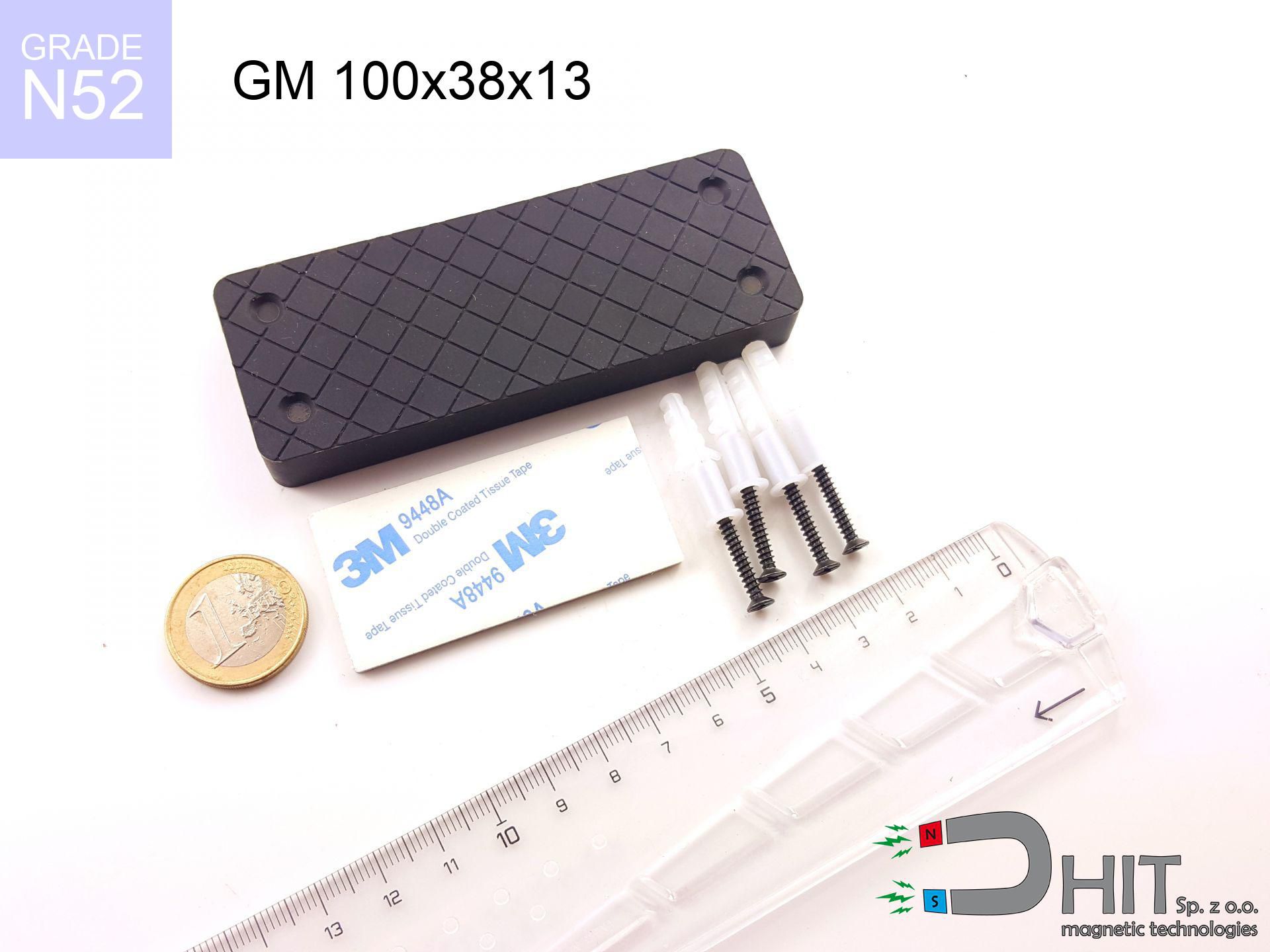
GM 100x38x13 / N52 - weapon holder
weapon holder
Catalog no 330454
GTIN/EAN: 5906301814719
- length
- 100 mm [±1 mm]
- Width
- 38 mm [±1 mm]
- Height
- 13 mm [±1 mm]
- Weight
- 148 g
- Magnetization Direction
- ↑ axial
How we measure these parameters — certificates and measurements
53.25 zł net / pcs
65.50 zł with VAT (23% VAT) / pcs
bulk discounts:
Need more?Frequently asked questions
Which magnetic holder is suitable for moving metal parts in a workshop?
How do I choose a holder for hanging a heavy item and check its real grip?
Which magnetic holders can be used outdoors?
How should I choose a strong threaded holder for field work?
Call us now
+48 888 99 98 98
alternatively let us know using
contact form
the contact section.
Specifications and structure of a neodymium magnet can be estimated using our
power calculator.
Order by 14:00 and we’ll ship today!
Technical data of the product - GM 100x38x13 / N52 - weapon holder
Specification / characteristics - GM 100x38x13 / N52 - weapon holder
| properties | values |
|---|---|
| Cat. no. | 330454 |
| GTIN/EAN | 5906301814719 |
| Production/Distribution | Dhit sp. z o.o. |
| Country of origin | Poland / China / Germany |
| Customs code | 85059029 |
| length | 100 mm [±1 mm] |
| Width | 38 mm [±1 mm] |
| Height | 13 mm [±1 mm] |
| Weight | 148 g |
| Magnetization Direction | ↑ axial |
| Load capacity ~ ? | 5.00 kg / 49.03 N |
| Manufacturing Tolerance | ±1 mm |
Magnetic properties of material N52
| properties | values | units |
|---|---|---|
| Remanence Br ? | 14.2-14.7 | kGs |
| Remanence Br ? | 1420-1470 | mT |
| Coercivity bHc ? | 10.8-12.5 | kOe |
| Coercivity bHc ? | 860-995 | kA/m |
| Intrinsic coercivity iHc | ≥ 12 | kOe |
| Intrinsic coercivity iHc | ≥ 955 | kA/m |
| Energy product BHmax ? | 48-53 | BH max MGOe |
| Energy product BHmax ? | 380-422 | BH max KJ/m |
| Maximum working temperature ? | ≤ 60 | °C |
Physical properties of sintered neodymium magnets Nd2Fe14B at 20°C
| properties | values | units |
|---|---|---|
| Vickers hardness | ≥550 | Hv |
| Density | ≥7.4 | g/cm3 |
| Curie Temperature TC | 310 | °C |
| Curie Temperature TF | 590 | °F |
| Specific resistance | 150 | μΩ⋅cm |
| Bending strength | 250 | MPa |
| Compressive strength | 1000~1100 | MPa |
| Thermal expansion parallel (∥) to orientation (M) | (3-4) x 10-6 | °C-1 |
| Thermal expansion perpendicular (⊥) to orientation (M) | -(1-3) x 10-6 | °C-1 |
| Young's modulus | 1.7 x 10⁴ | kg/mm² |
Material specification
| iron (Fe) | 64% – 68% |
| neodymium (Nd) | 29% – 32% |
| boron (B) | 1.1% – 1.2% |
| dysprosium (Dy) | 0.5% – 2.0% |
| coating (Ni-Cu-Ni) | < 0.05% |
Ecology and recycling (GPSR)
| recyclability (EoL) | 100% |
| recycled raw materials | ~10% (pre-cons) |
| carbon footprint | low / zredukowany |
| waste code (EWC) | 16 02 16 |
Other proposals


Strengths as well as weaknesses of Nd2Fe14B magnets.
Benefits
- Their power remains stable, and after approximately 10 years it decreases only by ~1% (theoretically),
- They retain their magnetic properties even under strong external field,
- Thanks to the shimmering finish, the plating of nickel, gold-plated, or silver-plated gives an visually attractive appearance,
- Neodymium magnets ensure maximum magnetic induction on a contact point, which ensures high operational effectiveness,
- Through (appropriate) combination of ingredients, they can achieve high thermal resistance, allowing for operation at temperatures reaching 230°C and above...
- Possibility of precise shaping and modifying to precise applications,
- Versatile presence in high-tech industry – they are commonly used in data components, electric drive systems, precision medical tools, as well as technologically advanced constructions.
- Relatively small size with high pulling force – neodymium magnets offer strong magnetic field in compact dimensions, which enables their usage in small systems
Cons
- Brittleness is one of their disadvantages. Upon strong impact they can break. We recommend keeping them in a strong case, which not only protects them against impacts but also increases their durability
- Do not exceed this material temperature limit: 60°C. Overheating may permanently weaken the magnet.
- Due to the susceptibility of magnets to corrosion in a humid environment, we advise using waterproof magnets made of rubber, plastic or other material resistant to moisture, when using outdoors
- Due to limitations in producing threads and complicated shapes in magnets, we recommend using cover - magnetic mount.
- Potential hazard related to microscopic parts of magnets can be dangerous, in case of ingestion, which gains importance in the aspect of protecting the youngest. Furthermore, small components of these magnets are able to be problematic in diagnostics medical in case of swallowing.
- Higher cost of purchase is one of the disadvantages compared to ceramic magnets, especially in budget applications
Lifting parameters
Maximum magnetic pulling force – what affects it?
- on a block made of structural steel, effectively closing the magnetic flux
- with a thickness minimum 10 mm
- with an polished touching surface
- with zero gap (without paint)
- under axial force vector (90-degree angle)
- in temp. approx. 20°C
Determinants of lifting force in real conditions
- Space between magnet and steel – every millimeter of separation (caused e.g. by varnish or unevenness) diminishes the pulling force, often by half at just 0.5 mm.
- Force direction – remember that the magnet holds strongest perpendicularly. Under shear forces, the holding force drops drastically, often to levels of 20-30% of the maximum value.
- Plate thickness – too thin steel does not accept the full field, causing part of the flux to be wasted into the air.
- Steel grade – ideal substrate is pure iron steel. Cast iron may generate lower lifting capacity.
- Surface quality – the more even the plate, the larger the contact zone and stronger the hold. Roughness acts like micro-gaps.
- Thermal factor – hot environment reduces pulling force. Too high temperature can permanently demagnetize the magnet.
Holding force was checked on the plate surface of 20 mm thickness, when a perpendicular force was applied, in contrast under parallel forces the lifting capacity is smaller. Additionally, even a slight gap between the magnet and the plate lowers the lifting capacity.
Safe handling of NdFeB magnets
GPS Danger
GPS units and smartphones are highly susceptible to magnetic fields. Direct contact with a powerful NdFeB magnet can decalibrate the sensors in your phone.
No play value
NdFeB magnets are not suitable for play. Swallowing multiple magnets can lead to them pinching intestinal walls, which poses a critical condition and necessitates immediate surgery.
Powerful field
Use magnets with awareness. Their powerful strength can shock even professionals. Stay alert and do not underestimate their power.
Metal Allergy
A percentage of the population have a sensitization to Ni, which is the common plating for neodymium magnets. Prolonged contact might lead to an allergic reaction. We suggest use safety gloves.
Electronic hazard
Very strong magnetic fields can destroy records on credit cards, hard drives, and other magnetic media. Keep a distance of at least 10 cm.
Operating temperature
Standard neodymium magnets (N-type) undergo demagnetization when the temperature goes above 80°C. This process is irreversible.
Warning for heart patients
Individuals with a pacemaker must keep an safe separation from magnets. The magnetism can interfere with the operation of the life-saving device.
Magnets are brittle
Neodymium magnets are ceramic materials, meaning they are fragile like glass. Clashing of two magnets leads to them cracking into small pieces.
Physical harm
Big blocks can smash fingers instantly. Never place your hand betwixt two strong magnets.
Machining danger
Machining of neodymium magnets carries a risk of fire risk. Magnetic powder oxidizes rapidly with oxygen and is difficult to extinguish.
Tabela kosztu i czasu dostawy
Płatność przed wysyłką:

GLS kurier
Przesyłka będzie u Ciebie za 2-3 dni
14.99 ZŁ

InPost Paczkomaty 24/7
Przesyłka będzie u Ciebie za 1-2 dni
12.30 ZŁ
Płatność przy odbiorze (pobranie):
GLS kurier
Przesyłka będzie u Ciebie za 1-2 dni
23.00 ZŁ