

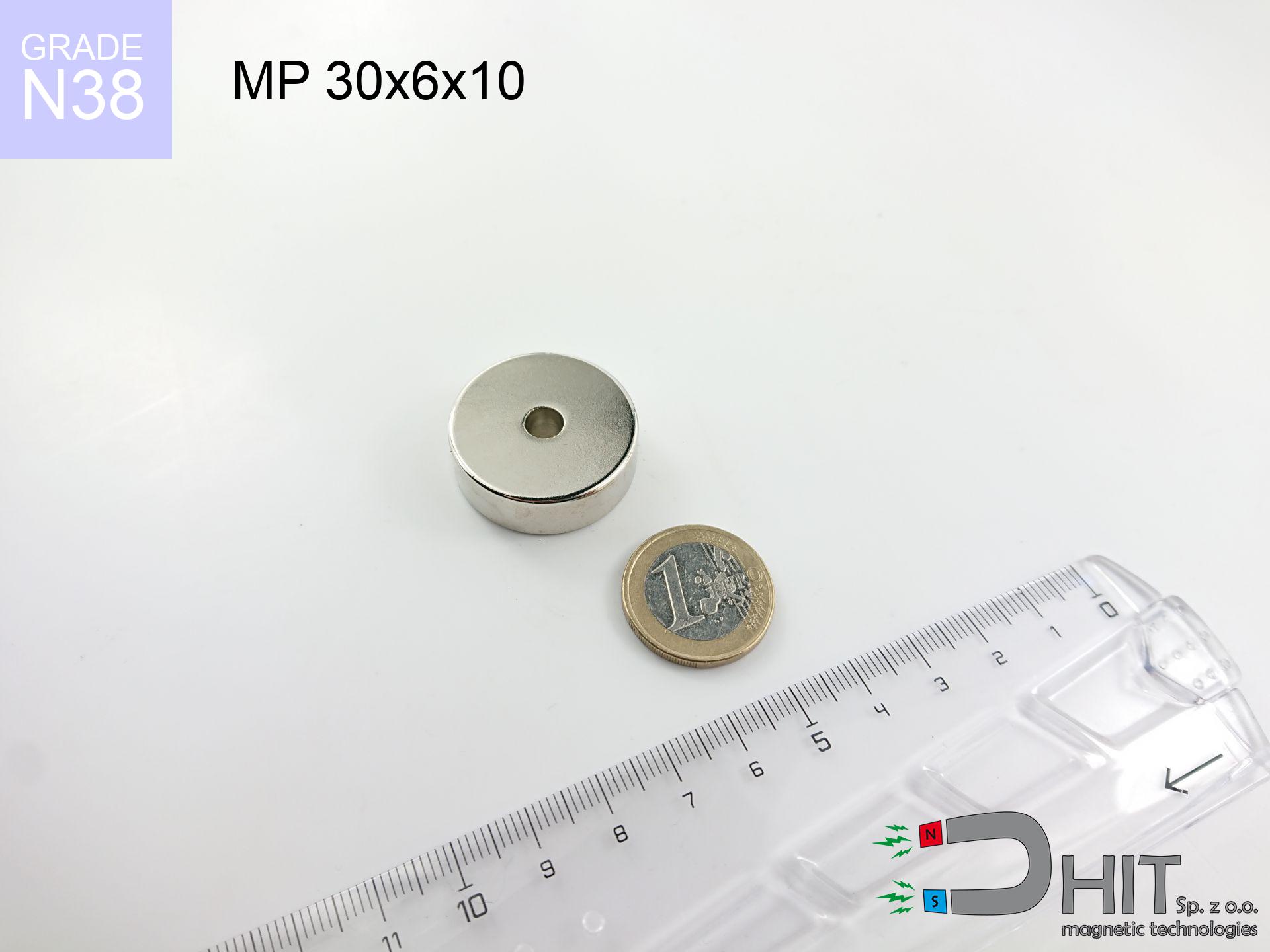
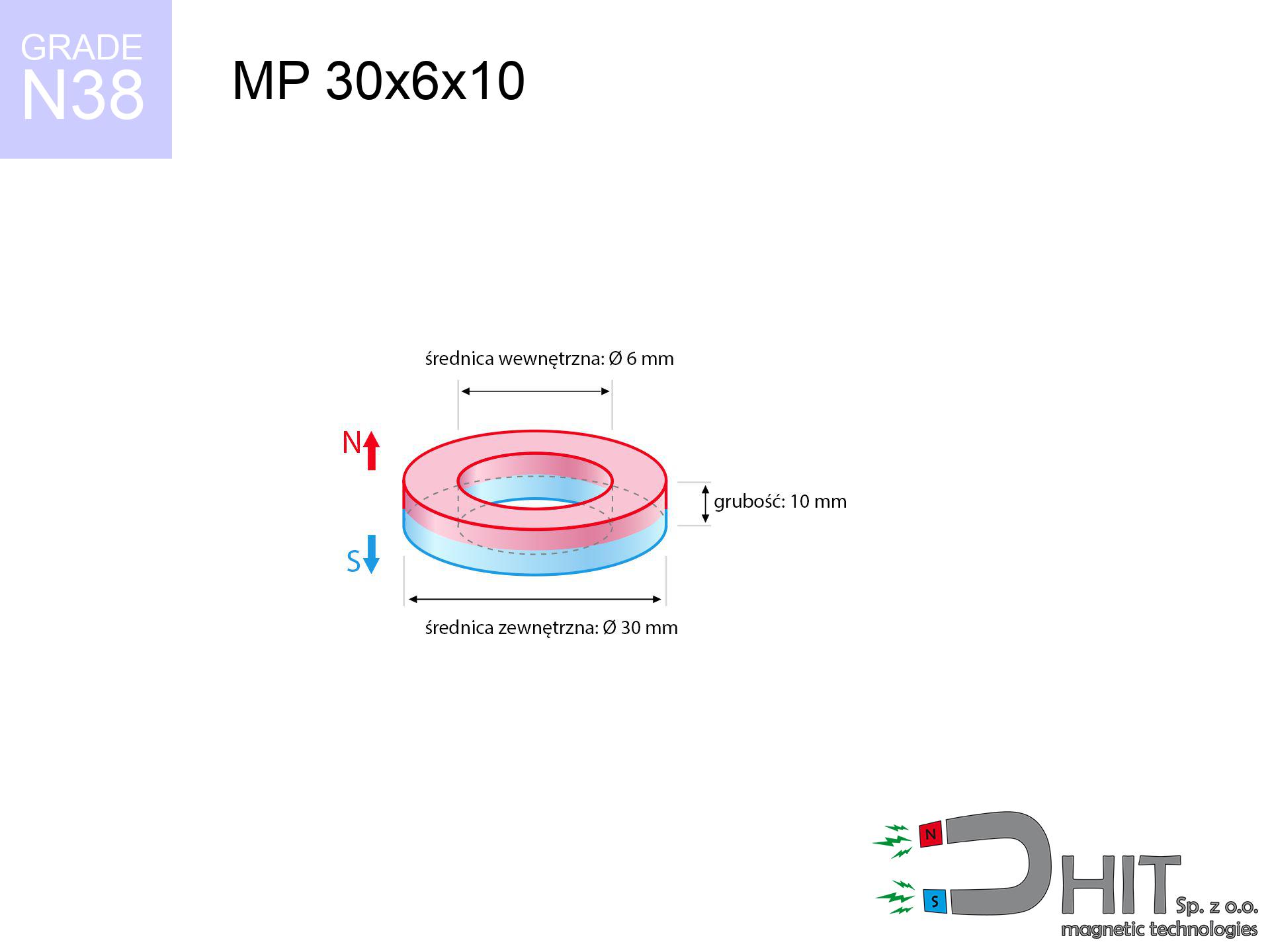
MP 30x6x10 / N38 - ring magnet
ring magnet
Catalog no 030197
GTIN/EAN: 5906301812142
- Diameter
- 30 mm [±0,1 mm]
- internal diameter Ø
- 6 mm [±0,1 mm]
- Height
- 10 mm [±0,1 mm]
- Weight
- 50.89 g
- Magnetization Direction
- ↑ axial
- Coating
- [NiCuNi] Nickel
How we measure these parameters — certificates and measurements
13.01 zł net / pcs
16.00 zł with VAT (23% VAT) / pcs
bulk discounts:
Need more?Frequently asked questions
Where can I compare prices of ring magnets for mounting in Poland?
Are ring magnets resistant to damage?
Which ring magnet is suitable for an outdoor structure?
Where can I check the available sizes of neodymium ring magnets?
Engineering report for this magnet
Full PDF analysis: pull and shear force, effect of distance, temperature and plate thickness, safety distances and the demagnetization curve.
Call us now
+48 888 99 98 98
alternatively let us know using
contact form
the contact section.
Specifications and structure of a neodymium magnet can be estimated using our
power calculator.
Order by 14:00 and we’ll ship today!
Technical of the product - MP 30x6x10 / N38 - ring magnet
Specification / characteristics - MP 30x6x10 / N38 - ring magnet
| properties | values |
|---|---|
| Cat. no. | 030197 |
| GTIN/EAN | 5906301812142 |
| Production/Distribution | Dhit sp. z o.o. |
| Country of origin | Poland / China / Germany |
| Customs code | 85059029 |
| Diameter | 30 mm [±0,1 mm] |
| internal diameter Ø | 6 mm [±0,1 mm] |
| Height | 10 mm [±0,1 mm] |
| Weight | 50.89 g |
| Magnetization Direction | ↑ axial |
| Load capacity ~ ? | 20.71 kg / 203.16 N |
| Magnetic Induction ~ ? | 343.81 mT / 3438 Gs |
| Coating | [NiCuNi] Nickel |
| Manufacturing Tolerance | ±0.1 mm |
Magnetic properties of material N38
| properties | values | units |
|---|---|---|
| Remanence Br ? | 12.2-12.6 | kGs |
| Remanence Br ? | 1220-1260 | mT |
| Coercivity bHc ? | 10.8-11.5 | kOe |
| Coercivity bHc ? | 860-915 | kA/m |
| Intrinsic coercivity iHc | ≥ 12 | kOe |
| Intrinsic coercivity iHc | ≥ 955 | kA/m |
| Energy product BHmax ? | 36-38 | BH max MGOe |
| Energy product BHmax ? | 287-303 | BH max KJ/m |
| Maximum working temperature ? | ≤ 80 | °C |
Physical properties of sintered neodymium magnets Nd2Fe14B at 20°C
| properties | values | units |
|---|---|---|
| Vickers hardness | ≥550 | Hv |
| Density | ≥7.4 | g/cm3 |
| Curie Temperature TC | 310 | °C |
| Curie Temperature TF | 590 | °F |
| Specific resistance | 150 | μΩ⋅cm |
| Bending strength | 250 | MPa |
| Compressive strength | 1000~1100 | MPa |
| Thermal expansion parallel (∥) to orientation (M) | (3-4) x 10-6 | °C-1 |
| Thermal expansion perpendicular (⊥) to orientation (M) | -(1-3) x 10-6 | °C-1 |
| Young's modulus | 1.7 x 10⁴ | kg/mm² |
Engineering analysis of the assembly - technical parameters
These data constitute the result of a mathematical analysis. Results are based on algorithms for the class Nd2Fe14B. Operational performance may differ from theoretical values. Treat these calculations as a supplementary guide when designing systems.
Table 1: Static force (pull vs gap) - power drop
MP 30x6x10 / N38
| Distance (mm) | Induction (Gauss) / mT | Pull Force (kg/lbs/g/N) | Risk Status |
|---|---|---|---|
| 0 mm |
5619 Gs
561.9 mT
|
20.71 kg / 45.66 lbs
20710.0 g / 203.2 N
|
crushing |
| 1 mm |
5241 Gs
524.1 mT
|
18.01 kg / 39.71 lbs
18011.7 g / 176.7 N
|
crushing |
| 2 mm |
4861 Gs
486.1 mT
|
15.50 kg / 34.17 lbs
15498.1 g / 152.0 N
|
crushing |
| 3 mm |
4490 Gs
449.0 mT
|
13.22 kg / 29.15 lbs
13223.5 g / 129.7 N
|
crushing |
| 5 mm |
3792 Gs
379.2 mT
|
9.43 kg / 20.79 lbs
9429.0 g / 92.5 N
|
warning |
| 10 mm |
2404 Gs
240.4 mT
|
3.79 kg / 8.36 lbs
3791.3 g / 37.2 N
|
warning |
| 15 mm |
1526 Gs
152.6 mT
|
1.53 kg / 3.37 lbs
1527.0 g / 15.0 N
|
weak grip |
| 20 mm |
1000 Gs
100.0 mT
|
0.66 kg / 1.45 lbs
655.5 g / 6.4 N
|
weak grip |
| 30 mm |
482 Gs
48.2 mT
|
0.15 kg / 0.34 lbs
152.6 g / 1.5 N
|
weak grip |
| 50 mm |
161 Gs
16.1 mT
|
0.02 kg / 0.04 lbs
17.0 g / 0.2 N
|
weak grip |
Table 2: Sliding load (vertical surface)
MP 30x6x10 / N38
| Distance (mm) | Friction coefficient | Pull Force (kg/lbs/g/N) |
|---|---|---|
| 0 mm | Stal (~0.2) |
4.14 kg / 9.13 lbs
4142.0 g / 40.6 N
|
| 1 mm | Stal (~0.2) |
3.60 kg / 7.94 lbs
3602.0 g / 35.3 N
|
| 2 mm | Stal (~0.2) |
3.10 kg / 6.83 lbs
3100.0 g / 30.4 N
|
| 3 mm | Stal (~0.2) |
2.64 kg / 5.83 lbs
2644.0 g / 25.9 N
|
| 5 mm | Stal (~0.2) |
1.89 kg / 4.16 lbs
1886.0 g / 18.5 N
|
| 10 mm | Stal (~0.2) |
0.76 kg / 1.67 lbs
758.0 g / 7.4 N
|
| 15 mm | Stal (~0.2) |
0.31 kg / 0.67 lbs
306.0 g / 3.0 N
|
| 20 mm | Stal (~0.2) |
0.13 kg / 0.29 lbs
132.0 g / 1.3 N
|
| 30 mm | Stal (~0.2) |
0.03 kg / 0.07 lbs
30.0 g / 0.3 N
|
| 50 mm | Stal (~0.2) |
0.00 kg / 0.01 lbs
4.0 g / 0.0 N
|
Table 3: Vertical assembly (shearing) - vertical pull
MP 30x6x10 / N38
| Surface type | Friction coefficient / % Mocy | Max load (kg/lbs/g/N) |
|---|---|---|
| Raw steel |
µ = 0.3
30% Nominalnej Siły
|
6.21 kg / 13.70 lbs
6213.0 g / 60.9 N
|
| Painted steel (standard) |
µ = 0.2
20% Nominalnej Siły
|
4.14 kg / 9.13 lbs
4142.0 g / 40.6 N
|
| Oily/slippery steel |
µ = 0.1
10% Nominalnej Siły
|
2.07 kg / 4.57 lbs
2071.0 g / 20.3 N
|
| Magnet with anti-slip rubber |
µ = 0.5
50% Nominalnej Siły
|
10.36 kg / 22.83 lbs
10355.0 g / 101.6 N
|
Table 4: Material efficiency (saturation) - power losses
MP 30x6x10 / N38
| Steel thickness (mm) | % power | Real pull force (kg/lbs/g/N) |
|---|---|---|
| 0.5 mm |
|
1.04 kg / 2.28 lbs
1035.5 g / 10.2 N
|
| 1 mm |
|
2.59 kg / 5.71 lbs
2588.8 g / 25.4 N
|
| 2 mm |
|
5.18 kg / 11.41 lbs
5177.5 g / 50.8 N
|
| 3 mm |
|
7.77 kg / 17.12 lbs
7766.3 g / 76.2 N
|
| 5 mm |
|
12.94 kg / 28.54 lbs
12943.8 g / 127.0 N
|
| 10 mm |
|
20.71 kg / 45.66 lbs
20710.0 g / 203.2 N
|
| 11 mm |
|
20.71 kg / 45.66 lbs
20710.0 g / 203.2 N
|
| 12 mm |
|
20.71 kg / 45.66 lbs
20710.0 g / 203.2 N
|
Table 5: Thermal stability (material behavior) - thermal limit
MP 30x6x10 / N38
| Ambient temp. (°C) | Power loss | Remaining pull (kg/lbs/g/N) | Status |
|---|---|---|---|
| 20 °C | 0.0% |
20.71 kg / 45.66 lbs
20710.0 g / 203.2 N
|
OK |
| 40 °C | -2.2% |
20.25 kg / 44.65 lbs
20254.4 g / 198.7 N
|
OK |
| 60 °C | -4.4% |
19.80 kg / 43.65 lbs
19798.8 g / 194.2 N
|
OK |
| 80 °C | -6.6% |
19.34 kg / 42.64 lbs
19343.1 g / 189.8 N
|
|
| 100 °C | -28.8% |
14.75 kg / 32.51 lbs
14745.5 g / 144.7 N
|
Table 6: Magnet-Magnet interaction (repulsion) - forces in the system
MP 30x6x10 / N38
| Gap (mm) | Attraction (kg/lbs) (N-S) | Shear Force (kg/lbs/g/N) | Repulsion (kg/lbs) (N-N) |
|---|---|---|---|
| 0 mm |
103.97 kg / 229.22 lbs
6 035 Gs
|
15.60 kg / 34.38 lbs
15596 g / 153.0 N
|
N/A |
| 1 mm |
97.15 kg / 214.17 lbs
10 864 Gs
|
14.57 kg / 32.13 lbs
14572 g / 143.0 N
|
87.43 kg / 192.75 lbs
~0 Gs
|
| 2 mm |
90.42 kg / 199.35 lbs
10 481 Gs
|
13.56 kg / 29.90 lbs
13564 g / 133.1 N
|
81.38 kg / 179.42 lbs
~0 Gs
|
| 3 mm |
83.97 kg / 185.13 lbs
10 100 Gs
|
12.60 kg / 27.77 lbs
12596 g / 123.6 N
|
75.57 kg / 166.61 lbs
~0 Gs
|
| 5 mm |
71.94 kg / 158.60 lbs
9 349 Gs
|
10.79 kg / 23.79 lbs
10791 g / 105.9 N
|
64.75 kg / 142.74 lbs
~0 Gs
|
| 10 mm |
47.34 kg / 104.36 lbs
7 583 Gs
|
7.10 kg / 15.65 lbs
7100 g / 69.7 N
|
42.60 kg / 93.92 lbs
~0 Gs
|
| 20 mm |
19.03 kg / 41.96 lbs
4 809 Gs
|
2.86 kg / 6.29 lbs
2855 g / 28.0 N
|
17.13 kg / 37.77 lbs
~0 Gs
|
| 50 mm |
1.53 kg / 3.37 lbs
1 363 Gs
|
0.23 kg / 0.51 lbs
229 g / 2.2 N
|
1.38 kg / 3.03 lbs
~0 Gs
|
| 60 mm |
0.77 kg / 1.69 lbs
965 Gs
|
0.11 kg / 0.25 lbs
115 g / 1.1 N
|
0.69 kg / 1.52 lbs
~0 Gs
|
| 70 mm |
0.41 kg / 0.90 lbs
706 Gs
|
0.06 kg / 0.14 lbs
61 g / 0.6 N
|
0.37 kg / 0.81 lbs
~0 Gs
|
| 80 mm |
0.23 kg / 0.51 lbs
531 Gs
|
0.03 kg / 0.08 lbs
35 g / 0.3 N
|
0.21 kg / 0.46 lbs
~0 Gs
|
| 90 mm |
0.14 kg / 0.30 lbs
409 Gs
|
0.02 kg / 0.05 lbs
21 g / 0.2 N
|
0.12 kg / 0.27 lbs
~0 Gs
|
| 100 mm |
0.09 kg / 0.19 lbs
322 Gs
|
0.01 kg / 0.03 lbs
13 g / 0.1 N
|
0.08 kg / 0.17 lbs
~0 Gs
|
Table 7: Hazards (implants) - warnings
MP 30x6x10 / N38
| Object / Device | Limit (Gauss) / mT | Safe distance |
|---|---|---|
| Pacemaker | 5 Gs (0.5 mT) | 19.5 cm |
| Hearing aid | 10 Gs (1.0 mT) | 15.0 cm |
| Mechanical watch | 20 Gs (2.0 mT) | 12.0 cm |
| Mobile device | 40 Gs (4.0 mT) | 9.0 cm |
| Car key | 50 Gs (5.0 mT) | 8.5 cm |
| Payment card | 400 Gs (40.0 mT) | 3.5 cm |
| HDD hard drive | 600 Gs (60.0 mT) | 3.0 cm |
Table 8: Impact energy (cracking risk) - warning
MP 30x6x10 / N38
| Start from (mm) | Speed (km/h) | Energy (J) | Predicted outcome |
|---|---|---|---|
| 10 mm |
22.80 km/h
(6.33 m/s)
|
1.02 J | |
| 30 mm |
24.98 km/h
(6.94 m/s)
|
1.23 J | |
| 50 mm |
25.10 km/h
(6.97 m/s)
|
1.24 J | |
| 100 mm |
25.12 km/h
(6.98 m/s)
|
1.24 J |
Table 9: Corrosion resistance
MP 30x6x10 / N38
| Technical parameter | Value / Description |
|---|---|
| Coating type | [NiCuNi] Nickel |
| Layer structure | Nickel - Copper - Nickel |
| Layer thickness | 10-20 µm |
| Salt spray test (SST) ? | 24 h |
| Recommended environment | Indoors only (dry) |
Table 10: Construction data (Flux)
MP 30x6x10 / N38
| Parameter | Value | SI Unit / Description |
|---|---|---|
| Magnetic Flux | 31 585 Mx | 315.8 µWb |
| Pc Coefficient | 0.96 | High (Stable) |
Table 11: Hydrostatics and buoyancy
MP 30x6x10 / N38
| Environment | Effective steel pull | Effect |
|---|---|---|
| Air (land) | 20.71 kg | Standard |
| Water (riverbed) |
23.71 kg
(+3.00 kg buoyancy gain)
|
+14.5% |
1. Shear force
*Caution: On a vertical wall, the magnet retains just a fraction of its nominal pull.
2. Steel thickness impact
*Thin metal sheet (e.g. computer case) drastically weakens the holding force.
3. Heat tolerance
N38: the maximum material working temperature is 80°C. Permitted conditions also depend on the shape and magnetic circuit.
4. Demagnetization curve and operating point (B-H)
chart generated for the permeance coefficient Pc (Permeance Coefficient) = 0.96
The chart above illustrates the magnetic characteristics of the material within the second quadrant of the hysteresis loop. The solid red line represents the demagnetization curve (material potential), while the dashed blue line is the load line based on the magnet's geometry. The Pc (Permeance Coefficient), also known as the load line slope, is a dimensionless value that describes the relationship between the magnet's shape and its magnetic stability. The intersection of these two lines (the black dot) is the operating point — it determines the actual magnetic flux density generated by the magnet in this specific configuration. A higher Pc value means the magnet is more 'slender' (tall relative to its area), resulting in a higher operating point and better resistance to irreversible demagnetization caused by external fields or temperature. A value of 0.42 is relatively low (typical for flat magnets), meaning the operating point is closer to the 'knee' of the curve — caution is advised when operating at temperatures near the maximum limit to avoid strength loss.
Chemical composition
| iron (Fe) | 64% – 68% |
| neodymium (Nd) | 29% – 32% |
| boron (B) | 1.1% – 1.2% |
| dysprosium (Dy) | 0.5% – 2.0% |
| coating (Ni-Cu-Ni) | < 0.05% |
Ecology and recycling (GPSR)
| recyclability (EoL) | 100% |
| recycled raw materials | ~10% (pre-cons) |
| carbon footprint | low / zredukowany |
| waste code (EWC) | 16 02 16 |
Check out also proposals
![UMH 42x9x46 [M6] / N38 - magnetic holder with hook](https://cdn3.dhit.pl/graphics/products/umh-42x9x46-m6-vat.jpg "UMH 42x9x46 [M6] / N38 - magnetic holder with hook")

Strengths as well as weaknesses of neodymium magnets.
Advantages
- They do not lose strength, even over nearly 10 years – the reduction in power is only ~1% (based on measurements),
- Neodymium magnets remain extremely resistant to magnetic field loss caused by external field sources,
- A magnet with a smooth silver surface looks better,
- The surface of neodymium magnets generates a powerful magnetic field – this is a distinguishing feature,
- Through (adequate) combination of ingredients, they can achieve high thermal resistance, enabling operation at temperatures approaching 230°C and above...
- Thanks to versatility in shaping and the ability to adapt to specific needs,
- Significant place in electronics industry – they find application in computer drives, electromotive mechanisms, medical equipment, and other advanced devices.
- Thanks to efficiency per cm³, small magnets offer high operating force, with minimal size,
Cons
- Susceptibility to cracking is one of their disadvantages. Upon strong impact they can break. We advise keeping them in a special holder, which not only protects them against impacts but also increases their durability
- Do not exceed this material temperature limit: 80°C. Overheating may permanently weaken the magnet.
- Due to the susceptibility of magnets to corrosion in a humid environment, we recommend using waterproof magnets made of rubber, plastic or other material stable to moisture, in case of application outdoors
- Limited ability of producing threads in the magnet and complicated shapes - preferred is cover - mounting mechanism.
- Possible danger to health – tiny shards of magnets are risky, if swallowed, which becomes key in the context of child safety. It is also worth noting that tiny parts of these magnets are able to disrupt the diagnostic process medical in case of swallowing.
- High unit price – neodymium magnets have a higher price than other types of magnets (e.g. ferrite), which hinders application in large quantities
Pull force analysis
Best holding force of the magnet in ideal parameters – what it depends on?
- with the contact of a yoke made of special test steel, ensuring full magnetic saturation
- with a thickness of at least 10 mm
- with an polished touching surface
- with zero gap (without paint)
- for force acting at a right angle (in the magnet axis)
- in neutral thermal conditions
Determinants of practical lifting force of a magnet
- Distance (betwixt the magnet and the plate), as even a microscopic distance (e.g. 0.5 mm) results in a drastic drop in force by up to 50% (this also applies to paint, rust or dirt).
- Loading method – catalog parameter refers to pulling vertically. When applying parallel force, the magnet holds much less (typically approx. 20-30% of maximum force).
- Substrate thickness – to utilize 100% power, the steel must be sufficiently thick. Paper-thin metal restricts the lifting capacity (the magnet "punches through" it).
- Steel grade – the best choice is pure iron steel. Hardened steels may have worse magnetic properties.
- Surface condition – ground elements ensure maximum contact, which improves force. Uneven metal weaken the grip.
- Heat – neodymium magnets have a negative temperature coefficient. When it is hot they lose power, and at low temperatures gain strength (up to a certain limit).
Lifting capacity was determined by applying a polished steel plate of suitable thickness (min. 20 mm), under vertically applied force, whereas under shearing force the lifting capacity is smaller. In addition, even a small distance between the magnet’s surface and the plate lowers the holding force.
H&S for magnets
Medical implants
Health Alert: Strong magnets can turn off pacemakers and defibrillators. Stay away if you have electronic implants.
Metal Allergy
Warning for allergy sufferers: The Ni-Cu-Ni coating contains nickel. If redness happens, cease handling magnets and use protective gear.
Phone sensors
GPS units and smartphones are highly susceptible to magnetic fields. Close proximity with a strong magnet can decalibrate the sensors in your phone.
Fire warning
Fire warning: Rare earth powder is highly flammable. Avoid machining magnets in home conditions as this may cause fire.
Physical harm
Pinching hazard: The attraction force is so immense that it can cause hematomas, pinching, and even bone fractures. Use thick gloves.
Safe operation
Exercise caution. Rare earth magnets attract from a distance and snap with huge force, often quicker than you can react.
Heat warning
Watch the temperature. Heating the magnet to high heat will permanently weaken its magnetic structure and pulling force.
Cards and drives
Avoid bringing magnets close to a purse, computer, or TV. The magnetism can destroy these devices and erase data from cards.
Magnet fragility
Despite metallic appearance, the material is delicate and not impact-resistant. Avoid impacts, as the magnet may shatter into hazardous fragments.
Adults only
Strictly store magnets away from children. Choking hazard is high, and the consequences of magnets clamping inside the body are fatal.
Tabela kosztu i czasu dostawy
Płatność przed wysyłką:

GLS kurier
Przesyłka będzie u Ciebie za 2-3 dni
14.99 ZŁ

InPost Paczkomaty 24/7
Przesyłka będzie u Ciebie za 1-2 dni
12.30 ZŁ
Płatność przy odbiorze (pobranie):
GLS kurier
Przesyłka będzie u Ciebie za 1-2 dni
23.00 ZŁ