


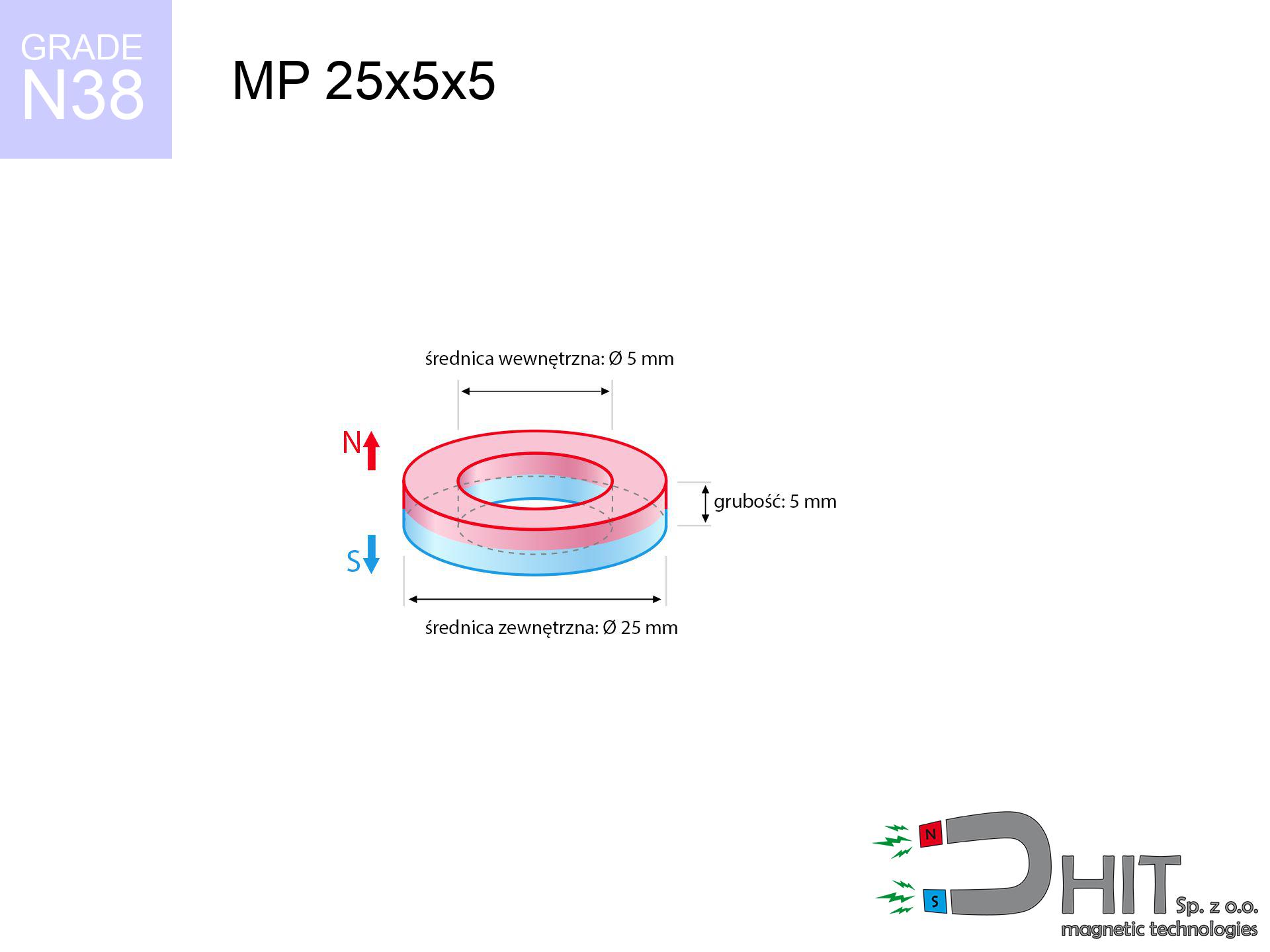
MP 25x5x5 / N38 - ring magnet
ring magnet
Catalog no 030193
GTIN/EAN: 5906301812104
- Diameter
- 25 mm [±0,1 mm]
- internal diameter Ø
- 5 mm [±0,1 mm]
- Height
- 5 mm [±0,1 mm]
- Weight
- 17.67 g
- Magnetization Direction
- ↑ axial
- Coating
- [NiCuNi] Nickel
How we measure these parameters — certificates and measurements
4.88 zł net / pcs
6.00 zł with VAT (23% VAT) / pcs
bulk discounts:
Need more?Frequently asked questions
Where can I compare prices of ring magnets for mounting in Poland?
Are ring magnets resistant to damage?
Which ring magnet is suitable for an outdoor structure?
Where can I check the available sizes of neodymium ring magnets?
Engineering report for this magnet
Full PDF analysis: pull and shear force, effect of distance, temperature and plate thickness, safety distances and the demagnetization curve.
Call us now
+48 888 99 98 98
alternatively let us know using
contact form
the contact section.
Specifications and structure of a neodymium magnet can be estimated using our
power calculator.
Order by 14:00 and we’ll ship today!
Physical properties - MP 25x5x5 / N38 - ring magnet
Specification / characteristics - MP 25x5x5 / N38 - ring magnet
| properties | values |
|---|---|
| Cat. no. | 030193 |
| GTIN/EAN | 5906301812104 |
| Production/Distribution | Dhit sp. z o.o. |
| Country of origin | Poland / China / Germany |
| Customs code | 85059029 |
| Diameter | 25 mm [±0,1 mm] |
| internal diameter Ø | 5 mm [±0,1 mm] |
| Height | 5 mm [±0,1 mm] |
| Weight | 17.67 g |
| Magnetization Direction | ↑ axial |
| Load capacity ~ ? | 7.66 kg / 75.12 N |
| Magnetic Induction ~ ? | 230.20 mT / 2302 Gs |
| Coating | [NiCuNi] Nickel |
| Manufacturing Tolerance | ±0.1 mm |
Magnetic properties of material N38
| properties | values | units |
|---|---|---|
| Remanence Br ? | 12.2-12.6 | kGs |
| Remanence Br ? | 1220-1260 | mT |
| Coercivity bHc ? | 10.8-11.5 | kOe |
| Coercivity bHc ? | 860-915 | kA/m |
| Intrinsic coercivity iHc | ≥ 12 | kOe |
| Intrinsic coercivity iHc | ≥ 955 | kA/m |
| Energy product BHmax ? | 36-38 | BH max MGOe |
| Energy product BHmax ? | 287-303 | BH max KJ/m |
| Maximum working temperature ? | ≤ 80 | °C |
Physical properties of sintered neodymium magnets Nd2Fe14B at 20°C
| properties | values | units |
|---|---|---|
| Vickers hardness | ≥550 | Hv |
| Density | ≥7.4 | g/cm3 |
| Curie Temperature TC | 310 | °C |
| Curie Temperature TF | 590 | °F |
| Specific resistance | 150 | μΩ⋅cm |
| Bending strength | 250 | MPa |
| Compressive strength | 1000~1100 | MPa |
| Thermal expansion parallel (∥) to orientation (M) | (3-4) x 10-6 | °C-1 |
| Thermal expansion perpendicular (⊥) to orientation (M) | -(1-3) x 10-6 | °C-1 |
| Young's modulus | 1.7 x 10⁴ | kg/mm² |
Technical analysis of the magnet - data
These values represent the direct effect of a physical calculation. Values were calculated on models for the material Nd2Fe14B. Operational parameters might slightly differ from theoretical values. Treat these data as a supplementary guide when designing systems.
Table 1: Static force (force vs gap) - interaction chart
MP 25x5x5 / N38
| Distance (mm) | Induction (Gauss) / mT | Pull Force (kg/lbs/g/N) | Risk Status |
|---|---|---|---|
| 0 mm |
5777 Gs
577.7 mT
|
7.66 kg / 16.89 pounds
7660.0 g / 75.1 N
|
strong |
| 1 mm |
5310 Gs
531.0 mT
|
6.47 kg / 14.27 pounds
6471.0 g / 63.5 N
|
strong |
| 2 mm |
4846 Gs
484.6 mT
|
5.39 kg / 11.88 pounds
5388.6 g / 52.9 N
|
strong |
| 3 mm |
4397 Gs
439.7 mT
|
4.44 kg / 9.78 pounds
4437.9 g / 43.5 N
|
strong |
| 5 mm |
3576 Gs
357.6 mT
|
2.93 kg / 6.47 pounds
2934.8 g / 28.8 N
|
strong |
| 10 mm |
2073 Gs
207.3 mT
|
0.99 kg / 2.17 pounds
985.9 g / 9.7 N
|
safe |
| 15 mm |
1231 Gs
123.1 mT
|
0.35 kg / 0.77 pounds
347.9 g / 3.4 N
|
safe |
| 20 mm |
773 Gs
77.3 mT
|
0.14 kg / 0.30 pounds
137.0 g / 1.3 N
|
safe |
| 30 mm |
356 Gs
35.6 mT
|
0.03 kg / 0.06 pounds
29.0 g / 0.3 N
|
safe |
| 50 mm |
115 Gs
11.5 mT
|
0.00 kg / 0.01 pounds
3.0 g / 0.0 N
|
safe |
Table 2: Sliding capacity (vertical surface)
MP 25x5x5 / N38
| Distance (mm) | Friction coefficient | Pull Force (kg/lbs/g/N) |
|---|---|---|
| 0 mm | Stal (~0.2) |
1.53 kg / 3.38 pounds
1532.0 g / 15.0 N
|
| 1 mm | Stal (~0.2) |
1.29 kg / 2.85 pounds
1294.0 g / 12.7 N
|
| 2 mm | Stal (~0.2) |
1.08 kg / 2.38 pounds
1078.0 g / 10.6 N
|
| 3 mm | Stal (~0.2) |
0.89 kg / 1.96 pounds
888.0 g / 8.7 N
|
| 5 mm | Stal (~0.2) |
0.59 kg / 1.29 pounds
586.0 g / 5.7 N
|
| 10 mm | Stal (~0.2) |
0.20 kg / 0.44 pounds
198.0 g / 1.9 N
|
| 15 mm | Stal (~0.2) |
0.07 kg / 0.15 pounds
70.0 g / 0.7 N
|
| 20 mm | Stal (~0.2) |
0.03 kg / 0.06 pounds
28.0 g / 0.3 N
|
| 30 mm | Stal (~0.2) |
0.01 kg / 0.01 pounds
6.0 g / 0.1 N
|
| 50 mm | Stal (~0.2) |
0.00 kg / 0.00 pounds
0.0 g / 0.0 N
|
Table 3: Vertical assembly (shearing) - behavior on slippery surfaces
MP 25x5x5 / N38
| Surface type | Friction coefficient / % Mocy | Max load (kg/lbs/g/N) |
|---|---|---|
| Raw steel |
µ = 0.3
30% Nominalnej Siły
|
2.30 kg / 5.07 pounds
2298.0 g / 22.5 N
|
| Painted steel (standard) |
µ = 0.2
20% Nominalnej Siły
|
1.53 kg / 3.38 pounds
1532.0 g / 15.0 N
|
| Oily/slippery steel |
µ = 0.1
10% Nominalnej Siły
|
0.77 kg / 1.69 pounds
766.0 g / 7.5 N
|
| Magnet with anti-slip rubber |
µ = 0.5
50% Nominalnej Siły
|
3.83 kg / 8.44 pounds
3830.0 g / 37.6 N
|
Table 4: Material efficiency (saturation) - power losses
MP 25x5x5 / N38
| Steel thickness (mm) | % power | Real pull force (kg/lbs/g/N) |
|---|---|---|
| 0.5 mm |
|
0.77 kg / 1.69 pounds
766.0 g / 7.5 N
|
| 1 mm |
|
1.92 kg / 4.22 pounds
1915.0 g / 18.8 N
|
| 2 mm |
|
3.83 kg / 8.44 pounds
3830.0 g / 37.6 N
|
| 3 mm |
|
5.75 kg / 12.67 pounds
5745.0 g / 56.4 N
|
| 5 mm |
|
7.66 kg / 16.89 pounds
7660.0 g / 75.1 N
|
| 10 mm |
|
7.66 kg / 16.89 pounds
7660.0 g / 75.1 N
|
| 11 mm |
|
7.66 kg / 16.89 pounds
7660.0 g / 75.1 N
|
| 12 mm |
|
7.66 kg / 16.89 pounds
7660.0 g / 75.1 N
|
Table 5: Thermal resistance (material behavior) - power drop
MP 25x5x5 / N38
| Ambient temp. (°C) | Power loss | Remaining pull (kg/lbs/g/N) | Status |
|---|---|---|---|
| 20 °C | 0.0% |
7.66 kg / 16.89 pounds
7660.0 g / 75.1 N
|
OK |
| 40 °C | -2.2% |
7.49 kg / 16.52 pounds
7491.5 g / 73.5 N
|
OK |
| 60 °C | -4.4% |
7.32 kg / 16.14 pounds
7323.0 g / 71.8 N
|
OK |
| 80 °C | -6.6% |
7.15 kg / 15.77 pounds
7154.4 g / 70.2 N
|
|
| 100 °C | -28.8% |
5.45 kg / 12.02 pounds
5453.9 g / 53.5 N
|
Table 6: Magnet-Magnet interaction (repulsion) - field collision
MP 25x5x5 / N38
| Gap (mm) | Attraction (kg/lbs) (N-S) | Shear Strength (kg/lbs/g/N) | Repulsion (kg/lbs) (N-N) |
|---|---|---|---|
| 0 mm |
82.42 kg / 181.72 pounds
6 082 Gs
|
12.36 kg / 27.26 pounds
12364 g / 121.3 N
|
N/A |
| 1 mm |
75.95 kg / 167.44 pounds
11 091 Gs
|
11.39 kg / 25.12 pounds
11392 g / 111.8 N
|
68.35 kg / 150.69 pounds
~0 Gs
|
| 2 mm |
69.63 kg / 153.51 pounds
10 620 Gs
|
10.44 kg / 23.03 pounds
10445 g / 102.5 N
|
62.67 kg / 138.16 pounds
~0 Gs
|
| 3 mm |
63.64 kg / 140.29 pounds
10 153 Gs
|
9.55 kg / 21.04 pounds
9545 g / 93.6 N
|
57.27 kg / 126.26 pounds
~0 Gs
|
| 5 mm |
52.69 kg / 116.16 pounds
9 238 Gs
|
7.90 kg / 17.42 pounds
7903 g / 77.5 N
|
47.42 kg / 104.54 pounds
~0 Gs
|
| 10 mm |
31.58 kg / 69.62 pounds
7 152 Gs
|
4.74 kg / 10.44 pounds
4737 g / 46.5 N
|
28.42 kg / 62.66 pounds
~0 Gs
|
| 20 mm |
10.61 kg / 23.39 pounds
4 145 Gs
|
1.59 kg / 3.51 pounds
1591 g / 15.6 N
|
9.55 kg / 21.05 pounds
~0 Gs
|
| 50 mm |
0.65 kg / 1.43 pounds
1 024 Gs
|
0.10 kg / 0.21 pounds
97 g / 1.0 N
|
0.58 kg / 1.28 pounds
~0 Gs
|
| 60 mm |
0.31 kg / 0.69 pounds
712 Gs
|
0.05 kg / 0.10 pounds
47 g / 0.5 N
|
0.28 kg / 0.62 pounds
~0 Gs
|
| 70 mm |
0.16 kg / 0.36 pounds
514 Gs
|
0.02 kg / 0.05 pounds
24 g / 0.2 N
|
0.15 kg / 0.32 pounds
~0 Gs
|
| 80 mm |
0.09 kg / 0.20 pounds
383 Gs
|
0.01 kg / 0.03 pounds
14 g / 0.1 N
|
0.08 kg / 0.18 pounds
~0 Gs
|
| 90 mm |
0.05 kg / 0.12 pounds
293 Gs
|
0.01 kg / 0.02 pounds
8 g / 0.1 N
|
0.05 kg / 0.11 pounds
~0 Gs
|
| 100 mm |
0.03 kg / 0.07 pounds
230 Gs
|
0.00 kg / 0.01 pounds
5 g / 0.0 N
|
0.03 kg / 0.06 pounds
~0 Gs
|
Table 7: Protective zones (implants) - precautionary measures
MP 25x5x5 / N38
| Object / Device | Limit (Gauss) / mT | Safe distance |
|---|---|---|
| Pacemaker | 5 Gs (0.5 mT) | 17.0 cm |
| Hearing aid | 10 Gs (1.0 mT) | 13.5 cm |
| Timepiece | 20 Gs (2.0 mT) | 10.5 cm |
| Mobile device | 40 Gs (4.0 mT) | 8.0 cm |
| Remote | 50 Gs (5.0 mT) | 7.5 cm |
| Payment card | 400 Gs (40.0 mT) | 3.0 cm |
| HDD hard drive | 600 Gs (60.0 mT) | 2.5 cm |
Table 8: Dynamics (kinetic energy) - collision effects
MP 25x5x5 / N38
| Start from (mm) | Speed (km/h) | Energy (J) | Predicted outcome |
|---|---|---|---|
| 10 mm |
22.16 km/h
(6.15 m/s)
|
0.33 J | |
| 30 mm |
23.68 km/h
(6.58 m/s)
|
0.38 J | |
| 50 mm |
23.74 km/h
(6.59 m/s)
|
0.38 J | |
| 100 mm |
23.75 km/h
(6.60 m/s)
|
0.38 J |
Table 9: Anti-corrosion coating durability
MP 25x5x5 / N38
| Technical parameter | Value / Description |
|---|---|
| Coating type | [NiCuNi] Nickel |
| Layer structure | Nickel - Copper - Nickel |
| Layer thickness | 10-20 µm |
| Salt spray test (SST) ? | 24 h |
| Recommended environment | Indoors only (dry) |
Table 10: Construction data (Flux)
MP 25x5x5 / N38
| Parameter | Value | SI Unit / Description |
|---|---|---|
| Magnetic Flux | 24 536 Mx | 245.4 µWb |
| Pc Coefficient | 1.03 | High (Stable) |
Table 11: Physics of underwater searching
MP 25x5x5 / N38
| Environment | Effective steel pull | Effect |
|---|---|---|
| Air (land) | 7.66 kg | Standard |
| Water (riverbed) |
8.77 kg
(+1.11 kg buoyancy gain)
|
+14.5% |
1. Sliding resistance
*Warning: On a vertical wall, the magnet holds only approx. 20-30% of its perpendicular strength.
2. Steel thickness impact
*Thin metal sheet (e.g. computer case) drastically weakens the holding force.
3. Heat tolerance
N38: the maximum material working temperature is 80°C. Permitted conditions also depend on the shape and magnetic circuit.
4. Demagnetization curve and operating point (B-H)
chart generated for the permeance coefficient Pc (Permeance Coefficient) = 1.03
The chart above illustrates the magnetic characteristics of the material within the second quadrant of the hysteresis loop. The solid red line represents the demagnetization curve (material potential), while the dashed blue line is the load line based on the magnet's geometry. The Pc (Permeance Coefficient), also known as the load line slope, is a dimensionless value that describes the relationship between the magnet's shape and its magnetic stability. The intersection of these two lines (the black dot) is the operating point — it determines the actual magnetic flux density generated by the magnet in this specific configuration. A higher Pc value means the magnet is more 'slender' (tall relative to its area), resulting in a higher operating point and better resistance to irreversible demagnetization caused by external fields or temperature. A value of 0.42 is relatively low (typical for flat magnets), meaning the operating point is closer to the 'knee' of the curve — caution is advised when operating at temperatures near the maximum limit to avoid strength loss.
Material specification
| iron (Fe) | 64% – 68% |
| neodymium (Nd) | 29% – 32% |
| boron (B) | 1.1% – 1.2% |
| dysprosium (Dy) | 0.5% – 2.0% |
| coating (Ni-Cu-Ni) | < 0.05% |
Ecology and recycling (GPSR)
| recyclability (EoL) | 100% |
| recycled raw materials | ~10% (pre-cons) |
| carbon footprint | low / zredukowany |
| waste code (EWC) | 16 02 16 |
Check out more products

Advantages as well as disadvantages of neodymium magnets.
Strengths
- Their power remains stable, and after approximately 10 years it decreases only by ~1% (theoretically),
- They retain their magnetic properties even under strong external field,
- The use of an refined layer of noble metals (nickel, gold, silver) causes the element to have aesthetics,
- Magnets possess extremely high magnetic induction on the outer side,
- Neodymium magnets are characterized by very high magnetic induction on the magnet surface and can function (depending on the form) even at a temperature of 230°C or more...
- Thanks to the potential of precise molding and customization to custom projects, neodymium magnets can be modeled in a wide range of shapes and sizes, which amplifies use scope,
- Wide application in modern industrial fields – they serve a role in mass storage devices, drive modules, precision medical tools, as well as technologically advanced constructions.
- Thanks to concentrated force, small magnets offer high operating force, occupying minimum space,
Disadvantages
- At strong impacts they can crack, therefore we advise placing them in steel cases. A metal housing provides additional protection against damage, as well as increases the magnet's durability.
- Do not exceed this material temperature limit: 80°C. Overheating may permanently weaken the magnet.
- When exposed to humidity, magnets start to rust. For applications outside, it is recommended to use protective magnets, such as those in rubber or plastics, which secure oxidation as well as corrosion.
- Due to limitations in producing threads and complicated shapes in magnets, we recommend using casing - magnetic mechanism.
- Potential hazard resulting from small fragments of magnets are risky, if swallowed, which is particularly important in the context of child health protection. It is also worth noting that tiny parts of these devices can disrupt the diagnostic process medical after entering the body.
- Higher cost of purchase is one of the disadvantages compared to ceramic magnets, especially in budget applications
Pull force analysis
Highest magnetic holding force – what affects it?
- using a plate made of high-permeability steel, acting as a magnetic yoke
- whose thickness reaches at least 10 mm
- with a plane free of scratches
- without the slightest air gap between the magnet and steel
- during pulling in a direction perpendicular to the mounting surface
- at conditions approx. 20°C
Determinants of lifting force in real conditions
- Distance – existence of any layer (paint, tape, gap) acts as an insulator, which reduces capacity steeply (even by 50% at 0.5 mm).
- Force direction – remember that the magnet has greatest strength perpendicularly. Under sliding down, the capacity drops significantly, often to levels of 20-30% of the nominal value.
- Metal thickness – thin material does not allow full use of the magnet. Part of the magnetic field passes through the material instead of converting into lifting capacity.
- Chemical composition of the base – low-carbon steel gives the best results. Alloy admixtures lower magnetic properties and lifting capacity.
- Surface condition – ground elements guarantee perfect abutment, which increases force. Rough surfaces weaken the grip.
- Temperature influence – high temperature weakens pulling force. Exceeding the limit temperature can permanently damage the magnet.
Lifting capacity testing was conducted on a smooth plate of suitable thickness, under a perpendicular pulling force, in contrast under attempts to slide the magnet the holding force is lower. Additionally, even a slight gap between the magnet and the plate lowers the lifting capacity.
H&S for magnets
Mechanical processing
Powder created during grinding of magnets is flammable. Do not drill into magnets unless you are an expert.
Phone sensors
Be aware: rare earth magnets generate a field that interferes with precision electronics. Maintain a separation from your phone, tablet, and GPS.
Bone fractures
Watch your fingers. Two powerful magnets will join immediately with a force of several hundred kilograms, crushing anything in their path. Exercise extreme caution!
Cards and drives
Equipment safety: Neodymium magnets can damage data carriers and delicate electronics (heart implants, hearing aids, timepieces).
Keep away from children
Only for adults. Tiny parts pose a choking risk, leading to serious injuries. Store away from kids and pets.
Implant safety
Health Alert: Strong magnets can deactivate pacemakers and defibrillators. Stay away if you have electronic implants.
Conscious usage
Use magnets with awareness. Their huge power can shock even experienced users. Stay alert and do not underestimate their power.
Beware of splinters
Watch out for shards. Magnets can fracture upon violent connection, launching shards into the air. Eye protection is mandatory.
Operating temperature
Regular neodymium magnets (N-type) lose power when the temperature surpasses 80°C. Damage is permanent.
Allergic reactions
Allergy Notice: The nickel-copper-nickel coating consists of nickel. If an allergic reaction appears, immediately stop working with magnets and wear gloves.
Tabela kosztu i czasu dostawy
Płatność przed wysyłką:

GLS kurier
Przesyłka będzie u Ciebie za 2-3 dni
14.99 ZŁ

InPost Paczkomaty 24/7
Przesyłka będzie u Ciebie za 1-2 dni
12.30 ZŁ
Płatność przy odbiorze (pobranie):
GLS kurier
Przesyłka będzie u Ciebie za 1-2 dni
23.00 ZŁ