

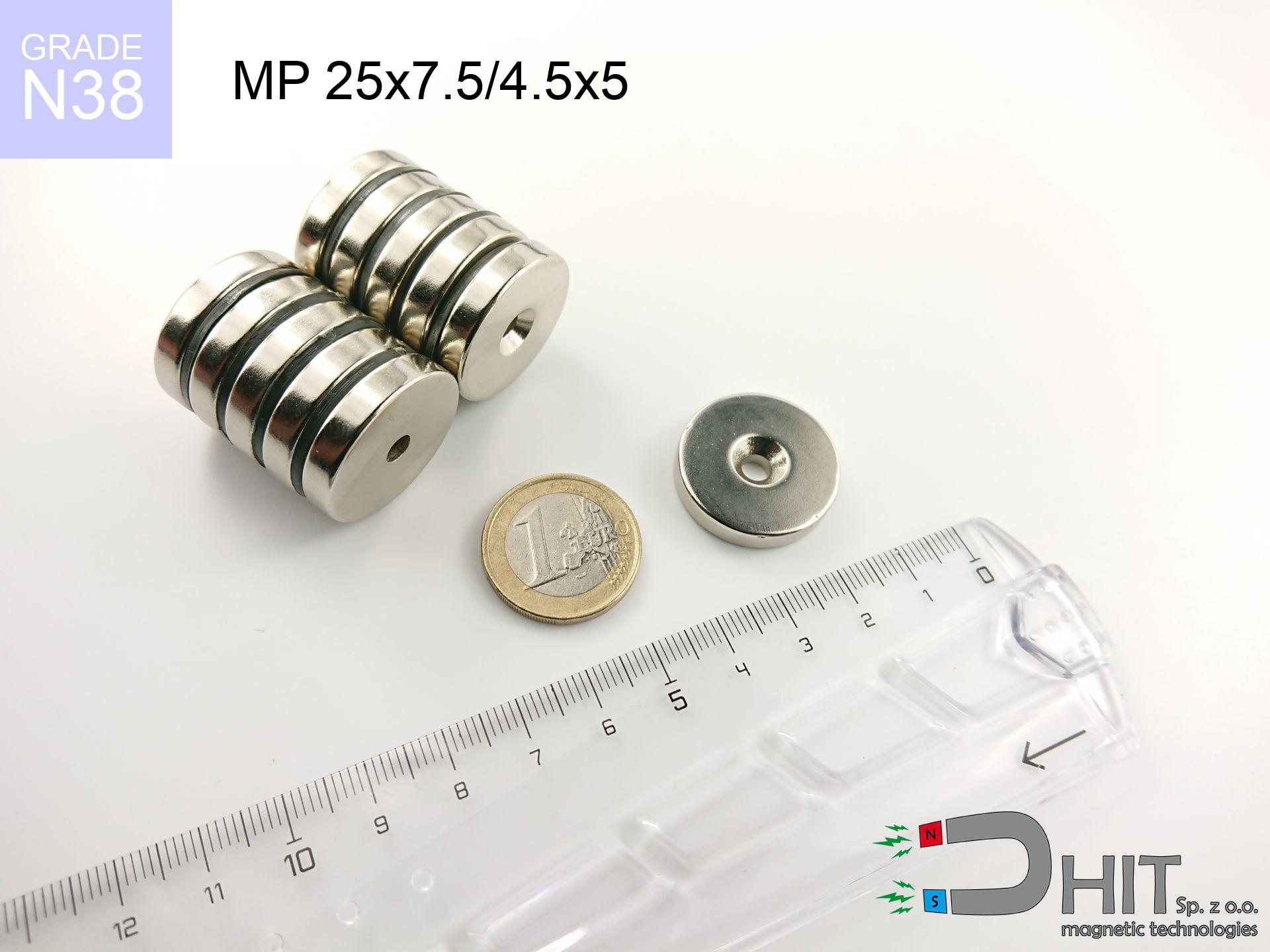
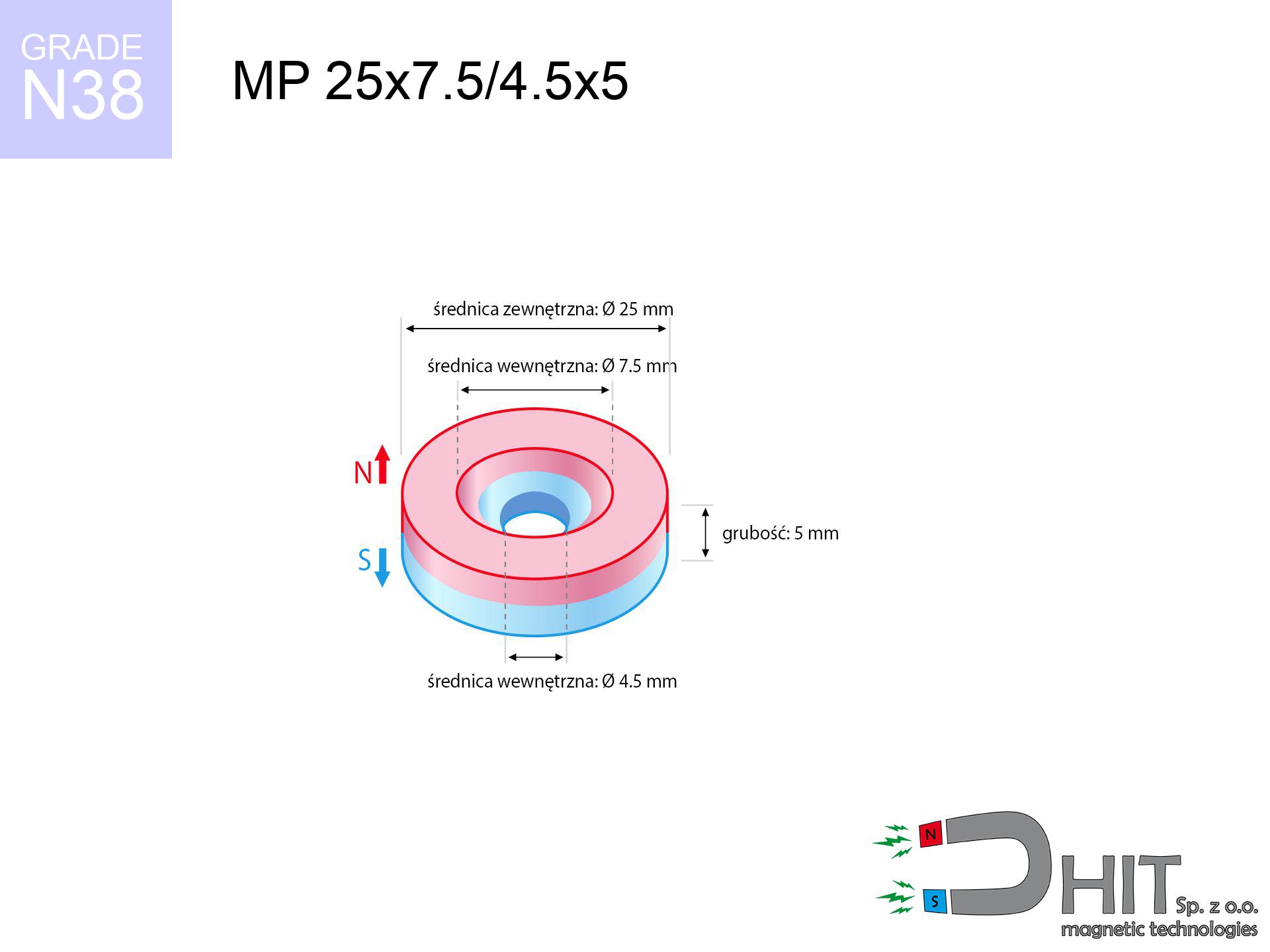
MP 25x7.5/4.5x5 / N38 - ring magnet
ring magnet
Catalog no 030194
GTIN/EAN: 5906301812111
- Diameter
- 25 mm [±0,1 mm]
- internal diameter Ø
- 7.5/4.5 mm [±0,1 mm]
- Height
- 5 mm [±0,1 mm]
- Weight
- 17.81 g
- Magnetization Direction
- ↑ axial
- Coating
- [NiCuNi] Nickel
How we measure these parameters — certificates and measurements
7.66 zł net / pcs
9.42 zł with VAT (23% VAT) / pcs
6.50 zł net was the lowest price in the last 30 days
bulk discounts:
Need more?Frequently asked questions
Where can I compare prices of ring magnets for mounting in Poland?
Are ring magnets resistant to damage?
Which ring magnet is suitable for an outdoor structure?
Where can I check the available sizes of neodymium ring magnets?
Engineering report for this magnet
Full PDF analysis: pull and shear force, effect of distance, temperature and plate thickness, safety distances and the demagnetization curve.
Call us now
+48 888 99 98 98
alternatively let us know using
contact form
the contact section.
Specifications and structure of a neodymium magnet can be estimated using our
power calculator.
Order by 14:00 and we’ll ship today!
Product card - MP 25x7.5/4.5x5 / N38 - ring magnet
Specification / characteristics - MP 25x7.5/4.5x5 / N38 - ring magnet
| properties | values |
|---|---|
| Cat. no. | 030194 |
| GTIN/EAN | 5906301812111 |
| Production/Distribution | Dhit sp. z o.o. |
| Country of origin | Poland / China / Germany |
| Customs code | 85059029 |
| Diameter | 25 mm [±0,1 mm] |
| internal diameter Ø | 7.5/4.5 mm [±0,1 mm] |
| Height | 5 mm [±0,1 mm] |
| Weight | 17.81 g |
| Magnetization Direction | ↑ axial |
| Load capacity ~ ? | 7.72 kg / 75.71 N |
| Magnetic Induction ~ ? | 230.20 mT / 2302 Gs |
| Coating | [NiCuNi] Nickel |
| Manufacturing Tolerance | ±0.1 mm |
Magnetic properties of material N38
| properties | values | units |
|---|---|---|
| Remanence Br ? | 12.2-12.6 | kGs |
| Remanence Br ? | 1220-1260 | mT |
| Coercivity bHc ? | 10.8-11.5 | kOe |
| Coercivity bHc ? | 860-915 | kA/m |
| Intrinsic coercivity iHc | ≥ 12 | kOe |
| Intrinsic coercivity iHc | ≥ 955 | kA/m |
| Energy product BHmax ? | 36-38 | BH max MGOe |
| Energy product BHmax ? | 287-303 | BH max KJ/m |
| Maximum working temperature ? | ≤ 80 | °C |
Physical properties of sintered neodymium magnets Nd2Fe14B at 20°C
| properties | values | units |
|---|---|---|
| Vickers hardness | ≥550 | Hv |
| Density | ≥7.4 | g/cm3 |
| Curie Temperature TC | 310 | °C |
| Curie Temperature TF | 590 | °F |
| Specific resistance | 150 | μΩ⋅cm |
| Bending strength | 250 | MPa |
| Compressive strength | 1000~1100 | MPa |
| Thermal expansion parallel (∥) to orientation (M) | (3-4) x 10-6 | °C-1 |
| Thermal expansion perpendicular (⊥) to orientation (M) | -(1-3) x 10-6 | °C-1 |
| Young's modulus | 1.7 x 10⁴ | kg/mm² |
Engineering analysis of the product - technical parameters
The following values are the direct effect of a mathematical simulation. Values were calculated on models for the material Nd2Fe14B. Operational performance may differ from theoretical values. Use these data as a preliminary roadmap when designing systems.
Table 1: Static force (pull vs distance) - characteristics
MP 25x7.5/4.5x5 / N38
| Distance (mm) | Induction (Gauss) / mT | Pull Force (kg/lbs/g/N) | Risk Status |
|---|---|---|---|
| 0 mm |
1995 Gs
199.5 mT
|
7.72 kg / 17.02 lbs
7720.0 g / 75.7 N
|
medium risk |
| 1 mm |
1906 Gs
190.6 mT
|
7.05 kg / 15.54 lbs
7049.4 g / 69.2 N
|
medium risk |
| 2 mm |
1793 Gs
179.3 mT
|
6.24 kg / 13.75 lbs
6236.8 g / 61.2 N
|
medium risk |
| 3 mm |
1664 Gs
166.4 mT
|
5.37 kg / 11.84 lbs
5368.9 g / 52.7 N
|
medium risk |
| 5 mm |
1385 Gs
138.5 mT
|
3.72 kg / 8.21 lbs
3722.8 g / 36.5 N
|
medium risk |
| 10 mm |
788 Gs
78.8 mT
|
1.20 kg / 2.65 lbs
1203.8 g / 11.8 N
|
low risk |
| 15 mm |
437 Gs
43.7 mT
|
0.37 kg / 0.82 lbs
370.3 g / 3.6 N
|
low risk |
| 20 mm |
253 Gs
25.3 mT
|
0.12 kg / 0.27 lbs
124.5 g / 1.2 N
|
low risk |
| 30 mm |
101 Gs
10.1 mT
|
0.02 kg / 0.04 lbs
19.8 g / 0.2 N
|
low risk |
| 50 mm |
27 Gs
2.7 mT
|
0.00 kg / 0.00 lbs
1.4 g / 0.0 N
|
low risk |
Table 2: Sliding force (wall)
MP 25x7.5/4.5x5 / N38
| Distance (mm) | Friction coefficient | Pull Force (kg/lbs/g/N) |
|---|---|---|
| 0 mm | Stal (~0.2) |
1.54 kg / 3.40 lbs
1544.0 g / 15.1 N
|
| 1 mm | Stal (~0.2) |
1.41 kg / 3.11 lbs
1410.0 g / 13.8 N
|
| 2 mm | Stal (~0.2) |
1.25 kg / 2.75 lbs
1248.0 g / 12.2 N
|
| 3 mm | Stal (~0.2) |
1.07 kg / 2.37 lbs
1074.0 g / 10.5 N
|
| 5 mm | Stal (~0.2) |
0.74 kg / 1.64 lbs
744.0 g / 7.3 N
|
| 10 mm | Stal (~0.2) |
0.24 kg / 0.53 lbs
240.0 g / 2.4 N
|
| 15 mm | Stal (~0.2) |
0.07 kg / 0.16 lbs
74.0 g / 0.7 N
|
| 20 mm | Stal (~0.2) |
0.02 kg / 0.05 lbs
24.0 g / 0.2 N
|
| 30 mm | Stal (~0.2) |
0.00 kg / 0.01 lbs
4.0 g / 0.0 N
|
| 50 mm | Stal (~0.2) |
0.00 kg / 0.00 lbs
0.0 g / 0.0 N
|
Table 3: Vertical assembly (shearing) - vertical pull
MP 25x7.5/4.5x5 / N38
| Surface type | Friction coefficient / % Mocy | Max load (kg/lbs/g/N) |
|---|---|---|
| Raw steel |
µ = 0.3
30% Nominalnej Siły
|
2.32 kg / 5.11 lbs
2316.0 g / 22.7 N
|
| Painted steel (standard) |
µ = 0.2
20% Nominalnej Siły
|
1.54 kg / 3.40 lbs
1544.0 g / 15.1 N
|
| Oily/slippery steel |
µ = 0.1
10% Nominalnej Siły
|
0.77 kg / 1.70 lbs
772.0 g / 7.6 N
|
| Magnet with anti-slip rubber |
µ = 0.5
50% Nominalnej Siły
|
3.86 kg / 8.51 lbs
3860.0 g / 37.9 N
|
Table 4: Steel thickness (substrate influence) - sheet metal selection
MP 25x7.5/4.5x5 / N38
| Steel thickness (mm) | % power | Real pull force (kg/lbs/g/N) |
|---|---|---|
| 0.5 mm |
|
0.77 kg / 1.70 lbs
772.0 g / 7.6 N
|
| 1 mm |
|
1.93 kg / 4.25 lbs
1930.0 g / 18.9 N
|
| 2 mm |
|
3.86 kg / 8.51 lbs
3860.0 g / 37.9 N
|
| 3 mm |
|
5.79 kg / 12.76 lbs
5790.0 g / 56.8 N
|
| 5 mm |
|
7.72 kg / 17.02 lbs
7720.0 g / 75.7 N
|
| 10 mm |
|
7.72 kg / 17.02 lbs
7720.0 g / 75.7 N
|
| 11 mm |
|
7.72 kg / 17.02 lbs
7720.0 g / 75.7 N
|
| 12 mm |
|
7.72 kg / 17.02 lbs
7720.0 g / 75.7 N
|
Table 5: Working in heat (material behavior) - thermal limit
MP 25x7.5/4.5x5 / N38
| Ambient temp. (°C) | Power loss | Remaining pull (kg/lbs/g/N) | Status |
|---|---|---|---|
| 20 °C | 0.0% |
7.72 kg / 17.02 lbs
7720.0 g / 75.7 N
|
OK |
| 40 °C | -2.2% |
7.55 kg / 16.65 lbs
7550.2 g / 74.1 N
|
OK |
| 60 °C | -4.4% |
7.38 kg / 16.27 lbs
7380.3 g / 72.4 N
|
|
| 80 °C | -6.6% |
7.21 kg / 15.90 lbs
7210.5 g / 70.7 N
|
|
| 100 °C | -28.8% |
5.50 kg / 12.12 lbs
5496.6 g / 53.9 N
|
Table 6: Two magnets (attraction) - field range
MP 25x7.5/4.5x5 / N38
| Gap (mm) | Attraction (kg/lbs) (N-S) | Shear Force (kg/lbs/g/N) | Repulsion (kg/lbs) (N-N) |
|---|---|---|---|
| 0 mm |
9.91 kg / 21.84 lbs
3 484 Gs
|
1.49 kg / 3.28 lbs
1486 g / 14.6 N
|
N/A |
| 1 mm |
9.51 kg / 20.96 lbs
3 909 Gs
|
1.43 kg / 3.14 lbs
1426 g / 14.0 N
|
8.56 kg / 18.87 lbs
~0 Gs
|
| 2 mm |
9.05 kg / 19.94 lbs
3 813 Gs
|
1.36 kg / 2.99 lbs
1357 g / 13.3 N
|
8.14 kg / 17.95 lbs
~0 Gs
|
| 3 mm |
8.54 kg / 18.83 lbs
3 705 Gs
|
1.28 kg / 2.82 lbs
1281 g / 12.6 N
|
7.69 kg / 16.94 lbs
~0 Gs
|
| 5 mm |
7.45 kg / 16.42 lbs
3 460 Gs
|
1.12 kg / 2.46 lbs
1117 g / 11.0 N
|
6.70 kg / 14.78 lbs
~0 Gs
|
| 10 mm |
4.78 kg / 10.53 lbs
2 771 Gs
|
0.72 kg / 1.58 lbs
717 g / 7.0 N
|
4.30 kg / 9.48 lbs
~0 Gs
|
| 20 mm |
1.54 kg / 3.41 lbs
1 576 Gs
|
0.23 kg / 0.51 lbs
232 g / 2.3 N
|
1.39 kg / 3.06 lbs
~0 Gs
|
| 50 mm |
0.06 kg / 0.13 lbs
312 Gs
|
0.01 kg / 0.02 lbs
9 g / 0.1 N
|
0.05 kg / 0.12 lbs
~0 Gs
|
| 60 mm |
0.03 kg / 0.06 lbs
202 Gs
|
0.00 kg / 0.01 lbs
4 g / 0.0 N
|
0.02 kg / 0.05 lbs
~0 Gs
|
| 70 mm |
0.01 kg / 0.03 lbs
138 Gs
|
0.00 kg / 0.00 lbs
2 g / 0.0 N
|
0.01 kg / 0.02 lbs
~0 Gs
|
| 80 mm |
0.01 kg / 0.01 lbs
97 Gs
|
0.00 kg / 0.00 lbs
1 g / 0.0 N
|
0.00 kg / 0.00 lbs
~0 Gs
|
| 90 mm |
0.00 kg / 0.01 lbs
71 Gs
|
0.00 kg / 0.00 lbs
0 g / 0.0 N
|
0.00 kg / 0.00 lbs
~0 Gs
|
| 100 mm |
0.00 kg / 0.00 lbs
54 Gs
|
0.00 kg / 0.00 lbs
0 g / 0.0 N
|
0.00 kg / 0.00 lbs
~0 Gs
|
Table 7: Protective zones (implants) - precautionary measures
MP 25x7.5/4.5x5 / N38
| Object / Device | Limit (Gauss) / mT | Safe distance |
|---|---|---|
| Pacemaker | 5 Gs (0.5 mT) | 9.5 cm |
| Hearing aid | 10 Gs (1.0 mT) | 7.5 cm |
| Timepiece | 20 Gs (2.0 mT) | 6.0 cm |
| Mobile device | 40 Gs (4.0 mT) | 4.5 cm |
| Remote | 50 Gs (5.0 mT) | 4.0 cm |
| Payment card | 400 Gs (40.0 mT) | 2.0 cm |
| HDD hard drive | 600 Gs (60.0 mT) | 1.5 cm |
Table 8: Impact energy (kinetic energy) - collision effects
MP 25x7.5/4.5x5 / N38
| Start from (mm) | Speed (km/h) | Energy (J) | Predicted outcome |
|---|---|---|---|
| 10 mm |
23.97 km/h
(6.66 m/s)
|
0.39 J | |
| 30 mm |
25.47 km/h
(7.07 m/s)
|
0.45 J | |
| 50 mm |
25.50 km/h
(7.08 m/s)
|
0.45 J | |
| 100 mm |
25.51 km/h
(7.09 m/s)
|
0.45 J |
Table 9: Surface protection spec
MP 25x7.5/4.5x5 / N38
| Technical parameter | Value / Description |
|---|---|
| Coating type | [NiCuNi] Nickel |
| Layer structure | Nickel - Copper - Nickel |
| Layer thickness | 10-20 µm |
| Salt spray test (SST) ? | 24 h |
| Recommended environment | Indoors only (dry) |
Table 10: Electrical data (Flux)
MP 25x7.5/4.5x5 / N38
| Parameter | Value | SI Unit / Description |
|---|---|---|
| Magnetic Flux | 9 759 Mx | 97.6 µWb |
| Pc Coefficient | 0.25 | Low (Flat) |
Table 11: Submerged application
MP 25x7.5/4.5x5 / N38
| Environment | Effective steel pull | Effect |
|---|---|---|
| Air (land) | 7.72 kg | Standard |
| Water (riverbed) |
8.84 kg
(+1.12 kg buoyancy gain)
|
+14.5% |
1. Sliding resistance
*Caution: On a vertical wall, the magnet retains only a fraction of its perpendicular strength.
2. Efficiency vs thickness
*Thin metal sheet (e.g. computer case) drastically reduces the holding force.
3. Temperature resistance
N38: the maximum material working temperature is 80°C. Permitted conditions also depend on the shape and magnetic circuit.
4. Demagnetization curve and operating point (B-H)
chart generated for the permeance coefficient Pc (Permeance Coefficient) = 0.25
This simulation demonstrates the magnetic stability of the selected magnet under specific geometric conditions. The solid red line represents the demagnetization curve (material potential), while the dashed blue line is the load line based on the magnet's geometry. The Pc (Permeance Coefficient), also known as the load line slope, is a dimensionless value that describes the relationship between the magnet's shape and its magnetic stability. The intersection of these two lines (the black dot) is the operating point — it determines the actual magnetic flux density generated by the magnet in this specific configuration. A higher Pc value means the magnet is more 'slender' (tall relative to its area), resulting in a higher operating point and better resistance to irreversible demagnetization caused by external fields or temperature. A value of 0.42 is relatively low (typical for flat magnets), meaning the operating point is closer to the 'knee' of the curve — caution is advised when operating at temperatures near the maximum limit to avoid strength loss.
Material specification
| iron (Fe) | 64% – 68% |
| neodymium (Nd) | 29% – 32% |
| boron (B) | 1.1% – 1.2% |
| dysprosium (Dy) | 0.5% – 2.0% |
| coating (Ni-Cu-Ni) | < 0.05% |
Sustainability
| recyclability (EoL) | 100% |
| recycled raw materials | ~10% (pre-cons) |
| carbon footprint | low / zredukowany |
| waste code (EWC) | 16 02 16 |
See also proposals


![UI 45x13x6 [C321] / N38 - badge holder](https://cdn3.dhit.pl/graphics/products/ui45x13x6-c321-jic.jpg "UI 45x13x6 [C321] / N38 - badge holder")
Advantages and disadvantages of Nd2Fe14B magnets.
Pros
- They do not lose power, even during around ten years – the decrease in strength is only ~1% (according to tests),
- They have excellent resistance to magnetic field loss when exposed to external fields,
- The use of an shiny layer of noble metals (nickel, gold, silver) causes the element to have aesthetics,
- The surface of neodymium magnets generates a intense magnetic field – this is one of their assets,
- Thanks to resistance to high temperature, they are able to function (depending on the form) even at temperatures up to 230°C and higher...
- Possibility of exact machining and modifying to specific applications,
- Universal use in innovative solutions – they serve a role in magnetic memories, brushless drives, medical equipment, and multitasking production systems.
- Compactness – despite small sizes they generate large force, making them ideal for precision applications
Disadvantages
- They are fragile upon heavy impacts. To avoid cracks, it is worth protecting magnets using a steel holder. Such protection not only protects the magnet but also increases its resistance to damage
- Do not exceed this material temperature limit: 80°C. Overheating may permanently weaken the magnet.
- Magnets exposed to a humid environment can corrode. Therefore during using outdoors, we advise using water-impermeable magnets made of rubber, plastic or other material resistant to moisture
- We recommend casing - magnetic mechanism, due to difficulties in producing nuts inside the magnet and complicated forms.
- Health risk resulting from small fragments of magnets are risky, if swallowed, which becomes key in the context of child health protection. Additionally, small components of these magnets can be problematic in diagnostics medical when they are in the body.
- With large orders the cost of neodymium magnets is economically unviable,
Pull force analysis
Maximum holding power of the magnet – what it depends on?
- on a block made of structural steel, perfectly concentrating the magnetic field
- whose transverse dimension is min. 10 mm
- with an ideally smooth touching surface
- under conditions of gap-free contact (surface-to-surface)
- for force acting at a right angle (in the magnet axis)
- at ambient temperature approx. 20 degrees Celsius
Determinants of practical lifting force of a magnet
- Space between magnet and steel – every millimeter of separation (caused e.g. by veneer or dirt) diminishes the magnet efficiency, often by half at just 0.5 mm.
- Force direction – note that the magnet holds strongest perpendicularly. Under shear forces, the holding force drops drastically, often to levels of 20-30% of the nominal value.
- Metal thickness – the thinner the sheet, the weaker the hold. Magnetic flux passes through the material instead of converting into lifting capacity.
- Steel grade – the best choice is high-permeability steel. Hardened steels may have worse magnetic properties.
- Surface condition – ground elements guarantee perfect abutment, which increases field saturation. Rough surfaces reduce efficiency.
- Operating temperature – neodymium magnets have a sensitivity to temperature. At higher temperatures they lose power, and in frost they can be stronger (up to a certain limit).
Lifting capacity testing was performed on plates with a smooth surface of suitable thickness, under perpendicular forces, in contrast under shearing force the load capacity is reduced by as much as 75%. In addition, even a slight gap between the magnet and the plate reduces the load capacity.
Safe handling of neodymium magnets
Do not underestimate power
Handle with care. Rare earth magnets attract from a long distance and connect with massive power, often faster than you can react.
GPS and phone interference
GPS units and mobile phones are extremely sensitive to magnetism. Close proximity with a powerful NdFeB magnet can decalibrate the internal compass in your phone.
Sensitization to coating
Medical facts indicate that nickel (the usual finish) is a common allergen. If your skin reacts to metals, avoid touching magnets with bare hands or opt for coated magnets.
Demagnetization risk
Do not overheat. NdFeB magnets are sensitive to heat. If you require operation above 80°C, look for special high-temperature series (H, SH, UH).
Medical implants
Health Alert: Neodymium magnets can deactivate pacemakers and defibrillators. Stay away if you have electronic implants.
This is not a toy
Product intended for adults. Tiny parts can be swallowed, causing serious injuries. Store away from children and animals.
Safe distance
Very strong magnetic fields can destroy records on credit cards, hard drives, and other magnetic media. Keep a distance of at least 10 cm.
Magnet fragility
NdFeB magnets are sintered ceramics, meaning they are very brittle. Impact of two magnets leads to them cracking into small pieces.
Finger safety
Risk of injury: The pulling power is so great that it can cause hematomas, crushing, and broken bones. Protective gloves are recommended.
Dust explosion hazard
Fire hazard: Neodymium dust is explosive. Avoid machining magnets without safety gear as this may cause fire.
Tabela kosztu i czasu dostawy
Płatność przed wysyłką:

GLS kurier
Przesyłka będzie u Ciebie za 2-3 dni
14.99 ZŁ

InPost Paczkomaty 24/7
Przesyłka będzie u Ciebie za 1-2 dni
12.30 ZŁ
Płatność przy odbiorze (pobranie):
GLS kurier
Przesyłka będzie u Ciebie za 1-2 dni
23.00 ZŁ