

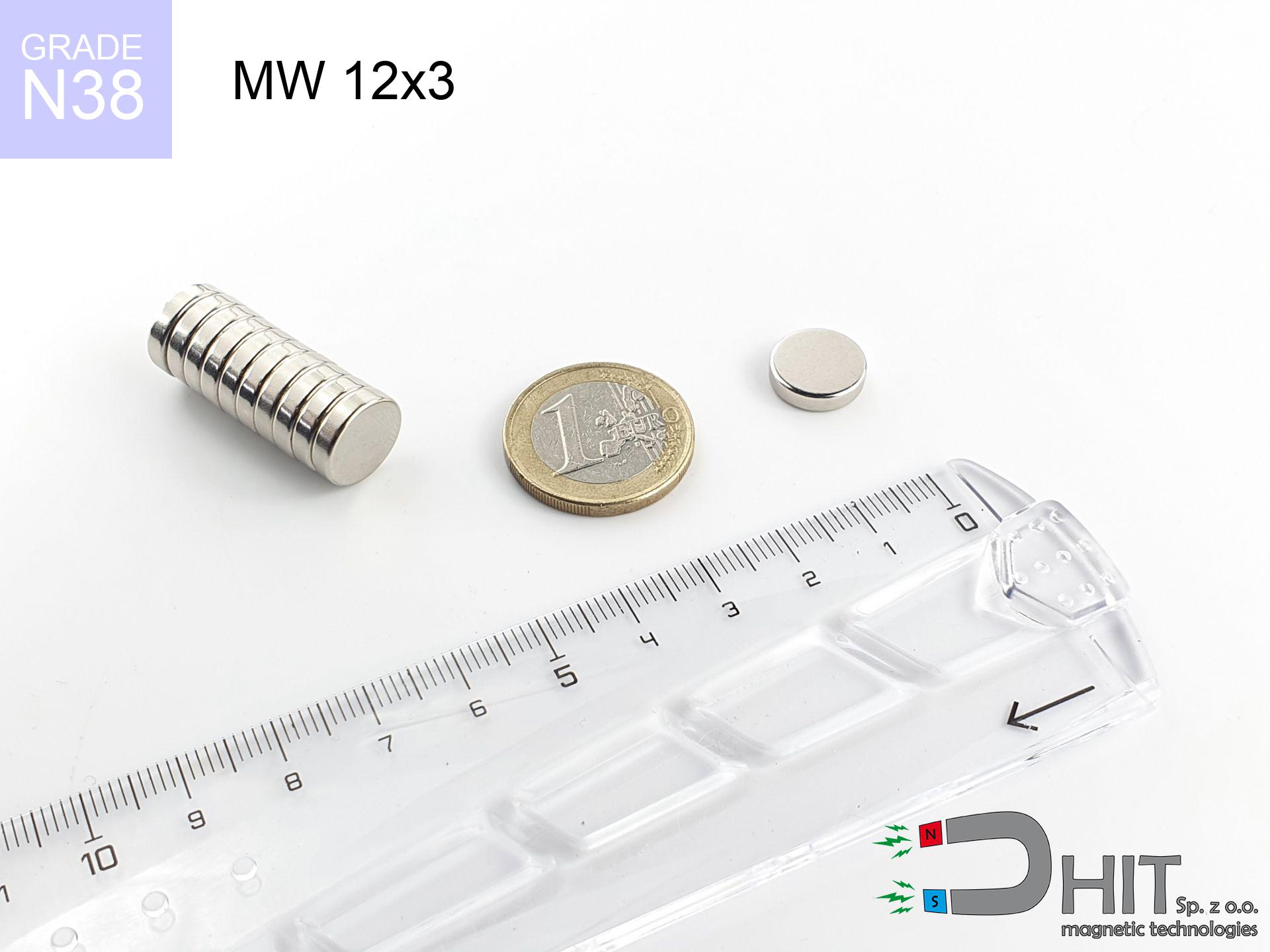
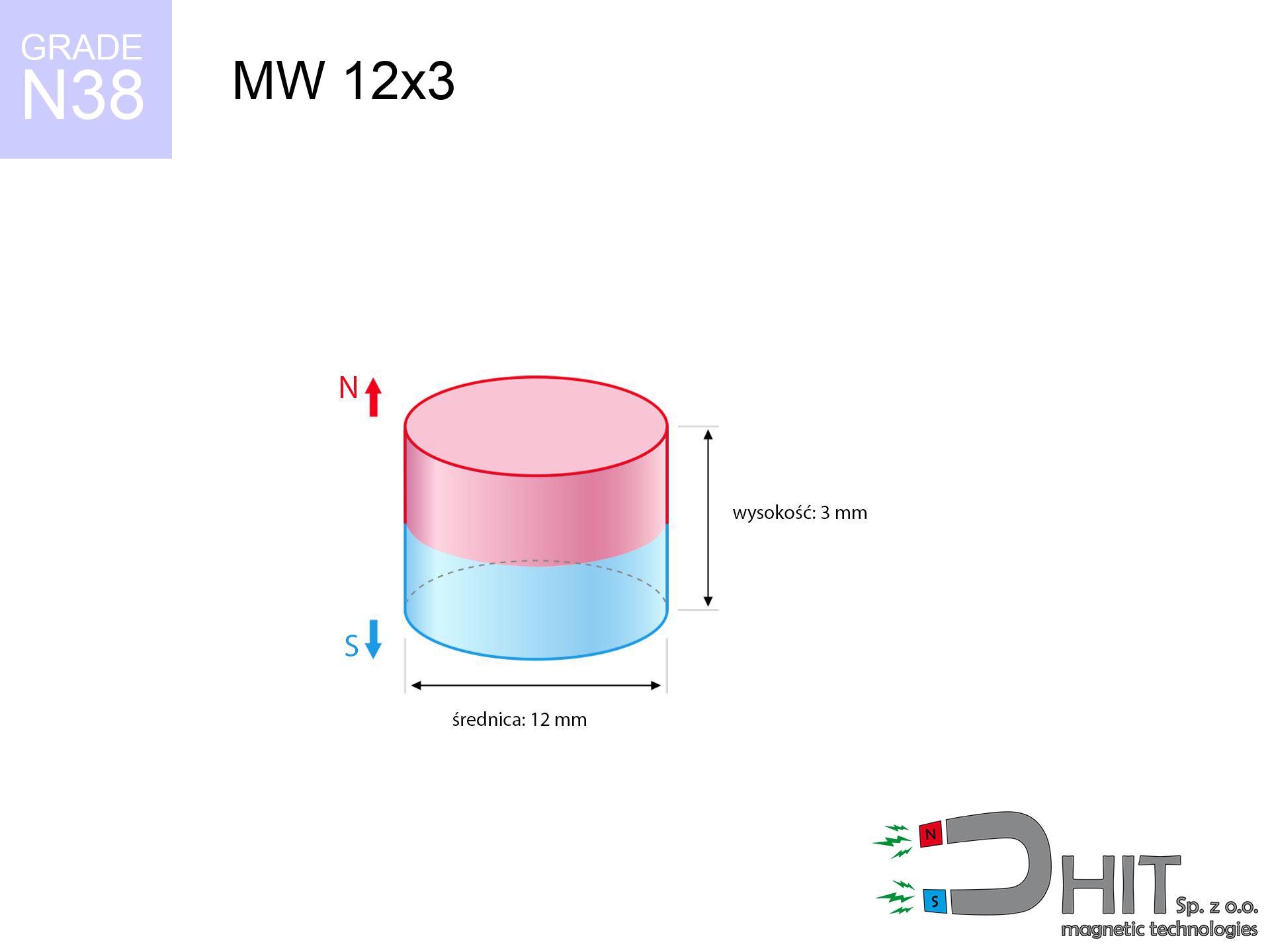
MW 12x3 / N38 - cylindrical magnet
cylindrical magnet
Catalog no 010018
GTIN/EAN: 5906301810179
- Diameter Ø
- 12 mm [±0,1 mm]
- Height
- 3 mm [±0,1 mm]
- Weight
- 2.54 g
- Magnetization Direction
- ↑ axial
- Coating
- [NiCuNi] Nickel
How we measure these parameters — certificates and measurements
1.340 zł net / pcs
1.648 zł with VAT (23% VAT) / pcs
bulk discounts:
Need more?Frequently asked questions
Where can I buy strong cylindrical neodymium magnets?
Can a small cylindrical magnet provide a strong grip for precise workshop work?
Which cylindrical magnet can work at a higher temperature?
Engineering report for this magnet
Full PDF analysis: pull and shear force, effect of distance, temperature and plate thickness, safety distances and the demagnetization curve.
Call us now
+48 888 99 98 98
alternatively let us know using
contact form
the contact section.
Specifications and structure of a neodymium magnet can be estimated using our
power calculator.
Order by 14:00 and we’ll ship today!
Technical data of the product - MW 12x3 / N38 - cylindrical magnet
Specification / characteristics - MW 12x3 / N38 - cylindrical magnet
| properties | values |
|---|---|
| Cat. no. | 010018 |
| GTIN/EAN | 5906301810179 |
| Production/Distribution | Dhit sp. z o.o. |
| Country of origin | Poland / China / Germany |
| Customs code | 85059029 |
| Diameter Ø | 12 mm [±0,1 mm] |
| Height | 3 mm [±0,1 mm] |
| Weight | 2.54 g |
| Magnetization Direction | ↑ axial |
| Load capacity ~ ? | 2.49 kg / 24.43 N |
| Magnetic Induction ~ ? | 277.09 mT / 2771 Gs |
| Coating | [NiCuNi] Nickel |
| Manufacturing Tolerance | ±0.1 mm |
Magnetic properties of material N38
| properties | values | units |
|---|---|---|
| Remanence Br ? | 12.2-12.6 | kGs |
| Remanence Br ? | 1220-1260 | mT |
| Coercivity bHc ? | 10.8-11.5 | kOe |
| Coercivity bHc ? | 860-915 | kA/m |
| Intrinsic coercivity iHc | ≥ 12 | kOe |
| Intrinsic coercivity iHc | ≥ 955 | kA/m |
| Energy product BHmax ? | 36-38 | BH max MGOe |
| Energy product BHmax ? | 287-303 | BH max KJ/m |
| Maximum working temperature ? | ≤ 80 | °C |
Physical properties of sintered neodymium magnets Nd2Fe14B at 20°C
| properties | values | units |
|---|---|---|
| Vickers hardness | ≥550 | Hv |
| Density | ≥7.4 | g/cm3 |
| Curie Temperature TC | 310 | °C |
| Curie Temperature TF | 590 | °F |
| Specific resistance | 150 | μΩ⋅cm |
| Bending strength | 250 | MPa |
| Compressive strength | 1000~1100 | MPa |
| Thermal expansion parallel (∥) to orientation (M) | (3-4) x 10-6 | °C-1 |
| Thermal expansion perpendicular (⊥) to orientation (M) | -(1-3) x 10-6 | °C-1 |
| Young's modulus | 1.7 x 10⁴ | kg/mm² |
Technical modeling of the assembly - report
The following values constitute the outcome of a physical simulation. Results were calculated on algorithms for the class Nd2Fe14B. Actual performance might slightly deviate from the simulation results. Treat these calculations as a preliminary roadmap for designers.
Table 1: Static force (pull vs distance) - characteristics
MW 12x3 / N38
| Distance (mm) | Induction (Gauss) / mT | Pull Force (kg/lbs/g/N) | Risk Status |
|---|---|---|---|
| 0 mm |
2770 Gs
277.0 mT
|
2.49 kg / 5.49 pounds
2490.0 g / 24.4 N
|
warning |
| 1 mm |
2420 Gs
242.0 mT
|
1.90 kg / 4.19 pounds
1900.6 g / 18.6 N
|
safe |
| 2 mm |
2009 Gs
200.9 mT
|
1.31 kg / 2.89 pounds
1309.4 g / 12.8 N
|
safe |
| 3 mm |
1611 Gs
161.1 mT
|
0.84 kg / 1.86 pounds
842.7 g / 8.3 N
|
safe |
| 5 mm |
991 Gs
99.1 mT
|
0.32 kg / 0.70 pounds
318.7 g / 3.1 N
|
safe |
| 10 mm |
313 Gs
31.3 mT
|
0.03 kg / 0.07 pounds
31.8 g / 0.3 N
|
safe |
| 15 mm |
125 Gs
12.5 mT
|
0.01 kg / 0.01 pounds
5.1 g / 0.0 N
|
safe |
| 20 mm |
61 Gs
6.1 mT
|
0.00 kg / 0.00 pounds
1.2 g / 0.0 N
|
safe |
| 30 mm |
20 Gs
2.0 mT
|
0.00 kg / 0.00 pounds
0.1 g / 0.0 N
|
safe |
| 50 mm |
5 Gs
0.5 mT
|
0.00 kg / 0.00 pounds
0.0 g / 0.0 N
|
safe |
Table 2: Vertical force (wall)
MW 12x3 / N38
| Distance (mm) | Friction coefficient | Pull Force (kg/lbs/g/N) |
|---|---|---|
| 0 mm | Stal (~0.2) |
0.50 kg / 1.10 pounds
498.0 g / 4.9 N
|
| 1 mm | Stal (~0.2) |
0.38 kg / 0.84 pounds
380.0 g / 3.7 N
|
| 2 mm | Stal (~0.2) |
0.26 kg / 0.58 pounds
262.0 g / 2.6 N
|
| 3 mm | Stal (~0.2) |
0.17 kg / 0.37 pounds
168.0 g / 1.6 N
|
| 5 mm | Stal (~0.2) |
0.06 kg / 0.14 pounds
64.0 g / 0.6 N
|
| 10 mm | Stal (~0.2) |
0.01 kg / 0.01 pounds
6.0 g / 0.1 N
|
| 15 mm | Stal (~0.2) |
0.00 kg / 0.00 pounds
2.0 g / 0.0 N
|
| 20 mm | Stal (~0.2) |
0.00 kg / 0.00 pounds
0.0 g / 0.0 N
|
| 30 mm | Stal (~0.2) |
0.00 kg / 0.00 pounds
0.0 g / 0.0 N
|
| 50 mm | Stal (~0.2) |
0.00 kg / 0.00 pounds
0.0 g / 0.0 N
|
Table 3: Vertical assembly (sliding) - behavior on slippery surfaces
MW 12x3 / N38
| Surface type | Friction coefficient / % Mocy | Max load (kg/lbs/g/N) |
|---|---|---|
| Raw steel |
µ = 0.3
30% Nominalnej Siły
|
0.75 kg / 1.65 pounds
747.0 g / 7.3 N
|
| Painted steel (standard) |
µ = 0.2
20% Nominalnej Siły
|
0.50 kg / 1.10 pounds
498.0 g / 4.9 N
|
| Oily/slippery steel |
µ = 0.1
10% Nominalnej Siły
|
0.25 kg / 0.55 pounds
249.0 g / 2.4 N
|
| Magnet with anti-slip rubber |
µ = 0.5
50% Nominalnej Siły
|
1.25 kg / 2.74 pounds
1245.0 g / 12.2 N
|
Table 4: Steel thickness (saturation) - power losses
MW 12x3 / N38
| Steel thickness (mm) | % power | Real pull force (kg/lbs/g/N) |
|---|---|---|
| 0.5 mm |
|
0.25 kg / 0.55 pounds
249.0 g / 2.4 N
|
| 1 mm |
|
0.62 kg / 1.37 pounds
622.5 g / 6.1 N
|
| 2 mm |
|
1.25 kg / 2.74 pounds
1245.0 g / 12.2 N
|
| 3 mm |
|
1.87 kg / 4.12 pounds
1867.5 g / 18.3 N
|
| 5 mm |
|
2.49 kg / 5.49 pounds
2490.0 g / 24.4 N
|
| 10 mm |
|
2.49 kg / 5.49 pounds
2490.0 g / 24.4 N
|
| 11 mm |
|
2.49 kg / 5.49 pounds
2490.0 g / 24.4 N
|
| 12 mm |
|
2.49 kg / 5.49 pounds
2490.0 g / 24.4 N
|
Table 5: Thermal stability (stability) - resistance threshold
MW 12x3 / N38
| Ambient temp. (°C) | Power loss | Remaining pull (kg/lbs/g/N) | Status |
|---|---|---|---|
| 20 °C | 0.0% |
2.49 kg / 5.49 pounds
2490.0 g / 24.4 N
|
OK |
| 40 °C | -2.2% |
2.44 kg / 5.37 pounds
2435.2 g / 23.9 N
|
OK |
| 60 °C | -4.4% |
2.38 kg / 5.25 pounds
2380.4 g / 23.4 N
|
|
| 80 °C | -6.6% |
2.33 kg / 5.13 pounds
2325.7 g / 22.8 N
|
|
| 100 °C | -28.8% |
1.77 kg / 3.91 pounds
1772.9 g / 17.4 N
|
Table 6: Magnet-Magnet interaction (attraction) - field collision
MW 12x3 / N38
| Gap (mm) | Attraction (kg/lbs) (N-S) | Shear Strength (kg/lbs/g/N) | Repulsion (kg/lbs) (N-N) |
|---|---|---|---|
| 0 mm |
5.35 kg / 11.79 pounds
4 377 Gs
|
0.80 kg / 1.77 pounds
802 g / 7.9 N
|
N/A |
| 1 mm |
4.75 kg / 10.46 pounds
5 218 Gs
|
0.71 kg / 1.57 pounds
712 g / 7.0 N
|
4.27 kg / 9.42 pounds
~0 Gs
|
| 2 mm |
4.08 kg / 9.00 pounds
4 840 Gs
|
0.61 kg / 1.35 pounds
612 g / 6.0 N
|
3.67 kg / 8.10 pounds
~0 Gs
|
| 3 mm |
3.42 kg / 7.55 pounds
4 433 Gs
|
0.51 kg / 1.13 pounds
514 g / 5.0 N
|
3.08 kg / 6.80 pounds
~0 Gs
|
| 5 mm |
2.27 kg / 5.01 pounds
3 610 Gs
|
0.34 kg / 0.75 pounds
341 g / 3.3 N
|
2.04 kg / 4.51 pounds
~0 Gs
|
| 10 mm |
0.68 kg / 1.51 pounds
1 982 Gs
|
0.10 kg / 0.23 pounds
103 g / 1.0 N
|
0.62 kg / 1.36 pounds
~0 Gs
|
| 20 mm |
0.07 kg / 0.15 pounds
626 Gs
|
0.01 kg / 0.02 pounds
10 g / 0.1 N
|
0.06 kg / 0.14 pounds
~0 Gs
|
| 50 mm |
0.00 kg / 0.00 pounds
67 Gs
|
0.00 kg / 0.00 pounds
0 g / 0.0 N
|
0.00 kg / 0.00 pounds
~0 Gs
|
| 60 mm |
0.00 kg / 0.00 pounds
41 Gs
|
0.00 kg / 0.00 pounds
0 g / 0.0 N
|
0.00 kg / 0.00 pounds
~0 Gs
|
| 70 mm |
0.00 kg / 0.00 pounds
27 Gs
|
0.00 kg / 0.00 pounds
0 g / 0.0 N
|
0.00 kg / 0.00 pounds
~0 Gs
|
| 80 mm |
0.00 kg / 0.00 pounds
18 Gs
|
0.00 kg / 0.00 pounds
0 g / 0.0 N
|
0.00 kg / 0.00 pounds
~0 Gs
|
| 90 mm |
0.00 kg / 0.00 pounds
13 Gs
|
0.00 kg / 0.00 pounds
0 g / 0.0 N
|
0.00 kg / 0.00 pounds
~0 Gs
|
| 100 mm |
0.00 kg / 0.00 pounds
10 Gs
|
0.00 kg / 0.00 pounds
0 g / 0.0 N
|
0.00 kg / 0.00 pounds
~0 Gs
|
Table 7: Protective zones (electronics) - precautionary measures
MW 12x3 / N38
| Object / Device | Limit (Gauss) / mT | Safe distance |
|---|---|---|
| Pacemaker | 5 Gs (0.5 mT) | 5.0 cm |
| Hearing aid | 10 Gs (1.0 mT) | 4.0 cm |
| Timepiece | 20 Gs (2.0 mT) | 3.5 cm |
| Mobile device | 40 Gs (4.0 mT) | 2.5 cm |
| Car key | 50 Gs (5.0 mT) | 2.5 cm |
| Payment card | 400 Gs (40.0 mT) | 1.0 cm |
| HDD hard drive | 600 Gs (60.0 mT) | 1.0 cm |
Table 8: Collisions (cracking risk) - warning
MW 12x3 / N38
| Start from (mm) | Speed (km/h) | Energy (J) | Predicted outcome |
|---|---|---|---|
| 10 mm |
25.61 km/h
(7.11 m/s)
|
0.06 J | |
| 30 mm |
25.78 km/h
(7.16 m/s)
|
0.07 J | |
| 50 mm |
25.79 km/h
(7.16 m/s)
|
0.07 J | |
| 100 mm |
25.79 km/h
(7.16 m/s)
|
0.07 J |
Table 9: Corrosion resistance
MW 12x3 / N38
| Technical parameter | Value / Description |
|---|---|
| Coating type | [NiCuNi] Nickel |
| Layer structure | Nickel - Copper - Nickel |
| Layer thickness | 10-20 µm |
| Salt spray test (SST) ? | 24 h |
| Recommended environment | Indoors only (dry) |
Table 10: Electrical data (Pc)
MW 12x3 / N38
| Parameter | Value | SI Unit / Description |
|---|---|---|
| Magnetic Flux | 3 483 Mx | 34.8 µWb |
| Pc Coefficient | 0.35 | Low (Flat) |
Table 11: Hydrostatics and buoyancy
MW 12x3 / N38
| Environment | Effective steel pull | Effect |
|---|---|---|
| Air (land) | 2.49 kg | Standard |
| Water (riverbed) |
2.85 kg
(+0.36 kg buoyancy gain)
|
+14.5% |
1. Vertical hold
*Caution: On a vertical surface, the magnet holds only a fraction of its max power.
2. Steel thickness impact
*Thin steel (e.g. 0.5mm PC case) severely reduces the holding force.
3. Temperature resistance
N38: the maximum material working temperature is 80°C. Permitted conditions also depend on the shape and magnetic circuit.
4. Demagnetization curve and operating point (B-H)
chart generated for the permeance coefficient Pc (Permeance Coefficient) = 0.35
This simulation demonstrates the magnetic stability of the selected magnet under specific geometric conditions. The solid red line represents the demagnetization curve (material potential), while the dashed blue line is the load line based on the magnet's geometry. The Pc (Permeance Coefficient), also known as the load line slope, is a dimensionless value that describes the relationship between the magnet's shape and its magnetic stability. The intersection of these two lines (the black dot) is the operating point — it determines the actual magnetic flux density generated by the magnet in this specific configuration. A higher Pc value means the magnet is more 'slender' (tall relative to its area), resulting in a higher operating point and better resistance to irreversible demagnetization caused by external fields or temperature. A value of 0.42 is relatively low (typical for flat magnets), meaning the operating point is closer to the 'knee' of the curve — caution is advised when operating at temperatures near the maximum limit to avoid strength loss.
Chemical composition
| iron (Fe) | 64% – 68% |
| neodymium (Nd) | 29% – 32% |
| boron (B) | 1.1% – 1.2% |
| dysprosium (Dy) | 0.5% – 2.0% |
| coating (Ni-Cu-Ni) | < 0.05% |
Ecology and recycling (GPSR)
| recyclability (EoL) | 100% |
| recycled raw materials | ~10% (pre-cons) |
| carbon footprint | low / zredukowany |
| waste code (EWC) | 16 02 16 |
See also deals
![SM 32x500 [2xM8] / N52 - magnetic separator](https://cdn3.dhit.pl/graphics/products/sm-32x500-2xm8-rub.jpg "SM 32x500 [2xM8] / N52 - magnetic separator")
![UMP 94x28 [3xM10] GW F300 GOLD Lina / N38 - search holder](https://cdn3.dhit.pl/graphics/products/ump-94x28-m10-gw-f300-+lina-kac.jpg "UMP 94x28 [3xM10] GW F300 GOLD Lina / N38 - search holder")
Pros and cons of rare earth magnets.
Benefits
- Their magnetic field is durable, and after approximately ten years it decreases only by ~1% (according to research),
- Magnets perfectly protect themselves against loss of magnetization caused by external fields,
- The use of an refined coating of noble metals (nickel, gold, silver) causes the element to look better,
- Neodymium magnets achieve maximum magnetic induction on a their surface, which increases force concentration,
- Made from properly selected components, these magnets show impressive resistance to high heat, enabling them to function (depending on their shape) at temperatures up to 230°C and above...
- Thanks to versatility in designing and the ability to modify to complex applications,
- Significant place in modern industrial fields – they find application in mass storage devices, motor assemblies, diagnostic systems, and modern systems.
- Relatively small size with high pulling force – neodymium magnets offer high power in tiny dimensions, which allows their use in compact constructions
Disadvantages
- Susceptibility to cracking is one of their disadvantages. Upon strong impact they can fracture. We advise keeping them in a strong case, which not only protects them against impacts but also increases their durability
- Do not exceed this material temperature limit: 80°C. Overheating may permanently weaken the magnet.
- Due to the susceptibility of magnets to corrosion in a humid environment, we suggest using waterproof magnets made of rubber, plastic or other material resistant to moisture, when using outdoors
- Due to limitations in producing threads and complex shapes in magnets, we propose using cover - magnetic mechanism.
- Potential hazard resulting from small fragments of magnets can be dangerous, when accidentally swallowed, which is particularly important in the context of child safety. It is also worth noting that tiny parts of these magnets can complicate diagnosis medical when they are in the body.
- With large orders the cost of neodymium magnets is economically unviable,
Lifting parameters
Breakaway strength of the magnet in ideal conditions – what affects it?
- on a plate made of mild steel, effectively closing the magnetic field
- possessing a thickness of at least 10 mm to avoid saturation
- with a surface cleaned and smooth
- with zero gap (no coatings)
- for force applied at a right angle (pull-off, not shear)
- at conditions approx. 20°C
Magnet lifting force in use – key factors
- Air gap (betwixt the magnet and the plate), because even a tiny distance (e.g. 0.5 mm) leads to a drastic drop in lifting capacity by up to 50% (this also applies to varnish, corrosion or dirt).
- Direction of force – highest force is obtained only during perpendicular pulling. The shear force of the magnet along the surface is standardly many times lower (approx. 1/5 of the lifting capacity).
- Plate thickness – too thin sheet causes magnetic saturation, causing part of the power to be wasted to the other side.
- Chemical composition of the base – mild steel attracts best. Alloy admixtures lower magnetic properties and holding force.
- Surface finish – full contact is obtained only on smooth steel. Any scratches and bumps create air cushions, weakening the magnet.
- Thermal factor – high temperature reduces pulling force. Exceeding the limit temperature can permanently demagnetize the magnet.
Lifting capacity was measured using a steel plate with a smooth surface of optimal thickness (min. 20 mm), under perpendicular pulling force, however under parallel forces the load capacity is reduced by as much as 75%. Additionally, even a slight gap between the magnet’s surface and the plate decreases the holding force.
H&S for magnets
Dust is flammable
Fire warning: Rare earth powder is explosive. Avoid machining magnets without safety gear as this may cause fire.
Fragile material
NdFeB magnets are ceramic materials, which means they are very brittle. Collision of two magnets will cause them cracking into shards.
Compass and GPS
Navigation devices and smartphones are highly susceptible to magnetic fields. Close proximity with a strong magnet can decalibrate the internal compass in your phone.
Respect the power
Handle magnets with awareness. Their immense force can surprise even experienced users. Be vigilant and respect their force.
ICD Warning
Individuals with a pacemaker have to maintain an safe separation from magnets. The magnetic field can stop the operation of the implant.
Power loss in heat
Watch the temperature. Exposing the magnet above 80 degrees Celsius will destroy its magnetic structure and strength.
Keep away from children
These products are not toys. Eating multiple magnets may result in them connecting inside the digestive tract, which poses a severe health hazard and necessitates urgent medical intervention.
Serious injuries
Mind your fingers. Two powerful magnets will join immediately with a force of massive weight, destroying everything in their path. Be careful!
Cards and drives
Avoid bringing magnets near a wallet, laptop, or screen. The magnetic field can permanently damage these devices and erase data from cards.
Nickel coating and allergies
Studies show that the nickel plating (the usual finish) is a potent allergen. If you have an allergy, refrain from touching magnets with bare hands or opt for versions in plastic housing.
Tabela kosztu i czasu dostawy
Płatność przed wysyłką:

GLS kurier
Przesyłka będzie u Ciebie za 2-3 dni
14.99 ZŁ

InPost Paczkomaty 24/7
Przesyłka będzie u Ciebie za 1-2 dni
12.30 ZŁ
Płatność przy odbiorze (pobranie):
GLS kurier
Przesyłka będzie u Ciebie za 1-2 dni
23.00 ZŁ