

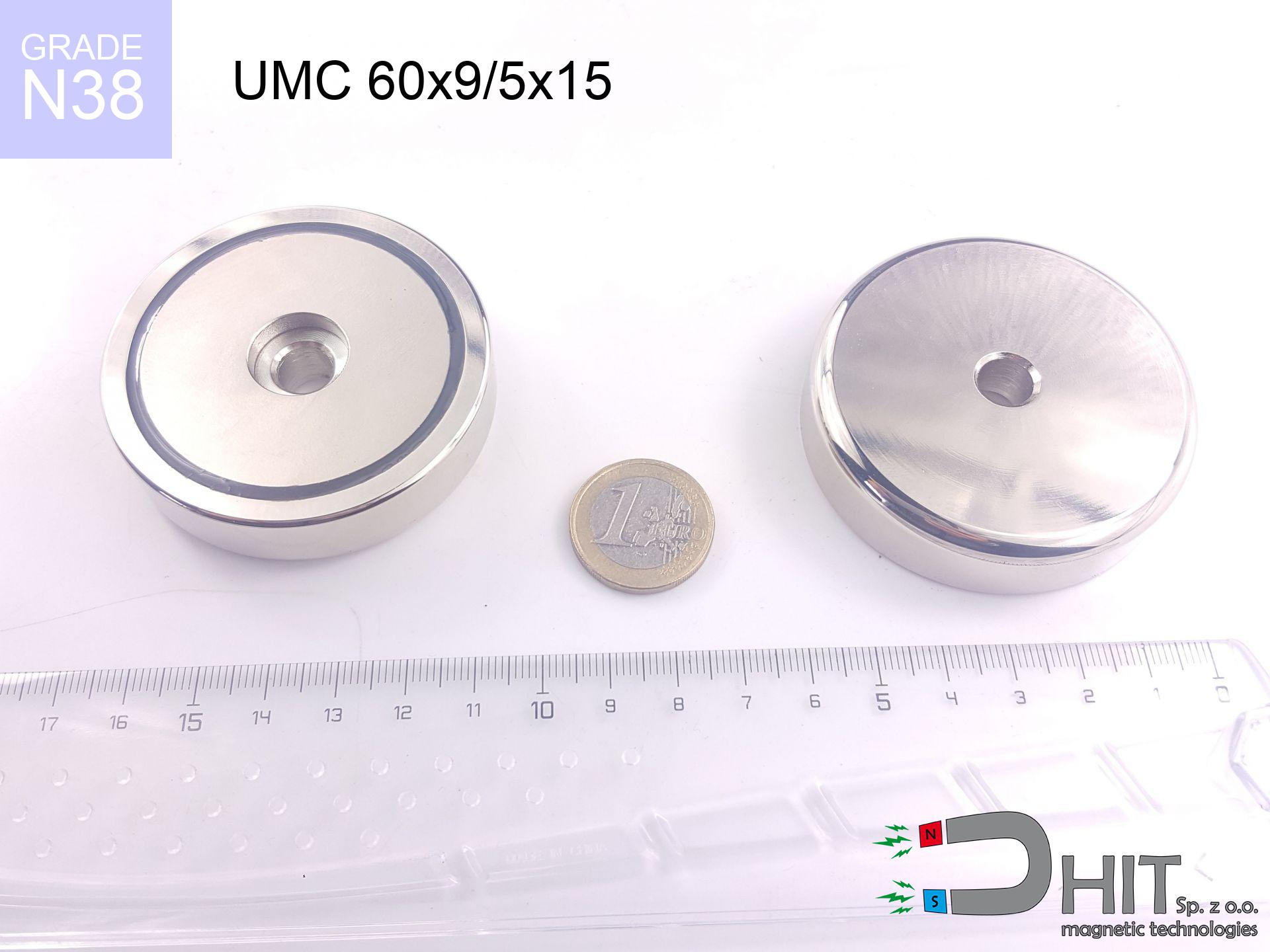
UMC 60x9/5x15 / N38 - cylindrical magnetic holder
cylindrical magnetic holder
Catalog no 320413
GTIN/EAN: 5906301814696
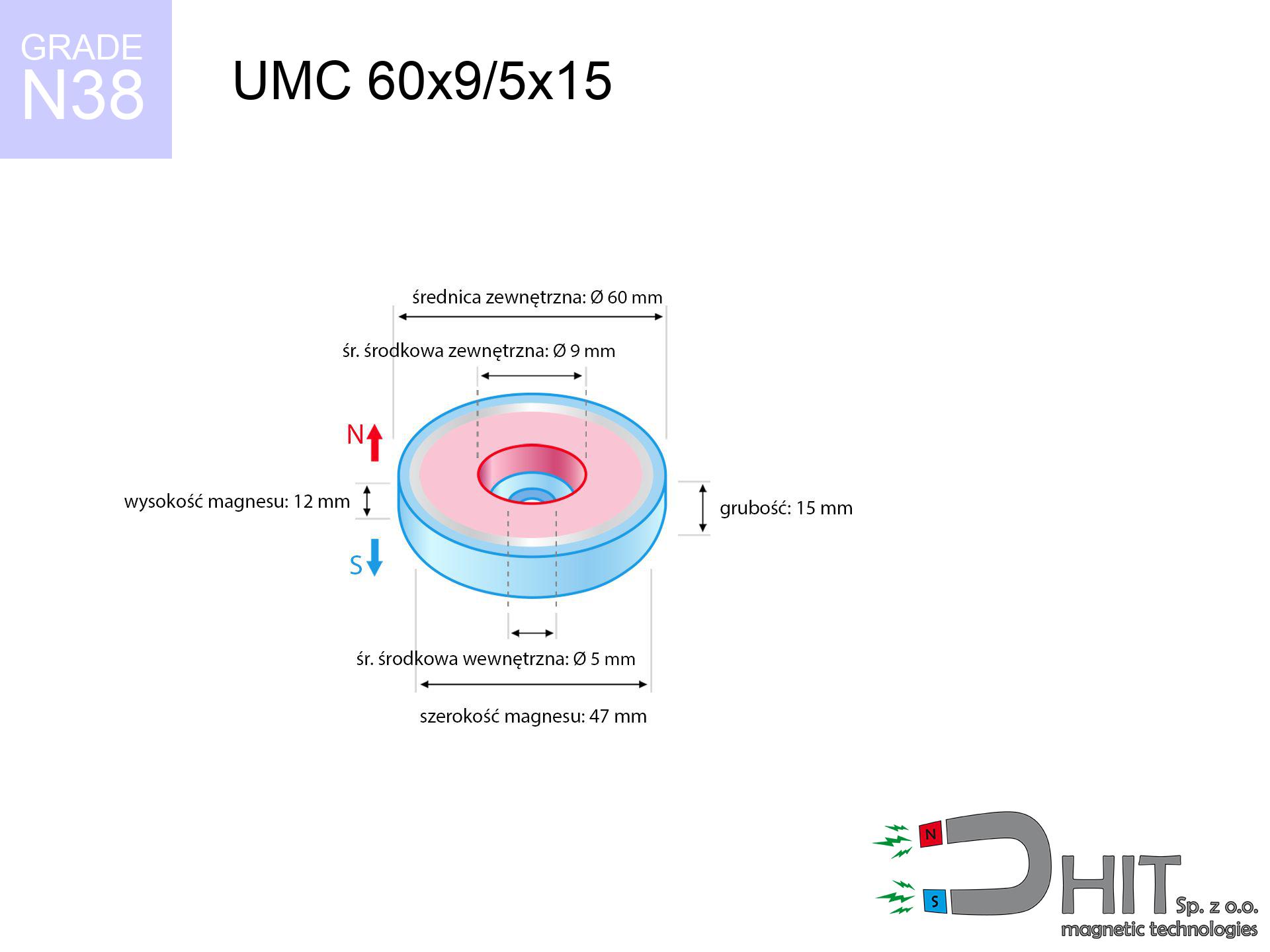
- Diameter
- 60 mm [±1 mm]
- internal diameter Ø
- 9/5 mm [±1 mm]
- Height
- 15 mm [±1 mm]
- Weight
- 240 g
- Magnetization Direction
- ↑ axial
- Coating
- [NiCuNi] Nickel
How we measure these parameters — certificates and measurements
52.80 zł net / pcs
64.94 zł with VAT (23% VAT) / pcs
bulk discounts:
Need more?Frequently asked questions
Which magnetic holder is suitable for moving metal parts in a workshop?
How do I choose a holder for hanging a heavy item and check its real grip?
Which magnetic holders can be used outdoors?
How should I choose a strong threaded holder for field work?
Call us now
+48 888 99 98 98
alternatively let us know using
contact form
the contact section.
Specifications and structure of a neodymium magnet can be estimated using our
power calculator.
Order by 14:00 and we’ll ship today!
Technical details - UMC 60x9/5x15 / N38 - cylindrical magnetic holder
Specification / characteristics - UMC 60x9/5x15 / N38 - cylindrical magnetic holder
| properties | values |
|---|---|
| Cat. no. | 320413 |
| GTIN/EAN | 5906301814696 |
| Production/Distribution | Dhit sp. z o.o. |
| Country of origin | Poland / China / Germany |
| Customs code | 85059029 |
| Diameter | 60 mm [±1 mm] |
| internal diameter Ø | 9/5 mm [±1 mm] |
| Height | 15 mm [±1 mm] |
| Weight | 240 g |
| Magnetization Direction | ↑ axial |
| Load capacity ~ ? | 95.00 kg / 931.63 N |
| Coating | [NiCuNi] Nickel |
| Manufacturing Tolerance | ±1 mm |
Magnetic properties of material N38
| properties | values | units |
|---|---|---|
| Remanence Br ? | 12.2-12.6 | kGs |
| Remanence Br ? | 1220-1260 | mT |
| Coercivity bHc ? | 10.8-11.5 | kOe |
| Coercivity bHc ? | 860-915 | kA/m |
| Intrinsic coercivity iHc | ≥ 12 | kOe |
| Intrinsic coercivity iHc | ≥ 955 | kA/m |
| Energy product BHmax ? | 36-38 | BH max MGOe |
| Energy product BHmax ? | 287-303 | BH max KJ/m |
| Maximum working temperature ? | ≤ 80 | °C |
Physical properties of sintered neodymium magnets Nd2Fe14B at 20°C
| properties | values | units |
|---|---|---|
| Vickers hardness | ≥550 | Hv |
| Density | ≥7.4 | g/cm3 |
| Curie Temperature TC | 310 | °C |
| Curie Temperature TF | 590 | °F |
| Specific resistance | 150 | μΩ⋅cm |
| Bending strength | 250 | MPa |
| Compressive strength | 1000~1100 | MPa |
| Thermal expansion parallel (∥) to orientation (M) | (3-4) x 10-6 | °C-1 |
| Thermal expansion perpendicular (⊥) to orientation (M) | -(1-3) x 10-6 | °C-1 |
| Young's modulus | 1.7 x 10⁴ | kg/mm² |
Chemical composition
| iron (Fe) | 64% – 68% |
| neodymium (Nd) | 29% – 32% |
| boron (B) | 1.1% – 1.2% |
| dysprosium (Dy) | 0.5% – 2.0% |
| coating (Ni-Cu-Ni) | < 0.05% |
Ecology and recycling (GPSR)
| recyclability (EoL) | 100% |
| recycled raw materials | ~10% (pre-cons) |
| carbon footprint | low / zredukowany |
| waste code (EWC) | 16 02 16 |
Other deals

![UMGZ 75x34x18 [M10] GZ / N38 - magnetic holder external thread](https://cdn3.dhit.pl/graphics/products/umgw-75x34x18-m10-gz-xid.jpg "UMGZ 75x34x18 [M10] GZ / N38 - magnetic holder external thread")
Advantages as well as disadvantages of neodymium magnets.
Benefits
- Their magnetic field is maintained, and after around 10 years it drops only by ~1% (according to research),
- Neodymium magnets are distinguished by highly resistant to loss of magnetic properties caused by external interference,
- By using a lustrous layer of silver, the element has an elegant look,
- The surface of neodymium magnets generates a strong magnetic field – this is a distinguishing feature,
- Through (adequate) combination of ingredients, they can achieve high thermal strength, allowing for functioning at temperatures approaching 230°C and above...
- Thanks to modularity in forming and the capacity to modify to client solutions,
- Universal use in electronics industry – they are used in mass storage devices, drive modules, precision medical tools, and industrial machines.
- Thanks to concentrated force, small magnets offer high operating force, with minimal size,
Disadvantages
- To avoid cracks upon strong impacts, we recommend using special steel holders. Such a solution protects the magnet and simultaneously improves its durability.
- Do not exceed this material temperature limit: 80°C. Overheating may permanently weaken the magnet.
- Due to the susceptibility of magnets to corrosion in a humid environment, we recommend using waterproof magnets made of rubber, plastic or other material stable to moisture, when using outdoors
- Limited possibility of creating nuts in the magnet and complex forms - recommended is casing - magnetic holder.
- Health risk resulting from small fragments of magnets can be dangerous, if swallowed, which gains importance in the aspect of protecting the youngest. It is also worth noting that small elements of these magnets are able to complicate diagnosis medical when they are in the body.
- Higher cost of purchase is one of the disadvantages compared to ceramic magnets, especially in budget applications
Holding force characteristics
Maximum lifting force for a neodymium magnet – what affects it?
- on a base made of mild steel, optimally conducting the magnetic field
- with a thickness minimum 10 mm
- characterized by smoothness
- without any clearance between the magnet and steel
- under axial application of breakaway force (90-degree angle)
- at standard ambient temperature
Magnet lifting force in use – key factors
- Distance (between the magnet and the metal), because even a microscopic distance (e.g. 0.5 mm) leads to a drastic drop in force by up to 50% (this also applies to varnish, rust or debris).
- Pull-off angle – note that the magnet has greatest strength perpendicularly. Under shear forces, the capacity drops drastically, often to levels of 20-30% of the nominal value.
- Substrate thickness – for full efficiency, the steel must be sufficiently thick. Thin sheet restricts the lifting capacity (the magnet "punches through" it).
- Metal type – not every steel reacts the same. High carbon content weaken the attraction effect.
- Surface condition – ground elements guarantee perfect abutment, which improves force. Rough surfaces weaken the grip.
- Temperature – temperature increase causes a temporary drop of induction. It is worth remembering the maximum operating temperature for a given model.
Lifting capacity was determined using a steel plate with a smooth surface of suitable thickness (min. 20 mm), under perpendicular pulling force, whereas under attempts to slide the magnet the lifting capacity is smaller. Additionally, even a small distance between the magnet’s surface and the plate decreases the holding force.
Warnings
ICD Warning
Individuals with a ICD should maintain an large gap from magnets. The magnetic field can interfere with the functioning of the implant.
Finger safety
Pinching hazard: The pulling power is so great that it can result in blood blisters, pinching, and even bone fractures. Use thick gloves.
Precision electronics
A strong magnetic field interferes with the operation of magnetometers in smartphones and navigation systems. Do not bring magnets close to a smartphone to avoid damaging the sensors.
Powerful field
Before use, read the rules. Uncontrolled attraction can destroy the magnet or injure your hand. Think ahead.
Product not for children
Adult use only. Small elements can be swallowed, causing severe trauma. Keep out of reach of kids and pets.
Shattering risk
NdFeB magnets are sintered ceramics, meaning they are very brittle. Impact of two magnets leads to them breaking into small pieces.
Keep away from computers
Very strong magnetic fields can destroy records on payment cards, HDDs, and other magnetic media. Maintain a gap of min. 10 cm.
Allergic reactions
Studies show that the nickel plating (the usual finish) is a common allergen. If you have an allergy, prevent touching magnets with bare hands and opt for encased magnets.
Flammability
Dust generated during cutting of magnets is self-igniting. Avoid drilling into magnets unless you are an expert.
Maximum temperature
Regular neodymium magnets (grade N) lose power when the temperature exceeds 80°C. The loss of strength is permanent.
Tabela kosztu i czasu dostawy
Płatność przed wysyłką:

GLS kurier
Przesyłka będzie u Ciebie za 2-3 dni
14.99 ZŁ

InPost Paczkomaty 24/7
Przesyłka będzie u Ciebie za 1-2 dni
12.30 ZŁ
Płatność przy odbiorze (pobranie):
GLS kurier
Przesyłka będzie u Ciebie za 1-2 dni
23.00 ZŁ