
![Holder with hook UMH 32x8x46 [M6] / N38](https://cdn3.dhit.pl/graphics/banners/magnet.webp "Holder with hook UMH 32x8x46 [M6] / N38")
![UMH 32x8x46 [M6] / N38 - magnetic holder with hook](https://cdn3.dhit.pl/graphics/products/umh-32x8x46-m6-xov.jpg)
UMH 32x8x46 [M6] / N38 - magnetic holder with hook
magnetic holder with hook
Catalog no 310427
GTIN/EAN: 5906301814566
- Diameter Ø
- 32 mm [±1 mm]
- Height
- 46 mm [±1 mm]
- Height
- 8 mm [±1 mm]
- Weight
- 53 g
- Magnetization Direction
- ↑ axial
- Coating
- [NiCuNi] Nickel
How we measure these parameters — certificates and measurements
18.00 zł net / pcs
22.14 zł with VAT (23% VAT) / pcs
bulk discounts:
Need more?Frequently asked questions
Which magnetic holder is suitable for moving metal parts in a workshop?
How do I choose a holder for hanging a heavy item and check its real grip?
Which magnetic holders can be used outdoors?
How should I choose a strong threaded holder for field work?
Call us now
+48 888 99 98 98
alternatively let us know using
contact form
the contact section.
Specifications and structure of a neodymium magnet can be estimated using our
power calculator.
Order by 14:00 and we’ll ship today!
Physical properties - UMH 32x8x46 [M6] / N38 - magnetic holder with hook
Specification / characteristics - UMH 32x8x46 [M6] / N38 - magnetic holder with hook
| properties | values |
|---|---|
| Cat. no. | 310427 |
| GTIN/EAN | 5906301814566 |
| Production/Distribution | Dhit sp. z o.o. |
| Country of origin | Poland / China / Germany |
| Customs code | 85059029 |
| Diameter Ø | 32 mm [±1 mm] |
| Height | 46 mm [±1 mm] |
| Height | 8 mm [±1 mm] |
| Weight | 53 g |
| Magnetization Direction | ↑ axial |
| Load capacity ~ ? | 38.00 kg / 372.65 N |
| Coating | [NiCuNi] Nickel |
| Manufacturing Tolerance | ±1 mm |
Magnetic properties of material N38
| properties | values | units |
|---|---|---|
| Remanence Br ? | 12.2-12.6 | kGs |
| Remanence Br ? | 1220-1260 | mT |
| Coercivity bHc ? | 10.8-11.5 | kOe |
| Coercivity bHc ? | 860-915 | kA/m |
| Intrinsic coercivity iHc | ≥ 12 | kOe |
| Intrinsic coercivity iHc | ≥ 955 | kA/m |
| Energy product BHmax ? | 36-38 | BH max MGOe |
| Energy product BHmax ? | 287-303 | BH max KJ/m |
| Maximum working temperature ? | ≤ 80 | °C |
Physical properties of sintered neodymium magnets Nd2Fe14B at 20°C
| properties | values | units |
|---|---|---|
| Vickers hardness | ≥550 | Hv |
| Density | ≥7.4 | g/cm3 |
| Curie Temperature TC | 310 | °C |
| Curie Temperature TF | 590 | °F |
| Specific resistance | 150 | μΩ⋅cm |
| Bending strength | 250 | MPa |
| Compressive strength | 1000~1100 | MPa |
| Thermal expansion parallel (∥) to orientation (M) | (3-4) x 10-6 | °C-1 |
| Thermal expansion perpendicular (⊥) to orientation (M) | -(1-3) x 10-6 | °C-1 |
| Young's modulus | 1.7 x 10⁴ | kg/mm² |
Chemical composition
| iron (Fe) | 64% – 68% |
| neodymium (Nd) | 29% – 32% |
| boron (B) | 1.1% – 1.2% |
| dysprosium (Dy) | 0.5% – 2.0% |
| coating (Ni-Cu-Ni) | < 0.05% |
Ecology and recycling (GPSR)
| recyclability (EoL) | 100% |
| recycled raw materials | ~10% (pre-cons) |
| carbon footprint | low / zredukowany |
| waste code (EWC) | 16 02 16 |
Check out also proposals

![BM 380x180x70 [4x M8] - magnetic beam](https://cdn3.dhit.pl/graphics/products/bm-380x180x70-4x-m8-wex.jpg "BM 380x180x70 [4x M8] - magnetic beam")
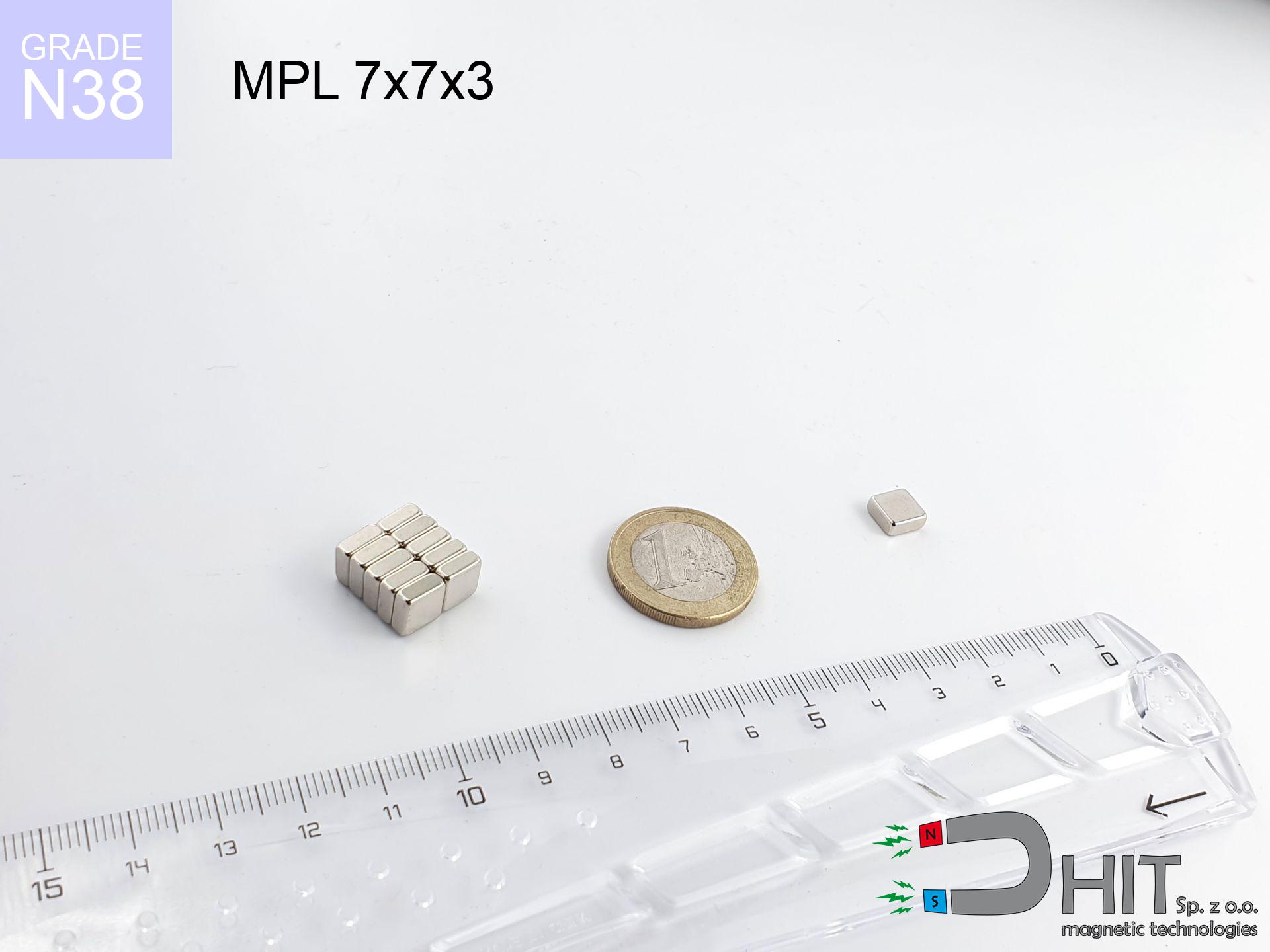
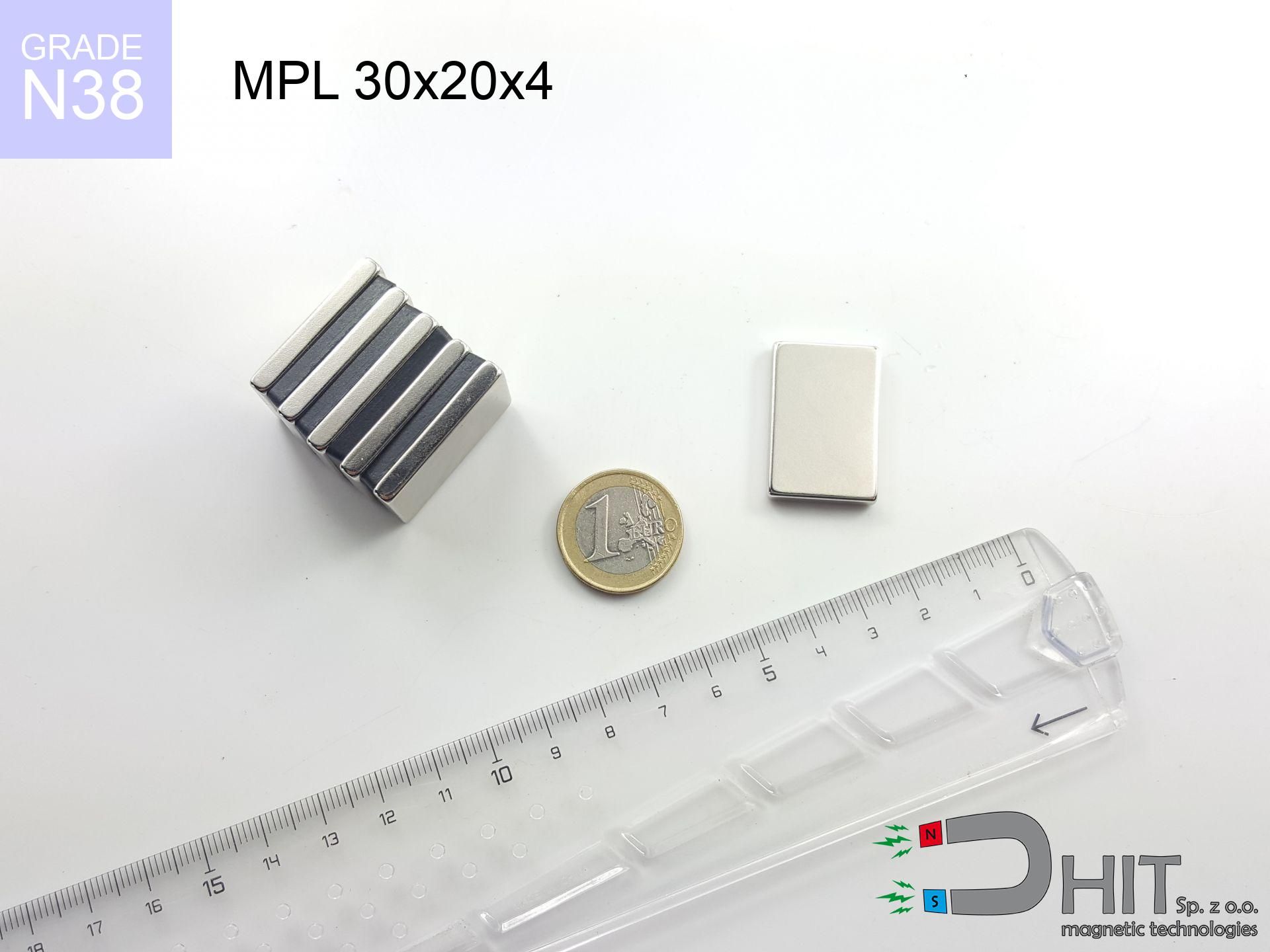
Advantages as well as disadvantages of neodymium magnets.
Strengths
- They have stable power, and over more than 10 years their attraction force decreases symbolically – ~1% (in testing),
- Neodymium magnets are distinguished by exceptionally resistant to magnetic field loss caused by external interference,
- By using a decorative coating of silver, the element presents an modern look,
- The surface of neodymium magnets generates a maximum magnetic field – this is one of their assets,
- Neodymium magnets are characterized by very high magnetic induction on the magnet surface and are able to act (depending on the form) even at a temperature of 230°C or more...
- In view of the ability of accurate molding and adaptation to specialized requirements, magnetic components can be created in a broad palette of geometric configurations, which makes them more universal,
- Wide application in high-tech industry – they are used in computer drives, motor assemblies, advanced medical instruments, as well as multitasking production systems.
- Relatively small size with high pulling force – neodymium magnets offer high power in small dimensions, which allows their use in small systems
Cons
- They are prone to damage upon too strong impacts. To avoid cracks, it is worth protecting magnets in special housings. Such protection not only shields the magnet but also improves its resistance to damage
- Do not exceed this material temperature limit: 80°C. Overheating may permanently weaken the magnet.
- When exposed to humidity, magnets usually rust. To use them in conditions outside, it is recommended to use protective magnets, such as those in rubber or plastics, which secure oxidation as well as corrosion.
- Due to limitations in producing nuts and complicated forms in magnets, we recommend using cover - magnetic mechanism.
- Potential hazard to health – tiny shards of magnets can be dangerous, when accidentally swallowed, which is particularly important in the context of child health protection. It is also worth noting that small components of these products are able to be problematic in diagnostics medical after entering the body.
- With budget limitations the cost of neodymium magnets is economically unviable,
Lifting parameters
Highest magnetic holding force – what contributes to it?
- using a sheet made of low-carbon steel, acting as a circuit closing element
- whose transverse dimension equals approx. 10 mm
- with an ideally smooth contact surface
- under conditions of ideal adhesion (surface-to-surface)
- during detachment in a direction perpendicular to the mounting surface
- at ambient temperature approx. 20 degrees Celsius
Lifting capacity in practice – influencing factors
- Distance – existence of any layer (paint, dirt, air) acts as an insulator, which reduces capacity steeply (even by 50% at 0.5 mm).
- Loading method – declared lifting capacity refers to detachment vertically. When slipping, the magnet holds much less (often approx. 20-30% of maximum force).
- Base massiveness – too thin steel causes magnetic saturation, causing part of the flux to be wasted into the air.
- Material composition – not every steel reacts the same. Alloy additives weaken the attraction effect.
- Surface structure – the more even the surface, the better the adhesion and higher the lifting capacity. Roughness acts like micro-gaps.
- Thermal environment – temperature increase causes a temporary drop of induction. It is worth remembering the maximum operating temperature for a given model.
Holding force was tested on the plate surface of 20 mm thickness, when the force acted perpendicularly, whereas under parallel forces the lifting capacity is smaller. Moreover, even a slight gap between the magnet and the plate lowers the holding force.
Warnings
Product not for children
Strictly store magnets out of reach of children. Risk of swallowing is significant, and the consequences of magnets clamping inside the body are tragic.
Conscious usage
Before starting, read the rules. Uncontrolled attraction can destroy the magnet or injure your hand. Be predictive.
GPS and phone interference
GPS units and smartphones are extremely sensitive to magnetic fields. Direct contact with a strong magnet can permanently damage the sensors in your phone.
Implant safety
People with a pacemaker have to keep an large gap from magnets. The magnetism can disrupt the operation of the life-saving device.
Heat warning
Avoid heat. Neodymium magnets are susceptible to temperature. If you require resistance above 80°C, inquire about special high-temperature series (H, SH, UH).
Metal Allergy
Some people suffer from a sensitization to Ni, which is the common plating for NdFeB magnets. Frequent touching can result in an allergic reaction. It is best to wear protective gloves.
Protect data
Equipment safety: Neodymium magnets can damage payment cards and delicate electronics (pacemakers, medical aids, mechanical watches).
Do not drill into magnets
Dust created during cutting of magnets is combustible. Avoid drilling into magnets unless you are an expert.
Material brittleness
Watch out for shards. Magnets can explode upon uncontrolled impact, launching shards into the air. Eye protection is mandatory.
Serious injuries
Protect your hands. Two powerful magnets will snap together instantly with a force of massive weight, crushing anything in their path. Be careful!
Tabela kosztu i czasu dostawy
Płatność przed wysyłką:

GLS kurier
Przesyłka będzie u Ciebie za 2-3 dni
14.99 ZŁ

InPost Paczkomaty 24/7
Przesyłka będzie u Ciebie za 1-2 dni
12.30 ZŁ
Płatność przy odbiorze (pobranie):
GLS kurier
Przesyłka będzie u Ciebie za 1-2 dni
23.00 ZŁ