
![Magnet with screw UMGZ 48x24x11.5 [M8] GZ / N38](https://cdn3.dhit.pl/graphics/banners/magnet.webp "Magnet with screw UMGZ 48x24x11.5 [M8] GZ / N38")
![UMGZ 48x24x11.5 [M8] GZ / N38 - magnetic holder external thread](https://cdn3.dhit.pl/graphics/products/umgw-48x24x11.5-m8-gz-bit.jpg)
![UMGZ 48x24x11.5 [M8] GZ / N38 - magnetic holder external thread - ujęcie 2](https://cdn3.dhit.pl/graphics/products/umgw-48x24x11.5-m8-gz-kow.jpg)
UMGZ 48x24x11.5 [M8] GZ / N38 - magnetic holder external thread
magnetic holder external thread
Catalog no 190415
GTIN/EAN: 5906301813866
- Diameter Ø
- 48 mm [±1 mm]
- Height
- 24 mm [±1 mm]
- Height
- 11.5 mm [±1 mm]
- Weight
- 140 g
- Coating
- [NiCuNi] Nickel
How we measure these parameters — certificates and measurements
48.70 zł net / pcs
59.90 zł with VAT (23% VAT) / pcs
bulk discounts:
Need more?Frequently asked questions
Which magnetic holder is suitable for moving metal parts in a workshop?
How do I choose a holder for hanging a heavy item and check its real grip?
Which magnetic holders can be used outdoors?
How should I choose a strong threaded holder for field work?
Call us now
+48 888 99 98 98
alternatively let us know using
contact form
the contact section.
Specifications and structure of a neodymium magnet can be estimated using our
power calculator.
Order by 14:00 and we’ll ship today!
Technical parameters of the product - UMGZ 48x24x11.5 [M8] GZ / N38 - magnetic holder external thread
Specification / characteristics - UMGZ 48x24x11.5 [M8] GZ / N38 - magnetic holder external thread
| properties | values |
|---|---|
| Cat. no. | 190415 |
| GTIN/EAN | 5906301813866 |
| Production/Distribution | Dhit sp. z o.o. |
| Country of origin | Poland / China / Germany |
| Customs code | 85059029 |
| Diameter Ø | 48 mm [±1 mm] |
| Height | 24 mm [±1 mm] |
| Height | 11.5 mm [±1 mm] |
| Weight | 140 g |
| Load capacity ~ ? | 80.00 kg / 784.53 N |
| Coating | [NiCuNi] Nickel |
| Manufacturing Tolerance | ±1 mm |
Magnetic properties of material N38
| properties | values | units |
|---|---|---|
| Remanence Br ? | 12.2-12.6 | kGs |
| Remanence Br ? | 1220-1260 | mT |
| Coercivity bHc ? | 10.8-11.5 | kOe |
| Coercivity bHc ? | 860-915 | kA/m |
| Intrinsic coercivity iHc | ≥ 12 | kOe |
| Intrinsic coercivity iHc | ≥ 955 | kA/m |
| Energy product BHmax ? | 36-38 | BH max MGOe |
| Energy product BHmax ? | 287-303 | BH max KJ/m |
| Maximum working temperature ? | ≤ 80 | °C |
Physical properties of sintered neodymium magnets Nd2Fe14B at 20°C
| properties | values | units |
|---|---|---|
| Vickers hardness | ≥550 | Hv |
| Density | ≥7.4 | g/cm3 |
| Curie Temperature TC | 310 | °C |
| Curie Temperature TF | 590 | °F |
| Specific resistance | 150 | μΩ⋅cm |
| Bending strength | 250 | MPa |
| Compressive strength | 1000~1100 | MPa |
| Thermal expansion parallel (∥) to orientation (M) | (3-4) x 10-6 | °C-1 |
| Thermal expansion perpendicular (⊥) to orientation (M) | -(1-3) x 10-6 | °C-1 |
| Young's modulus | 1.7 x 10⁴ | kg/mm² |
Chemical composition
| iron (Fe) | 64% – 68% |
| neodymium (Nd) | 29% – 32% |
| boron (B) | 1.1% – 1.2% |
| dysprosium (Dy) | 0.5% – 2.0% |
| coating (Ni-Cu-Ni) | < 0.05% |
Environmental data
| recyclability (EoL) | 100% |
| recycled raw materials | ~10% (pre-cons) |
| carbon footprint | low / zredukowany |
| waste code (EWC) | 16 02 16 |
Other deals
![SM 32x475 [2xM8] / N52 - magnetic separator](https://cdn3.dhit.pl/graphics/products/sm-32x475-2xm8-wef.jpg "SM 32x475 [2xM8] / N52 - magnetic separator")
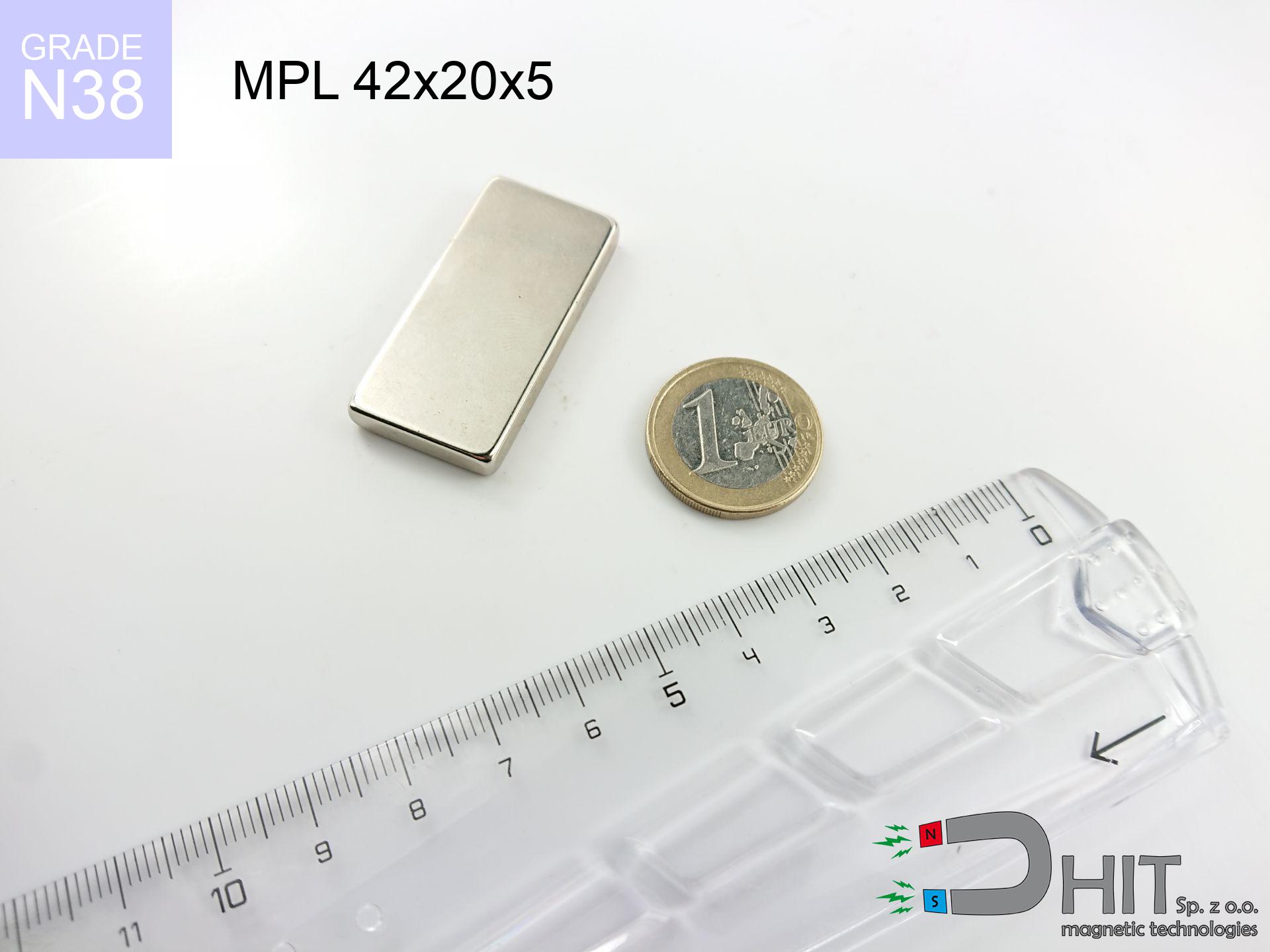
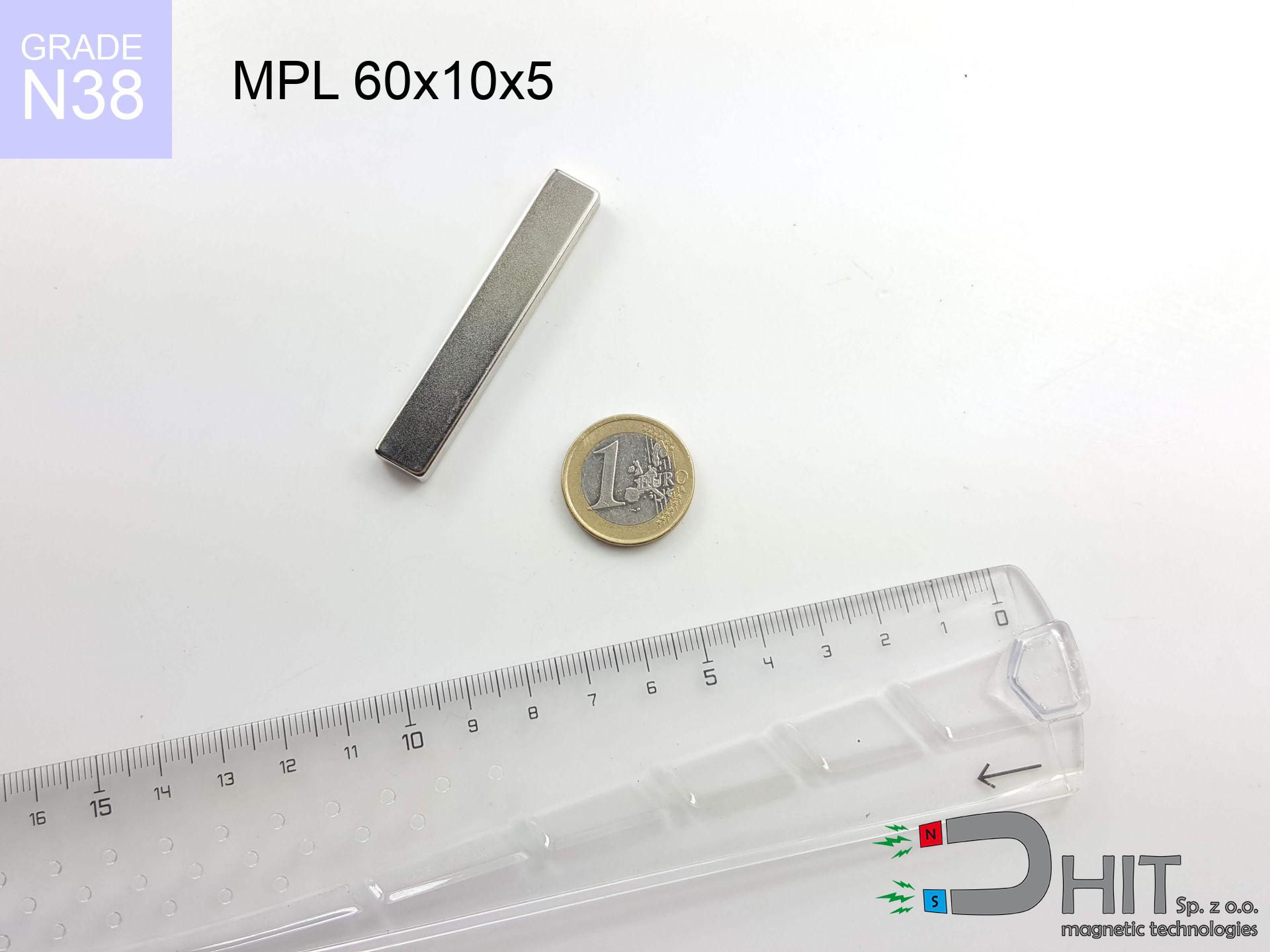

Advantages and disadvantages of Nd2Fe14B magnets.
Strengths
- They do not lose magnetism, even during nearly 10 years – the decrease in lifting capacity is only ~1% (based on measurements),
- They are extremely resistant to demagnetization induced by external magnetic fields,
- A magnet with a smooth silver surface is more attractive,
- The surface of neodymium magnets generates a unique magnetic field – this is one of their assets,
- Due to their durability and thermal resistance, neodymium magnets can operate (depending on the form) even at high temperatures reaching 230°C or more...
- Possibility of custom creating and adjusting to precise applications,
- Huge importance in electronics industry – they are utilized in data components, drive modules, diagnostic systems, and technologically advanced constructions.
- Thanks to efficiency per cm³, small magnets offer high operating force, occupying minimum space,
Cons
- Brittleness is one of their disadvantages. Upon strong impact they can fracture. We recommend keeping them in a strong case, which not only secures them against impacts but also raises their durability
- Do not exceed this material temperature limit: 80°C. Overheating may permanently weaken the magnet.
- Magnets exposed to a humid environment can corrode. Therefore when using outdoors, we recommend using water-impermeable magnets made of rubber, plastic or other material protecting against moisture
- Due to limitations in realizing threads and complex shapes in magnets, we recommend using a housing - magnetic mount.
- Health risk resulting from small fragments of magnets pose a threat, in case of ingestion, which is particularly important in the aspect of protecting the youngest. Additionally, small components of these magnets can disrupt the diagnostic process medical in case of swallowing.
- Higher cost of purchase is a significant factor to consider compared to ceramic magnets, especially in budget applications
Pull force analysis
Highest magnetic holding force – what contributes to it?
- using a base made of low-carbon steel, functioning as a circuit closing element
- whose transverse dimension is min. 10 mm
- with an polished touching surface
- under conditions of ideal adhesion (metal-to-metal)
- during pulling in a direction vertical to the plane
- in temp. approx. 20°C
Impact of factors on magnetic holding capacity in practice
- Distance – the presence of foreign body (paint, tape, air) acts as an insulator, which reduces capacity steeply (even by 50% at 0.5 mm).
- Load vector – highest force is reached only during pulling at a 90° angle. The resistance to sliding of the magnet along the plate is standardly many times smaller (approx. 1/5 of the lifting capacity).
- Wall thickness – thin material does not allow full use of the magnet. Magnetic flux penetrates through instead of converting into lifting capacity.
- Metal type – not every steel attracts identically. Alloy additives worsen the interaction with the magnet.
- Base smoothness – the more even the plate, the better the adhesion and stronger the hold. Roughness acts like micro-gaps.
- Heat – neodymium magnets have a negative temperature coefficient. When it is hot they lose power, and at low temperatures they can be stronger (up to a certain limit).
Lifting capacity was assessed by applying a polished steel plate of optimal thickness (min. 20 mm), under vertically applied force, however under parallel forces the holding force is lower. Additionally, even a slight gap between the magnet and the plate reduces the holding force.
Precautions when working with neodymium magnets
Allergic reactions
Studies show that the nickel plating (standard magnet coating) is a strong allergen. If your skin reacts to metals, avoid direct skin contact and opt for versions in plastic housing.
Machining danger
Combustion risk: Neodymium dust is highly flammable. Do not process magnets without safety gear as this may cause fire.
Precision electronics
Navigation devices and smartphones are extremely susceptible to magnetism. Direct contact with a strong magnet can ruin the internal compass in your phone.
Permanent damage
Standard neodymium magnets (N-type) lose magnetization when the temperature exceeds 80°C. This process is irreversible.
Choking Hazard
Always keep magnets out of reach of children. Ingestion danger is high, and the effects of magnets connecting inside the body are life-threatening.
Handling rules
Before use, check safety instructions. Uncontrolled attraction can destroy the magnet or hurt your hand. Think ahead.
Crushing force
Risk of injury: The attraction force is so immense that it can cause blood blisters, crushing, and even bone fractures. Use thick gloves.
Data carriers
Data protection: Strong magnets can damage data carriers and sensitive devices (pacemakers, medical aids, mechanical watches).
Fragile material
Despite metallic appearance, neodymium is brittle and cannot withstand shocks. Avoid impacts, as the magnet may crumble into sharp, dangerous pieces.
ICD Warning
For implant holders: Strong magnetic fields affect medical devices. Keep at least 30 cm distance or ask another person to work with the magnets.
Tabela kosztu i czasu dostawy
Płatność przed wysyłką:

GLS kurier
Przesyłka będzie u Ciebie za 2-3 dni
14.99 ZŁ

InPost Paczkomaty 24/7
Przesyłka będzie u Ciebie za 1-2 dni
12.30 ZŁ
Płatność przy odbiorze (pobranie):
GLS kurier
Przesyłka będzie u Ciebie za 1-2 dni
23.00 ZŁ