
![Magnet with screw UMGZ 20x15x7 [M4] GZ / N38](https://cdn3.dhit.pl/graphics/banners/magnet.webp "Magnet with screw UMGZ 20x15x7 [M4] GZ / N38")
![UMGZ 20x15x7 [M4] GZ / N38 - magnetic holder external thread](https://cdn3.dhit.pl/graphics/products/um-20x15x7-m4-gz-vaf.jpg)
![UMGZ 20x15x7 [M4] GZ / N38 - magnetic holder external thread - ujęcie 2](https://cdn3.dhit.pl/graphics/products/umgw-20x15x7-m4-gz-jeb.jpg)
UMGZ 20x15x7 [M4] GZ / N38 - magnetic holder external thread
magnetic holder external thread
Catalog no 190322
GTIN/EAN: 5906301813811
- Diameter Ø
- 20 mm [±1 mm]
- Height
- 15 mm [±1 mm]
- Height
- 7 mm [±1 mm]
- Weight
- 14 g
- Coating
- [NiCuNi] Nickel
How we measure these parameters — certificates and measurements
5.87 zł net / pcs
7.22 zł with VAT (23% VAT) / pcs
bulk discounts:
Need more?Frequently asked questions
Which magnetic holder is suitable for moving metal parts in a workshop?
How do I choose a holder for hanging a heavy item and check its real grip?
Which magnetic holders can be used outdoors?
How should I choose a strong threaded holder for field work?
Call us now
+48 888 99 98 98
alternatively let us know using
contact form
the contact section.
Specifications and structure of a neodymium magnet can be estimated using our
power calculator.
Order by 14:00 and we’ll ship today!
Technical specification of the product - UMGZ 20x15x7 [M4] GZ / N38 - magnetic holder external thread
Specification / characteristics - UMGZ 20x15x7 [M4] GZ / N38 - magnetic holder external thread
| properties | values |
|---|---|
| Cat. no. | 190322 |
| GTIN/EAN | 5906301813811 |
| Production/Distribution | Dhit sp. z o.o. |
| Country of origin | Poland / China / Germany |
| Customs code | 85059029 |
| Diameter Ø | 20 mm [±1 mm] |
| Height | 15 mm [±1 mm] |
| Height | 7 mm [±1 mm] |
| Weight | 14 g |
| Load capacity ~ ? | 9.00 kg / 88.26 N |
| Coating | [NiCuNi] Nickel |
| Manufacturing Tolerance | ±1 mm |
Magnetic properties of material N38
| properties | values | units |
|---|---|---|
| Remanence Br ? | 12.2-12.6 | kGs |
| Remanence Br ? | 1220-1260 | mT |
| Coercivity bHc ? | 10.8-11.5 | kOe |
| Coercivity bHc ? | 860-915 | kA/m |
| Intrinsic coercivity iHc | ≥ 12 | kOe |
| Intrinsic coercivity iHc | ≥ 955 | kA/m |
| Energy product BHmax ? | 36-38 | BH max MGOe |
| Energy product BHmax ? | 287-303 | BH max KJ/m |
| Maximum working temperature ? | ≤ 80 | °C |
Physical properties of sintered neodymium magnets Nd2Fe14B at 20°C
| properties | values | units |
|---|---|---|
| Vickers hardness | ≥550 | Hv |
| Density | ≥7.4 | g/cm3 |
| Curie Temperature TC | 310 | °C |
| Curie Temperature TF | 590 | °F |
| Specific resistance | 150 | μΩ⋅cm |
| Bending strength | 250 | MPa |
| Compressive strength | 1000~1100 | MPa |
| Thermal expansion parallel (∥) to orientation (M) | (3-4) x 10-6 | °C-1 |
| Thermal expansion perpendicular (⊥) to orientation (M) | -(1-3) x 10-6 | °C-1 |
| Young's modulus | 1.7 x 10⁴ | kg/mm² |
Chemical composition
| iron (Fe) | 64% – 68% |
| neodymium (Nd) | 29% – 32% |
| boron (B) | 1.1% – 1.2% |
| dysprosium (Dy) | 0.5% – 2.0% |
| coating (Ni-Cu-Ni) | < 0.05% |
Sustainability
| recyclability (EoL) | 100% |
| recycled raw materials | ~10% (pre-cons) |
| carbon footprint | low / zredukowany |
| waste code (EWC) | 16 02 16 |
Other products
![SM 25x225 [2xM8] / N42 - magnetic separator](https://cdn3.dhit.pl/graphics/products/sm-25x225-2xm8-tix.jpg "SM 25x225 [2xM8] / N42 - magnetic separator")
![SM 28x150 [2xM8] / N52 - magnetic separator](https://cdn3.dhit.pl/graphics/products/sm-28x150-2xm8-bon.jpg "SM 28x150 [2xM8] / N52 - magnetic separator")
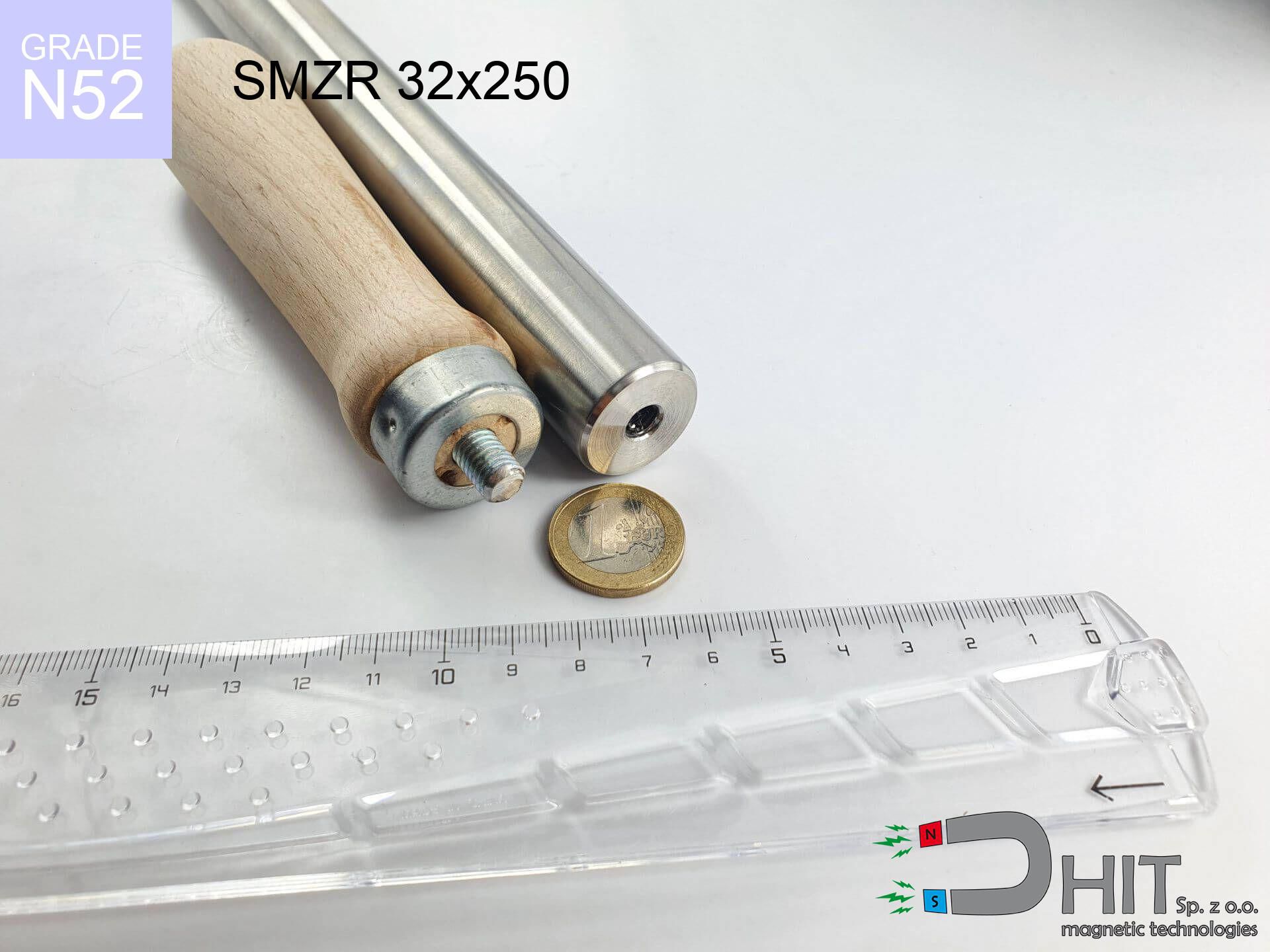
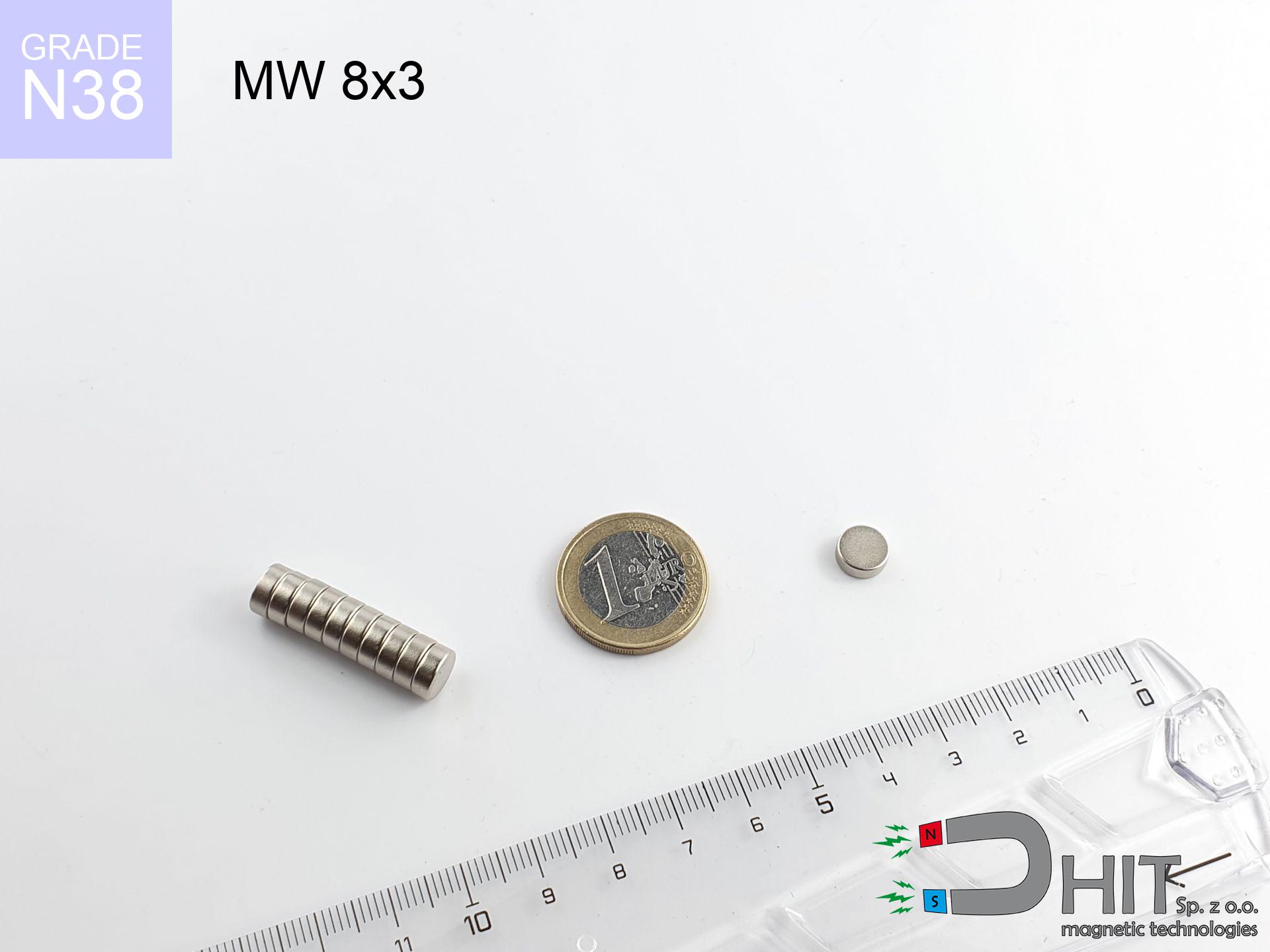
Pros as well as cons of rare earth magnets.
Benefits
- They retain magnetic properties for almost 10 years – the loss is just ~1% (in theory),
- Neodymium magnets are extremely resistant to loss of magnetic properties caused by external field sources,
- A magnet with a metallic gold surface is more attractive,
- Magnets exhibit very high magnetic induction on the outer layer,
- Made from properly selected components, these magnets show impressive resistance to high heat, enabling them to function (depending on their form) at temperatures up to 230°C and above...
- Due to the potential of flexible molding and adaptation to individualized projects, NdFeB magnets can be modeled in a wide range of shapes and sizes, which expands the range of possible applications,
- Huge importance in electronics industry – they find application in hard drives, electromotive mechanisms, medical equipment, also multitasking production systems.
- Relatively small size with high pulling force – neodymium magnets offer strong magnetic field in compact dimensions, which enables their usage in compact constructions
Weaknesses
- At strong impacts they can crack, therefore we recommend placing them in steel cases. A metal housing provides additional protection against damage, as well as increases the magnet's durability.
- Do not exceed this material temperature limit: 80°C. Overheating may permanently weaken the magnet.
- Due to the susceptibility of magnets to corrosion in a humid environment, we suggest using waterproof magnets made of rubber, plastic or other material immune to moisture, when using outdoors
- We suggest cover - magnetic holder, due to difficulties in producing nuts inside the magnet and complex forms.
- Health risk resulting from small fragments of magnets can be dangerous, when accidentally swallowed, which is particularly important in the context of child health protection. Additionally, small elements of these magnets can disrupt the diagnostic process medical in case of swallowing.
- Due to neodymium price, their price is higher than average,
Holding force characteristics
Breakaway strength of the magnet in ideal conditions – what affects it?
- with the application of a sheet made of low-carbon steel, ensuring full magnetic saturation
- whose transverse dimension reaches at least 10 mm
- with an polished touching surface
- under conditions of no distance (metal-to-metal)
- during pulling in a direction perpendicular to the mounting surface
- at temperature room level
Lifting capacity in real conditions – factors
- Gap (betwixt the magnet and the plate), as even a microscopic clearance (e.g. 0.5 mm) can cause a decrease in lifting capacity by up to 50% (this also applies to varnish, rust or dirt).
- Angle of force application – highest force is obtained only during pulling at a 90° angle. The force required to slide of the magnet along the surface is usually many times lower (approx. 1/5 of the lifting capacity).
- Substrate thickness – for full efficiency, the steel must be sufficiently thick. Thin sheet limits the attraction force (the magnet "punches through" it).
- Metal type – not every steel attracts identically. Alloy additives weaken the interaction with the magnet.
- Smoothness – full contact is possible only on smooth steel. Any scratches and bumps reduce the real contact area, weakening the magnet.
- Temperature – temperature increase causes a temporary drop of force. Check the thermal limit for a given model.
Holding force was measured on a smooth steel plate of 20 mm thickness, when the force acted perpendicularly, whereas under shearing force the load capacity is reduced by as much as 5 times. Moreover, even a small distance between the magnet and the plate lowers the load capacity.
H&S for magnets
Cards and drives
Very strong magnetic fields can erase data on payment cards, HDDs, and storage devices. Keep a distance of min. 10 cm.
Crushing risk
Watch your fingers. Two powerful magnets will snap together immediately with a force of several hundred kilograms, destroying everything in their path. Exercise extreme caution!
Impact on smartphones
Navigation devices and smartphones are extremely sensitive to magnetism. Direct contact with a strong magnet can permanently damage the internal compass in your phone.
Metal Allergy
Nickel alert: The Ni-Cu-Ni coating consists of nickel. If redness occurs, immediately stop working with magnets and use protective gear.
Conscious usage
Before starting, read the rules. Uncontrolled attraction can break the magnet or injure your hand. Think ahead.
Heat sensitivity
Avoid heat. Neodymium magnets are sensitive to heat. If you require operation above 80°C, look for HT versions (H, SH, UH).
Do not drill into magnets
Drilling and cutting of NdFeB material poses a fire hazard. Magnetic powder oxidizes rapidly with oxygen and is hard to extinguish.
Protective goggles
NdFeB magnets are ceramic materials, meaning they are very brittle. Impact of two magnets leads to them cracking into small pieces.
Product not for children
Always keep magnets out of reach of children. Choking hazard is significant, and the effects of magnets connecting inside the body are life-threatening.
Health Danger
Medical warning: Neodymium magnets can deactivate pacemakers and defibrillators. Do not approach if you have electronic implants.
Tabela kosztu i czasu dostawy
Płatność przed wysyłką:

GLS kurier
Przesyłka będzie u Ciebie za 2-3 dni
14.99 ZŁ

InPost Paczkomaty 24/7
Przesyłka będzie u Ciebie za 1-2 dni
12.30 ZŁ
Płatność przy odbiorze (pobranie):
GLS kurier
Przesyłka będzie u Ciebie za 1-2 dni
23.00 ZŁ