

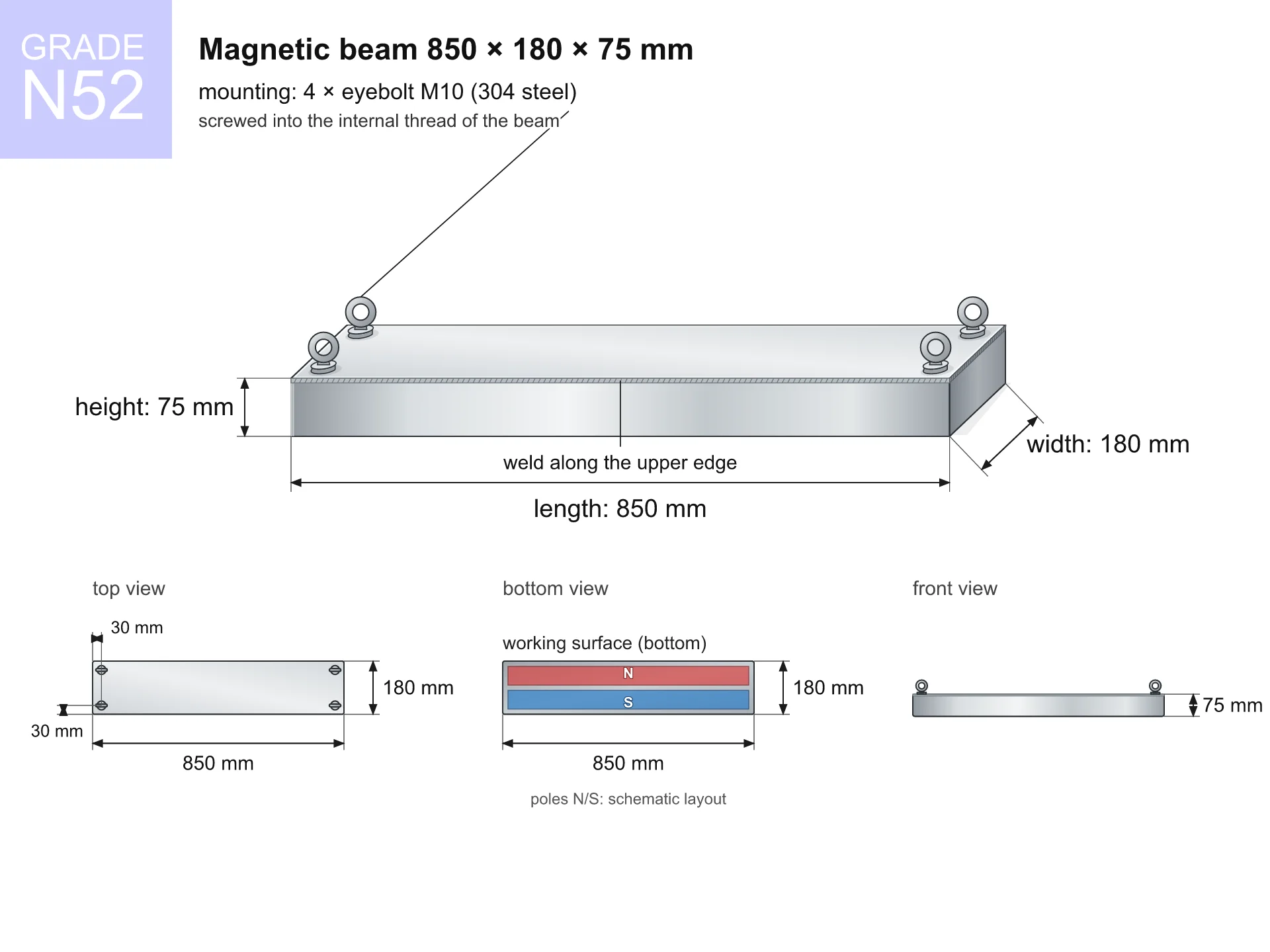
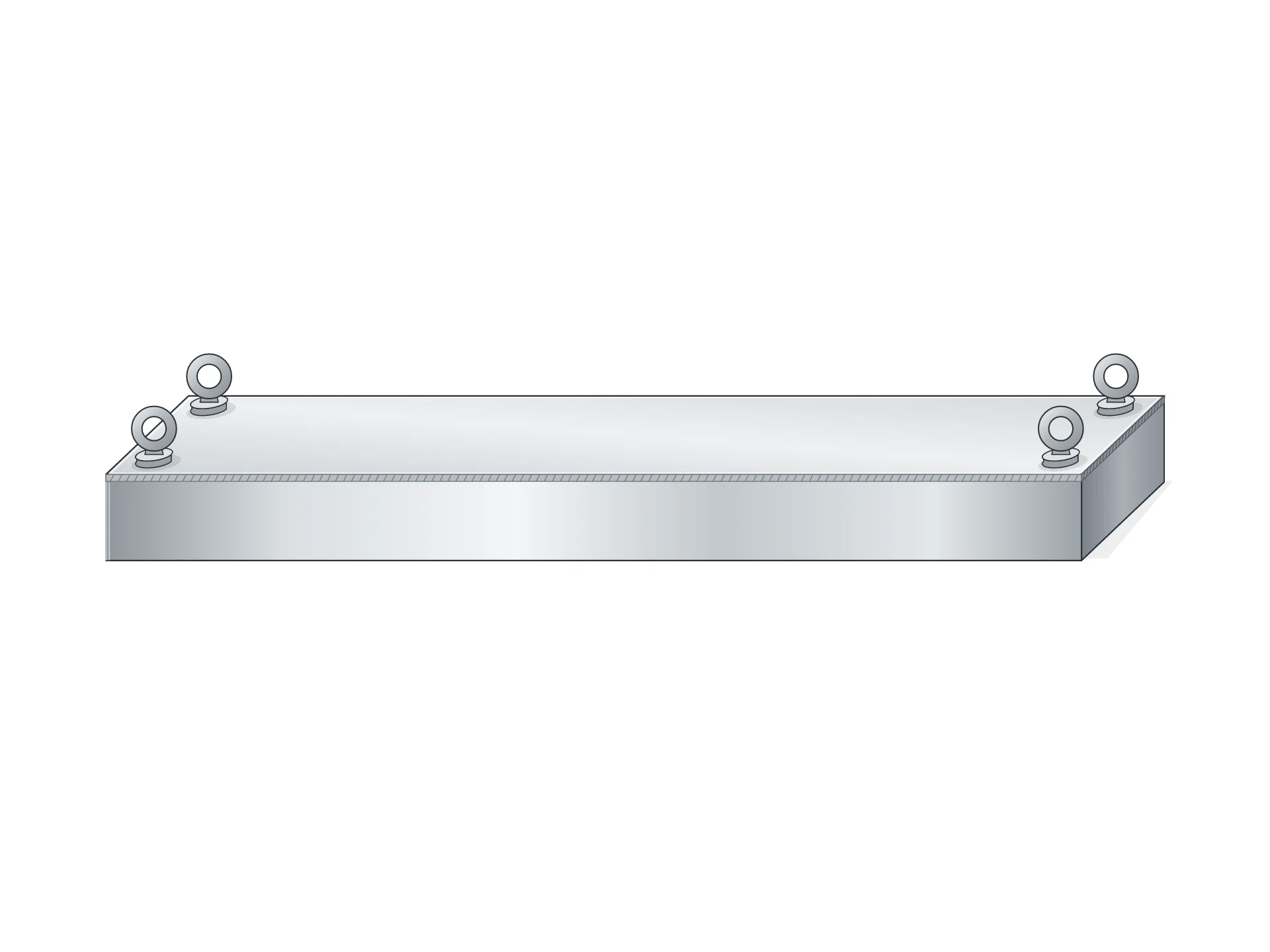
BM 850x180x75 [M10x4] - magnetic beam
magnetic beam
Catalog no 090576
GTIN/EAN: 5906301815686
- length
- 850 mm [±1 mm]
- Width
- 180 mm [±1 mm]
- Height
- 75 mm [±1 mm]
- Weight
- 58500 g
How we measure these parameters — certificates and measurements
6984.50 zł net / pcs
8590.94 zł with VAT (23% VAT) / pcs
bulk discounts:
Need more?Frequently asked questions
How do I choose a separator for fine contamination and check availability?
Where can I order a separator for a production line, and what should I check?
How can I verify a separator's declared magnetic parameters before purchase?
Can a magnetic beam withstand continuous work on a production line?
What roller design is suitable for a dusty environment?
How do I choose the size of a hand-held separator?
What is a hand-held separator for, and how is it different from a built-in rod?
Which separator type suits a small production plant?
Call us now
+48 888 99 98 98
alternatively let us know using
contact form
the contact section.
Specifications and structure of a neodymium magnet can be estimated using our
power calculator.
Order by 14:00 and we’ll ship today!
Technical parameters - BM 850x180x75 [M10x4] - magnetic beam
Specification / characteristics - BM 850x180x75 [M10x4] - magnetic beam
| properties | values |
|---|---|
| Cat. no. | 090576 |
| GTIN/EAN | 5906301815686 |
| Distributor | Dhit sp. z o.o. |
| Country of origin | Poland / China / Germany |
| Customs code | 85059029 |
| length | 850 mm [±1 mm] |
| Width | 180 mm [±1 mm] |
| Height | 75 mm [±1 mm] |
| Weight | 58500 g |
| Manufacturing Tolerance | ±1 mm |
Physical properties of sintered neodymium magnets Nd2Fe14B at 20°C
| properties | values | units |
|---|---|---|
| Vickers hardness | ≥550 | Hv |
| Density | ≥7.4 | g/cm3 |
| Curie Temperature TC | 310 | °C |
| Curie Temperature TF | 590 | °F |
| Specific resistance | 150 | μΩ⋅cm |
| Bending strength | 250 | MPa |
| Compressive strength | 1000~1100 | MPa |
| Thermal expansion parallel (∥) to orientation (M) | (3-4) x 10-6 | °C-1 |
| Thermal expansion perpendicular (⊥) to orientation (M) | -(1-3) x 10-6 | °C-1 |
| Young's modulus | 1.7 x 10⁴ | kg/mm² |
Elemental analysis
| iron (Fe) | 64% – 68% |
| neodymium (Nd) | 29% – 32% |
| boron (B) | 1.1% – 1.2% |
| dysprosium (Dy) | 0.5% – 2.0% |
| coating (Ni-Cu-Ni) | < 0.05% |
Ecology and recycling (GPSR)
| recyclability (EoL) | 100% |
| recycled raw materials | ~10% (pre-cons) |
| carbon footprint | low / zredukowany |
| waste code (EWC) | 16 02 16 |
View more products

Advantages and disadvantages of neodymium magnets.
Strengths
- Their power remains stable, and after around ten years it decreases only by ~1% (theoretically),
- They have excellent resistance to magnetism drop due to external magnetic sources,
- The use of an shiny coating of noble metals (nickel, gold, silver) causes the element to be more visually attractive,
- Magnets possess huge magnetic induction on the outer layer,
- Due to their durability and thermal resistance, neodymium magnets are capable of operate (depending on the shape) even at high temperatures reaching 230°C or more...
- Thanks to modularity in forming and the ability to adapt to complex applications,
- Huge importance in modern industrial fields – they serve a role in mass storage devices, electric drive systems, advanced medical instruments, as well as industrial machines.
- Compactness – despite small sizes they provide effective action, making them ideal for precision applications
Disadvantages
- They are prone to damage upon heavy impacts. To avoid cracks, it is worth securing magnets in a protective case. Such protection not only protects the magnet but also improves its resistance to damage
- Heat sensitivity: observe the temperature specified for this product. Overheating may permanently weaken the magnet.
- Due to the susceptibility of magnets to corrosion in a humid environment, we advise using waterproof magnets made of rubber, plastic or other material resistant to moisture, in case of application outdoors
- We suggest casing - magnetic mount, due to difficulties in realizing threads inside the magnet and complex shapes.
- Potential hazard resulting from small fragments of magnets pose a threat, when accidentally swallowed, which gains importance in the context of child health protection. Additionally, small elements of these magnets are able to complicate diagnosis medical after entering the body.
- With large orders the cost of neodymium magnets is economically unviable,
Lifting parameters
Magnetic strength at its maximum – what it depends on?
- on a base made of mild steel, optimally conducting the magnetic field
- possessing a thickness of min. 10 mm to ensure full flux closure
- characterized by lack of roughness
- under conditions of no distance (surface-to-surface)
- during detachment in a direction perpendicular to the mounting surface
- at room temperature
Lifting capacity in real conditions – factors
- Gap between surfaces – every millimeter of distance (caused e.g. by veneer or unevenness) significantly weakens the magnet efficiency, often by half at just 0.5 mm.
- Force direction – catalog parameter refers to pulling vertically. When applying parallel force, the magnet exhibits much less (typically approx. 20-30% of nominal force).
- Wall thickness – the thinner the sheet, the weaker the hold. Part of the magnetic field penetrates through instead of converting into lifting capacity.
- Metal type – not every steel reacts the same. Alloy additives weaken the attraction effect.
- Surface quality – the smoother and more polished the surface, the larger the contact zone and higher the lifting capacity. Roughness creates an air distance.
- Thermal conditions – neodymium magnets have a negative temperature coefficient. When it is hot they lose power, and at low temperatures gain strength (up to a certain limit).
Lifting capacity testing was performed on a smooth plate of optimal thickness, under a perpendicular pulling force, in contrast under parallel forces the holding force is lower. Moreover, even a minimal clearance between the magnet’s surface and the plate reduces the load capacity.
H&S for magnets
Serious injuries
Big blocks can crush fingers in a fraction of a second. Under no circumstances put your hand betwixt two attracting surfaces.
Dust is flammable
Drilling and cutting of NdFeB material poses a fire hazard. Magnetic powder oxidizes rapidly with oxygen and is hard to extinguish.
Maximum temperature
Do not exceed the maximum operating temperature stated in the specifications of the particular product. The limit depends on the material, geometry and operating arrangement; there is no single threshold for all neodymium magnets. Overheating can permanently weaken a magnet.
This is not a toy
Adult use only. Small elements pose a choking risk, leading to intestinal necrosis. Keep out of reach of kids and pets.
Conscious usage
Use magnets consciously. Their powerful strength can surprise even experienced users. Stay alert and respect their force.
Allergy Warning
Nickel alert: The Ni-Cu-Ni coating consists of nickel. If skin irritation occurs, immediately stop handling magnets and wear gloves.
Cards and drives
Intense magnetic fields can corrupt files on payment cards, hard drives, and storage devices. Keep a distance of min. 10 cm.
Shattering risk
Despite metallic appearance, the material is brittle and not impact-resistant. Avoid impacts, as the magnet may shatter into hazardous fragments.
Implant safety
Warning for patients: Strong magnetic fields disrupt electronics. Keep at least 30 cm distance or ask another person to work with the magnets.
Precision electronics
A powerful magnetic field negatively affects the functioning of compasses in phones and GPS navigation. Do not bring magnets near a device to prevent breaking the sensors.
Tabela kosztu i czasu dostawy
Płatność przed wysyłką:

GLS kurier
Przesyłka będzie u Ciebie za 2-3 dni
14.99 ZŁ

InPost Paczkomaty 24/7
Przesyłka będzie u Ciebie za 1-2 dni
12.30 ZŁ
Płatność przy odbiorze (pobranie):
GLS kurier
Przesyłka będzie u Ciebie za 1-2 dni
23.00 ZŁ