
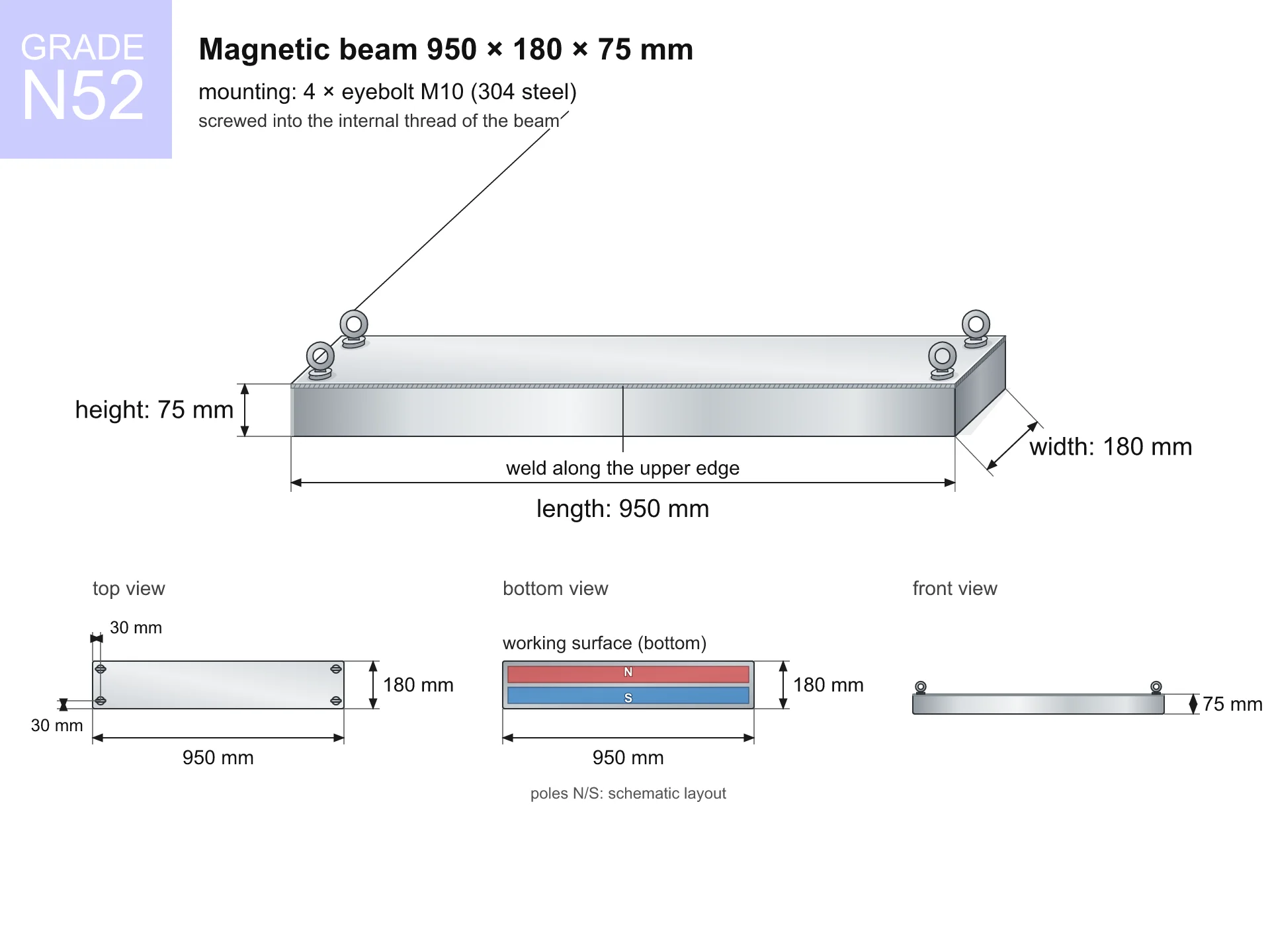
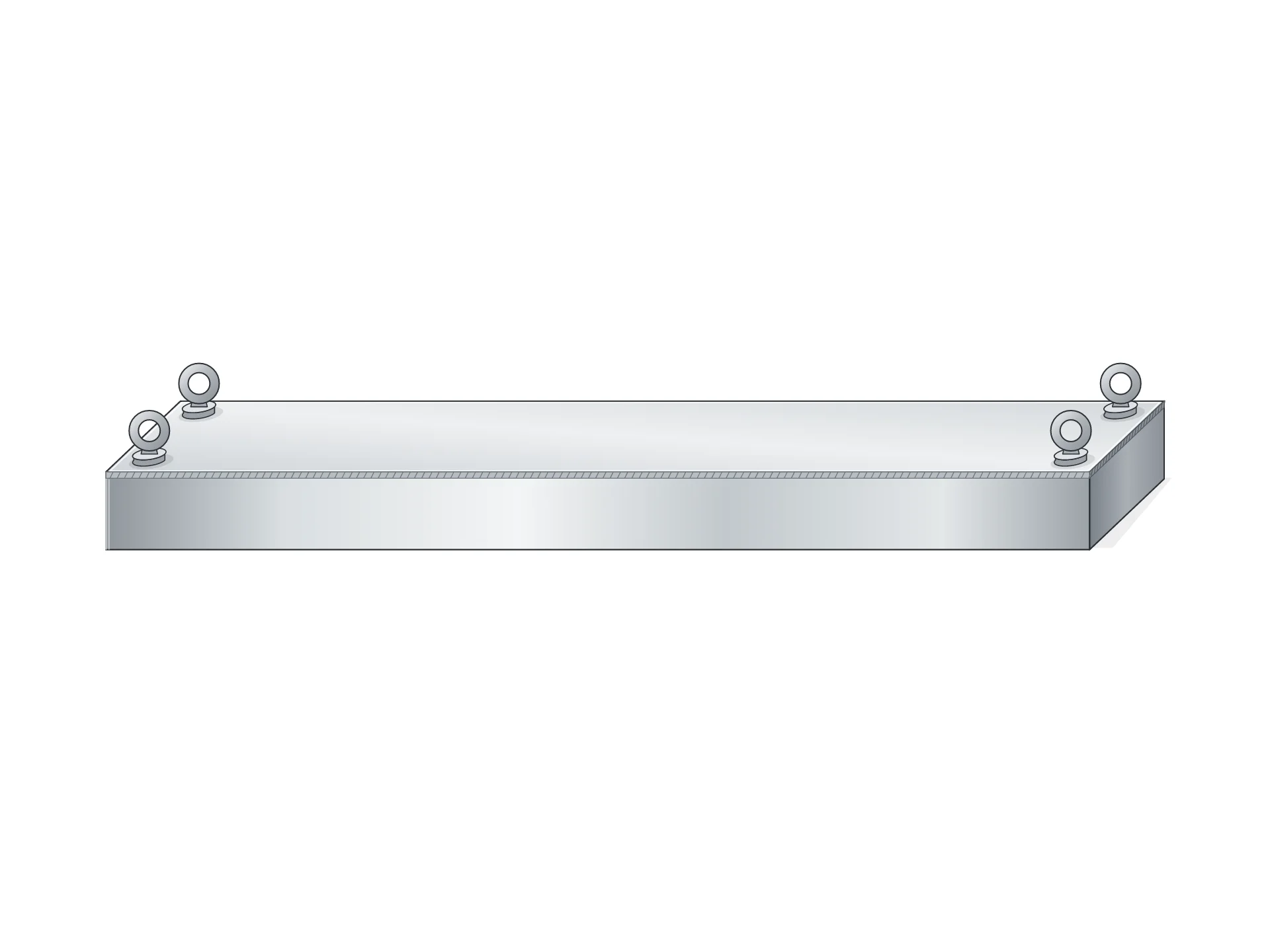
BM 950x180x75 [M10x4] - magnetic beam
magnetic beam
Catalog no 090577
GTIN/EAN: 5906301815693
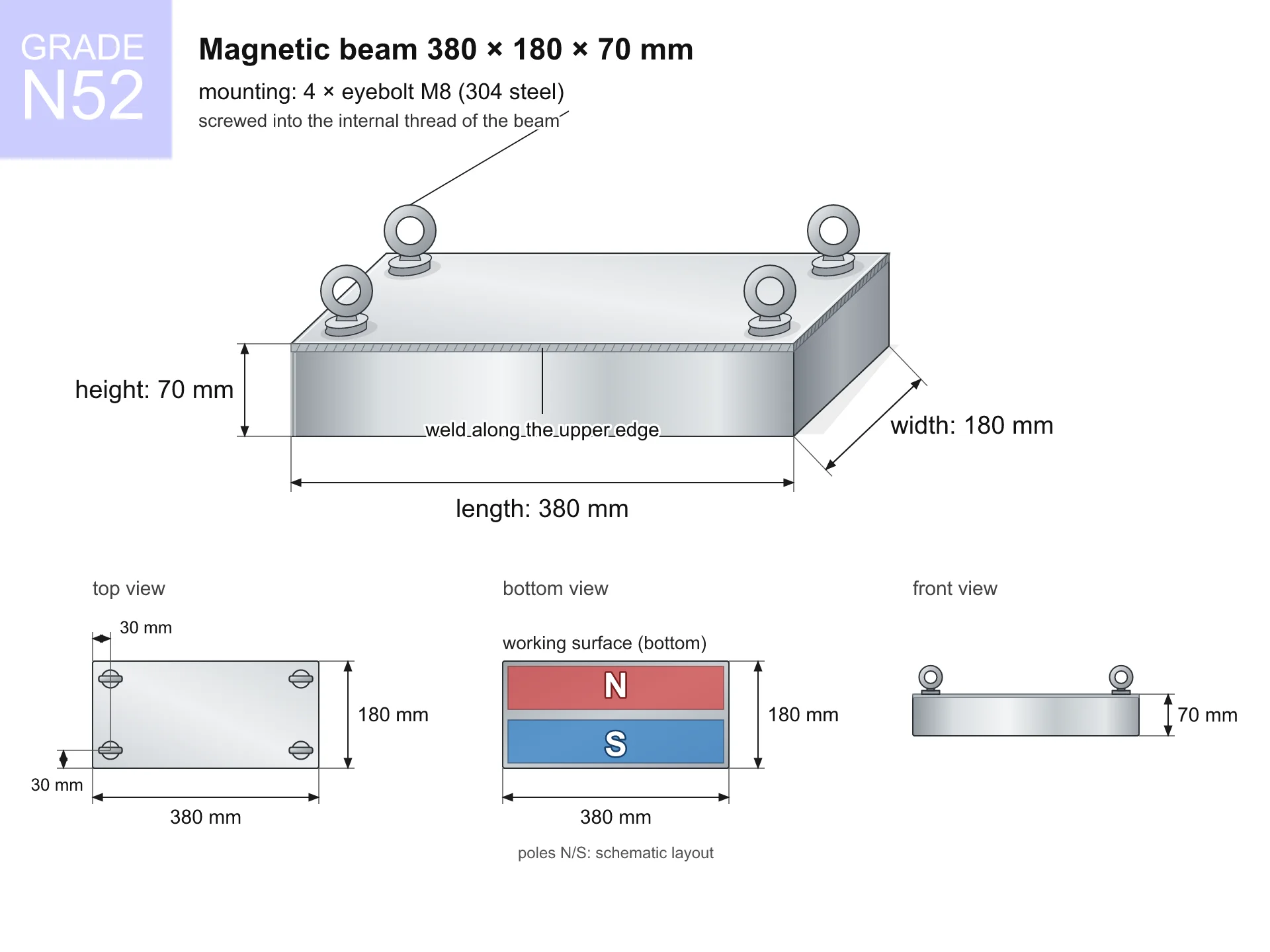
- length
- 950 mm [±1 mm]
- Width
- 180 mm [±1 mm]
- Height
- 75 mm [±1 mm]
- Weight
- 65350 g
How we measure these parameters — certificates and measurements
7363.00 zł net / pcs
9056.49 zł with VAT (23% VAT) / pcs
bulk discounts:
Need more?Frequently asked questions
How do I choose a separator for fine contamination and check availability?
Where can I order a separator for a production line, and what should I check?
How can I verify a separator's declared magnetic parameters before purchase?
Can a magnetic beam withstand continuous work on a production line?
What roller design is suitable for a dusty environment?
How do I choose the size of a hand-held separator?
What is a hand-held separator for, and how is it different from a built-in rod?
Which separator type suits a small production plant?
Call us now
+48 888 99 98 98
alternatively let us know using
contact form
the contact section.
Specifications and structure of a neodymium magnet can be estimated using our
power calculator.
Order by 14:00 and we’ll ship today!
Technical of the product - BM 950x180x75 [M10x4] - magnetic beam
Specification / characteristics - BM 950x180x75 [M10x4] - magnetic beam
| properties | values |
|---|---|
| Cat. no. | 090577 |
| GTIN/EAN | 5906301815693 |
| Distributor | Dhit sp. z o.o. |
| Country of origin | Poland / China / Germany |
| Customs code | 85059029 |
| length | 950 mm [±1 mm] |
| Width | 180 mm [±1 mm] |
| Height | 75 mm [±1 mm] |
| Weight | 65350 g |
| Manufacturing Tolerance | ±1 mm |
Physical properties of sintered neodymium magnets Nd2Fe14B at 20°C
| properties | values | units |
|---|---|---|
| Vickers hardness | ≥550 | Hv |
| Density | ≥7.4 | g/cm3 |
| Curie Temperature TC | 310 | °C |
| Curie Temperature TF | 590 | °F |
| Specific resistance | 150 | μΩ⋅cm |
| Bending strength | 250 | MPa |
| Compressive strength | 1000~1100 | MPa |
| Thermal expansion parallel (∥) to orientation (M) | (3-4) x 10-6 | °C-1 |
| Thermal expansion perpendicular (⊥) to orientation (M) | -(1-3) x 10-6 | °C-1 |
| Young's modulus | 1.7 x 10⁴ | kg/mm² |
Material specification
| iron (Fe) | 64% – 68% |
| neodymium (Nd) | 29% – 32% |
| boron (B) | 1.1% – 1.2% |
| dysprosium (Dy) | 0.5% – 2.0% |
| coating (Ni-Cu-Ni) | < 0.05% |
Ecology and recycling (GPSR)
| recyclability (EoL) | 100% |
| recycled raw materials | ~10% (pre-cons) |
| carbon footprint | low / zredukowany |
| waste code (EWC) | 16 02 16 |
Other offers
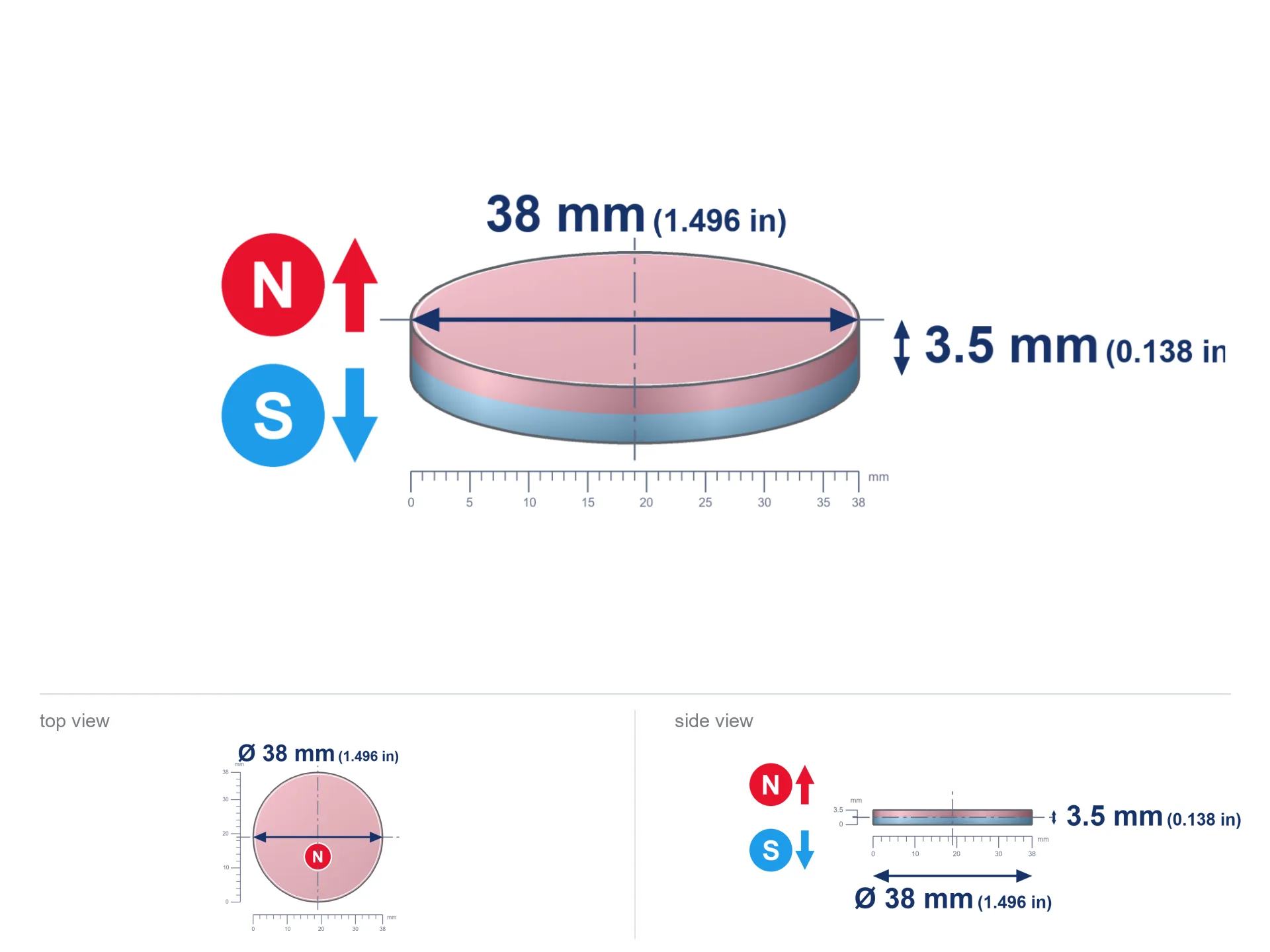

Pros and cons of rare earth magnets.
Advantages
- Their power remains stable, and after approximately ten years it drops only by ~1% (according to research),
- Neodymium magnets are characterized by extremely resistant to magnetic field loss caused by external field sources,
- In other words, due to the shiny surface of nickel, the element gains visual value,
- Neodymium magnets generate maximum magnetic induction on a their surface, which allows for strong attraction,
- Through (appropriate) combination of ingredients, they can achieve high thermal resistance, allowing for functioning at temperatures reaching 230°C and above...
- Thanks to freedom in designing and the capacity to customize to unusual requirements,
- Huge importance in modern technologies – they are utilized in data components, electromotive mechanisms, advanced medical instruments, as well as technologically advanced constructions.
- Relatively small size with high pulling force – neodymium magnets offer impressive pulling force in small dimensions, which enables their usage in miniature devices
Limitations
- They are prone to damage upon too strong impacts. To avoid cracks, it is worth securing magnets using a steel holder. Such protection not only shields the magnet but also improves its resistance to damage
- Heat sensitivity: observe the temperature specified for this product. Overheating may permanently weaken the magnet.
- Magnets exposed to a humid environment can rust. Therefore when using outdoors, we suggest using water-impermeable magnets made of rubber, plastic or other material resistant to moisture
- Due to limitations in realizing nuts and complex forms in magnets, we propose using casing - magnetic mount.
- Health risk related to microscopic parts of magnets pose a threat, if swallowed, which gains importance in the aspect of protecting the youngest. It is also worth noting that small components of these devices are able to be problematic in diagnostics medical when they are in the body.
- Due to complex production process, their price exceeds standard values,
Lifting parameters
Detachment force of the magnet in optimal conditions – what affects it?
- using a plate made of mild steel, functioning as a circuit closing element
- whose transverse dimension is min. 10 mm
- with a surface cleaned and smooth
- with direct contact (without impurities)
- under vertical application of breakaway force (90-degree angle)
- at conditions approx. 20°C
Practical aspects of lifting capacity – factors
- Space between magnet and steel – even a fraction of a millimeter of distance (caused e.g. by veneer or unevenness) significantly weakens the pulling force, often by half at just 0.5 mm.
- Force direction – declared lifting capacity refers to detachment vertically. When attempting to slide, the magnet exhibits significantly lower power (typically approx. 20-30% of maximum force).
- Wall thickness – thin material does not allow full use of the magnet. Magnetic flux passes through the material instead of generating force.
- Steel grade – ideal substrate is high-permeability steel. Stainless steels may have worse magnetic properties.
- Surface finish – ideal contact is possible only on smooth steel. Any scratches and bumps reduce the real contact area, reducing force.
- Operating temperature – NdFeB sinters have a negative temperature coefficient. When it is hot they are weaker, and in frost gain strength (up to a certain limit).
Lifting capacity was assessed with the use of a steel plate with a smooth surface of suitable thickness (min. 20 mm), under vertically applied force, whereas under parallel forces the holding force is lower. Moreover, even a minimal clearance between the magnet’s surface and the plate reduces the holding force.
Precautions when working with neodymium magnets
Danger to the youngest
NdFeB magnets are not intended for children. Eating several magnets can lead to them connecting inside the digestive tract, which constitutes a critical condition and necessitates urgent medical intervention.
Maximum temperature
Do not exceed the maximum operating temperature stated in the specifications of the particular product. The limit depends on the material, geometry and operating arrangement; there is no single threshold for all neodymium magnets. Overheating can permanently weaken a magnet.
Nickel coating and allergies
Allergy Notice: The Ni-Cu-Ni coating contains nickel. If redness appears, cease handling magnets and use protective gear.
Protective goggles
Neodymium magnets are sintered ceramics, which means they are very brittle. Clashing of two magnets will cause them breaking into shards.
Magnetic interference
Be aware: neodymium magnets generate a field that disrupts sensitive sensors. Keep a safe distance from your mobile, device, and GPS.
Life threat
People with a pacemaker should keep an absolute distance from magnets. The magnetism can disrupt the operation of the life-saving device.
Cards and drives
Do not bring magnets close to a wallet, laptop, or TV. The magnetic field can destroy these devices and wipe information from cards.
Fire risk
Powder produced during cutting of magnets is combustible. Avoid drilling into magnets unless you are an expert.
Respect the power
Exercise caution. Rare earth magnets attract from a long distance and connect with huge force, often faster than you can react.
Crushing force
Big blocks can break fingers instantly. Under no circumstances put your hand betwixt two attracting surfaces.
Tabela kosztu i czasu dostawy
Płatność przed wysyłką:

GLS kurier
Przesyłka będzie u Ciebie za 2-3 dni
14.99 ZŁ

InPost Paczkomaty 24/7
Przesyłka będzie u Ciebie za 1-2 dni
12.30 ZŁ
Płatność przy odbiorze (pobranie):
GLS kurier
Przesyłka będzie u Ciebie za 1-2 dni
23.00 ZŁ