


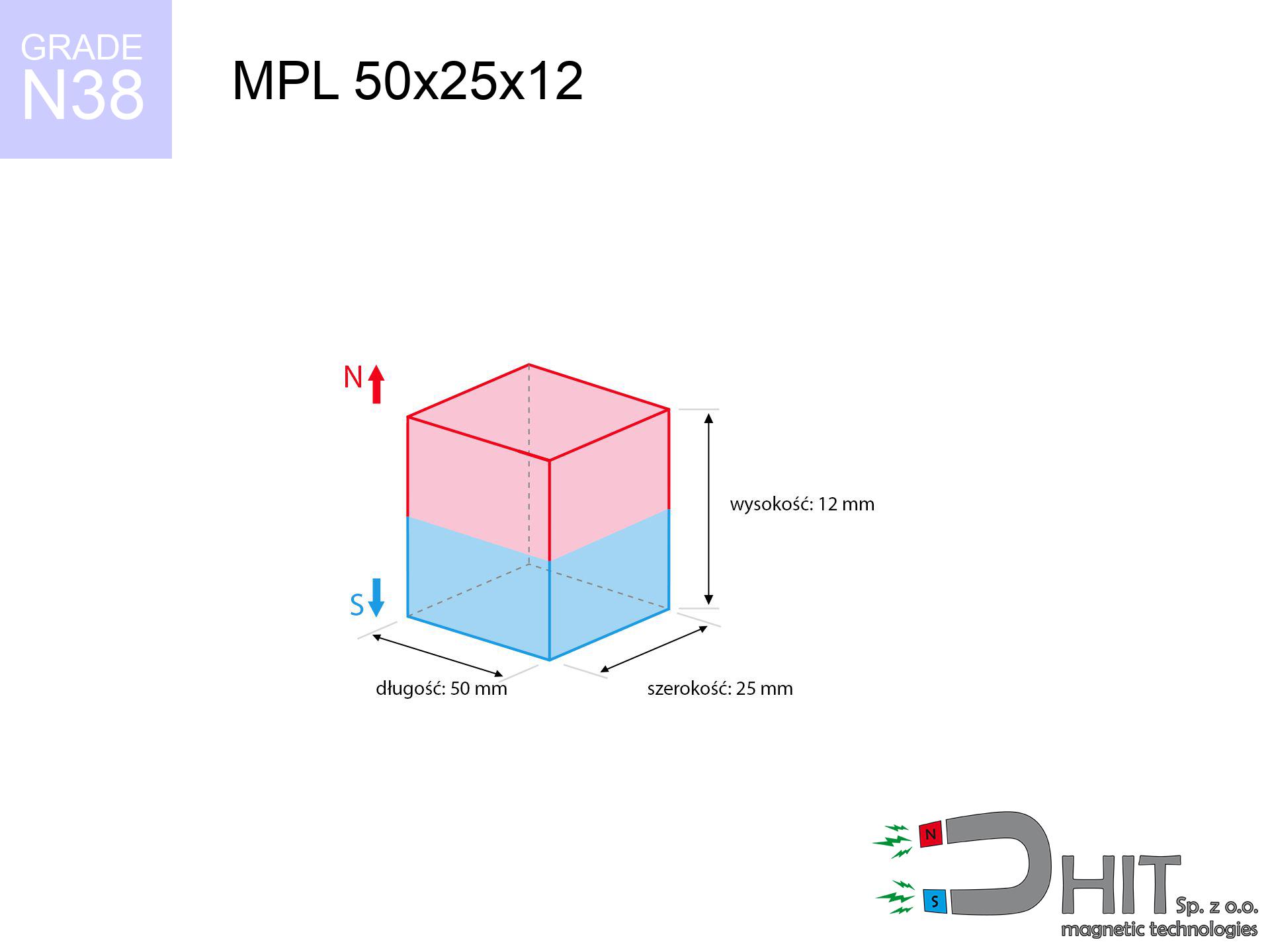
MPL 50x25x12 / N38 - lamellar magnet
lamellar magnet
Catalog no 020343
GTIN/EAN: 5906301811855
- length
- 50 mm [±0,1 mm]
- Width
- 25 mm [±0,1 mm]
- Height
- 12 mm [±0,1 mm]
- Weight
- 112.5 g
- Magnetization Direction
- ↑ axial
- Coating
- [NiCuNi] Nickel
How we measure these parameters — certificates and measurements
37.00 zł net / pcs
45.51 zł with VAT (23% VAT) / pcs
bulk discounts:
Need more?Frequently asked questions
What pull rating should I choose for a workshop block magnet?
Are block neodymium magnets available in more durable versions?
How should I choose block magnets for mounting a structure?
Engineering report for this magnet
Full PDF analysis: pull and shear force, effect of distance, temperature and plate thickness, safety distances and the demagnetization curve.
Call us now
+48 888 99 98 98
alternatively let us know using
contact form
the contact section.
Specifications and structure of a neodymium magnet can be estimated using our
power calculator.
Order by 14:00 and we’ll ship today!
Technical - MPL 50x25x12 / N38 - lamellar magnet
Specification / characteristics - MPL 50x25x12 / N38 - lamellar magnet
| properties | values |
|---|---|
| Cat. no. | 020343 |
| GTIN/EAN | 5906301811855 |
| Production/Distribution | Dhit sp. z o.o. |
| Country of origin | Poland / China / Germany |
| Customs code | 85059029 |
| length | 50 mm [±0,1 mm] |
| Width | 25 mm [±0,1 mm] |
| Height | 12 mm [±0,1 mm] |
| Weight | 112.5 g |
| Magnetization Direction | ↑ axial |
| Load capacity ~ ? | 37.12 kg / 364.18 N |
| Magnetic Induction ~ ? | 340.43 mT / 3404 Gs |
| Coating | [NiCuNi] Nickel |
| Manufacturing Tolerance | ±0.1 mm |
Magnetic properties of material N38
| properties | values | units |
|---|---|---|
| Remanence Br ? | 12.2-12.6 | kGs |
| Remanence Br ? | 1220-1260 | mT |
| Coercivity bHc ? | 10.8-11.5 | kOe |
| Coercivity bHc ? | 860-915 | kA/m |
| Intrinsic coercivity iHc | ≥ 12 | kOe |
| Intrinsic coercivity iHc | ≥ 955 | kA/m |
| Energy product BHmax ? | 36-38 | BH max MGOe |
| Energy product BHmax ? | 287-303 | BH max KJ/m |
| Maximum working temperature ? | ≤ 80 | °C |
Physical properties of sintered neodymium magnets Nd2Fe14B at 20°C
| properties | values | units |
|---|---|---|
| Vickers hardness | ≥550 | Hv |
| Density | ≥7.4 | g/cm3 |
| Curie Temperature TC | 310 | °C |
| Curie Temperature TF | 590 | °F |
| Specific resistance | 150 | μΩ⋅cm |
| Bending strength | 250 | MPa |
| Compressive strength | 1000~1100 | MPa |
| Thermal expansion parallel (∥) to orientation (M) | (3-4) x 10-6 | °C-1 |
| Thermal expansion perpendicular (⊥) to orientation (M) | -(1-3) x 10-6 | °C-1 |
| Young's modulus | 1.7 x 10⁴ | kg/mm² |
Physical simulation of the magnet - data
The following data are the direct effect of a mathematical simulation. Values were calculated on models for the material Nd2Fe14B. Operational conditions might slightly differ from theoretical values. Please consider these data as a reference point when designing systems.
Table 1: Static force (pull vs gap) - interaction chart
MPL 50x25x12 / N38
| Distance (mm) | Induction (Gauss) / mT | Pull Force (kg/lbs/g/N) | Risk Status |
|---|---|---|---|
| 0 mm |
3404 Gs
340.4 mT
|
37.12 kg / 81.84 LBS
37120.0 g / 364.1 N
|
critical level |
| 1 mm |
3234 Gs
323.4 mT
|
33.50 kg / 73.86 LBS
33501.5 g / 328.6 N
|
critical level |
| 2 mm |
3052 Gs
305.2 mT
|
29.85 kg / 65.80 LBS
29847.1 g / 292.8 N
|
critical level |
| 3 mm |
2866 Gs
286.6 mT
|
26.32 kg / 58.02 LBS
26317.3 g / 258.2 N
|
critical level |
| 5 mm |
2496 Gs
249.6 mT
|
19.97 kg / 44.02 LBS
19965.4 g / 195.9 N
|
critical level |
| 10 mm |
1702 Gs
170.2 mT
|
9.28 kg / 20.45 LBS
9278.2 g / 91.0 N
|
medium risk |
| 15 mm |
1151 Gs
115.1 mT
|
4.25 kg / 9.36 LBS
4246.0 g / 41.7 N
|
medium risk |
| 20 mm |
792 Gs
79.2 mT
|
2.01 kg / 4.44 LBS
2012.1 g / 19.7 N
|
medium risk |
| 30 mm |
404 Gs
40.4 mT
|
0.52 kg / 1.15 LBS
523.0 g / 5.1 N
|
low risk |
| 50 mm |
137 Gs
13.7 mT
|
0.06 kg / 0.13 LBS
60.1 g / 0.6 N
|
low risk |
Table 2: Sliding load (vertical surface)
MPL 50x25x12 / N38
| Distance (mm) | Friction coefficient | Pull Force (kg/lbs/g/N) |
|---|---|---|
| 0 mm | Stal (~0.2) |
7.42 kg / 16.37 LBS
7424.0 g / 72.8 N
|
| 1 mm | Stal (~0.2) |
6.70 kg / 14.77 LBS
6700.0 g / 65.7 N
|
| 2 mm | Stal (~0.2) |
5.97 kg / 13.16 LBS
5970.0 g / 58.6 N
|
| 3 mm | Stal (~0.2) |
5.26 kg / 11.61 LBS
5264.0 g / 51.6 N
|
| 5 mm | Stal (~0.2) |
3.99 kg / 8.81 LBS
3994.0 g / 39.2 N
|
| 10 mm | Stal (~0.2) |
1.86 kg / 4.09 LBS
1856.0 g / 18.2 N
|
| 15 mm | Stal (~0.2) |
0.85 kg / 1.87 LBS
850.0 g / 8.3 N
|
| 20 mm | Stal (~0.2) |
0.40 kg / 0.89 LBS
402.0 g / 3.9 N
|
| 30 mm | Stal (~0.2) |
0.10 kg / 0.23 LBS
104.0 g / 1.0 N
|
| 50 mm | Stal (~0.2) |
0.01 kg / 0.03 LBS
12.0 g / 0.1 N
|
Table 3: Vertical assembly (shearing) - vertical pull
MPL 50x25x12 / N38
| Surface type | Friction coefficient / % Mocy | Max load (kg/lbs/g/N) |
|---|---|---|
| Raw steel |
µ = 0.3
30% Nominalnej Siły
|
11.14 kg / 24.55 LBS
11136.0 g / 109.2 N
|
| Painted steel (standard) |
µ = 0.2
20% Nominalnej Siły
|
7.42 kg / 16.37 LBS
7424.0 g / 72.8 N
|
| Oily/slippery steel |
µ = 0.1
10% Nominalnej Siły
|
3.71 kg / 8.18 LBS
3712.0 g / 36.4 N
|
| Magnet with anti-slip rubber |
µ = 0.5
50% Nominalnej Siły
|
18.56 kg / 40.92 LBS
18560.0 g / 182.1 N
|
Table 4: Steel thickness (saturation) - power losses
MPL 50x25x12 / N38
| Steel thickness (mm) | % power | Real pull force (kg/lbs/g/N) |
|---|---|---|
| 0.5 mm |
|
1.86 kg / 4.09 LBS
1856.0 g / 18.2 N
|
| 1 mm |
|
4.64 kg / 10.23 LBS
4640.0 g / 45.5 N
|
| 2 mm |
|
9.28 kg / 20.46 LBS
9280.0 g / 91.0 N
|
| 3 mm |
|
13.92 kg / 30.69 LBS
13920.0 g / 136.6 N
|
| 5 mm |
|
23.20 kg / 51.15 LBS
23200.0 g / 227.6 N
|
| 10 mm |
|
37.12 kg / 81.84 LBS
37120.0 g / 364.1 N
|
| 11 mm |
|
37.12 kg / 81.84 LBS
37120.0 g / 364.1 N
|
| 12 mm |
|
37.12 kg / 81.84 LBS
37120.0 g / 364.1 N
|
Table 5: Thermal resistance (material behavior) - power drop
MPL 50x25x12 / N38
| Ambient temp. (°C) | Power loss | Remaining pull (kg/lbs/g/N) | Status |
|---|---|---|---|
| 20 °C | 0.0% |
37.12 kg / 81.84 LBS
37120.0 g / 364.1 N
|
OK |
| 40 °C | -2.2% |
36.30 kg / 80.04 LBS
36303.4 g / 356.1 N
|
OK |
| 60 °C | -4.4% |
35.49 kg / 78.23 LBS
35486.7 g / 348.1 N
|
|
| 80 °C | -6.6% |
34.67 kg / 76.43 LBS
34670.1 g / 340.1 N
|
|
| 100 °C | -28.8% |
26.43 kg / 58.27 LBS
26429.4 g / 259.3 N
|
Table 6: Magnet-Magnet interaction (repulsion) - field collision
MPL 50x25x12 / N38
| Gap (mm) | Attraction (kg/lbs) (N-S) | Shear Force (kg/lbs/g/N) | Repulsion (kg/lbs) (N-N) |
|---|---|---|---|
| 0 mm |
89.28 kg / 196.82 LBS
4 856 Gs
|
13.39 kg / 29.52 LBS
13392 g / 131.4 N
|
N/A |
| 1 mm |
84.99 kg / 187.37 LBS
6 642 Gs
|
12.75 kg / 28.11 LBS
12749 g / 125.1 N
|
76.49 kg / 168.63 LBS
~0 Gs
|
| 2 mm |
80.57 kg / 177.64 LBS
6 467 Gs
|
12.09 kg / 26.65 LBS
12086 g / 118.6 N
|
72.52 kg / 159.87 LBS
~0 Gs
|
| 3 mm |
76.16 kg / 167.90 LBS
6 287 Gs
|
11.42 kg / 25.19 LBS
11424 g / 112.1 N
|
68.54 kg / 151.11 LBS
~0 Gs
|
| 5 mm |
67.49 kg / 148.78 LBS
5 919 Gs
|
10.12 kg / 22.32 LBS
10123 g / 99.3 N
|
60.74 kg / 133.91 LBS
~0 Gs
|
| 10 mm |
48.02 kg / 105.86 LBS
4 992 Gs
|
7.20 kg / 15.88 LBS
7203 g / 70.7 N
|
43.22 kg / 95.28 LBS
~0 Gs
|
| 20 mm |
22.32 kg / 49.20 LBS
3 403 Gs
|
3.35 kg / 7.38 LBS
3347 g / 32.8 N
|
20.08 kg / 44.28 LBS
~0 Gs
|
| 50 mm |
2.41 kg / 5.31 LBS
1 118 Gs
|
0.36 kg / 0.80 LBS
361 g / 3.5 N
|
2.17 kg / 4.78 LBS
~0 Gs
|
| 60 mm |
1.26 kg / 2.77 LBS
808 Gs
|
0.19 kg / 0.42 LBS
189 g / 1.9 N
|
1.13 kg / 2.50 LBS
~0 Gs
|
| 70 mm |
0.69 kg / 1.52 LBS
598 Gs
|
0.10 kg / 0.23 LBS
103 g / 1.0 N
|
0.62 kg / 1.37 LBS
~0 Gs
|
| 80 mm |
0.39 kg / 0.87 LBS
452 Gs
|
0.06 kg / 0.13 LBS
59 g / 0.6 N
|
0.35 kg / 0.78 LBS
~0 Gs
|
| 90 mm |
0.23 kg / 0.52 LBS
349 Gs
|
0.04 kg / 0.08 LBS
35 g / 0.3 N
|
0.21 kg / 0.47 LBS
~0 Gs
|
| 100 mm |
0.14 kg / 0.32 LBS
274 Gs
|
0.02 kg / 0.05 LBS
22 g / 0.2 N
|
0.13 kg / 0.29 LBS
~0 Gs
|
Table 7: Protective zones (implants) - precautionary measures
MPL 50x25x12 / N38
| Object / Device | Limit (Gauss) / mT | Safe distance |
|---|---|---|
| Pacemaker | 5 Gs (0.5 mT) | 17.5 cm |
| Hearing aid | 10 Gs (1.0 mT) | 14.0 cm |
| Timepiece | 20 Gs (2.0 mT) | 11.0 cm |
| Mobile device | 40 Gs (4.0 mT) | 8.5 cm |
| Car key | 50 Gs (5.0 mT) | 8.0 cm |
| Payment card | 400 Gs (40.0 mT) | 3.5 cm |
| HDD hard drive | 600 Gs (60.0 mT) | 2.5 cm |
Table 8: Impact energy (kinetic energy) - warning
MPL 50x25x12 / N38
| Start from (mm) | Speed (km/h) | Energy (J) | Predicted outcome |
|---|---|---|---|
| 10 mm |
21.86 km/h
(6.07 m/s)
|
2.07 J | |
| 30 mm |
24.67 km/h
(6.85 m/s)
|
2.64 J | |
| 50 mm |
24.85 km/h
(6.90 m/s)
|
2.68 J | |
| 100 mm |
24.89 km/h
(6.91 m/s)
|
2.69 J |
Table 9: Coating parameters (durability)
MPL 50x25x12 / N38
| Technical parameter | Value / Description |
|---|---|
| Coating type | [NiCuNi] Nickel |
| Layer structure | Nickel - Copper - Nickel |
| Layer thickness | 10-20 µm |
| Salt spray test (SST) ? | 24 h |
| Recommended environment | Indoors only (dry) |
Table 10: Construction data (Flux)
MPL 50x25x12 / N38
| Parameter | Value | SI Unit / Description |
|---|---|---|
| Magnetic Flux | 42 945 Mx | 429.5 µWb |
| Pc Coefficient | 0.40 | Low (Flat) |
Table 11: Underwater work (magnet fishing)
MPL 50x25x12 / N38
| Environment | Effective steel pull | Effect |
|---|---|---|
| Air (land) | 37.12 kg | Standard |
| Water (riverbed) |
42.50 kg
(+5.38 kg buoyancy gain)
|
+14.5% |
1. Wall mount (shear)
*Note: On a vertical wall, the magnet retains merely approx. 20-30% of its nominal pull.
2. Plate thickness effect
*Thin metal sheet (e.g. computer case) significantly weakens the holding force.
3. Power loss vs temp
N38: the maximum material working temperature is 80°C. Permitted conditions also depend on the shape and magnetic circuit.
4. Demagnetization curve and operating point (B-H)
chart generated for the permeance coefficient Pc (Permeance Coefficient) = 0.40
This simulation demonstrates the magnetic stability of the selected magnet under specific geometric conditions. The solid red line represents the demagnetization curve (material potential), while the dashed blue line is the load line based on the magnet's geometry. The Pc (Permeance Coefficient), also known as the load line slope, is a dimensionless value that describes the relationship between the magnet's shape and its magnetic stability. The intersection of these two lines (the black dot) is the operating point — it determines the actual magnetic flux density generated by the magnet in this specific configuration. A higher Pc value means the magnet is more 'slender' (tall relative to its area), resulting in a higher operating point and better resistance to irreversible demagnetization caused by external fields or temperature. A value of 0.42 is relatively low (typical for flat magnets), meaning the operating point is closer to the 'knee' of the curve — caution is advised when operating at temperatures near the maximum limit to avoid strength loss.
Chemical composition
| iron (Fe) | 64% – 68% |
| neodymium (Nd) | 29% – 32% |
| boron (B) | 1.1% – 1.2% |
| dysprosium (Dy) | 0.5% – 2.0% |
| coating (Ni-Cu-Ni) | < 0.05% |
Ecology and recycling (GPSR)
| recyclability (EoL) | 100% |
| recycled raw materials | ~10% (pre-cons) |
| carbon footprint | low / zredukowany |
| waste code (EWC) | 16 02 16 |
Other deals
![SM 25x300 [2xM8] / N52 - magnetic separator](https://cdn3.dhit.pl/graphics/products/sm-25x300-2xm8-dij.jpg "SM 25x300 [2xM8] / N52 - magnetic separator")

![SM 32x500 [2xM8] / N42 - magnetic separator](https://cdn3.dhit.pl/graphics/products/sm-32x500-2xm8-jan.jpg "SM 32x500 [2xM8] / N42 - magnetic separator")
Strengths and weaknesses of rare earth magnets.
Benefits
- Their strength is durable, and after approximately 10 years it decreases only by ~1% (theoretically),
- They are noted for resistance to demagnetization induced by external field influence,
- The use of an aesthetic coating of noble metals (nickel, gold, silver) causes the element to present itself better,
- The surface of neodymium magnets generates a maximum magnetic field – this is a key feature,
- Made from properly selected components, these magnets show impressive resistance to high heat, enabling them to function (depending on their form) at temperatures up to 230°C and above...
- In view of the possibility of free forming and customization to individualized projects, NdFeB magnets can be modeled in a variety of shapes and sizes, which amplifies use scope,
- Versatile presence in electronics industry – they serve a role in computer drives, motor assemblies, advanced medical instruments, as well as technologically advanced constructions.
- Compactness – despite small sizes they provide effective action, making them ideal for precision applications
Weaknesses
- They are fragile upon heavy impacts. To avoid cracks, it is worth securing magnets using a steel holder. Such protection not only protects the magnet but also increases its resistance to damage
- Do not exceed this material temperature limit: 80°C. Overheating may permanently weaken the magnet.
- Due to the susceptibility of magnets to corrosion in a humid environment, we recommend using waterproof magnets made of rubber, plastic or other material stable to moisture, in case of application outdoors
- We recommend cover - magnetic mount, due to difficulties in producing threads inside the magnet and complex shapes.
- Possible danger resulting from small fragments of magnets pose a threat, when accidentally swallowed, which gains importance in the aspect of protecting the youngest. Additionally, small elements of these products can complicate diagnosis medical in case of swallowing.
- With budget limitations the cost of neodymium magnets is economically unviable,
Holding force characteristics
Maximum magnetic pulling force – what contributes to it?
- on a block made of mild steel, effectively closing the magnetic field
- with a cross-section of at least 10 mm
- with a plane free of scratches
- under conditions of no distance (surface-to-surface)
- during pulling in a direction vertical to the plane
- at room temperature
Determinants of lifting force in real conditions
- Gap between magnet and steel – even a fraction of a millimeter of distance (caused e.g. by varnish or unevenness) drastically reduces the magnet efficiency, often by half at just 0.5 mm.
- Force direction – catalog parameter refers to detachment vertically. When attempting to slide, the magnet holds much less (typically approx. 20-30% of nominal force).
- Wall thickness – the thinner the sheet, the weaker the hold. Magnetic flux penetrates through instead of converting into lifting capacity.
- Metal type – different alloys reacts the same. Alloy additives weaken the interaction with the magnet.
- Surface quality – the smoother and more polished the surface, the larger the contact zone and stronger the hold. Roughness creates an air distance.
- Temperature – heating the magnet results in weakening of force. Check the thermal limit for a given model.
Lifting capacity testing was carried out on a smooth plate of suitable thickness, under perpendicular forces, in contrast under shearing force the lifting capacity is smaller. In addition, even a minimal clearance between the magnet and the plate decreases the lifting capacity.
Warnings
Threat to navigation
A strong magnetic field negatively affects the functioning of magnetometers in phones and GPS navigation. Maintain magnets near a device to prevent breaking the sensors.
Protective goggles
NdFeB magnets are ceramic materials, which means they are very brittle. Clashing of two magnets will cause them shattering into shards.
Immense force
Before starting, check safety instructions. Uncontrolled attraction can break the magnet or injure your hand. Think ahead.
Allergy Warning
Nickel alert: The nickel-copper-nickel coating contains nickel. If skin irritation occurs, immediately stop working with magnets and wear gloves.
Safe distance
Intense magnetic fields can erase data on payment cards, hard drives, and other magnetic media. Keep a distance of at least 10 cm.
Fire warning
Mechanical processing of neodymium magnets poses a fire hazard. Neodymium dust oxidizes rapidly with oxygen and is difficult to extinguish.
Demagnetization risk
Watch the temperature. Heating the magnet to high heat will ruin its magnetic structure and strength.
Life threat
Life threat: Strong magnets can deactivate pacemakers and defibrillators. Stay away if you have medical devices.
Do not give to children
Product intended for adults. Tiny parts pose a choking risk, causing severe trauma. Store away from kids and pets.
Crushing force
Danger of trauma: The attraction force is so immense that it can cause hematomas, pinching, and broken bones. Protective gloves are recommended.
Tabela kosztu i czasu dostawy
Płatność przed wysyłką:

GLS kurier
Przesyłka będzie u Ciebie za 2-3 dni
14.99 ZŁ

InPost Paczkomaty 24/7
Przesyłka będzie u Ciebie za 1-2 dni
12.30 ZŁ
Płatność przy odbiorze (pobranie):
GLS kurier
Przesyłka będzie u Ciebie za 1-2 dni
23.00 ZŁ