


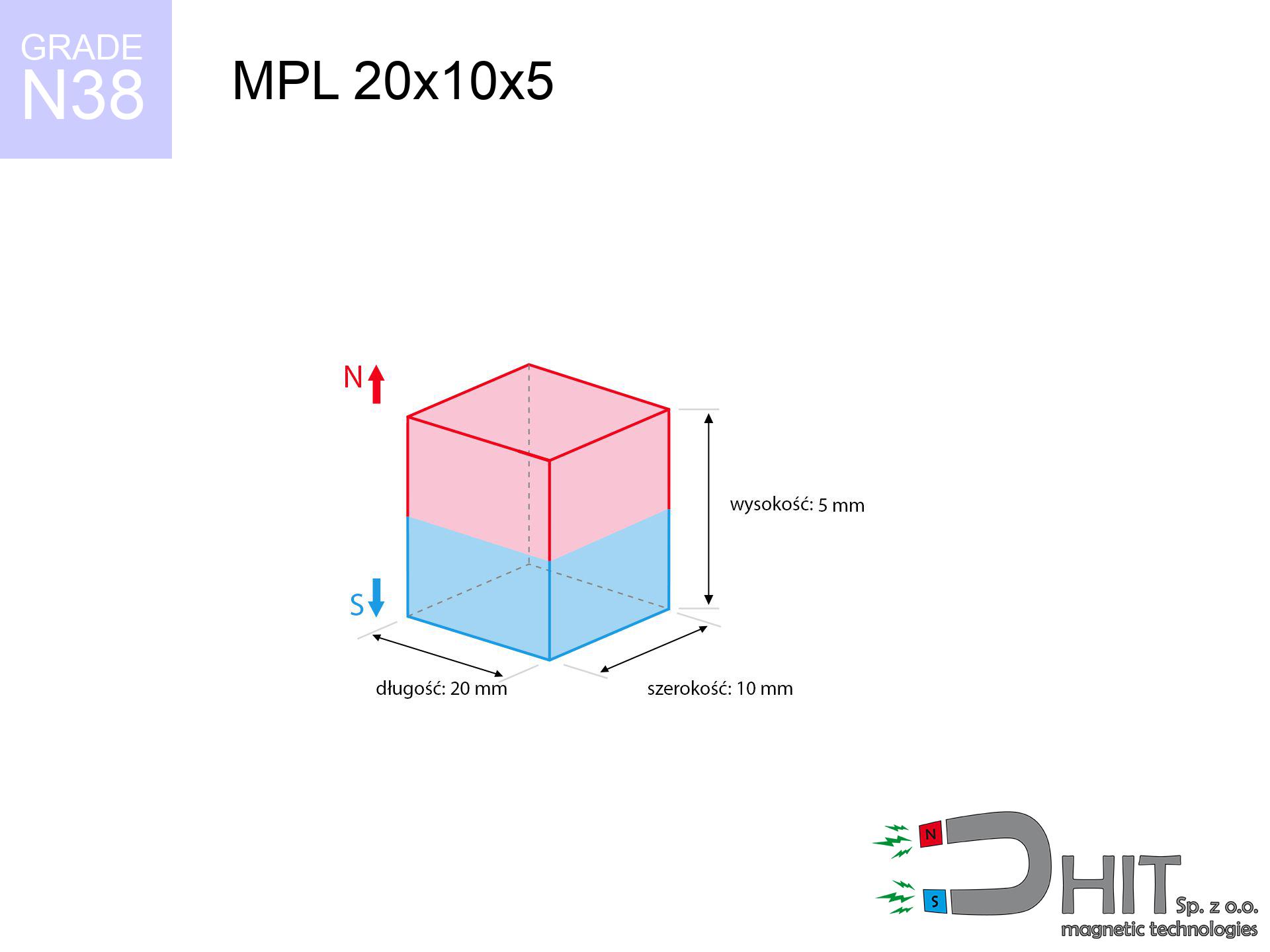
MPL 20x10x5 / N38 - lamellar magnet
lamellar magnet
Catalog no 020128
GTIN/EAN: 5906301811343
- length
- 20 mm [±0,1 mm]
- Width
- 10 mm [±0,1 mm]
- Height
- 5 mm [±0,1 mm]
- Weight
- 7.5 g
- Magnetization Direction
- ↑ axial
- Coating
- [NiCuNi] Nickel
How we measure these parameters — certificates and measurements
4.50 zł net / pcs
5.54 zł with VAT (23% VAT) / pcs
bulk discounts:
Need more?Frequently asked questions
What pull rating should I choose for a workshop block magnet?
Are block neodymium magnets available in more durable versions?
How should I choose block magnets for mounting a structure?
Engineering report for this magnet
Full PDF analysis: pull and shear force, effect of distance, temperature and plate thickness, safety distances and the demagnetization curve.
Call us now
+48 888 99 98 98
alternatively let us know using
contact form
the contact section.
Specifications and structure of a neodymium magnet can be estimated using our
power calculator.
Order by 14:00 and we’ll ship today!
Product card - MPL 20x10x5 / N38 - lamellar magnet
Specification / characteristics - MPL 20x10x5 / N38 - lamellar magnet
| properties | values |
|---|---|
| Cat. no. | 020128 |
| GTIN/EAN | 5906301811343 |
| Production/Distribution | Dhit sp. z o.o. |
| Country of origin | Poland / China / Germany |
| Customs code | 85059029 |
| length | 20 mm [±0,1 mm] |
| Width | 10 mm [±0,1 mm] |
| Height | 5 mm [±0,1 mm] |
| Weight | 7.5 g |
| Magnetization Direction | ↑ axial |
| Load capacity ~ ? | 6.15 kg / 60.31 N |
| Magnetic Induction ~ ? | 349.47 mT / 3495 Gs |
| Coating | [NiCuNi] Nickel |
| Manufacturing Tolerance | ±0.1 mm |
Magnetic properties of material N38
| properties | values | units |
|---|---|---|
| Remanence Br ? | 12.2-12.6 | kGs |
| Remanence Br ? | 1220-1260 | mT |
| Coercivity bHc ? | 10.8-11.5 | kOe |
| Coercivity bHc ? | 860-915 | kA/m |
| Intrinsic coercivity iHc | ≥ 12 | kOe |
| Intrinsic coercivity iHc | ≥ 955 | kA/m |
| Energy product BHmax ? | 36-38 | BH max MGOe |
| Energy product BHmax ? | 287-303 | BH max KJ/m |
| Maximum working temperature ? | ≤ 80 | °C |
Physical properties of sintered neodymium magnets Nd2Fe14B at 20°C
| properties | values | units |
|---|---|---|
| Vickers hardness | ≥550 | Hv |
| Density | ≥7.4 | g/cm3 |
| Curie Temperature TC | 310 | °C |
| Curie Temperature TF | 590 | °F |
| Specific resistance | 150 | μΩ⋅cm |
| Bending strength | 250 | MPa |
| Compressive strength | 1000~1100 | MPa |
| Thermal expansion parallel (∥) to orientation (M) | (3-4) x 10-6 | °C-1 |
| Thermal expansion perpendicular (⊥) to orientation (M) | -(1-3) x 10-6 | °C-1 |
| Young's modulus | 1.7 x 10⁴ | kg/mm² |
Engineering modeling of the product - report
The following information are the result of a physical analysis. Values rely on models for the material Nd2Fe14B. Actual parameters may differ from theoretical values. Please consider these data as a supplementary guide during assembly planning.
Table 1: Static pull force (pull vs gap) - characteristics
MPL 20x10x5 / N38
| Distance (mm) | Induction (Gauss) / mT | Pull Force (kg/lbs/g/N) | Risk Status |
|---|---|---|---|
| 0 mm |
3493 Gs
349.3 mT
|
6.15 kg / 13.56 pounds
6150.0 g / 60.3 N
|
warning |
| 1 mm |
3035 Gs
303.5 mT
|
4.64 kg / 10.23 pounds
4641.8 g / 45.5 N
|
warning |
| 2 mm |
2558 Gs
255.8 mT
|
3.30 kg / 7.27 pounds
3298.0 g / 32.4 N
|
warning |
| 3 mm |
2120 Gs
212.0 mT
|
2.26 kg / 4.99 pounds
2264.8 g / 22.2 N
|
warning |
| 5 mm |
1433 Gs
143.3 mT
|
1.03 kg / 2.28 pounds
1034.5 g / 10.1 N
|
weak grip |
| 10 mm |
574 Gs
57.4 mT
|
0.17 kg / 0.37 pounds
166.1 g / 1.6 N
|
weak grip |
| 15 mm |
267 Gs
26.7 mT
|
0.04 kg / 0.08 pounds
35.9 g / 0.4 N
|
weak grip |
| 20 mm |
141 Gs
14.1 mT
|
0.01 kg / 0.02 pounds
10.1 g / 0.1 N
|
weak grip |
| 30 mm |
52 Gs
5.2 mT
|
0.00 kg / 0.00 pounds
1.4 g / 0.0 N
|
weak grip |
| 50 mm |
13 Gs
1.3 mT
|
0.00 kg / 0.00 pounds
0.1 g / 0.0 N
|
weak grip |
Table 2: Slippage capacity (wall)
MPL 20x10x5 / N38
| Distance (mm) | Friction coefficient | Pull Force (kg/lbs/g/N) |
|---|---|---|
| 0 mm | Stal (~0.2) |
1.23 kg / 2.71 pounds
1230.0 g / 12.1 N
|
| 1 mm | Stal (~0.2) |
0.93 kg / 2.05 pounds
928.0 g / 9.1 N
|
| 2 mm | Stal (~0.2) |
0.66 kg / 1.46 pounds
660.0 g / 6.5 N
|
| 3 mm | Stal (~0.2) |
0.45 kg / 1.00 pounds
452.0 g / 4.4 N
|
| 5 mm | Stal (~0.2) |
0.21 kg / 0.45 pounds
206.0 g / 2.0 N
|
| 10 mm | Stal (~0.2) |
0.03 kg / 0.07 pounds
34.0 g / 0.3 N
|
| 15 mm | Stal (~0.2) |
0.01 kg / 0.02 pounds
8.0 g / 0.1 N
|
| 20 mm | Stal (~0.2) |
0.00 kg / 0.00 pounds
2.0 g / 0.0 N
|
| 30 mm | Stal (~0.2) |
0.00 kg / 0.00 pounds
0.0 g / 0.0 N
|
| 50 mm | Stal (~0.2) |
0.00 kg / 0.00 pounds
0.0 g / 0.0 N
|
Table 3: Wall mounting (sliding) - behavior on slippery surfaces
MPL 20x10x5 / N38
| Surface type | Friction coefficient / % Mocy | Max load (kg/lbs/g/N) |
|---|---|---|
| Raw steel |
µ = 0.3
30% Nominalnej Siły
|
1.85 kg / 4.07 pounds
1845.0 g / 18.1 N
|
| Painted steel (standard) |
µ = 0.2
20% Nominalnej Siły
|
1.23 kg / 2.71 pounds
1230.0 g / 12.1 N
|
| Oily/slippery steel |
µ = 0.1
10% Nominalnej Siły
|
0.62 kg / 1.36 pounds
615.0 g / 6.0 N
|
| Magnet with anti-slip rubber |
µ = 0.5
50% Nominalnej Siły
|
3.08 kg / 6.78 pounds
3075.0 g / 30.2 N
|
Table 4: Steel thickness (saturation) - sheet metal selection
MPL 20x10x5 / N38
| Steel thickness (mm) | % power | Real pull force (kg/lbs/g/N) |
|---|---|---|
| 0.5 mm |
|
0.62 kg / 1.36 pounds
615.0 g / 6.0 N
|
| 1 mm |
|
1.54 kg / 3.39 pounds
1537.5 g / 15.1 N
|
| 2 mm |
|
3.08 kg / 6.78 pounds
3075.0 g / 30.2 N
|
| 3 mm |
|
4.61 kg / 10.17 pounds
4612.5 g / 45.2 N
|
| 5 mm |
|
6.15 kg / 13.56 pounds
6150.0 g / 60.3 N
|
| 10 mm |
|
6.15 kg / 13.56 pounds
6150.0 g / 60.3 N
|
| 11 mm |
|
6.15 kg / 13.56 pounds
6150.0 g / 60.3 N
|
| 12 mm |
|
6.15 kg / 13.56 pounds
6150.0 g / 60.3 N
|
Table 5: Thermal stability (stability) - thermal limit
MPL 20x10x5 / N38
| Ambient temp. (°C) | Power loss | Remaining pull (kg/lbs/g/N) | Status |
|---|---|---|---|
| 20 °C | 0.0% |
6.15 kg / 13.56 pounds
6150.0 g / 60.3 N
|
OK |
| 40 °C | -2.2% |
6.01 kg / 13.26 pounds
6014.7 g / 59.0 N
|
OK |
| 60 °C | -4.4% |
5.88 kg / 12.96 pounds
5879.4 g / 57.7 N
|
|
| 80 °C | -6.6% |
5.74 kg / 12.66 pounds
5744.1 g / 56.3 N
|
|
| 100 °C | -28.8% |
4.38 kg / 9.65 pounds
4378.8 g / 43.0 N
|
Table 6: Two magnets (attraction) - forces in the system
MPL 20x10x5 / N38
| Gap (mm) | Attraction (kg/lbs) (N-S) | Sliding Force (kg/lbs/g/N) | Repulsion (kg/lbs) (N-N) |
|---|---|---|---|
| 0 mm |
15.04 kg / 33.17 pounds
4 923 Gs
|
2.26 kg / 4.98 pounds
2257 g / 22.1 N
|
N/A |
| 1 mm |
13.20 kg / 29.11 pounds
6 544 Gs
|
1.98 kg / 4.37 pounds
1980 g / 19.4 N
|
11.88 kg / 26.19 pounds
~0 Gs
|
| 2 mm |
11.36 kg / 25.03 pounds
6 069 Gs
|
1.70 kg / 3.76 pounds
1703 g / 16.7 N
|
10.22 kg / 22.53 pounds
~0 Gs
|
| 3 mm |
9.63 kg / 21.22 pounds
5 588 Gs
|
1.44 kg / 3.18 pounds
1444 g / 14.2 N
|
8.66 kg / 19.10 pounds
~0 Gs
|
| 5 mm |
6.71 kg / 14.78 pounds
4 664 Gs
|
1.01 kg / 2.22 pounds
1006 g / 9.9 N
|
6.03 kg / 13.30 pounds
~0 Gs
|
| 10 mm |
2.53 kg / 5.58 pounds
2 865 Gs
|
0.38 kg / 0.84 pounds
380 g / 3.7 N
|
2.28 kg / 5.02 pounds
~0 Gs
|
| 20 mm |
0.41 kg / 0.90 pounds
1 148 Gs
|
0.06 kg / 0.13 pounds
61 g / 0.6 N
|
0.37 kg / 0.81 pounds
~0 Gs
|
| 50 mm |
0.01 kg / 0.02 pounds
165 Gs
|
0.00 kg / 0.00 pounds
1 g / 0.0 N
|
0.00 kg / 0.00 pounds
~0 Gs
|
| 60 mm |
0.00 kg / 0.01 pounds
104 Gs
|
0.00 kg / 0.00 pounds
0 g / 0.0 N
|
0.00 kg / 0.00 pounds
~0 Gs
|
| 70 mm |
0.00 kg / 0.00 pounds
69 Gs
|
0.00 kg / 0.00 pounds
0 g / 0.0 N
|
0.00 kg / 0.00 pounds
~0 Gs
|
| 80 mm |
0.00 kg / 0.00 pounds
48 Gs
|
0.00 kg / 0.00 pounds
0 g / 0.0 N
|
0.00 kg / 0.00 pounds
~0 Gs
|
| 90 mm |
0.00 kg / 0.00 pounds
35 Gs
|
0.00 kg / 0.00 pounds
0 g / 0.0 N
|
0.00 kg / 0.00 pounds
~0 Gs
|
| 100 mm |
0.00 kg / 0.00 pounds
26 Gs
|
0.00 kg / 0.00 pounds
0 g / 0.0 N
|
0.00 kg / 0.00 pounds
~0 Gs
|
Table 7: Hazards (electronics) - warnings
MPL 20x10x5 / N38
| Object / Device | Limit (Gauss) / mT | Safe distance |
|---|---|---|
| Pacemaker | 5 Gs (0.5 mT) | 7.5 cm |
| Hearing aid | 10 Gs (1.0 mT) | 6.0 cm |
| Mechanical watch | 20 Gs (2.0 mT) | 4.5 cm |
| Phone / Smartphone | 40 Gs (4.0 mT) | 3.5 cm |
| Car key | 50 Gs (5.0 mT) | 3.5 cm |
| Payment card | 400 Gs (40.0 mT) | 1.5 cm |
| HDD hard drive | 600 Gs (60.0 mT) | 1.0 cm |
Table 8: Dynamics (cracking risk) - warning
MPL 20x10x5 / N38
| Start from (mm) | Speed (km/h) | Energy (J) | Predicted outcome |
|---|---|---|---|
| 10 mm |
24.41 km/h
(6.78 m/s)
|
0.17 J | |
| 30 mm |
24.80 km/h
(6.89 m/s)
|
0.18 J | |
| 50 mm |
24.80 km/h
(6.89 m/s)
|
0.18 J | |
| 100 mm |
24.80 km/h
(6.89 m/s)
|
0.18 J |
Table 9: Anti-corrosion coating durability
MPL 20x10x5 / N38
| Technical parameter | Value / Description |
|---|---|
| Coating type | [NiCuNi] Nickel |
| Layer structure | Nickel - Copper - Nickel |
| Layer thickness | 10-20 µm |
| Salt spray test (SST) ? | 24 h |
| Recommended environment | Indoors only (dry) |
Table 10: Electrical data (Pc)
MPL 20x10x5 / N38
| Parameter | Value | SI Unit / Description |
|---|---|---|
| Magnetic Flux | 7 031 Mx | 70.3 µWb |
| Pc Coefficient | 0.42 | Low (Flat) |
Table 11: Physics of underwater searching
MPL 20x10x5 / N38
| Environment | Effective steel pull | Effect |
|---|---|---|
| Air (land) | 6.15 kg | Standard |
| Water (riverbed) |
7.04 kg
(+0.89 kg buoyancy gain)
|
+14.5% |
1. Shear force
*Note: On a vertical wall, the magnet retains just approx. 20-30% of its max power.
2. Steel saturation
*Thin steel (e.g. 0.5mm PC case) severely weakens the holding force.
3. Power loss vs temp
N38: the maximum material working temperature is 80°C. Permitted conditions also depend on the shape and magnetic circuit.
4. Demagnetization curve and operating point (B-H)
chart generated for the permeance coefficient Pc (Permeance Coefficient) = 0.42
The chart above illustrates the magnetic characteristics of the material within the second quadrant of the hysteresis loop. The solid red line represents the demagnetization curve (material potential), while the dashed blue line is the load line based on the magnet's geometry. The Pc (Permeance Coefficient), also known as the load line slope, is a dimensionless value that describes the relationship between the magnet's shape and its magnetic stability. The intersection of these two lines (the black dot) is the operating point — it determines the actual magnetic flux density generated by the magnet in this specific configuration. A higher Pc value means the magnet is more 'slender' (tall relative to its area), resulting in a higher operating point and better resistance to irreversible demagnetization caused by external fields or temperature. A value of 0.42 is relatively low (typical for flat magnets), meaning the operating point is closer to the 'knee' of the curve — caution is advised when operating at temperatures near the maximum limit to avoid strength loss.
Material specification
| iron (Fe) | 64% – 68% |
| neodymium (Nd) | 29% – 32% |
| boron (B) | 1.1% – 1.2% |
| dysprosium (Dy) | 0.5% – 2.0% |
| coating (Ni-Cu-Ni) | < 0.05% |
Sustainability
| recyclability (EoL) | 100% |
| recycled raw materials | ~10% (pre-cons) |
| carbon footprint | low / zredukowany |
| waste code (EWC) | 16 02 16 |
Check out more offers
![UMGW 20x15x7 [M4] GW / N38 - magnetic holder internal thread](https://cdn3.dhit.pl/graphics/products/um-20x15x7-m4-gw-big.jpg "UMGW 20x15x7 [M4] GW / N38 - magnetic holder internal thread")
![SM 32x250 [2xM8] / N52 - magnetic separator](https://cdn3.dhit.pl/graphics/products/sm-32x250-2xm8-guf.jpg "SM 32x250 [2xM8] / N52 - magnetic separator")
![UI 45x13x6 [Z323] / N38 - badge holder](https://cdn3.dhit.pl/graphics/products/ui45x13x6-z323-fap.jpg "UI 45x13x6 [Z323] / N38 - badge holder")
Advantages and disadvantages of neodymium magnets.
Advantages
- They retain full power for almost 10 years – the loss is just ~1% (based on simulations),
- They are resistant to demagnetization induced by presence of other magnetic fields,
- A magnet with a metallic nickel surface has an effective appearance,
- Magnets are distinguished by excellent magnetic induction on the working surface,
- Made from properly selected components, these magnets show impressive resistance to high heat, enabling them to function (depending on their form) at temperatures up to 230°C and above...
- Considering the potential of flexible shaping and adaptation to unique solutions, neodymium magnets can be produced in a broad palette of forms and dimensions, which expands the range of possible applications,
- Wide application in high-tech industry – they are utilized in magnetic memories, electric drive systems, medical equipment, and technologically advanced constructions.
- Compactness – despite small sizes they offer powerful magnetic field, making them ideal for precision applications
Limitations
- At very strong impacts they can break, therefore we advise placing them in steel cases. A metal housing provides additional protection against damage and increases the magnet's durability.
- Do not exceed this material temperature limit: 80°C. Overheating may permanently weaken the magnet.
- Magnets exposed to a humid environment can corrode. Therefore during using outdoors, we suggest using water-impermeable magnets made of rubber, plastic or other material protecting against moisture
- We suggest cover - magnetic mechanism, due to difficulties in realizing nuts inside the magnet and complex forms.
- Possible danger to health – tiny shards of magnets pose a threat, in case of ingestion, which gains importance in the context of child health protection. Furthermore, tiny parts of these magnets are able to complicate diagnosis medical in case of swallowing.
- With large orders the cost of neodymium magnets is economically unviable,
Holding force characteristics
Maximum magnetic pulling force – what it depends on?
- using a plate made of low-carbon steel, functioning as a ideal flux conductor
- whose thickness equals approx. 10 mm
- with a plane cleaned and smooth
- under conditions of no distance (surface-to-surface)
- during pulling in a direction perpendicular to the mounting surface
- in neutral thermal conditions
Magnet lifting force in use – key factors
- Distance (betwixt the magnet and the metal), because even a tiny clearance (e.g. 0.5 mm) leads to a reduction in lifting capacity by up to 50% (this also applies to varnish, rust or debris).
- Force direction – declared lifting capacity refers to detachment vertically. When attempting to slide, the magnet holds much less (typically approx. 20-30% of maximum force).
- Wall thickness – thin material does not allow full use of the magnet. Magnetic flux passes through the material instead of generating force.
- Material type – the best choice is high-permeability steel. Cast iron may attract less.
- Surface structure – the more even the surface, the better the adhesion and higher the lifting capacity. Roughness acts like micro-gaps.
- Temperature influence – hot environment reduces magnetic field. Exceeding the limit temperature can permanently damage the magnet.
Holding force was measured on a smooth steel plate of 20 mm thickness, when the force acted perpendicularly, however under parallel forces the load capacity is reduced by as much as 75%. In addition, even a small distance between the magnet’s surface and the plate decreases the lifting capacity.
Precautions when working with NdFeB magnets
Allergic reactions
Warning for allergy sufferers: The Ni-Cu-Ni coating consists of nickel. If an allergic reaction occurs, cease handling magnets and wear gloves.
Precision electronics
Note: rare earth magnets generate a field that interferes with sensitive sensors. Keep a safe distance from your phone, device, and navigation systems.
Implant safety
Life threat: Neodymium magnets can turn off pacemakers and defibrillators. Do not approach if you have medical devices.
Electronic hazard
Equipment safety: Neodymium magnets can ruin data carriers and sensitive devices (pacemakers, medical aids, timepieces).
Combustion hazard
Mechanical processing of NdFeB material carries a risk of fire hazard. Magnetic powder oxidizes rapidly with oxygen and is difficult to extinguish.
Swallowing risk
Absolutely keep magnets out of reach of children. Ingestion danger is significant, and the consequences of magnets clamping inside the body are very dangerous.
Powerful field
Be careful. Neodymium magnets act from a distance and snap with huge force, often quicker than you can move away.
Shattering risk
Despite metallic appearance, neodymium is delicate and cannot withstand shocks. Avoid impacts, as the magnet may shatter into sharp, dangerous pieces.
Do not overheat magnets
Watch the temperature. Exposing the magnet above 80 degrees Celsius will destroy its magnetic structure and pulling force.
Pinching danger
Protect your hands. Two powerful magnets will snap together instantly with a force of massive weight, destroying everything in their path. Be careful!
Tabela kosztu i czasu dostawy
Płatność przed wysyłką:

GLS kurier
Przesyłka będzie u Ciebie za 2-3 dni
14.99 ZŁ

InPost Paczkomaty 24/7
Przesyłka będzie u Ciebie za 1-2 dni
12.30 ZŁ
Płatność przy odbiorze (pobranie):
GLS kurier
Przesyłka będzie u Ciebie za 1-2 dni
23.00 ZŁ