


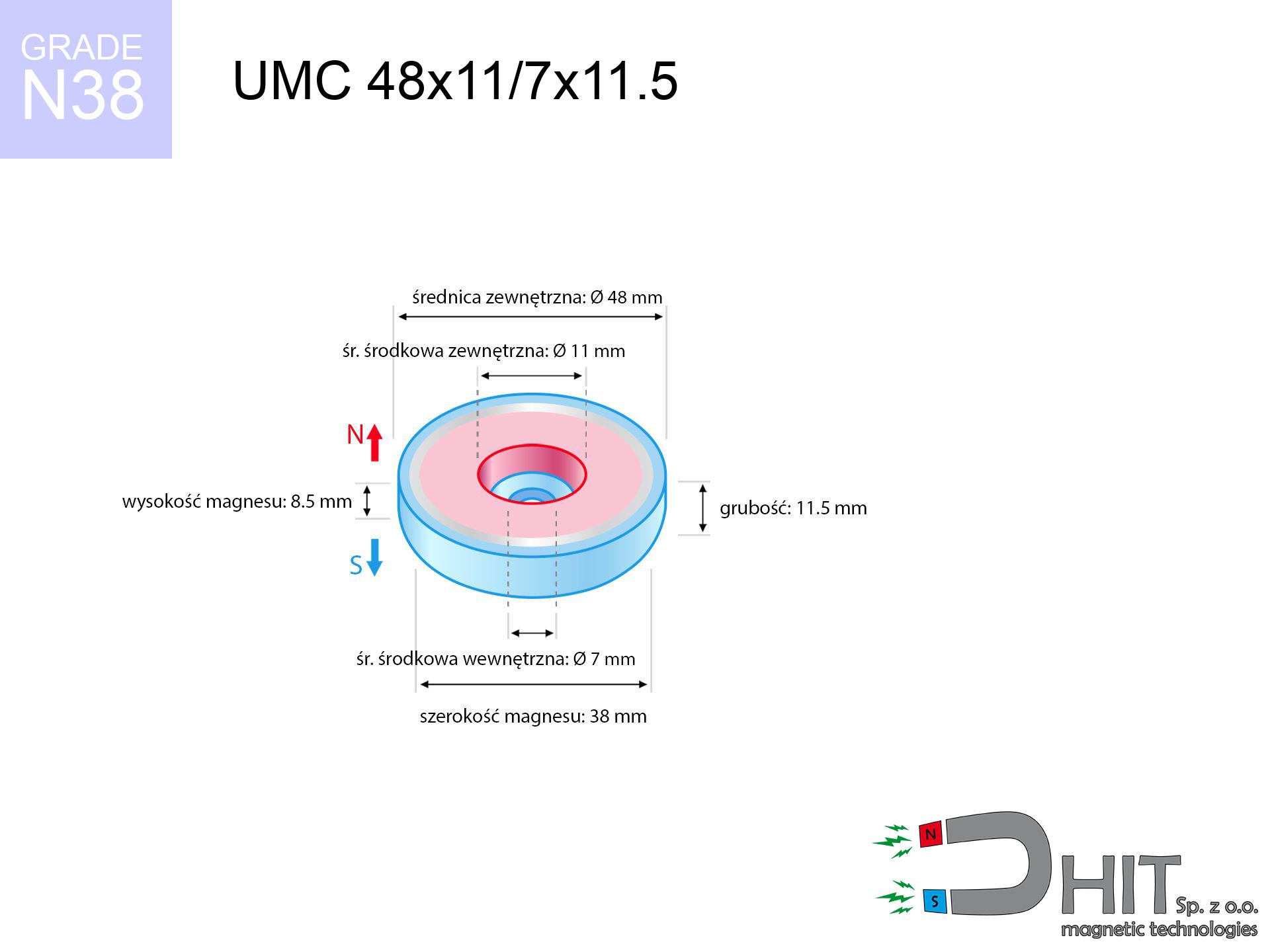
UMC 48x11/7x11.5 / N38 - cylindrical magnetic holder
cylindrical magnetic holder
Catalog no 320412
GTIN/EAN: 5906301814689
- Diameter
- 48 mm [±1 mm]
- internal diameter Ø
- 11/7 mm [±1 mm]
- Height
- 11.5 mm [±1 mm]
- Weight
- 114 g
- Magnetization Direction
- ↑ axial
- Coating
- [NiCuNi] Nickel
How we measure these parameters — certificates and measurements
36.67 zł net / pcs
45.10 zł with VAT (23% VAT) / pcs
bulk discounts:
Need more?Frequently asked questions
Which magnetic holder is suitable for moving metal parts in a workshop?
How do I choose a holder for hanging a heavy item and check its real grip?
Which magnetic holders can be used outdoors?
How should I choose a strong threaded holder for field work?
Call us now
+48 888 99 98 98
alternatively let us know using
contact form
the contact section.
Specifications and structure of a neodymium magnet can be estimated using our
power calculator.
Order by 14:00 and we’ll ship today!
Technical of the product - UMC 48x11/7x11.5 / N38 - cylindrical magnetic holder
Specification / characteristics - UMC 48x11/7x11.5 / N38 - cylindrical magnetic holder
| properties | values |
|---|---|
| Cat. no. | 320412 |
| GTIN/EAN | 5906301814689 |
| Production/Distribution | Dhit sp. z o.o. |
| Country of origin | Poland / China / Germany |
| Customs code | 85059029 |
| Diameter | 48 mm [±1 mm] |
| internal diameter Ø | 11/7 mm [±1 mm] |
| Height | 11.5 mm [±1 mm] |
| Weight | 114 g |
| Magnetization Direction | ↑ axial |
| Load capacity ~ ? | 63.00 kg / 617.82 N |
| Coating | [NiCuNi] Nickel |
| Manufacturing Tolerance | ±1 mm |
Magnetic properties of material N38
| properties | values | units |
|---|---|---|
| Remanence Br ? | 12.2-12.6 | kGs |
| Remanence Br ? | 1220-1260 | mT |
| Coercivity bHc ? | 10.8-11.5 | kOe |
| Coercivity bHc ? | 860-915 | kA/m |
| Intrinsic coercivity iHc | ≥ 12 | kOe |
| Intrinsic coercivity iHc | ≥ 955 | kA/m |
| Energy product BHmax ? | 36-38 | BH max MGOe |
| Energy product BHmax ? | 287-303 | BH max KJ/m |
| Maximum working temperature ? | ≤ 80 | °C |
Physical properties of sintered neodymium magnets Nd2Fe14B at 20°C
| properties | values | units |
|---|---|---|
| Vickers hardness | ≥550 | Hv |
| Density | ≥7.4 | g/cm3 |
| Curie Temperature TC | 310 | °C |
| Curie Temperature TF | 590 | °F |
| Specific resistance | 150 | μΩ⋅cm |
| Bending strength | 250 | MPa |
| Compressive strength | 1000~1100 | MPa |
| Thermal expansion parallel (∥) to orientation (M) | (3-4) x 10-6 | °C-1 |
| Thermal expansion perpendicular (⊥) to orientation (M) | -(1-3) x 10-6 | °C-1 |
| Young's modulus | 1.7 x 10⁴ | kg/mm² |
Chemical composition
| iron (Fe) | 64% – 68% |
| neodymium (Nd) | 29% – 32% |
| boron (B) | 1.1% – 1.2% |
| dysprosium (Dy) | 0.5% – 2.0% |
| coating (Ni-Cu-Ni) | < 0.05% |
Ecology and recycling (GPSR)
| recyclability (EoL) | 100% |
| recycled raw materials | ~10% (pre-cons) |
| carbon footprint | low / zredukowany |
| waste code (EWC) | 16 02 16 |
View more proposals

![SM 32x425 [2xM8] / N52 - magnetic separator](https://cdn3.dhit.pl/graphics/products/sm-32x425-2xm8-tas.jpg "SM 32x425 [2xM8] / N52 - magnetic separator")
![SM 32x475 [2xM8] / N42 - magnetic separator](https://cdn3.dhit.pl/graphics/products/sm-32x475-2xm8-jot.jpg "SM 32x475 [2xM8] / N42 - magnetic separator")
Advantages and disadvantages of rare earth magnets.
Pros
- They do not lose magnetism, even over around ten years – the reduction in strength is only ~1% (according to tests),
- Magnets effectively defend themselves against loss of magnetization caused by external fields,
- The use of an elegant layer of noble metals (nickel, gold, silver) causes the element to present itself better,
- Magnets are distinguished by impressive magnetic induction on the working surface,
- Neodymium magnets are characterized by very high magnetic induction on the magnet surface and can function (depending on the form) even at a temperature of 230°C or more...
- Possibility of precise creating as well as adapting to individual conditions,
- Significant place in high-tech industry – they are commonly used in HDD drives, electromotive mechanisms, advanced medical instruments, also complex engineering applications.
- Compactness – despite small sizes they provide effective action, making them ideal for precision applications
Cons
- To avoid cracks upon strong impacts, we recommend using special steel housings. Such a solution secures the magnet and simultaneously improves its durability.
- Do not exceed this material temperature limit: 80°C. Overheating may permanently weaken the magnet.
- Due to the susceptibility of magnets to corrosion in a humid environment, we recommend using waterproof magnets made of rubber, plastic or other material resistant to moisture, in case of application outdoors
- Due to limitations in creating nuts and complex forms in magnets, we propose using a housing - magnetic holder.
- Health risk related to microscopic parts of magnets are risky, when accidentally swallowed, which becomes key in the aspect of protecting the youngest. It is also worth noting that small components of these devices can disrupt the diagnostic process medical after entering the body.
- Due to complex production process, their price exceeds standard values,
Pull force analysis
Maximum lifting force for a neodymium magnet – what contributes to it?
- on a block made of mild steel, effectively closing the magnetic flux
- possessing a thickness of at least 10 mm to avoid saturation
- with an ground contact surface
- with zero gap (no paint)
- under vertical force direction (90-degree angle)
- at temperature room level
Lifting capacity in practice – influencing factors
- Distance – existence of any layer (rust, dirt, air) acts as an insulator, which lowers power steeply (even by 50% at 0.5 mm).
- Pull-off angle – note that the magnet has greatest strength perpendicularly. Under sliding down, the capacity drops significantly, often to levels of 20-30% of the nominal value.
- Steel thickness – too thin steel does not accept the full field, causing part of the power to be lost to the other side.
- Material type – ideal substrate is pure iron steel. Stainless steels may attract less.
- Smoothness – full contact is possible only on polished steel. Any scratches and bumps create air cushions, weakening the magnet.
- Thermal factor – high temperature weakens pulling force. Exceeding the limit temperature can permanently damage the magnet.
Holding force was measured on a smooth steel plate of 20 mm thickness, when the force acted perpendicularly, whereas under shearing force the load capacity is reduced by as much as 5 times. Moreover, even a slight gap between the magnet’s surface and the plate decreases the holding force.
Safety rules for work with neodymium magnets
Keep away from electronics
Navigation devices and smartphones are extremely sensitive to magnetic fields. Close proximity with a strong magnet can decalibrate the internal compass in your phone.
Pinching danger
Big blocks can smash fingers in a fraction of a second. Never put your hand betwixt two strong magnets.
Cards and drives
Equipment safety: Strong magnets can damage payment cards and sensitive devices (pacemakers, medical aids, mechanical watches).
Fire risk
Dust created during grinding of magnets is flammable. Avoid drilling into magnets without proper cooling and knowledge.
Respect the power
Use magnets with awareness. Their immense force can shock even professionals. Plan your moves and respect their force.
Do not give to children
Only for adults. Tiny parts can be swallowed, leading to intestinal necrosis. Store away from children and animals.
Maximum temperature
Regular neodymium magnets (N-type) lose power when the temperature surpasses 80°C. Damage is permanent.
Beware of splinters
Watch out for shards. Magnets can fracture upon uncontrolled impact, launching shards into the air. Eye protection is mandatory.
Pacemakers
Patients with a pacemaker have to keep an safe separation from magnets. The magnetism can interfere with the operation of the life-saving device.
Sensitization to coating
Nickel alert: The Ni-Cu-Ni coating consists of nickel. If an allergic reaction occurs, cease working with magnets and use protective gear.
Tabela kosztu i czasu dostawy
Płatność przed wysyłką:

GLS kurier
Przesyłka będzie u Ciebie za 2-3 dni
14.99 ZŁ

InPost Paczkomaty 24/7
Przesyłka będzie u Ciebie za 1-2 dni
12.30 ZŁ
Płatność przy odbiorze (pobranie):
GLS kurier
Przesyłka będzie u Ciebie za 1-2 dni
23.00 ZŁ