

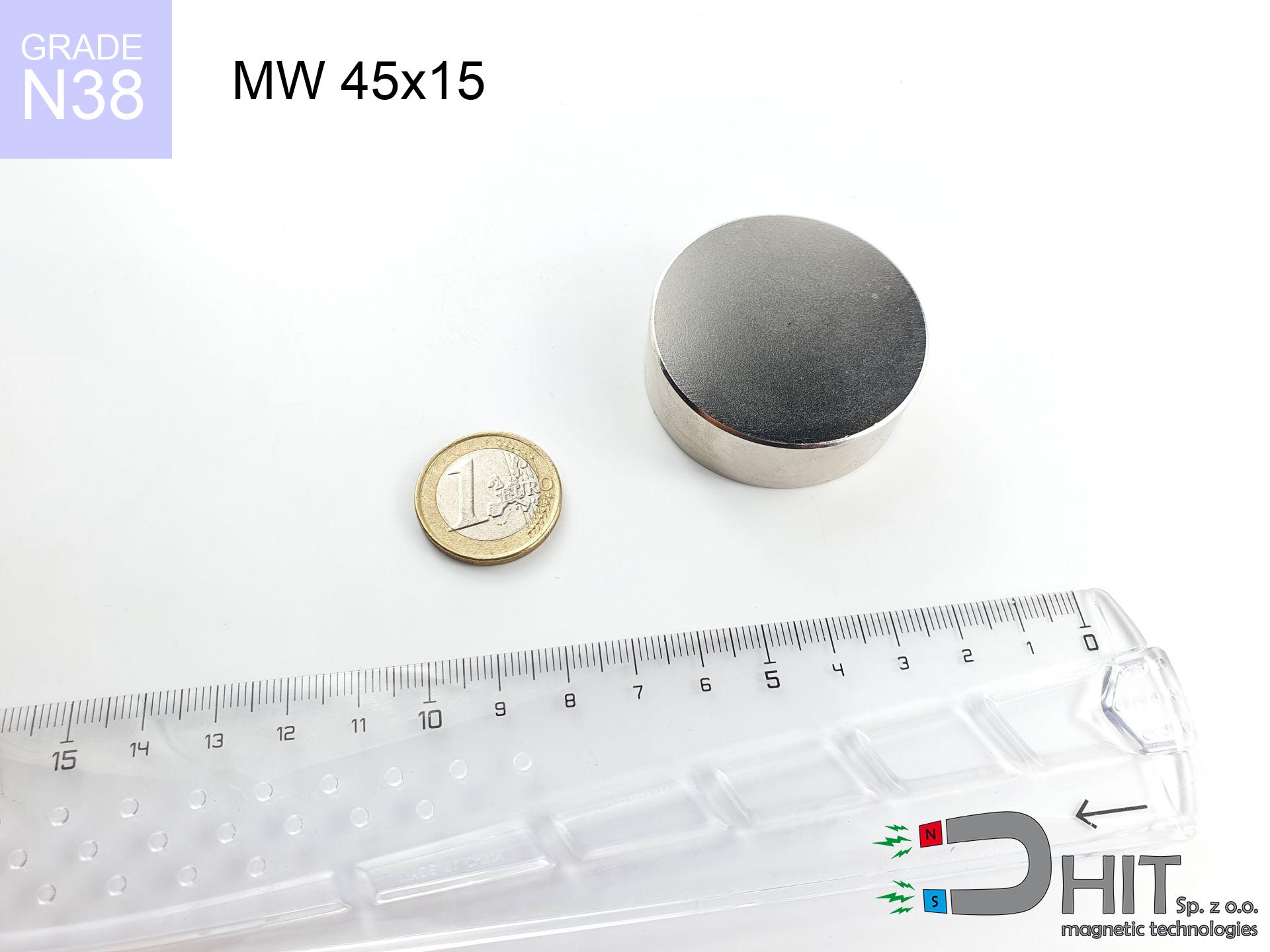
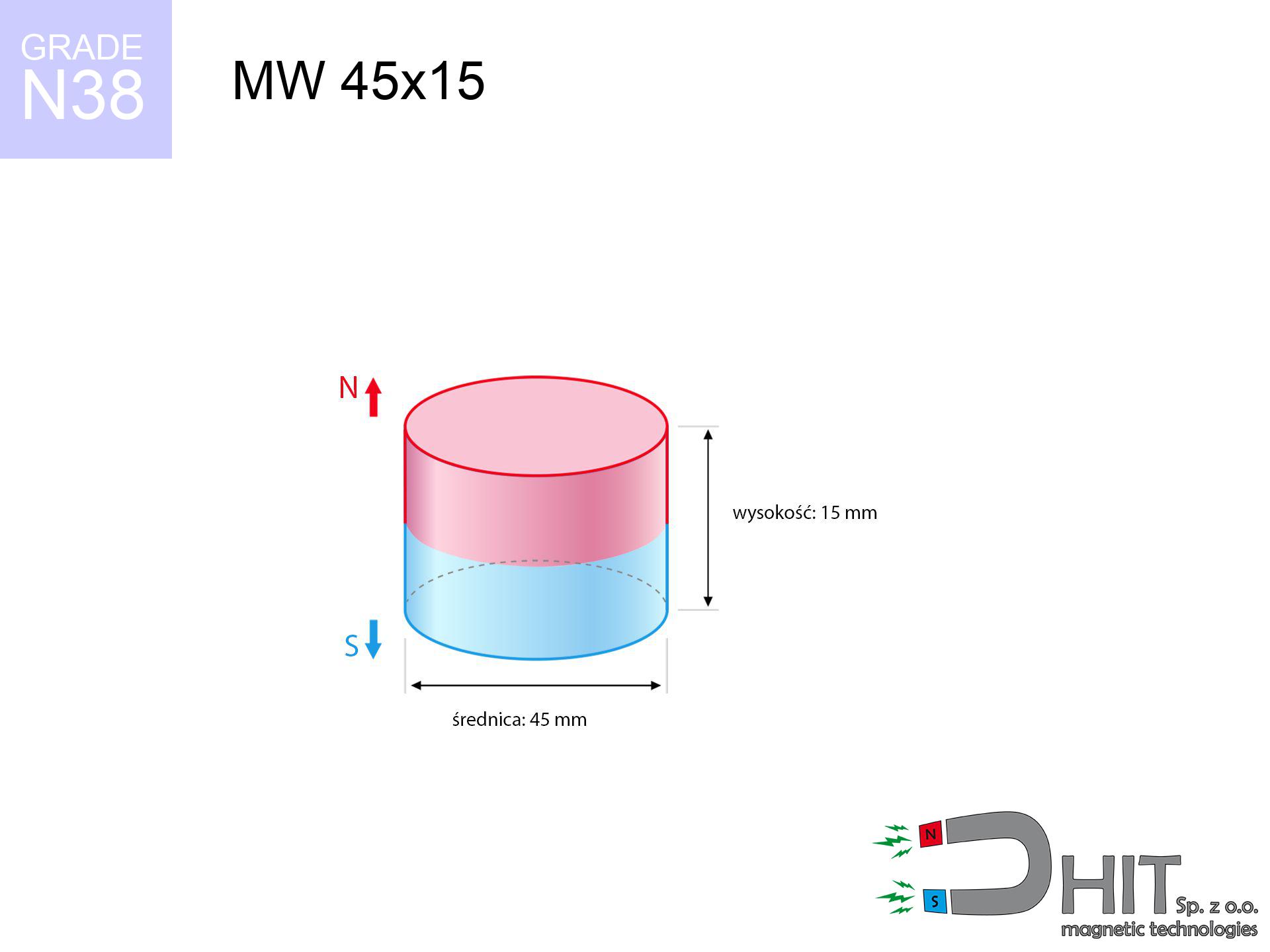
MW 45x15 / N38 - cylindrical magnet
cylindrical magnet
Catalog no 010070
GTIN/EAN: 5906301810698
- Diameter Ø
- 45 mm [±0,1 mm]
- Height
- 15 mm [±0,1 mm]
- Weight
- 178.92 g
- Magnetization Direction
- ↑ axial
- Coating
- [NiCuNi] Nickel
How we measure these parameters — certificates and measurements
50.28 zł net / pcs
61.84 zł with VAT (23% VAT) / pcs
bulk discounts:
Need more?Frequently asked questions
Where can I buy strong cylindrical neodymium magnets?
Can a small cylindrical magnet provide a strong grip for precise workshop work?
Which cylindrical magnet can work at a higher temperature?
Engineering report for this magnet
Full PDF analysis: pull and shear force, effect of distance, temperature and plate thickness, safety distances and the demagnetization curve.
Call us now
+48 888 99 98 98
alternatively let us know using
contact form
the contact section.
Specifications and structure of a neodymium magnet can be estimated using our
power calculator.
Order by 14:00 and we’ll ship today!
Technical details - MW 45x15 / N38 - cylindrical magnet
Specification / characteristics - MW 45x15 / N38 - cylindrical magnet
| properties | values |
|---|---|
| Cat. no. | 010070 |
| GTIN/EAN | 5906301810698 |
| Production/Distribution | Dhit sp. z o.o. |
| Country of origin | Poland / China / Germany |
| Customs code | 85059029 |
| Diameter Ø | 45 mm [±0,1 mm] |
| Height | 15 mm [±0,1 mm] |
| Weight | 178.92 g |
| Magnetization Direction | ↑ axial |
| Load capacity ~ ? | 48.55 kg / 476.32 N |
| Magnetic Induction ~ ? | 343.84 mT / 3438 Gs |
| Coating | [NiCuNi] Nickel |
| Manufacturing Tolerance | ±0.1 mm |
Magnetic properties of material N38
| properties | values | units |
|---|---|---|
| Remanence Br ? | 12.2-12.6 | kGs |
| Remanence Br ? | 1220-1260 | mT |
| Coercivity bHc ? | 10.8-11.5 | kOe |
| Coercivity bHc ? | 860-915 | kA/m |
| Intrinsic coercivity iHc | ≥ 12 | kOe |
| Intrinsic coercivity iHc | ≥ 955 | kA/m |
| Energy product BHmax ? | 36-38 | BH max MGOe |
| Energy product BHmax ? | 287-303 | BH max KJ/m |
| Maximum working temperature ? | ≤ 80 | °C |
Physical properties of sintered neodymium magnets Nd2Fe14B at 20°C
| properties | values | units |
|---|---|---|
| Vickers hardness | ≥550 | Hv |
| Density | ≥7.4 | g/cm3 |
| Curie Temperature TC | 310 | °C |
| Curie Temperature TF | 590 | °F |
| Specific resistance | 150 | μΩ⋅cm |
| Bending strength | 250 | MPa |
| Compressive strength | 1000~1100 | MPa |
| Thermal expansion parallel (∥) to orientation (M) | (3-4) x 10-6 | °C-1 |
| Thermal expansion perpendicular (⊥) to orientation (M) | -(1-3) x 10-6 | °C-1 |
| Young's modulus | 1.7 x 10⁴ | kg/mm² |
Engineering analysis of the magnet - report
Presented values are the direct effect of a physical calculation. Values were calculated on algorithms for the class Nd2Fe14B. Operational conditions may differ from theoretical values. Treat these calculations as a supplementary guide when designing systems.
Table 1: Static pull force (pull vs distance) - interaction chart
MW 45x15 / N38
| Distance (mm) | Induction (Gauss) / mT | Pull Force (kg/lbs/g/N) | Risk Status |
|---|---|---|---|
| 0 mm |
3438 Gs
343.8 mT
|
48.55 kg / 107.03 pounds
48550.0 g / 476.3 N
|
critical level |
| 1 mm |
3318 Gs
331.8 mT
|
45.21 kg / 99.68 pounds
45214.3 g / 443.6 N
|
critical level |
| 2 mm |
3189 Gs
318.9 mT
|
41.76 kg / 92.07 pounds
41762.8 g / 409.7 N
|
critical level |
| 3 mm |
3054 Gs
305.4 mT
|
38.30 kg / 84.44 pounds
38303.2 g / 375.8 N
|
critical level |
| 5 mm |
2774 Gs
277.4 mT
|
31.61 kg / 69.69 pounds
31610.0 g / 310.1 N
|
critical level |
| 10 mm |
2090 Gs
209.0 mT
|
17.95 kg / 39.57 pounds
17948.5 g / 176.1 N
|
critical level |
| 15 mm |
1521 Gs
152.1 mT
|
9.50 kg / 20.95 pounds
9500.8 g / 93.2 N
|
strong |
| 20 mm |
1096 Gs
109.6 mT
|
4.94 kg / 10.88 pounds
4936.3 g / 48.4 N
|
strong |
| 30 mm |
585 Gs
58.5 mT
|
1.41 kg / 3.10 pounds
1407.9 g / 13.8 N
|
low risk |
| 50 mm |
205 Gs
20.5 mT
|
0.17 kg / 0.38 pounds
172.6 g / 1.7 N
|
low risk |
Table 2: Slippage load (vertical surface)
MW 45x15 / N38
| Distance (mm) | Friction coefficient | Pull Force (kg/lbs/g/N) |
|---|---|---|
| 0 mm | Stal (~0.2) |
9.71 kg / 21.41 pounds
9710.0 g / 95.3 N
|
| 1 mm | Stal (~0.2) |
9.04 kg / 19.93 pounds
9042.0 g / 88.7 N
|
| 2 mm | Stal (~0.2) |
8.35 kg / 18.41 pounds
8352.0 g / 81.9 N
|
| 3 mm | Stal (~0.2) |
7.66 kg / 16.89 pounds
7660.0 g / 75.1 N
|
| 5 mm | Stal (~0.2) |
6.32 kg / 13.94 pounds
6322.0 g / 62.0 N
|
| 10 mm | Stal (~0.2) |
3.59 kg / 7.91 pounds
3590.0 g / 35.2 N
|
| 15 mm | Stal (~0.2) |
1.90 kg / 4.19 pounds
1900.0 g / 18.6 N
|
| 20 mm | Stal (~0.2) |
0.99 kg / 2.18 pounds
988.0 g / 9.7 N
|
| 30 mm | Stal (~0.2) |
0.28 kg / 0.62 pounds
282.0 g / 2.8 N
|
| 50 mm | Stal (~0.2) |
0.03 kg / 0.07 pounds
34.0 g / 0.3 N
|
Table 3: Wall mounting (sliding) - behavior on slippery surfaces
MW 45x15 / N38
| Surface type | Friction coefficient / % Mocy | Max load (kg/lbs/g/N) |
|---|---|---|
| Raw steel |
µ = 0.3
30% Nominalnej Siły
|
14.56 kg / 32.11 pounds
14565.0 g / 142.9 N
|
| Painted steel (standard) |
µ = 0.2
20% Nominalnej Siły
|
9.71 kg / 21.41 pounds
9710.0 g / 95.3 N
|
| Oily/slippery steel |
µ = 0.1
10% Nominalnej Siły
|
4.86 kg / 10.70 pounds
4855.0 g / 47.6 N
|
| Magnet with anti-slip rubber |
µ = 0.5
50% Nominalnej Siły
|
24.28 kg / 53.52 pounds
24275.0 g / 238.1 N
|
Table 4: Material efficiency (substrate influence) - power losses
MW 45x15 / N38
| Steel thickness (mm) | % power | Real pull force (kg/lbs/g/N) |
|---|---|---|
| 0.5 mm |
|
2.43 kg / 5.35 pounds
2427.5 g / 23.8 N
|
| 1 mm |
|
6.07 kg / 13.38 pounds
6068.8 g / 59.5 N
|
| 2 mm |
|
12.14 kg / 26.76 pounds
12137.5 g / 119.1 N
|
| 3 mm |
|
18.21 kg / 40.14 pounds
18206.2 g / 178.6 N
|
| 5 mm |
|
30.34 kg / 66.90 pounds
30343.8 g / 297.7 N
|
| 10 mm |
|
48.55 kg / 107.03 pounds
48550.0 g / 476.3 N
|
| 11 mm |
|
48.55 kg / 107.03 pounds
48550.0 g / 476.3 N
|
| 12 mm |
|
48.55 kg / 107.03 pounds
48550.0 g / 476.3 N
|
Table 5: Working in heat (stability) - thermal limit
MW 45x15 / N38
| Ambient temp. (°C) | Power loss | Remaining pull (kg/lbs/g/N) | Status |
|---|---|---|---|
| 20 °C | 0.0% |
48.55 kg / 107.03 pounds
48550.0 g / 476.3 N
|
OK |
| 40 °C | -2.2% |
47.48 kg / 104.68 pounds
47481.9 g / 465.8 N
|
OK |
| 60 °C | -4.4% |
46.41 kg / 102.32 pounds
46413.8 g / 455.3 N
|
|
| 80 °C | -6.6% |
45.35 kg / 99.97 pounds
45345.7 g / 444.8 N
|
|
| 100 °C | -28.8% |
34.57 kg / 76.21 pounds
34567.6 g / 339.1 N
|
Table 6: Magnet-Magnet interaction (repulsion) - field range
MW 45x15 / N38
| Gap (mm) | Attraction (kg/lbs) (N-S) | Lateral Force (kg/lbs/g/N) | Repulsion (kg/lbs) (N-N) |
|---|---|---|---|
| 0 mm |
115.89 kg / 255.50 pounds
4 958 Gs
|
17.38 kg / 38.32 pounds
17384 g / 170.5 N
|
N/A |
| 1 mm |
111.99 kg / 246.89 pounds
6 759 Gs
|
16.80 kg / 37.03 pounds
16798 g / 164.8 N
|
100.79 kg / 222.20 pounds
~0 Gs
|
| 2 mm |
107.93 kg / 237.94 pounds
6 636 Gs
|
16.19 kg / 35.69 pounds
16189 g / 158.8 N
|
97.14 kg / 214.15 pounds
~0 Gs
|
| 3 mm |
103.82 kg / 228.89 pounds
6 508 Gs
|
15.57 kg / 34.33 pounds
15573 g / 152.8 N
|
93.44 kg / 206.00 pounds
~0 Gs
|
| 5 mm |
95.55 kg / 210.66 pounds
6 244 Gs
|
14.33 kg / 31.60 pounds
14333 g / 140.6 N
|
86.00 kg / 189.59 pounds
~0 Gs
|
| 10 mm |
75.46 kg / 166.35 pounds
5 548 Gs
|
11.32 kg / 24.95 pounds
11318 g / 111.0 N
|
67.91 kg / 149.72 pounds
~0 Gs
|
| 20 mm |
42.84 kg / 94.46 pounds
4 181 Gs
|
6.43 kg / 14.17 pounds
6427 g / 63.0 N
|
38.56 kg / 85.01 pounds
~0 Gs
|
| 50 mm |
6.20 kg / 13.67 pounds
1 591 Gs
|
0.93 kg / 2.05 pounds
930 g / 9.1 N
|
5.58 kg / 12.31 pounds
~0 Gs
|
| 60 mm |
3.36 kg / 7.41 pounds
1 171 Gs
|
0.50 kg / 1.11 pounds
504 g / 4.9 N
|
3.02 kg / 6.67 pounds
~0 Gs
|
| 70 mm |
1.89 kg / 4.16 pounds
877 Gs
|
0.28 kg / 0.62 pounds
283 g / 2.8 N
|
1.70 kg / 3.74 pounds
~0 Gs
|
| 80 mm |
1.10 kg / 2.42 pounds
669 Gs
|
0.16 kg / 0.36 pounds
165 g / 1.6 N
|
0.99 kg / 2.18 pounds
~0 Gs
|
| 90 mm |
0.66 kg / 1.46 pounds
520 Gs
|
0.10 kg / 0.22 pounds
99 g / 1.0 N
|
0.60 kg / 1.31 pounds
~0 Gs
|
| 100 mm |
0.41 kg / 0.91 pounds
410 Gs
|
0.06 kg / 0.14 pounds
62 g / 0.6 N
|
0.37 kg / 0.82 pounds
~0 Gs
|
Table 7: Protective zones (electronics) - warnings
MW 45x15 / N38
| Object / Device | Limit (Gauss) / mT | Safe distance |
|---|---|---|
| Pacemaker | 5 Gs (0.5 mT) | 20.5 cm |
| Hearing aid | 10 Gs (1.0 mT) | 16.0 cm |
| Mechanical watch | 20 Gs (2.0 mT) | 12.5 cm |
| Phone / Smartphone | 40 Gs (4.0 mT) | 10.0 cm |
| Remote | 50 Gs (5.0 mT) | 9.0 cm |
| Payment card | 400 Gs (40.0 mT) | 4.0 cm |
| HDD hard drive | 600 Gs (60.0 mT) | 3.0 cm |
Table 8: Impact energy (kinetic energy) - warning
MW 45x15 / N38
| Start from (mm) | Speed (km/h) | Energy (J) | Predicted outcome |
|---|---|---|---|
| 10 mm |
21.39 km/h
(5.94 m/s)
|
3.16 J | |
| 30 mm |
25.33 km/h
(7.04 m/s)
|
4.43 J | |
| 50 mm |
25.64 km/h
(7.12 m/s)
|
4.54 J | |
| 100 mm |
25.70 km/h
(7.14 m/s)
|
4.56 J |
Table 9: Anti-corrosion coating durability
MW 45x15 / N38
| Technical parameter | Value / Description |
|---|---|
| Coating type | [NiCuNi] Nickel |
| Layer structure | Nickel - Copper - Nickel |
| Layer thickness | 10-20 µm |
| Salt spray test (SST) ? | 24 h |
| Recommended environment | Indoors only (dry) |
Table 10: Construction data (Pc)
MW 45x15 / N38
| Parameter | Value | SI Unit / Description |
|---|---|---|
| Magnetic Flux | 57 854 Mx | 578.5 µWb |
| Pc Coefficient | 0.44 | Low (Flat) |
Table 11: Physics of underwater searching
MW 45x15 / N38
| Environment | Effective steel pull | Effect |
|---|---|---|
| Air (land) | 48.55 kg | Standard |
| Water (riverbed) |
55.59 kg
(+7.04 kg buoyancy gain)
|
+14.5% |
1. Vertical hold
*Note: On a vertical surface, the magnet holds just ~20% of its perpendicular strength.
2. Steel saturation
*Thin steel (e.g. 0.5mm PC case) significantly reduces the holding force.
3. Temperature resistance
N38: the maximum material working temperature is 80°C. Permitted conditions also depend on the shape and magnetic circuit.
4. Demagnetization curve and operating point (B-H)
chart generated for the permeance coefficient Pc (Permeance Coefficient) = 0.44
The chart above illustrates the magnetic characteristics of the material within the second quadrant of the hysteresis loop. The solid red line represents the demagnetization curve (material potential), while the dashed blue line is the load line based on the magnet's geometry. The Pc (Permeance Coefficient), also known as the load line slope, is a dimensionless value that describes the relationship between the magnet's shape and its magnetic stability. The intersection of these two lines (the black dot) is the operating point — it determines the actual magnetic flux density generated by the magnet in this specific configuration. A higher Pc value means the magnet is more 'slender' (tall relative to its area), resulting in a higher operating point and better resistance to irreversible demagnetization caused by external fields or temperature. A value of 0.42 is relatively low (typical for flat magnets), meaning the operating point is closer to the 'knee' of the curve — caution is advised when operating at temperatures near the maximum limit to avoid strength loss.
Elemental analysis
| iron (Fe) | 64% – 68% |
| neodymium (Nd) | 29% – 32% |
| boron (B) | 1.1% – 1.2% |
| dysprosium (Dy) | 0.5% – 2.0% |
| coating (Ni-Cu-Ni) | < 0.05% |
Sustainability
| recyclability (EoL) | 100% |
| recycled raw materials | ~10% (pre-cons) |
| carbon footprint | low / zredukowany |
| waste code (EWC) | 16 02 16 |
View also products
![UMP 94x28 [3xM10] GW F300 GOLD / N38 - search holder](https://cdn3.dhit.pl/graphics/products/ump-94x28-m10-gw-f300-vux.jpg "UMP 94x28 [3xM10] GW F300 GOLD / N38 - search holder")

Strengths as well as weaknesses of rare earth magnets.
Pros
- They do not lose power, even after around ten years – the reduction in lifting capacity is only ~1% (according to tests),
- They retain their magnetic properties even under strong external field,
- In other words, due to the metallic surface of nickel, the element becomes visually attractive,
- The surface of neodymium magnets generates a strong magnetic field – this is a key feature,
- Neodymium magnets are characterized by very high magnetic induction on the magnet surface and can function (depending on the shape) even at a temperature of 230°C or more...
- Possibility of accurate modeling as well as modifying to complex conditions,
- Wide application in modern technologies – they are commonly used in computer drives, motor assemblies, medical devices, also modern systems.
- Compactness – despite small sizes they generate large force, making them ideal for precision applications
Cons
- They are fragile upon heavy impacts. To avoid cracks, it is worth protecting magnets in special housings. Such protection not only protects the magnet but also improves its resistance to damage
- Do not exceed this material temperature limit: 80°C. Overheating may permanently weaken the magnet.
- When exposed to humidity, magnets start to rust. For applications outside, it is recommended to use protective magnets, such as those in rubber or plastics, which prevent oxidation and corrosion.
- Limited ability of producing threads in the magnet and complicated shapes - recommended is a housing - magnet mounting.
- Health risk related to microscopic parts of magnets pose a threat, if swallowed, which becomes key in the context of child health protection. Additionally, tiny parts of these devices are able to be problematic in diagnostics medical when they are in the body.
- High unit price – neodymium magnets cost more than other types of magnets (e.g. ferrite), which increases costs of application in large quantities
Pull force analysis
Detachment force of the magnet in optimal conditions – what affects it?
- with the use of a yoke made of low-carbon steel, ensuring maximum field concentration
- possessing a thickness of at least 10 mm to avoid saturation
- with a surface perfectly flat
- without any air gap between the magnet and steel
- for force applied at a right angle (in the magnet axis)
- at temperature room level
Determinants of practical lifting force of a magnet
- Gap (between the magnet and the metal), as even a microscopic distance (e.g. 0.5 mm) results in a drastic drop in force by up to 50% (this also applies to paint, corrosion or debris).
- Force direction – remember that the magnet holds strongest perpendicularly. Under shear forces, the capacity drops drastically, often to levels of 20-30% of the nominal value.
- Plate thickness – too thin steel causes magnetic saturation, causing part of the power to be escaped into the air.
- Material composition – not every steel attracts identically. High carbon content worsen the interaction with the magnet.
- Surface finish – ideal contact is obtained only on polished steel. Rough texture create air cushions, reducing force.
- Operating temperature – NdFeB sinters have a sensitivity to temperature. At higher temperatures they are weaker, and at low temperatures gain strength (up to a certain limit).
Lifting capacity was assessed using a smooth steel plate of suitable thickness (min. 20 mm), under perpendicular pulling force, in contrast under parallel forces the load capacity is reduced by as much as fivefold. Additionally, even a small distance between the magnet and the plate lowers the lifting capacity.
Warnings
Medical implants
For implant holders: Powerful magnets disrupt electronics. Maintain at least 30 cm distance or request help to work with the magnets.
Magnetic interference
A powerful magnetic field negatively affects the functioning of magnetometers in smartphones and navigation systems. Keep magnets close to a device to avoid breaking the sensors.
Do not underestimate power
Handle magnets consciously. Their powerful strength can surprise even professionals. Plan your moves and do not underestimate their power.
Demagnetization risk
Do not overheat. NdFeB magnets are sensitive to temperature. If you need resistance above 80°C, ask us about HT versions (H, SH, UH).
Fragile material
Despite the nickel coating, the material is brittle and cannot withstand shocks. Avoid impacts, as the magnet may crumble into hazardous fragments.
Sensitization to coating
Allergy Notice: The Ni-Cu-Ni coating contains nickel. If an allergic reaction happens, immediately stop handling magnets and use protective gear.
Keep away from children
Strictly keep magnets out of reach of children. Choking hazard is high, and the effects of magnets clamping inside the body are life-threatening.
Keep away from computers
Do not bring magnets near a wallet, laptop, or TV. The magnetism can irreversibly ruin these devices and wipe information from cards.
Dust explosion hazard
Fire hazard: Rare earth powder is highly flammable. Do not process magnets in home conditions as this risks ignition.
Pinching danger
Big blocks can smash fingers in a fraction of a second. Under no circumstances put your hand between two strong magnets.
Tabela kosztu i czasu dostawy
Płatność przed wysyłką:

GLS kurier
Przesyłka będzie u Ciebie za 2-3 dni
14.99 ZŁ

InPost Paczkomaty 24/7
Przesyłka będzie u Ciebie za 1-2 dni
12.30 ZŁ
Płatność przy odbiorze (pobranie):
GLS kurier
Przesyłka będzie u Ciebie za 1-2 dni
23.00 ZŁ