

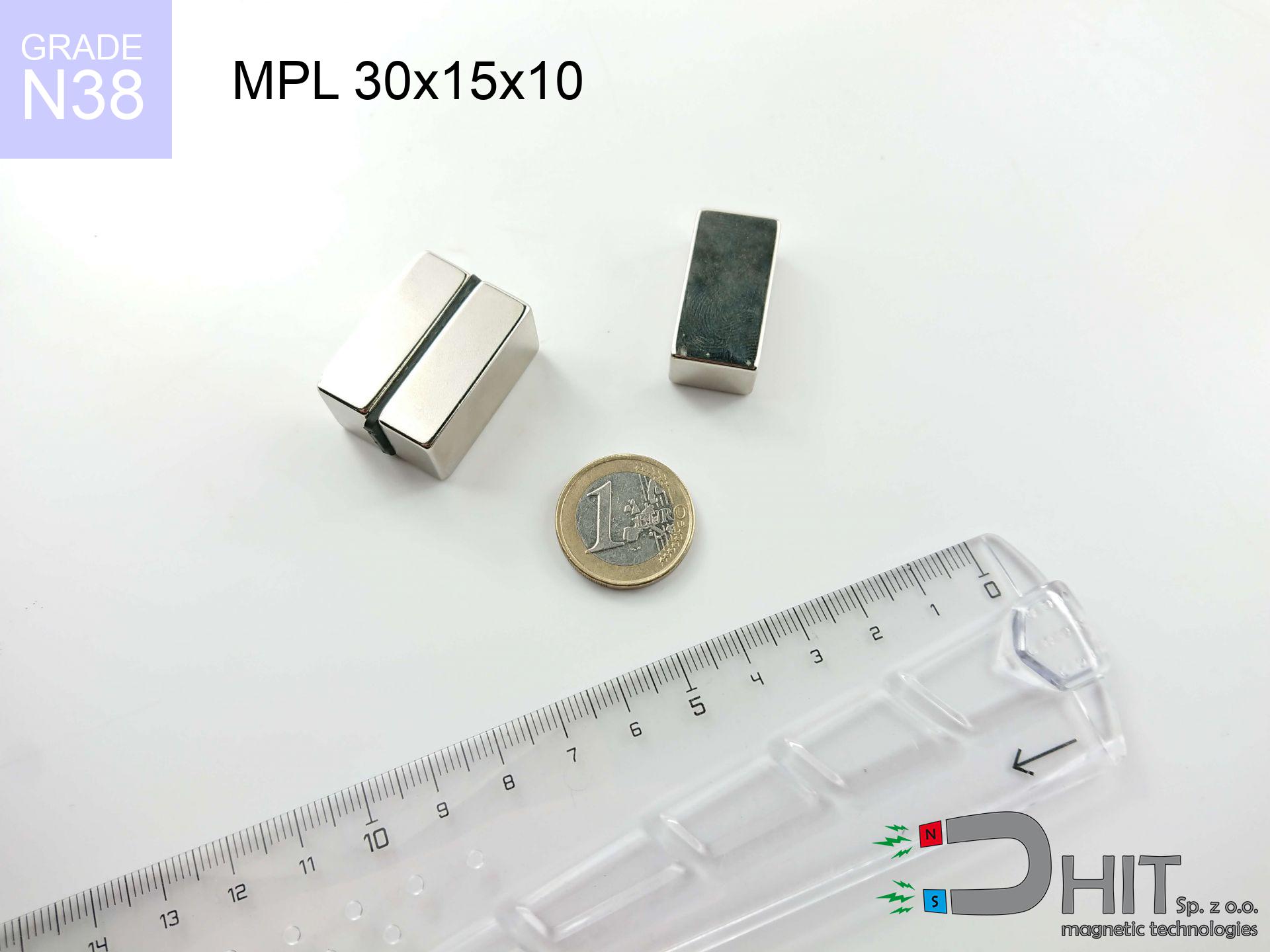
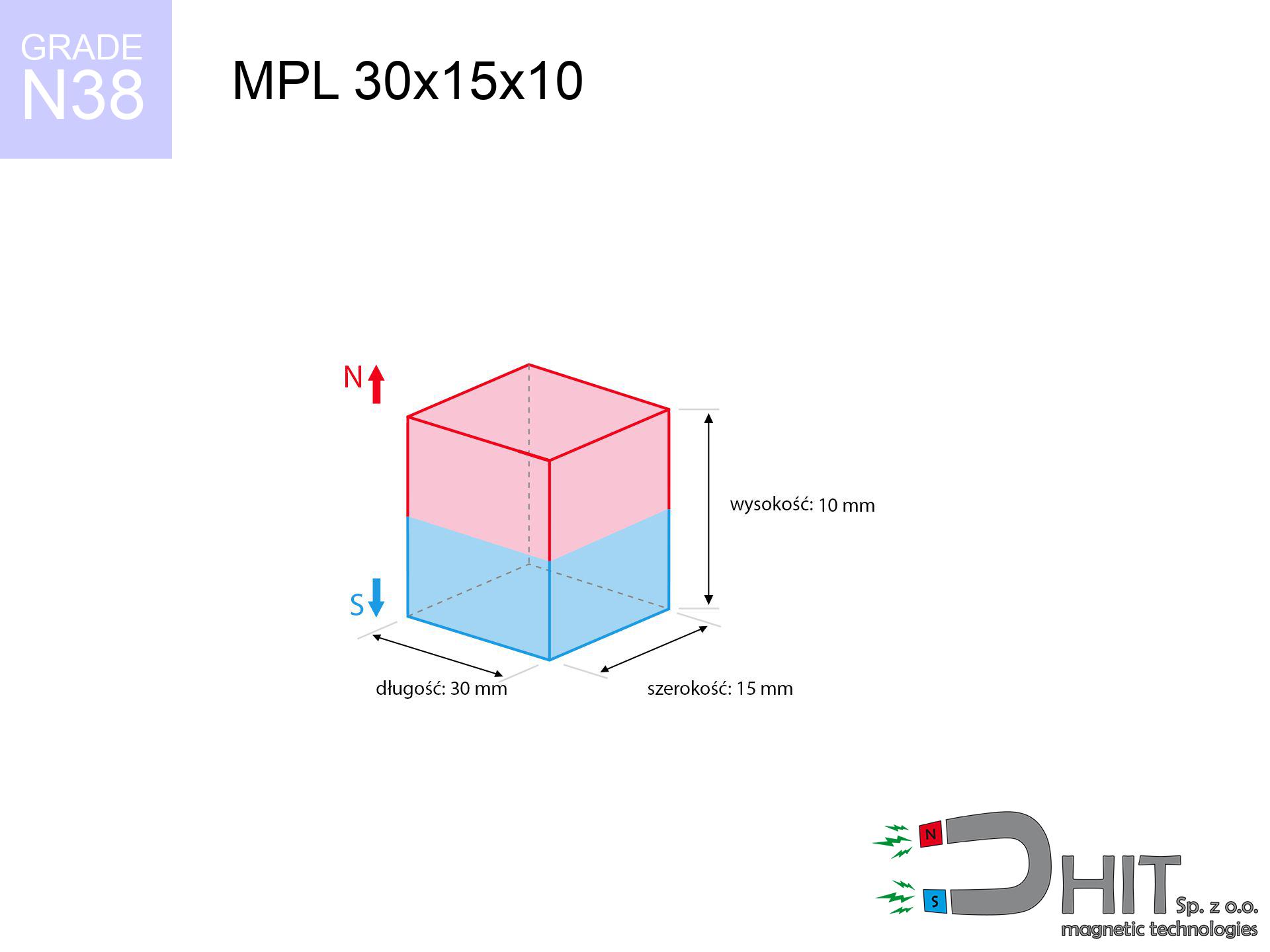
MPL 30x15x10 / N38 - lamellar magnet
lamellar magnet
Catalog no 020389
GTIN/EAN: 5906301811886
- length
- 30 mm [±0,1 mm]
- Width
- 15 mm [±0,1 mm]
- Height
- 10 mm [±0,1 mm]
- Weight
- 33.75 g
- Magnetization Direction
- ↑ axial
- Coating
- [NiCuNi] Nickel
How we measure these parameters — certificates and measurements
19.90 zł net / pcs
24.48 zł with VAT (23% VAT) / pcs
bulk discounts:
Need more?Frequently asked questions
What pull rating should I choose for a workshop block magnet?
Are block neodymium magnets available in more durable versions?
How should I choose block magnets for mounting a structure?
Engineering report for this magnet
Full PDF analysis: pull and shear force, effect of distance, temperature and plate thickness, safety distances and the demagnetization curve.
Call us now
+48 888 99 98 98
alternatively let us know using
contact form
the contact section.
Specifications and structure of a neodymium magnet can be estimated using our
power calculator.
Order by 14:00 and we’ll ship today!
Technical data - MPL 30x15x10 / N38 - lamellar magnet
Specification / characteristics - MPL 30x15x10 / N38 - lamellar magnet
| properties | values |
|---|---|
| Cat. no. | 020389 |
| GTIN/EAN | 5906301811886 |
| Production/Distribution | Dhit sp. z o.o. |
| Country of origin | Poland / China / Germany |
| Customs code | 85059029 |
| length | 30 mm [±0,1 mm] |
| Width | 15 mm [±0,1 mm] |
| Height | 10 mm [±0,1 mm] |
| Weight | 33.75 g |
| Magnetization Direction | ↑ axial |
| Load capacity ~ ? | 16.84 kg / 165.22 N |
| Magnetic Induction ~ ? | 413.45 mT / 4135 Gs |
| Coating | [NiCuNi] Nickel |
| Manufacturing Tolerance | ±0.1 mm |
Magnetic properties of material N38
| properties | values | units |
|---|---|---|
| Remanence Br ? | 12.2-12.6 | kGs |
| Remanence Br ? | 1220-1260 | mT |
| Coercivity bHc ? | 10.8-11.5 | kOe |
| Coercivity bHc ? | 860-915 | kA/m |
| Intrinsic coercivity iHc | ≥ 12 | kOe |
| Intrinsic coercivity iHc | ≥ 955 | kA/m |
| Energy product BHmax ? | 36-38 | BH max MGOe |
| Energy product BHmax ? | 287-303 | BH max KJ/m |
| Maximum working temperature ? | ≤ 80 | °C |
Physical properties of sintered neodymium magnets Nd2Fe14B at 20°C
| properties | values | units |
|---|---|---|
| Vickers hardness | ≥550 | Hv |
| Density | ≥7.4 | g/cm3 |
| Curie Temperature TC | 310 | °C |
| Curie Temperature TF | 590 | °F |
| Specific resistance | 150 | μΩ⋅cm |
| Bending strength | 250 | MPa |
| Compressive strength | 1000~1100 | MPa |
| Thermal expansion parallel (∥) to orientation (M) | (3-4) x 10-6 | °C-1 |
| Thermal expansion perpendicular (⊥) to orientation (M) | -(1-3) x 10-6 | °C-1 |
| Young's modulus | 1.7 x 10⁴ | kg/mm² |
Physical simulation of the product - report
These values constitute the result of a mathematical simulation. Values rely on algorithms for the class Nd2Fe14B. Real-world conditions may differ from theoretical values. Use these calculations as a supplementary guide when designing systems.
Table 1: Static force (pull vs gap) - power drop
MPL 30x15x10 / N38
| Distance (mm) | Induction (Gauss) / mT | Pull Force (kg/lbs/g/N) | Risk Status |
|---|---|---|---|
| 0 mm |
4133 Gs
413.3 mT
|
16.84 kg / 37.13 pounds
16840.0 g / 165.2 N
|
crushing |
| 1 mm |
3754 Gs
375.4 mT
|
13.89 kg / 30.62 pounds
13889.5 g / 136.3 N
|
crushing |
| 2 mm |
3365 Gs
336.5 mT
|
11.16 kg / 24.60 pounds
11159.2 g / 109.5 N
|
crushing |
| 3 mm |
2988 Gs
298.8 mT
|
8.80 kg / 19.41 pounds
8803.6 g / 86.4 N
|
strong |
| 5 mm |
2321 Gs
232.1 mT
|
5.31 kg / 11.71 pounds
5309.9 g / 52.1 N
|
strong |
| 10 mm |
1225 Gs
122.5 mT
|
1.48 kg / 3.26 pounds
1480.1 g / 14.5 N
|
safe |
| 15 mm |
684 Gs
68.4 mT
|
0.46 kg / 1.02 pounds
461.6 g / 4.5 N
|
safe |
| 20 mm |
409 Gs
40.9 mT
|
0.16 kg / 0.36 pounds
164.8 g / 1.6 N
|
safe |
| 30 mm |
173 Gs
17.3 mT
|
0.03 kg / 0.07 pounds
29.6 g / 0.3 N
|
safe |
| 50 mm |
50 Gs
5.0 mT
|
0.00 kg / 0.01 pounds
2.4 g / 0.0 N
|
safe |
Table 2: Vertical capacity (vertical surface)
MPL 30x15x10 / N38
| Distance (mm) | Friction coefficient | Pull Force (kg/lbs/g/N) |
|---|---|---|
| 0 mm | Stal (~0.2) |
3.37 kg / 7.43 pounds
3368.0 g / 33.0 N
|
| 1 mm | Stal (~0.2) |
2.78 kg / 6.12 pounds
2778.0 g / 27.3 N
|
| 2 mm | Stal (~0.2) |
2.23 kg / 4.92 pounds
2232.0 g / 21.9 N
|
| 3 mm | Stal (~0.2) |
1.76 kg / 3.88 pounds
1760.0 g / 17.3 N
|
| 5 mm | Stal (~0.2) |
1.06 kg / 2.34 pounds
1062.0 g / 10.4 N
|
| 10 mm | Stal (~0.2) |
0.30 kg / 0.65 pounds
296.0 g / 2.9 N
|
| 15 mm | Stal (~0.2) |
0.09 kg / 0.20 pounds
92.0 g / 0.9 N
|
| 20 mm | Stal (~0.2) |
0.03 kg / 0.07 pounds
32.0 g / 0.3 N
|
| 30 mm | Stal (~0.2) |
0.01 kg / 0.01 pounds
6.0 g / 0.1 N
|
| 50 mm | Stal (~0.2) |
0.00 kg / 0.00 pounds
0.0 g / 0.0 N
|
Table 3: Vertical assembly (shearing) - vertical pull
MPL 30x15x10 / N38
| Surface type | Friction coefficient / % Mocy | Max load (kg/lbs/g/N) |
|---|---|---|
| Raw steel |
µ = 0.3
30% Nominalnej Siły
|
5.05 kg / 11.14 pounds
5052.0 g / 49.6 N
|
| Painted steel (standard) |
µ = 0.2
20% Nominalnej Siły
|
3.37 kg / 7.43 pounds
3368.0 g / 33.0 N
|
| Oily/slippery steel |
µ = 0.1
10% Nominalnej Siły
|
1.68 kg / 3.71 pounds
1684.0 g / 16.5 N
|
| Magnet with anti-slip rubber |
µ = 0.5
50% Nominalnej Siły
|
8.42 kg / 18.56 pounds
8420.0 g / 82.6 N
|
Table 4: Steel thickness (substrate influence) - power losses
MPL 30x15x10 / N38
| Steel thickness (mm) | % power | Real pull force (kg/lbs/g/N) |
|---|---|---|
| 0.5 mm |
|
0.84 kg / 1.86 pounds
842.0 g / 8.3 N
|
| 1 mm |
|
2.11 kg / 4.64 pounds
2105.0 g / 20.7 N
|
| 2 mm |
|
4.21 kg / 9.28 pounds
4210.0 g / 41.3 N
|
| 3 mm |
|
6.31 kg / 13.92 pounds
6315.0 g / 62.0 N
|
| 5 mm |
|
10.53 kg / 23.20 pounds
10525.0 g / 103.3 N
|
| 10 mm |
|
16.84 kg / 37.13 pounds
16840.0 g / 165.2 N
|
| 11 mm |
|
16.84 kg / 37.13 pounds
16840.0 g / 165.2 N
|
| 12 mm |
|
16.84 kg / 37.13 pounds
16840.0 g / 165.2 N
|
Table 5: Thermal resistance (material behavior) - thermal limit
MPL 30x15x10 / N38
| Ambient temp. (°C) | Power loss | Remaining pull (kg/lbs/g/N) | Status |
|---|---|---|---|
| 20 °C | 0.0% |
16.84 kg / 37.13 pounds
16840.0 g / 165.2 N
|
OK |
| 40 °C | -2.2% |
16.47 kg / 36.31 pounds
16469.5 g / 161.6 N
|
OK |
| 60 °C | -4.4% |
16.10 kg / 35.49 pounds
16099.0 g / 157.9 N
|
|
| 80 °C | -6.6% |
15.73 kg / 34.68 pounds
15728.6 g / 154.3 N
|
|
| 100 °C | -28.8% |
11.99 kg / 26.43 pounds
11990.1 g / 117.6 N
|
Table 6: Magnet-Magnet interaction (repulsion) - field collision
MPL 30x15x10 / N38
| Gap (mm) | Attraction (kg/lbs) (N-S) | Lateral Force (kg/lbs/g/N) | Repulsion (kg/lbs) (N-N) |
|---|---|---|---|
| 0 mm |
47.39 kg / 104.48 pounds
5 357 Gs
|
7.11 kg / 15.67 pounds
7109 g / 69.7 N
|
N/A |
| 1 mm |
43.23 kg / 95.30 pounds
7 895 Gs
|
6.48 kg / 14.29 pounds
6484 g / 63.6 N
|
38.90 kg / 85.77 pounds
~0 Gs
|
| 2 mm |
39.09 kg / 86.17 pounds
7 507 Gs
|
5.86 kg / 12.93 pounds
5863 g / 57.5 N
|
35.18 kg / 77.56 pounds
~0 Gs
|
| 3 mm |
35.13 kg / 77.45 pounds
7 117 Gs
|
5.27 kg / 11.62 pounds
5270 g / 51.7 N
|
31.62 kg / 69.70 pounds
~0 Gs
|
| 5 mm |
27.95 kg / 61.61 pounds
6 348 Gs
|
4.19 kg / 9.24 pounds
4192 g / 41.1 N
|
25.15 kg / 55.45 pounds
~0 Gs
|
| 10 mm |
14.94 kg / 32.94 pounds
4 642 Gs
|
2.24 kg / 4.94 pounds
2242 g / 22.0 N
|
13.45 kg / 29.65 pounds
~0 Gs
|
| 20 mm |
4.17 kg / 9.18 pounds
2 451 Gs
|
0.62 kg / 1.38 pounds
625 g / 6.1 N
|
3.75 kg / 8.26 pounds
~0 Gs
|
| 50 mm |
0.19 kg / 0.41 pounds
519 Gs
|
0.03 kg / 0.06 pounds
28 g / 0.3 N
|
0.17 kg / 0.37 pounds
~0 Gs
|
| 60 mm |
0.08 kg / 0.18 pounds
347 Gs
|
0.01 kg / 0.03 pounds
13 g / 0.1 N
|
0.08 kg / 0.17 pounds
~0 Gs
|
| 70 mm |
0.04 kg / 0.09 pounds
242 Gs
|
0.01 kg / 0.01 pounds
6 g / 0.1 N
|
0.04 kg / 0.08 pounds
~0 Gs
|
| 80 mm |
0.02 kg / 0.05 pounds
175 Gs
|
0.00 kg / 0.01 pounds
3 g / 0.0 N
|
0.02 kg / 0.04 pounds
~0 Gs
|
| 90 mm |
0.01 kg / 0.03 pounds
130 Gs
|
0.00 kg / 0.00 pounds
2 g / 0.0 N
|
0.01 kg / 0.02 pounds
~0 Gs
|
| 100 mm |
0.01 kg / 0.02 pounds
99 Gs
|
0.00 kg / 0.00 pounds
1 g / 0.0 N
|
0.00 kg / 0.00 pounds
~0 Gs
|
Table 7: Hazards (implants) - warnings
MPL 30x15x10 / N38
| Object / Device | Limit (Gauss) / mT | Safe distance |
|---|---|---|
| Pacemaker | 5 Gs (0.5 mT) | 12.0 cm |
| Hearing aid | 10 Gs (1.0 mT) | 9.5 cm |
| Mechanical watch | 20 Gs (2.0 mT) | 7.5 cm |
| Mobile device | 40 Gs (4.0 mT) | 5.5 cm |
| Remote | 50 Gs (5.0 mT) | 5.0 cm |
| Payment card | 400 Gs (40.0 mT) | 2.5 cm |
| HDD hard drive | 600 Gs (60.0 mT) | 2.0 cm |
Table 8: Impact energy (kinetic energy) - warning
MPL 30x15x10 / N38
| Start from (mm) | Speed (km/h) | Energy (J) | Predicted outcome |
|---|---|---|---|
| 10 mm |
22.40 km/h
(6.22 m/s)
|
0.65 J | |
| 30 mm |
23.47 km/h
(6.52 m/s)
|
0.72 J | |
| 50 mm |
23.50 km/h
(6.53 m/s)
|
0.72 J | |
| 100 mm |
23.51 km/h
(6.53 m/s)
|
0.72 J |
Table 9: Corrosion resistance
MPL 30x15x10 / N38
| Technical parameter | Value / Description |
|---|---|
| Coating type | [NiCuNi] Nickel |
| Layer structure | Nickel - Copper - Nickel |
| Layer thickness | 10-20 µm |
| Salt spray test (SST) ? | 24 h |
| Recommended environment | Indoors only (dry) |
Table 10: Construction data (Flux)
MPL 30x15x10 / N38
| Parameter | Value | SI Unit / Description |
|---|---|---|
| Magnetic Flux | 18 390 Mx | 183.9 µWb |
| Pc Coefficient | 0.52 | Low (Flat) |
Table 11: Hydrostatics and buoyancy
MPL 30x15x10 / N38
| Environment | Effective steel pull | Effect |
|---|---|---|
| Air (land) | 16.84 kg | Standard |
| Water (riverbed) |
19.28 kg
(+2.44 kg buoyancy gain)
|
+14.5% |
1. Shear force
*Warning: On a vertical surface, the magnet holds merely ~20% of its nominal pull.
2. Efficiency vs thickness
*Thin metal sheet (e.g. computer case) significantly weakens the holding force.
3. Thermal stability
N38: the maximum material working temperature is 80°C. Permitted conditions also depend on the shape and magnetic circuit.
4. Demagnetization curve and operating point (B-H)
chart generated for the permeance coefficient Pc (Permeance Coefficient) = 0.52
The chart above illustrates the magnetic characteristics of the material within the second quadrant of the hysteresis loop. The solid red line represents the demagnetization curve (material potential), while the dashed blue line is the load line based on the magnet's geometry. The Pc (Permeance Coefficient), also known as the load line slope, is a dimensionless value that describes the relationship between the magnet's shape and its magnetic stability. The intersection of these two lines (the black dot) is the operating point — it determines the actual magnetic flux density generated by the magnet in this specific configuration. A higher Pc value means the magnet is more 'slender' (tall relative to its area), resulting in a higher operating point and better resistance to irreversible demagnetization caused by external fields or temperature. A value of 0.42 is relatively low (typical for flat magnets), meaning the operating point is closer to the 'knee' of the curve — caution is advised when operating at temperatures near the maximum limit to avoid strength loss.
Material specification
| iron (Fe) | 64% – 68% |
| neodymium (Nd) | 29% – 32% |
| boron (B) | 1.1% – 1.2% |
| dysprosium (Dy) | 0.5% – 2.0% |
| coating (Ni-Cu-Ni) | < 0.05% |
Sustainability
| recyclability (EoL) | 100% |
| recycled raw materials | ~10% (pre-cons) |
| carbon footprint | low / zredukowany |
| waste code (EWC) | 16 02 16 |
See also deals



Advantages as well as disadvantages of Nd2Fe14B magnets.
Strengths
- They have unchanged lifting capacity, and over more than 10 years their attraction force decreases symbolically – ~1% (in testing),
- They retain their magnetic properties even under external field action,
- In other words, due to the smooth layer of nickel, the element is aesthetically pleasing,
- The surface of neodymium magnets generates a intense magnetic field – this is a key feature,
- Made from properly selected components, these magnets show impressive resistance to high heat, enabling them to function (depending on their shape) at temperatures up to 230°C and above...
- Due to the possibility of accurate molding and customization to individualized projects, neodymium magnets can be modeled in a variety of shapes and sizes, which expands the range of possible applications,
- Huge importance in modern industrial fields – they serve a role in magnetic memories, motor assemblies, medical equipment, as well as technologically advanced constructions.
- Relatively small size with high pulling force – neodymium magnets offer impressive pulling force in compact dimensions, which allows their use in small systems
Weaknesses
- Brittleness is one of their disadvantages. Upon intense impact they can fracture. We advise keeping them in a special holder, which not only secures them against impacts but also raises their durability
- Do not exceed this material temperature limit: 80°C. Overheating may permanently weaken the magnet.
- They rust in a humid environment - during use outdoors we advise using waterproof magnets e.g. in rubber, plastic
- Due to limitations in realizing nuts and complicated forms in magnets, we recommend using a housing - magnetic mount.
- Possible danger to health – tiny shards of magnets pose a threat, if swallowed, which gains importance in the aspect of protecting the youngest. It is also worth noting that tiny parts of these products are able to be problematic in diagnostics medical in case of swallowing.
- High unit price – neodymium magnets are more expensive than other types of magnets (e.g. ferrite), which can limit application in large quantities
Pull force analysis
Maximum magnetic pulling force – what contributes to it?
- using a plate made of high-permeability steel, serving as a ideal flux conductor
- whose thickness is min. 10 mm
- with an polished contact surface
- without any insulating layer between the magnet and steel
- for force acting at a right angle (pull-off, not shear)
- in neutral thermal conditions
Practical aspects of lifting capacity – factors
- Clearance – existence of any layer (rust, tape, air) acts as an insulator, which reduces capacity steeply (even by 50% at 0.5 mm).
- Force direction – note that the magnet holds strongest perpendicularly. Under sliding down, the capacity drops significantly, often to levels of 20-30% of the nominal value.
- Element thickness – for full efficiency, the steel must be adequately massive. Thin sheet restricts the lifting capacity (the magnet "punches through" it).
- Steel type – low-carbon steel gives the best results. Alloy steels decrease magnetic properties and lifting capacity.
- Smoothness – ideal contact is possible only on polished steel. Rough texture reduce the real contact area, reducing force.
- Heat – neodymium magnets have a sensitivity to temperature. At higher temperatures they lose power, and at low temperatures they can be stronger (up to a certain limit).
Lifting capacity was assessed by applying a steel plate with a smooth surface of suitable thickness (min. 20 mm), under perpendicular detachment force, in contrast under attempts to slide the magnet the lifting capacity is smaller. Moreover, even a slight gap between the magnet and the plate reduces the load capacity.
Safe handling of NdFeB magnets
Handling guide
Before use, read the rules. Uncontrolled attraction can destroy the magnet or injure your hand. Think ahead.
Swallowing risk
Product intended for adults. Tiny parts can be swallowed, leading to serious injuries. Store away from kids and pets.
Eye protection
NdFeB magnets are sintered ceramics, which means they are prone to chipping. Impact of two magnets will cause them cracking into shards.
Compass and GPS
A strong magnetic field interferes with the operation of compasses in smartphones and navigation systems. Maintain magnets close to a device to avoid breaking the sensors.
Finger safety
Protect your hands. Two large magnets will snap together instantly with a force of several hundred kilograms, destroying everything in their path. Be careful!
Threat to electronics
Equipment safety: Neodymium magnets can damage data carriers and delicate electronics (heart implants, hearing aids, timepieces).
Skin irritation risks
Certain individuals suffer from a sensitization to Ni, which is the typical protective layer for NdFeB magnets. Prolonged contact might lead to dermatitis. We strongly advise wear protective gloves.
Medical interference
Warning for patients: Powerful magnets affect medical devices. Maintain minimum 30 cm distance or ask another person to handle the magnets.
Do not overheat magnets
Regular neodymium magnets (grade N) lose magnetization when the temperature surpasses 80°C. Damage is permanent.
Machining danger
Combustion risk: Neodymium dust is highly flammable. Avoid machining magnets without safety gear as this may cause fire.
Tabela kosztu i czasu dostawy
Płatność przed wysyłką:

GLS kurier
Przesyłka będzie u Ciebie za 2-3 dni
14.99 ZŁ

InPost Paczkomaty 24/7
Przesyłka będzie u Ciebie za 1-2 dni
12.30 ZŁ
Płatność przy odbiorze (pobranie):
GLS kurier
Przesyłka będzie u Ciebie za 1-2 dni
23.00 ZŁ