

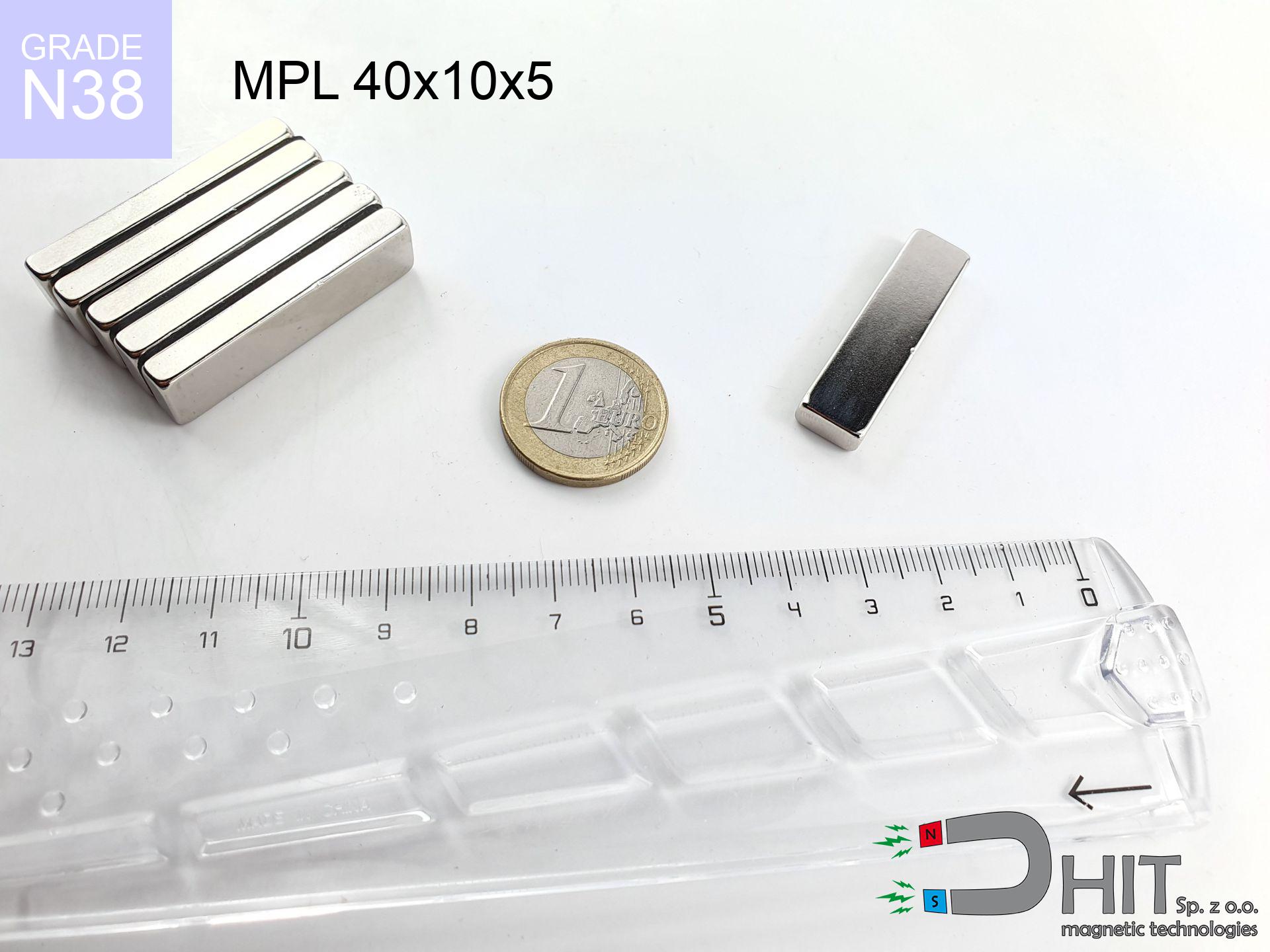
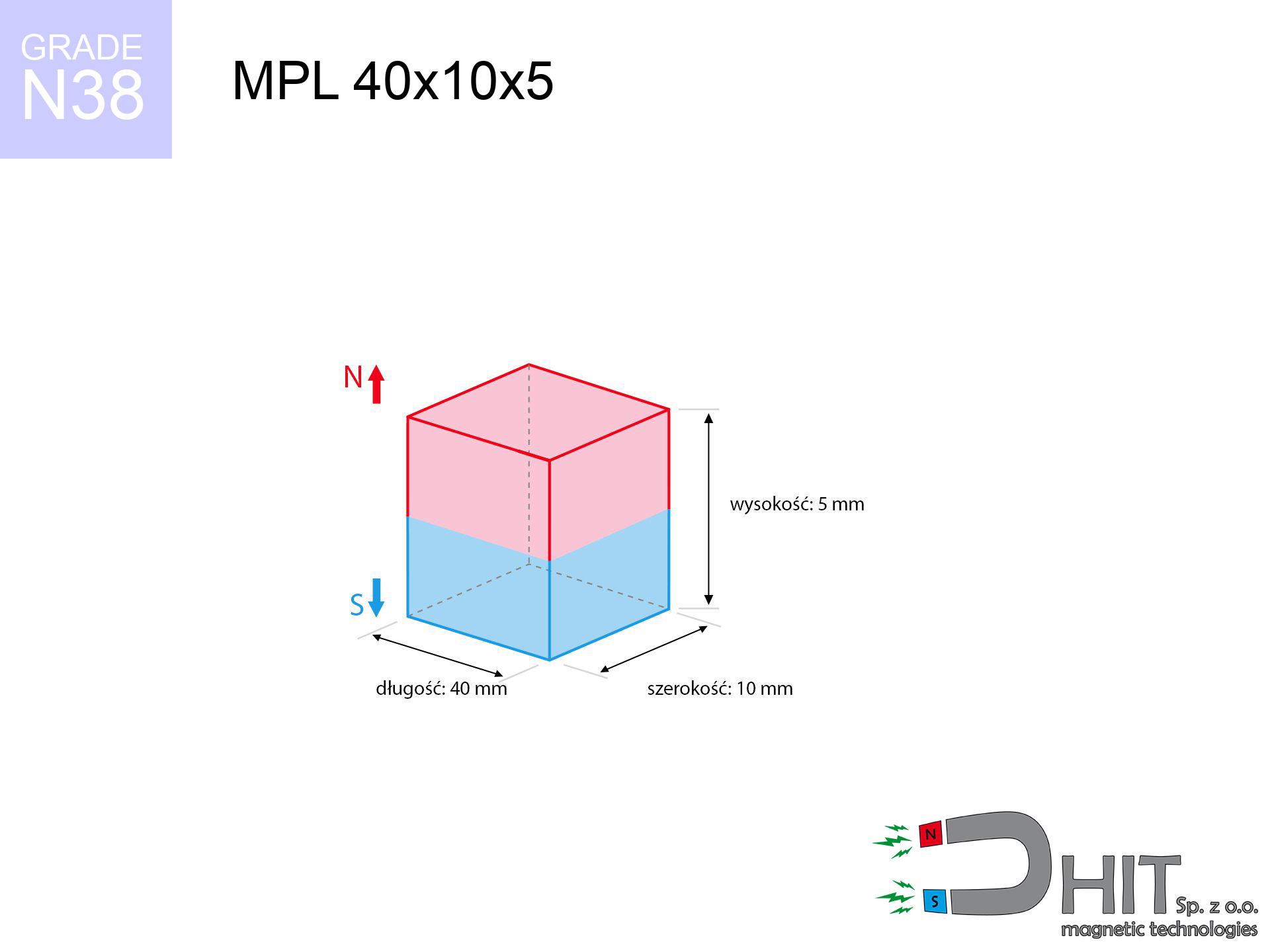
MPL 40x10x5 / N38 - lamellar magnet
lamellar magnet
Catalog no 020152
GTIN/EAN: 5906301811589
- length
- 40 mm [±0,1 mm]
- Width
- 10 mm [±0,1 mm]
- Height
- 5 mm [±0,1 mm]
- Weight
- 15 g
- Magnetization Direction
- ↑ axial
- Coating
- [NiCuNi] Nickel
How we measure these parameters — certificates and measurements
4.90 zł net / pcs
6.03 zł with VAT (23% VAT) / pcs
bulk discounts:
Need more?Frequently asked questions
What pull rating should I choose for a workshop block magnet?
Are block neodymium magnets available in more durable versions?
How should I choose block magnets for mounting a structure?
Engineering report for this magnet
Full PDF analysis: pull and shear force, effect of distance, temperature and plate thickness, safety distances and the demagnetization curve.
Call us now
+48 888 99 98 98
alternatively let us know using
contact form
the contact section.
Specifications and structure of a neodymium magnet can be estimated using our
power calculator.
Order by 14:00 and we’ll ship today!
Product card - MPL 40x10x5 / N38 - lamellar magnet
Specification / characteristics - MPL 40x10x5 / N38 - lamellar magnet
| properties | values |
|---|---|
| Cat. no. | 020152 |
| GTIN/EAN | 5906301811589 |
| Production/Distribution | Dhit sp. z o.o. |
| Country of origin | Poland / China / Germany |
| Customs code | 85059029 |
| length | 40 mm [±0,1 mm] |
| Width | 10 mm [±0,1 mm] |
| Height | 5 mm [±0,1 mm] |
| Weight | 15 g |
| Magnetization Direction | ↑ axial |
| Load capacity ~ ? | 11.85 kg / 116.27 N |
| Magnetic Induction ~ ? | 321.37 mT / 3214 Gs |
| Coating | [NiCuNi] Nickel |
| Manufacturing Tolerance | ±0.1 mm |
Magnetic properties of material N38
| properties | values | units |
|---|---|---|
| Remanence Br ? | 12.2-12.6 | kGs |
| Remanence Br ? | 1220-1260 | mT |
| Coercivity bHc ? | 10.8-11.5 | kOe |
| Coercivity bHc ? | 860-915 | kA/m |
| Intrinsic coercivity iHc | ≥ 12 | kOe |
| Intrinsic coercivity iHc | ≥ 955 | kA/m |
| Energy product BHmax ? | 36-38 | BH max MGOe |
| Energy product BHmax ? | 287-303 | BH max KJ/m |
| Maximum working temperature ? | ≤ 80 | °C |
Physical properties of sintered neodymium magnets Nd2Fe14B at 20°C
| properties | values | units |
|---|---|---|
| Vickers hardness | ≥550 | Hv |
| Density | ≥7.4 | g/cm3 |
| Curie Temperature TC | 310 | °C |
| Curie Temperature TF | 590 | °F |
| Specific resistance | 150 | μΩ⋅cm |
| Bending strength | 250 | MPa |
| Compressive strength | 1000~1100 | MPa |
| Thermal expansion parallel (∥) to orientation (M) | (3-4) x 10-6 | °C-1 |
| Thermal expansion perpendicular (⊥) to orientation (M) | -(1-3) x 10-6 | °C-1 |
| Young's modulus | 1.7 x 10⁴ | kg/mm² |
Engineering analysis of the product - report
The following data represent the result of a physical calculation. Results are based on algorithms for the material Nd2Fe14B. Real-world conditions may differ from theoretical values. Use these calculations as a preliminary roadmap when designing systems.
Table 1: Static force (force vs gap) - interaction chart
MPL 40x10x5 / N38
| Distance (mm) | Induction (Gauss) / mT | Pull Force (kg/lbs/g/N) | Risk Status |
|---|---|---|---|
| 0 mm |
3212 Gs
321.2 mT
|
11.85 kg / 26.12 pounds
11850.0 g / 116.2 N
|
critical level |
| 1 mm |
2791 Gs
279.1 mT
|
8.95 kg / 19.73 pounds
8947.7 g / 87.8 N
|
strong |
| 2 mm |
2358 Gs
235.8 mT
|
6.38 kg / 14.08 pounds
6384.9 g / 62.6 N
|
strong |
| 3 mm |
1965 Gs
196.5 mT
|
4.43 kg / 9.77 pounds
4432.4 g / 43.5 N
|
strong |
| 5 mm |
1360 Gs
136.0 mT
|
2.12 kg / 4.68 pounds
2122.9 g / 20.8 N
|
strong |
| 10 mm |
615 Gs
61.5 mT
|
0.43 kg / 0.96 pounds
434.1 g / 4.3 N
|
low risk |
| 15 mm |
329 Gs
32.9 mT
|
0.12 kg / 0.27 pounds
124.5 g / 1.2 N
|
low risk |
| 20 mm |
195 Gs
19.5 mT
|
0.04 kg / 0.10 pounds
43.9 g / 0.4 N
|
low risk |
| 30 mm |
83 Gs
8.3 mT
|
0.01 kg / 0.02 pounds
8.0 g / 0.1 N
|
low risk |
| 50 mm |
24 Gs
2.4 mT
|
0.00 kg / 0.00 pounds
0.6 g / 0.0 N
|
low risk |
Table 2: Vertical capacity (wall)
MPL 40x10x5 / N38
| Distance (mm) | Friction coefficient | Pull Force (kg/lbs/g/N) |
|---|---|---|
| 0 mm | Stal (~0.2) |
2.37 kg / 5.22 pounds
2370.0 g / 23.2 N
|
| 1 mm | Stal (~0.2) |
1.79 kg / 3.95 pounds
1790.0 g / 17.6 N
|
| 2 mm | Stal (~0.2) |
1.28 kg / 2.81 pounds
1276.0 g / 12.5 N
|
| 3 mm | Stal (~0.2) |
0.89 kg / 1.95 pounds
886.0 g / 8.7 N
|
| 5 mm | Stal (~0.2) |
0.42 kg / 0.93 pounds
424.0 g / 4.2 N
|
| 10 mm | Stal (~0.2) |
0.09 kg / 0.19 pounds
86.0 g / 0.8 N
|
| 15 mm | Stal (~0.2) |
0.02 kg / 0.05 pounds
24.0 g / 0.2 N
|
| 20 mm | Stal (~0.2) |
0.01 kg / 0.02 pounds
8.0 g / 0.1 N
|
| 30 mm | Stal (~0.2) |
0.00 kg / 0.00 pounds
2.0 g / 0.0 N
|
| 50 mm | Stal (~0.2) |
0.00 kg / 0.00 pounds
0.0 g / 0.0 N
|
Table 3: Vertical assembly (shearing) - behavior on slippery surfaces
MPL 40x10x5 / N38
| Surface type | Friction coefficient / % Mocy | Max load (kg/lbs/g/N) |
|---|---|---|
| Raw steel |
µ = 0.3
30% Nominalnej Siły
|
3.55 kg / 7.84 pounds
3555.0 g / 34.9 N
|
| Painted steel (standard) |
µ = 0.2
20% Nominalnej Siły
|
2.37 kg / 5.22 pounds
2370.0 g / 23.2 N
|
| Oily/slippery steel |
µ = 0.1
10% Nominalnej Siły
|
1.19 kg / 2.61 pounds
1185.0 g / 11.6 N
|
| Magnet with anti-slip rubber |
µ = 0.5
50% Nominalnej Siły
|
5.93 kg / 13.06 pounds
5925.0 g / 58.1 N
|
Table 4: Material efficiency (substrate influence) - power losses
MPL 40x10x5 / N38
| Steel thickness (mm) | % power | Real pull force (kg/lbs/g/N) |
|---|---|---|
| 0.5 mm |
|
0.59 kg / 1.31 pounds
592.5 g / 5.8 N
|
| 1 mm |
|
1.48 kg / 3.27 pounds
1481.3 g / 14.5 N
|
| 2 mm |
|
2.96 kg / 6.53 pounds
2962.5 g / 29.1 N
|
| 3 mm |
|
4.44 kg / 9.80 pounds
4443.8 g / 43.6 N
|
| 5 mm |
|
7.41 kg / 16.33 pounds
7406.3 g / 72.7 N
|
| 10 mm |
|
11.85 kg / 26.12 pounds
11850.0 g / 116.2 N
|
| 11 mm |
|
11.85 kg / 26.12 pounds
11850.0 g / 116.2 N
|
| 12 mm |
|
11.85 kg / 26.12 pounds
11850.0 g / 116.2 N
|
Table 5: Working in heat (stability) - thermal limit
MPL 40x10x5 / N38
| Ambient temp. (°C) | Power loss | Remaining pull (kg/lbs/g/N) | Status |
|---|---|---|---|
| 20 °C | 0.0% |
11.85 kg / 26.12 pounds
11850.0 g / 116.2 N
|
OK |
| 40 °C | -2.2% |
11.59 kg / 25.55 pounds
11589.3 g / 113.7 N
|
OK |
| 60 °C | -4.4% |
11.33 kg / 24.98 pounds
11328.6 g / 111.1 N
|
|
| 80 °C | -6.6% |
11.07 kg / 24.40 pounds
11067.9 g / 108.6 N
|
|
| 100 °C | -28.8% |
8.44 kg / 18.60 pounds
8437.2 g / 82.8 N
|
Table 6: Magnet-Magnet interaction (attraction) - field range
MPL 40x10x5 / N38
| Gap (mm) | Attraction (kg/lbs) (N-S) | Sliding Force (kg/lbs/g/N) | Repulsion (kg/lbs) (N-N) |
|---|---|---|---|
| 0 mm |
25.44 kg / 56.10 pounds
4 569 Gs
|
3.82 kg / 8.41 pounds
3817 g / 37.4 N
|
N/A |
| 1 mm |
22.33 kg / 49.22 pounds
6 018 Gs
|
3.35 kg / 7.38 pounds
3349 g / 32.9 N
|
20.09 kg / 44.30 pounds
~0 Gs
|
| 2 mm |
19.21 kg / 42.36 pounds
5 582 Gs
|
2.88 kg / 6.35 pounds
2882 g / 28.3 N
|
17.29 kg / 38.12 pounds
~0 Gs
|
| 3 mm |
16.31 kg / 35.96 pounds
5 144 Gs
|
2.45 kg / 5.39 pounds
2447 g / 24.0 N
|
14.68 kg / 32.36 pounds
~0 Gs
|
| 5 mm |
11.45 kg / 25.23 pounds
4 309 Gs
|
1.72 kg / 3.78 pounds
1717 g / 16.8 N
|
10.30 kg / 22.71 pounds
~0 Gs
|
| 10 mm |
4.56 kg / 10.05 pounds
2 719 Gs
|
0.68 kg / 1.51 pounds
684 g / 6.7 N
|
4.10 kg / 9.04 pounds
~0 Gs
|
| 20 mm |
0.93 kg / 2.05 pounds
1 230 Gs
|
0.14 kg / 0.31 pounds
140 g / 1.4 N
|
0.84 kg / 1.85 pounds
~0 Gs
|
| 50 mm |
0.04 kg / 0.08 pounds
249 Gs
|
0.01 kg / 0.01 pounds
6 g / 0.1 N
|
0.03 kg / 0.08 pounds
~0 Gs
|
| 60 mm |
0.02 kg / 0.04 pounds
167 Gs
|
0.00 kg / 0.01 pounds
3 g / 0.0 N
|
0.02 kg / 0.03 pounds
~0 Gs
|
| 70 mm |
0.01 kg / 0.02 pounds
116 Gs
|
0.00 kg / 0.00 pounds
1 g / 0.0 N
|
0.00 kg / 0.00 pounds
~0 Gs
|
| 80 mm |
0.00 kg / 0.01 pounds
84 Gs
|
0.00 kg / 0.00 pounds
1 g / 0.0 N
|
0.00 kg / 0.00 pounds
~0 Gs
|
| 90 mm |
0.00 kg / 0.01 pounds
62 Gs
|
0.00 kg / 0.00 pounds
0 g / 0.0 N
|
0.00 kg / 0.00 pounds
~0 Gs
|
| 100 mm |
0.00 kg / 0.00 pounds
48 Gs
|
0.00 kg / 0.00 pounds
0 g / 0.0 N
|
0.00 kg / 0.00 pounds
~0 Gs
|
Table 7: Safety (HSE) (implants) - warnings
MPL 40x10x5 / N38
| Object / Device | Limit (Gauss) / mT | Safe distance |
|---|---|---|
| Pacemaker | 5 Gs (0.5 mT) | 9.0 cm |
| Hearing aid | 10 Gs (1.0 mT) | 7.0 cm |
| Timepiece | 20 Gs (2.0 mT) | 5.5 cm |
| Mobile device | 40 Gs (4.0 mT) | 4.5 cm |
| Remote | 50 Gs (5.0 mT) | 4.0 cm |
| Payment card | 400 Gs (40.0 mT) | 1.5 cm |
| HDD hard drive | 600 Gs (60.0 mT) | 1.5 cm |
Table 8: Dynamics (cracking risk) - collision effects
MPL 40x10x5 / N38
| Start from (mm) | Speed (km/h) | Energy (J) | Predicted outcome |
|---|---|---|---|
| 10 mm |
24.30 km/h
(6.75 m/s)
|
0.34 J | |
| 30 mm |
24.92 km/h
(6.92 m/s)
|
0.36 J | |
| 50 mm |
24.93 km/h
(6.92 m/s)
|
0.36 J | |
| 100 mm |
24.94 km/h
(6.93 m/s)
|
0.36 J |
Table 9: Corrosion resistance
MPL 40x10x5 / N38
| Technical parameter | Value / Description |
|---|---|
| Coating type | [NiCuNi] Nickel |
| Layer structure | Nickel - Copper - Nickel |
| Layer thickness | 10-20 µm |
| Salt spray test (SST) ? | 24 h |
| Recommended environment | Indoors only (dry) |
Table 10: Electrical data (Flux)
MPL 40x10x5 / N38
| Parameter | Value | SI Unit / Description |
|---|---|---|
| Magnetic Flux | 11 419 Mx | 114.2 µWb |
| Pc Coefficient | 0.31 | Low (Flat) |
Table 11: Hydrostatics and buoyancy
MPL 40x10x5 / N38
| Environment | Effective steel pull | Effect |
|---|---|---|
| Air (land) | 11.85 kg | Standard |
| Water (riverbed) |
13.57 kg
(+1.72 kg buoyancy gain)
|
+14.5% |
1. Sliding resistance
*Note: On a vertical surface, the magnet holds only ~20% of its perpendicular strength.
2. Steel thickness impact
*Thin metal sheet (e.g. computer case) severely weakens the holding force.
3. Temperature resistance
N38: the maximum material working temperature is 80°C. Permitted conditions also depend on the shape and magnetic circuit.
4. Demagnetization curve and operating point (B-H)
chart generated for the permeance coefficient Pc (Permeance Coefficient) = 0.31
This simulation demonstrates the magnetic stability of the selected magnet under specific geometric conditions. The solid red line represents the demagnetization curve (material potential), while the dashed blue line is the load line based on the magnet's geometry. The Pc (Permeance Coefficient), also known as the load line slope, is a dimensionless value that describes the relationship between the magnet's shape and its magnetic stability. The intersection of these two lines (the black dot) is the operating point — it determines the actual magnetic flux density generated by the magnet in this specific configuration. A higher Pc value means the magnet is more 'slender' (tall relative to its area), resulting in a higher operating point and better resistance to irreversible demagnetization caused by external fields or temperature. A value of 0.42 is relatively low (typical for flat magnets), meaning the operating point is closer to the 'knee' of the curve — caution is advised when operating at temperatures near the maximum limit to avoid strength loss.
Elemental analysis
| iron (Fe) | 64% – 68% |
| neodymium (Nd) | 29% – 32% |
| boron (B) | 1.1% – 1.2% |
| dysprosium (Dy) | 0.5% – 2.0% |
| coating (Ni-Cu-Ni) | < 0.05% |
Sustainability
| recyclability (EoL) | 100% |
| recycled raw materials | ~10% (pre-cons) |
| carbon footprint | low / zredukowany |
| waste code (EWC) | 16 02 16 |
Other proposals
![UMGGW 88x8.5 [M6] GW / N38 - magnetic holder rubber internal thread](https://cdn3.dhit.pl/graphics/products/umg-88x8.5-m8-gw-let.jpg "UMGGW 88x8.5 [M6] GW / N38 - magnetic holder rubber internal thread")

Strengths and weaknesses of neodymium magnets.
Strengths
- Their strength remains stable, and after around 10 years it decreases only by ~1% (according to research),
- They are extremely resistant to demagnetization induced by external field influence,
- In other words, due to the smooth surface of silver, the element gains visual value,
- They show high magnetic induction at the operating surface, which improves attraction properties,
- Neodymium magnets are characterized by extremely high magnetic induction on the magnet surface and are able to act (depending on the form) even at a temperature of 230°C or more...
- Possibility of accurate shaping and optimizing to specific applications,
- Key role in future technologies – they are used in HDD drives, electric drive systems, diagnostic systems, also technologically advanced constructions.
- Thanks to their power density, small magnets offer high operating force, in miniature format,
Cons
- Brittleness is one of their disadvantages. Upon intense impact they can fracture. We recommend keeping them in a steel housing, which not only protects them against impacts but also increases their durability
- Do not exceed this material temperature limit: 80°C. Overheating may permanently weaken the magnet.
- They oxidize in a humid environment. For use outdoors we suggest using waterproof magnets e.g. in rubber, plastic
- Limited ability of creating threads in the magnet and complicated shapes - preferred is a housing - magnet mounting.
- Potential hazard related to microscopic parts of magnets pose a threat, in case of ingestion, which is particularly important in the aspect of protecting the youngest. Furthermore, small elements of these magnets can disrupt the diagnostic process medical when they are in the body.
- Due to neodymium price, their price is relatively high,
Holding force characteristics
Maximum holding power of the magnet – what contributes to it?
- with the contact of a yoke made of special test steel, guaranteeing full magnetic saturation
- whose transverse dimension equals approx. 10 mm
- characterized by even structure
- without any insulating layer between the magnet and steel
- under vertical force vector (90-degree angle)
- in stable room temperature
Magnet lifting force in use – key factors
- Gap (between the magnet and the plate), since even a microscopic clearance (e.g. 0.5 mm) results in a drastic drop in lifting capacity by up to 50% (this also applies to paint, rust or dirt).
- Loading method – declared lifting capacity refers to detachment vertically. When slipping, the magnet holds significantly lower power (often approx. 20-30% of maximum force).
- Steel thickness – too thin steel causes magnetic saturation, causing part of the power to be escaped into the air.
- Material composition – different alloys attracts identically. High carbon content worsen the attraction effect.
- Plate texture – smooth surfaces guarantee perfect abutment, which increases field saturation. Uneven metal reduce efficiency.
- Thermal factor – high temperature weakens magnetic field. Exceeding the limit temperature can permanently damage the magnet.
Lifting capacity testing was performed on plates with a smooth surface of suitable thickness, under a perpendicular pulling force, whereas under shearing force the load capacity is reduced by as much as 5 times. In addition, even a minimal clearance between the magnet and the plate reduces the holding force.
Warnings
Pacemakers
Warning for patients: Powerful magnets disrupt electronics. Maintain at least 30 cm distance or ask another person to work with the magnets.
Keep away from computers
Powerful magnetic fields can corrupt files on credit cards, HDDs, and storage devices. Maintain a gap of at least 10 cm.
Heat sensitivity
Standard neodymium magnets (grade N) undergo demagnetization when the temperature exceeds 80°C. Damage is permanent.
Respect the power
Handle with care. Rare earth magnets attract from a long distance and snap with massive power, often faster than you can react.
Bone fractures
Risk of injury: The pulling power is so great that it can result in blood blisters, crushing, and broken bones. Use thick gloves.
Warning for allergy sufferers
Medical facts indicate that nickel (the usual finish) is a common allergen. For allergy sufferers, avoid touching magnets with bare hands or choose coated magnets.
Fragile material
Despite metallic appearance, neodymium is brittle and cannot withstand shocks. Do not hit, as the magnet may crumble into sharp, dangerous pieces.
Dust explosion hazard
Fire warning: Rare earth powder is highly flammable. Avoid machining magnets in home conditions as this risks ignition.
Threat to navigation
A powerful magnetic field disrupts the functioning of compasses in smartphones and navigation systems. Keep magnets close to a device to avoid breaking the sensors.
Product not for children
Always store magnets away from children. Choking hazard is high, and the consequences of magnets connecting inside the body are life-threatening.
Tabela kosztu i czasu dostawy
Płatność przed wysyłką:

GLS kurier
Przesyłka będzie u Ciebie za 2-3 dni
14.99 ZŁ

InPost Paczkomaty 24/7
Przesyłka będzie u Ciebie za 1-2 dni
12.30 ZŁ
Płatność przy odbiorze (pobranie):
GLS kurier
Przesyłka będzie u Ciebie za 1-2 dni
23.00 ZŁ