

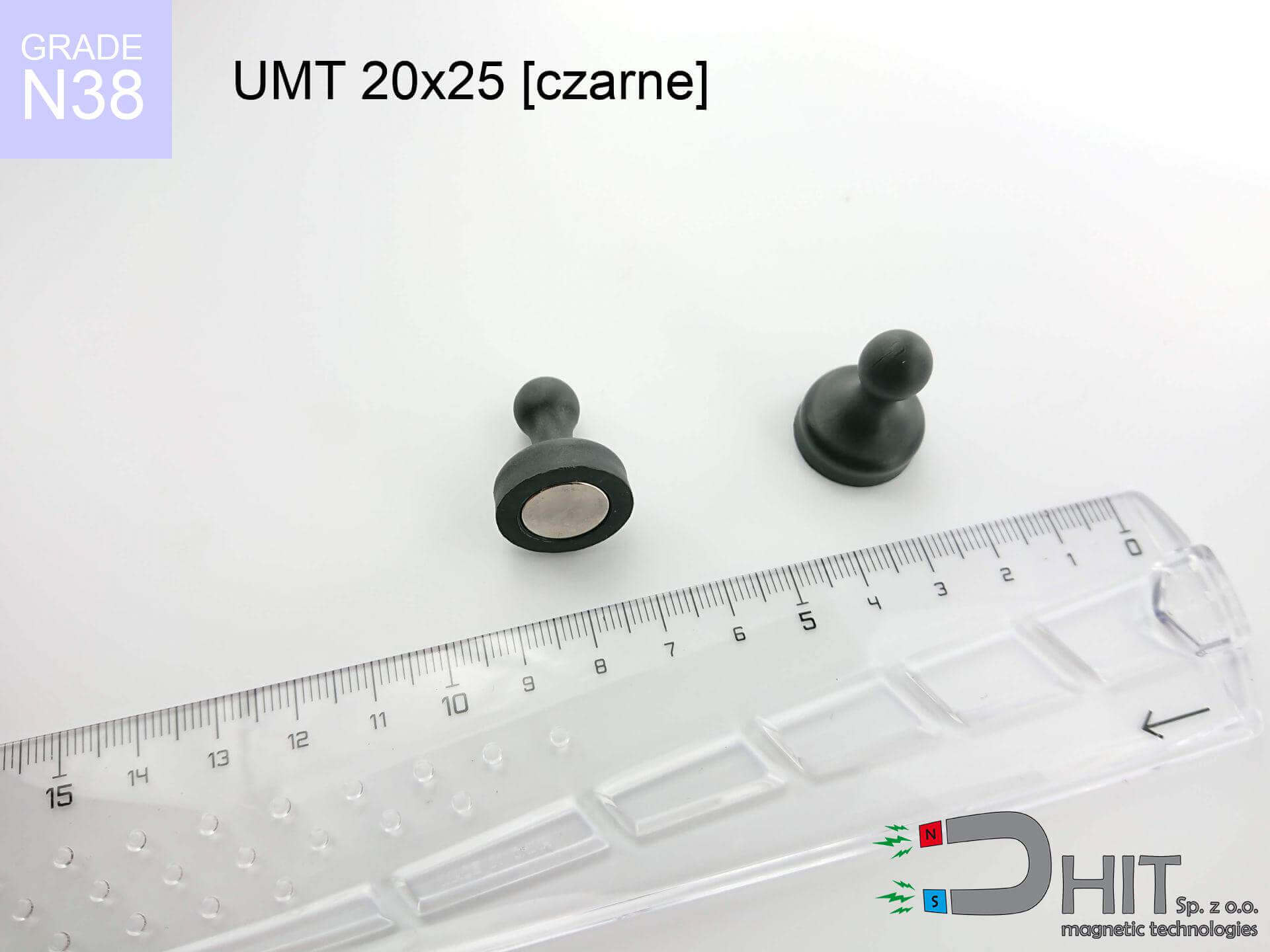
UMT 20x25 black / N38 - board holder
board holder
Catalog no 230263
GTIN/EAN: 5906301814269
- Diameter Ø
- 20 mm [±1 mm]
- Height
- 25 mm [±1 mm]
- Weight
- 7 g
- Coating
- [NiCuNi] Nickel
How we measure these parameters — certificates and measurements
2.84 zł net / pcs
3.49 zł with VAT (23% VAT) / pcs
bulk discounts:
Need more?Frequently asked questions
How many sheets of paper will one magnetic pin hold?
Will a magnetic pin stick to any board - whiteboard, glass, cork?
Will the magnet leave a mark or scratch the board or the fridge?
What is the difference between the 12x20 and 20x25 sizes, and which one suits an office?
Are magnetic pins suitable for large-format maps and plans?
Call us now
+48 888 99 98 98
alternatively let us know using
contact form
the contact section.
Specifications and structure of a neodymium magnet can be estimated using our
power calculator.
Order by 14:00 and we’ll ship today!
Detailed specification - UMT 20x25 black / N38 - board holder
Specification / characteristics - UMT 20x25 black / N38 - board holder
| properties | values |
|---|---|
| Cat. no. | 230263 |
| GTIN/EAN | 5906301814269 |
| Production/Distribution | Dhit sp. z o.o. |
| Country of origin | Poland / China / Germany |
| Customs code | 85059029 |
| Diameter Ø | 20 mm [±1 mm] |
| Height | 25 mm [±1 mm] |
| Weight | 7 g |
| Coating | [NiCuNi] Nickel |
| Manufacturing Tolerance | ±1 mm |
Magnetic properties of material N38
| properties | values | units |
|---|---|---|
| Remanence Br ? | 12.2-12.6 | kGs |
| Remanence Br ? | 1220-1260 | mT |
| Coercivity bHc ? | 10.8-11.5 | kOe |
| Coercivity bHc ? | 860-915 | kA/m |
| Intrinsic coercivity iHc | ≥ 12 | kOe |
| Intrinsic coercivity iHc | ≥ 955 | kA/m |
| Energy product BHmax ? | 36-38 | BH max MGOe |
| Energy product BHmax ? | 287-303 | BH max KJ/m |
| Maximum working temperature ? | ≤ 80 | °C |
Physical properties of sintered neodymium magnets Nd2Fe14B at 20°C
| properties | values | units |
|---|---|---|
| Vickers hardness | ≥550 | Hv |
| Density | ≥7.4 | g/cm3 |
| Curie Temperature TC | 310 | °C |
| Curie Temperature TF | 590 | °F |
| Specific resistance | 150 | μΩ⋅cm |
| Bending strength | 250 | MPa |
| Compressive strength | 1000~1100 | MPa |
| Thermal expansion parallel (∥) to orientation (M) | (3-4) x 10-6 | °C-1 |
| Thermal expansion perpendicular (⊥) to orientation (M) | -(1-3) x 10-6 | °C-1 |
| Young's modulus | 1.7 x 10⁴ | kg/mm² |
Chemical composition
| iron (Fe) | 64% – 68% |
| neodymium (Nd) | 29% – 32% |
| boron (B) | 1.1% – 1.2% |
| dysprosium (Dy) | 0.5% – 2.0% |
| coating (Ni-Cu-Ni) | < 0.05% |
Ecology and recycling (GPSR)
| recyclability (EoL) | 100% |
| recycled raw materials | ~10% (pre-cons) |
| carbon footprint | low / zredukowany |
| waste code (EWC) | 16 02 16 |
Check out more offers
![SM 32x200 [2xM8] / N42 - magnetic separator](https://cdn3.dhit.pl/graphics/products/sm-32x200-2xm8-fub.jpg "SM 32x200 [2xM8] / N42 - magnetic separator")

Advantages and disadvantages of neodymium magnets.
Advantages
- They do not lose power, even over approximately 10 years – the drop in lifting capacity is only ~1% (based on measurements),
- They maintain their magnetic properties even under close interference source,
- In other words, due to the aesthetic layer of gold, the element gains a professional look,
- Magnetic induction on the working layer of the magnet turns out to be maximum,
- Neodymium magnets are characterized by extremely high magnetic induction on the magnet surface and can function (depending on the form) even at a temperature of 230°C or more...
- Thanks to flexibility in forming and the capacity to customize to complex applications,
- Significant place in future technologies – they are used in hard drives, electromotive mechanisms, precision medical tools, and modern systems.
- Thanks to efficiency per cm³, small magnets offer high operating force, in miniature format,
Limitations
- Brittleness is one of their disadvantages. Upon strong impact they can break. We advise keeping them in a steel housing, which not only secures them against impacts but also raises their durability
- Do not exceed this material temperature limit: 80°C. Overheating may permanently weaken the magnet.
- Due to the susceptibility of magnets to corrosion in a humid environment, we advise using waterproof magnets made of rubber, plastic or other material immune to moisture, when using outdoors
- Due to limitations in producing threads and complex shapes in magnets, we recommend using cover - magnetic holder.
- Health risk resulting from small fragments of magnets pose a threat, if swallowed, which gains importance in the context of child health protection. It is also worth noting that tiny parts of these products can complicate diagnosis medical after entering the body.
- Due to neodymium price, their price exceeds standard values,
Pull force analysis
Maximum magnetic pulling force – what contributes to it?
- with the application of a yoke made of low-carbon steel, guaranteeing full magnetic saturation
- whose thickness equals approx. 10 mm
- with an ground contact surface
- with total lack of distance (without impurities)
- under axial application of breakaway force (90-degree angle)
- in neutral thermal conditions
Practical aspects of lifting capacity – factors
- Air gap (betwixt the magnet and the metal), as even a microscopic clearance (e.g. 0.5 mm) results in a reduction in lifting capacity by up to 50% (this also applies to paint, rust or debris).
- Force direction – catalog parameter refers to detachment vertically. When applying parallel force, the magnet holds much less (typically approx. 20-30% of nominal force).
- Substrate thickness – to utilize 100% power, the steel must be sufficiently thick. Thin sheet limits the lifting capacity (the magnet "punches through" it).
- Material composition – not every steel reacts the same. Alloy additives worsen the attraction effect.
- Base smoothness – the more even the plate, the larger the contact zone and higher the lifting capacity. Unevenness acts like micro-gaps.
- Thermal conditions – NdFeB sinters have a sensitivity to temperature. When it is hot they are weaker, and at low temperatures they can be stronger (up to a certain limit).
Lifting capacity testing was conducted on a smooth plate of suitable thickness, under a perpendicular pulling force, in contrast under parallel forces the holding force is lower. In addition, even a small distance between the magnet and the plate reduces the holding force.
H&S for magnets
ICD Warning
Health Alert: Neodymium magnets can deactivate heart devices and defibrillators. Do not approach if you have medical devices.
Pinching danger
Risk of injury: The attraction force is so great that it can result in hematomas, crushing, and even bone fractures. Use thick gloves.
Caution required
Before use, check safety instructions. Sudden snapping can break the magnet or hurt your hand. Think ahead.
Danger to the youngest
These products are not toys. Swallowing several magnets can lead to them pinching intestinal walls, which constitutes a critical condition and requires urgent medical intervention.
Eye protection
Despite metallic appearance, neodymium is brittle and cannot withstand shocks. Do not hit, as the magnet may shatter into hazardous fragments.
Data carriers
Very strong magnetic fields can erase data on payment cards, HDDs, and storage devices. Keep a distance of at least 10 cm.
Maximum temperature
Do not overheat. Neodymium magnets are sensitive to heat. If you require operation above 80°C, ask us about special high-temperature series (H, SH, UH).
GPS Danger
An intense magnetic field negatively affects the functioning of magnetometers in smartphones and GPS navigation. Do not bring magnets near a device to prevent breaking the sensors.
Nickel allergy
Warning for allergy sufferers: The nickel-copper-nickel coating contains nickel. If skin irritation occurs, immediately stop working with magnets and wear gloves.
Fire warning
Mechanical processing of neodymium magnets poses a fire risk. Magnetic powder oxidizes rapidly with oxygen and is hard to extinguish.
Tabela kosztu i czasu dostawy
Płatność przed wysyłką:

GLS kurier
Przesyłka będzie u Ciebie za 2-3 dni
14.99 ZŁ

InPost Paczkomaty 24/7
Przesyłka będzie u Ciebie za 1-2 dni
12.30 ZŁ
Płatność przy odbiorze (pobranie):
GLS kurier
Przesyłka będzie u Ciebie za 1-2 dni
23.00 ZŁ