

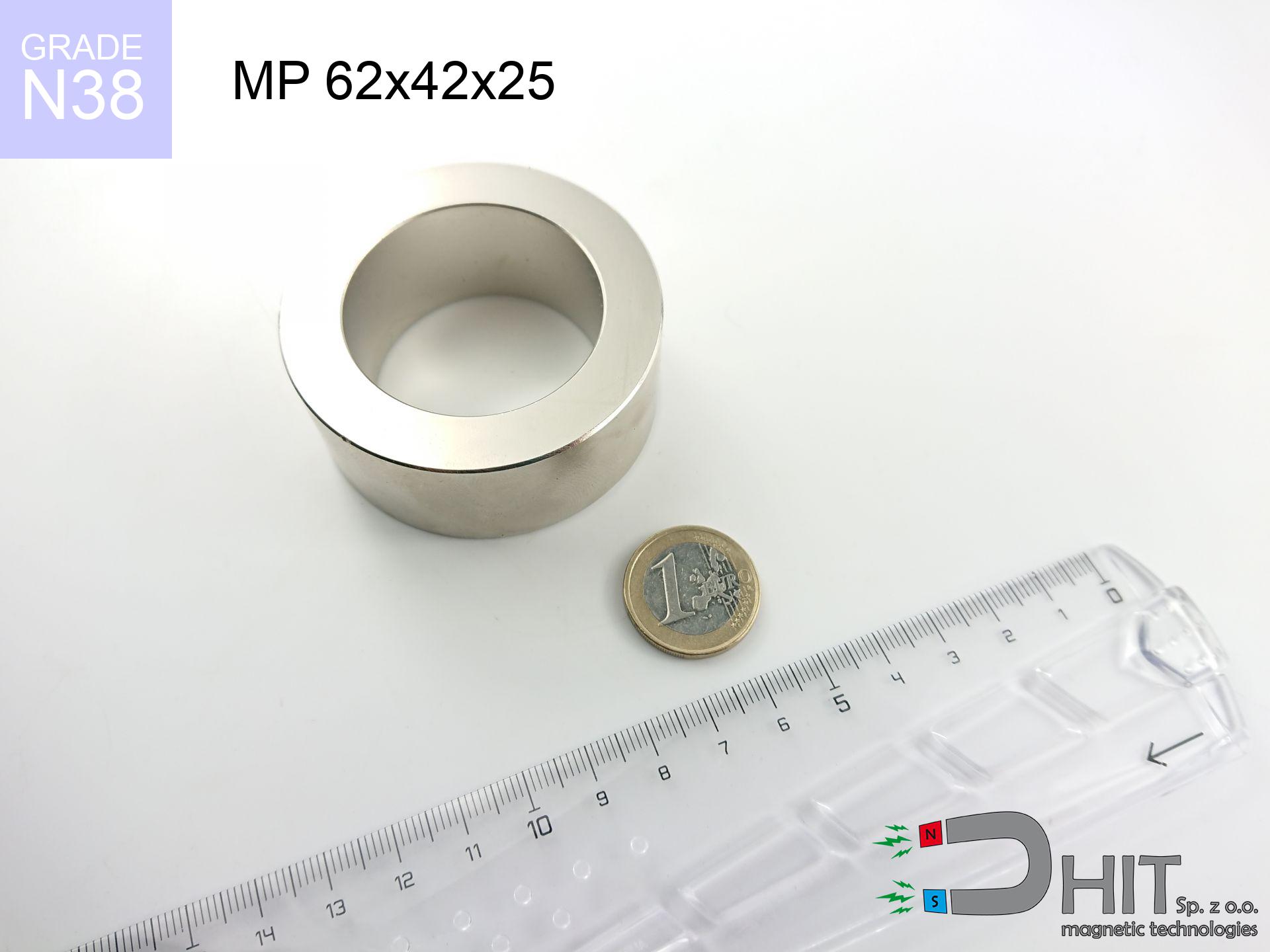
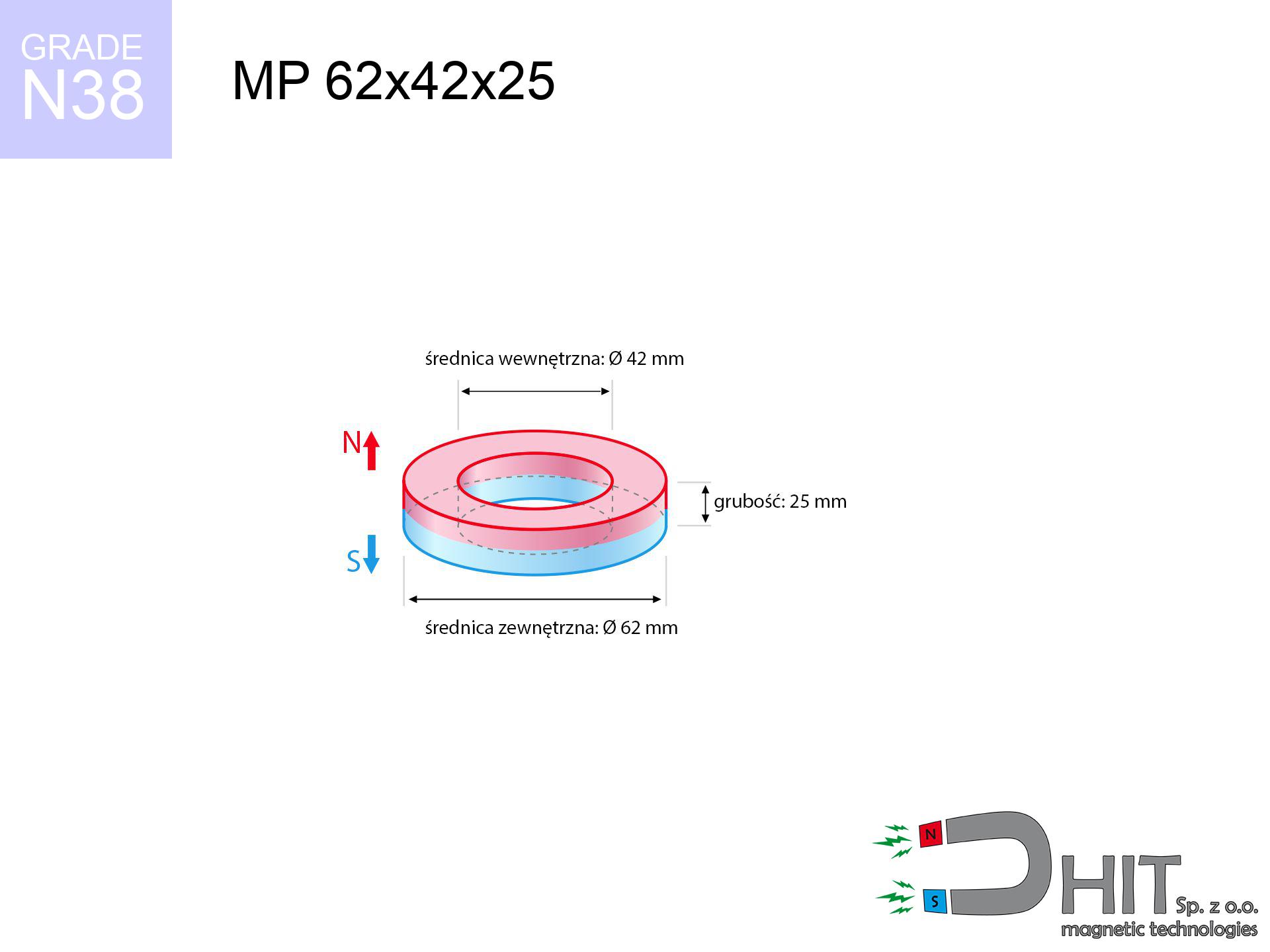
MP 62x42x25 / N38 - ring magnet
ring magnet
Catalog no 030205
GTIN/EAN: 5906301812227
- Diameter
- 62 mm [±0,1 mm]
- internal diameter Ø
- 42 mm [±0,1 mm]
- Height
- 25 mm [±0,1 mm]
- Weight
- 306.31 g
- Magnetization Direction
- ↑ axial
- Coating
- [NiCuNi] Nickel
How we measure these parameters — certificates and measurements
134.15 zł net / pcs
165.00 zł with VAT (23% VAT) / pcs
bulk discounts:
Need more?Frequently asked questions
Where can I compare prices of ring magnets for mounting in Poland?
Are ring magnets resistant to damage?
Which ring magnet is suitable for an outdoor structure?
Where can I check the available sizes of neodymium ring magnets?
Engineering report for this magnet
Full PDF analysis: pull and shear force, effect of distance, temperature and plate thickness, safety distances and the demagnetization curve.
Call us now
+48 888 99 98 98
alternatively let us know using
contact form
the contact section.
Specifications and structure of a neodymium magnet can be estimated using our
power calculator.
Order by 14:00 and we’ll ship today!
Technical data - MP 62x42x25 / N38 - ring magnet
Specification / characteristics - MP 62x42x25 / N38 - ring magnet
| properties | values |
|---|---|
| Cat. no. | 030205 |
| GTIN/EAN | 5906301812227 |
| Production/Distribution | Dhit sp. z o.o. |
| Country of origin | Poland / China / Germany |
| Customs code | 85059029 |
| Diameter | 62 mm [±0,1 mm] |
| internal diameter Ø | 42 mm [±0,1 mm] |
| Height | 25 mm [±0,1 mm] |
| Weight | 306.31 g |
| Magnetization Direction | ↑ axial |
| Load capacity ~ ? | 58.67 kg / 575.60 N |
| Magnetic Induction ~ ? | 389.14 mT / 3891 Gs |
| Coating | [NiCuNi] Nickel |
| Manufacturing Tolerance | ±0.1 mm |
Magnetic properties of material N38
| properties | values | units |
|---|---|---|
| Remanence Br ? | 12.2-12.6 | kGs |
| Remanence Br ? | 1220-1260 | mT |
| Coercivity bHc ? | 10.8-11.5 | kOe |
| Coercivity bHc ? | 860-915 | kA/m |
| Intrinsic coercivity iHc | ≥ 12 | kOe |
| Intrinsic coercivity iHc | ≥ 955 | kA/m |
| Energy product BHmax ? | 36-38 | BH max MGOe |
| Energy product BHmax ? | 287-303 | BH max KJ/m |
| Maximum working temperature ? | ≤ 80 | °C |
Physical properties of sintered neodymium magnets Nd2Fe14B at 20°C
| properties | values | units |
|---|---|---|
| Vickers hardness | ≥550 | Hv |
| Density | ≥7.4 | g/cm3 |
| Curie Temperature TC | 310 | °C |
| Curie Temperature TF | 590 | °F |
| Specific resistance | 150 | μΩ⋅cm |
| Bending strength | 250 | MPa |
| Compressive strength | 1000~1100 | MPa |
| Thermal expansion parallel (∥) to orientation (M) | (3-4) x 10-6 | °C-1 |
| Thermal expansion perpendicular (⊥) to orientation (M) | -(1-3) x 10-6 | °C-1 |
| Young's modulus | 1.7 x 10⁴ | kg/mm² |
Engineering modeling of the magnet - data
Presented values represent the outcome of a mathematical calculation. Values were calculated on algorithms for the class Nd2Fe14B. Operational parameters might slightly differ. Use these calculations as a preliminary roadmap during assembly planning.
Table 1: Static force (force vs distance) - interaction chart
MP 62x42x25 / N38
| Distance (mm) | Induction (Gauss) / mT | Pull Force (kg/lbs/g/N) | Risk Status |
|---|---|---|---|
| 0 mm |
4472 Gs
447.2 mT
|
58.67 kg / 129.35 pounds
58670.0 g / 575.6 N
|
dangerous! |
| 1 mm |
4338 Gs
433.8 mT
|
55.21 kg / 121.72 pounds
55213.2 g / 541.6 N
|
dangerous! |
| 2 mm |
4201 Gs
420.1 mT
|
51.77 kg / 114.13 pounds
51768.5 g / 507.8 N
|
dangerous! |
| 3 mm |
4061 Gs
406.1 mT
|
48.39 kg / 106.69 pounds
48394.9 g / 474.8 N
|
dangerous! |
| 5 mm |
3781 Gs
378.1 mT
|
41.94 kg / 92.47 pounds
41942.4 g / 411.5 N
|
dangerous! |
| 10 mm |
3097 Gs
309.7 mT
|
28.15 kg / 62.06 pounds
28148.0 g / 276.1 N
|
dangerous! |
| 15 mm |
2485 Gs
248.5 mT
|
18.12 kg / 39.94 pounds
18118.5 g / 177.7 N
|
dangerous! |
| 20 mm |
1972 Gs
197.2 mT
|
11.41 kg / 25.16 pounds
11412.7 g / 112.0 N
|
dangerous! |
| 30 mm |
1239 Gs
123.9 mT
|
4.51 kg / 9.93 pounds
4505.2 g / 44.2 N
|
medium risk |
| 50 mm |
533 Gs
53.3 mT
|
0.83 kg / 1.84 pounds
832.4 g / 8.2 N
|
low risk |
Table 2: Sliding capacity (wall)
MP 62x42x25 / N38
| Distance (mm) | Friction coefficient | Pull Force (kg/lbs/g/N) |
|---|---|---|
| 0 mm | Stal (~0.2) |
11.73 kg / 25.87 pounds
11734.0 g / 115.1 N
|
| 1 mm | Stal (~0.2) |
11.04 kg / 24.34 pounds
11042.0 g / 108.3 N
|
| 2 mm | Stal (~0.2) |
10.35 kg / 22.83 pounds
10354.0 g / 101.6 N
|
| 3 mm | Stal (~0.2) |
9.68 kg / 21.34 pounds
9678.0 g / 94.9 N
|
| 5 mm | Stal (~0.2) |
8.39 kg / 18.49 pounds
8388.0 g / 82.3 N
|
| 10 mm | Stal (~0.2) |
5.63 kg / 12.41 pounds
5630.0 g / 55.2 N
|
| 15 mm | Stal (~0.2) |
3.62 kg / 7.99 pounds
3624.0 g / 35.6 N
|
| 20 mm | Stal (~0.2) |
2.28 kg / 5.03 pounds
2282.0 g / 22.4 N
|
| 30 mm | Stal (~0.2) |
0.90 kg / 1.99 pounds
902.0 g / 8.8 N
|
| 50 mm | Stal (~0.2) |
0.17 kg / 0.37 pounds
166.0 g / 1.6 N
|
Table 3: Vertical assembly (sliding) - behavior on slippery surfaces
MP 62x42x25 / N38
| Surface type | Friction coefficient / % Mocy | Max load (kg/lbs/g/N) |
|---|---|---|
| Raw steel |
µ = 0.3
30% Nominalnej Siły
|
17.60 kg / 38.80 pounds
17601.0 g / 172.7 N
|
| Painted steel (standard) |
µ = 0.2
20% Nominalnej Siły
|
11.73 kg / 25.87 pounds
11734.0 g / 115.1 N
|
| Oily/slippery steel |
µ = 0.1
10% Nominalnej Siły
|
5.87 kg / 12.93 pounds
5867.0 g / 57.6 N
|
| Magnet with anti-slip rubber |
µ = 0.5
50% Nominalnej Siły
|
29.34 kg / 64.67 pounds
29335.0 g / 287.8 N
|
Table 4: Steel thickness (saturation) - sheet metal selection
MP 62x42x25 / N38
| Steel thickness (mm) | % power | Real pull force (kg/lbs/g/N) |
|---|---|---|
| 0.5 mm |
|
1.96 kg / 4.31 pounds
1955.7 g / 19.2 N
|
| 1 mm |
|
4.89 kg / 10.78 pounds
4889.2 g / 48.0 N
|
| 2 mm |
|
9.78 kg / 21.56 pounds
9778.3 g / 95.9 N
|
| 3 mm |
|
14.67 kg / 32.34 pounds
14667.5 g / 143.9 N
|
| 5 mm |
|
24.45 kg / 53.89 pounds
24445.8 g / 239.8 N
|
| 10 mm |
|
48.89 kg / 107.79 pounds
48891.7 g / 479.6 N
|
| 11 mm |
|
53.78 kg / 118.57 pounds
53780.8 g / 527.6 N
|
| 12 mm |
|
58.67 kg / 129.35 pounds
58670.0 g / 575.6 N
|
Table 5: Thermal stability (stability) - thermal limit
MP 62x42x25 / N38
| Ambient temp. (°C) | Power loss | Remaining pull (kg/lbs/g/N) | Status |
|---|---|---|---|
| 20 °C | 0.0% |
58.67 kg / 129.35 pounds
58670.0 g / 575.6 N
|
OK |
| 40 °C | -2.2% |
57.38 kg / 126.50 pounds
57379.3 g / 562.9 N
|
OK |
| 60 °C | -4.4% |
56.09 kg / 123.65 pounds
56088.5 g / 550.2 N
|
OK |
| 80 °C | -6.6% |
54.80 kg / 120.81 pounds
54797.8 g / 537.6 N
|
|
| 100 °C | -28.8% |
41.77 kg / 92.09 pounds
41773.0 g / 409.8 N
|
Table 6: Two magnets (attraction) - field range
MP 62x42x25 / N38
| Gap (mm) | Attraction (kg/lbs) (N-S) | Shear Force (kg/lbs/g/N) | Repulsion (kg/lbs) (N-N) |
|---|---|---|---|
| 0 mm |
264.93 kg / 584.07 pounds
5 588 Gs
|
39.74 kg / 87.61 pounds
39740 g / 389.8 N
|
N/A |
| 1 mm |
257.19 kg / 567.00 pounds
8 812 Gs
|
38.58 kg / 85.05 pounds
38578 g / 378.4 N
|
231.47 kg / 510.30 pounds
~0 Gs
|
| 2 mm |
249.32 kg / 549.66 pounds
8 676 Gs
|
37.40 kg / 82.45 pounds
37398 g / 366.9 N
|
224.39 kg / 494.69 pounds
~0 Gs
|
| 3 mm |
241.51 kg / 532.44 pounds
8 539 Gs
|
36.23 kg / 79.87 pounds
36227 g / 355.4 N
|
217.36 kg / 479.19 pounds
~0 Gs
|
| 5 mm |
226.10 kg / 498.47 pounds
8 262 Gs
|
33.92 kg / 74.77 pounds
33915 g / 332.7 N
|
203.49 kg / 448.62 pounds
~0 Gs
|
| 10 mm |
189.40 kg / 417.55 pounds
7 562 Gs
|
28.41 kg / 62.63 pounds
28409 g / 278.7 N
|
170.46 kg / 375.79 pounds
~0 Gs
|
| 20 mm |
127.11 kg / 280.22 pounds
6 195 Gs
|
19.07 kg / 42.03 pounds
19066 g / 187.0 N
|
114.40 kg / 252.20 pounds
~0 Gs
|
| 50 mm |
32.28 kg / 71.17 pounds
3 122 Gs
|
4.84 kg / 10.68 pounds
4843 g / 47.5 N
|
29.06 kg / 64.06 pounds
~0 Gs
|
| 60 mm |
20.34 kg / 44.85 pounds
2 478 Gs
|
3.05 kg / 6.73 pounds
3052 g / 29.9 N
|
18.31 kg / 40.36 pounds
~0 Gs
|
| 70 mm |
12.99 kg / 28.63 pounds
1 980 Gs
|
1.95 kg / 4.29 pounds
1948 g / 19.1 N
|
11.69 kg / 25.77 pounds
~0 Gs
|
| 80 mm |
8.43 kg / 18.59 pounds
1 595 Gs
|
1.26 kg / 2.79 pounds
1265 g / 12.4 N
|
7.59 kg / 16.73 pounds
~0 Gs
|
| 90 mm |
5.58 kg / 12.29 pounds
1 298 Gs
|
0.84 kg / 1.84 pounds
836 g / 8.2 N
|
5.02 kg / 11.06 pounds
~0 Gs
|
| 100 mm |
3.76 kg / 8.29 pounds
1 065 Gs
|
0.56 kg / 1.24 pounds
564 g / 5.5 N
|
3.38 kg / 7.46 pounds
~0 Gs
|
Table 7: Safety (HSE) (electronics) - warnings
MP 62x42x25 / N38
| Object / Device | Limit (Gauss) / mT | Safe distance |
|---|---|---|
| Pacemaker | 5 Gs (0.5 mT) | 32.5 cm |
| Hearing aid | 10 Gs (1.0 mT) | 25.5 cm |
| Timepiece | 20 Gs (2.0 mT) | 20.0 cm |
| Mobile device | 40 Gs (4.0 mT) | 15.5 cm |
| Car key | 50 Gs (5.0 mT) | 14.0 cm |
| Payment card | 400 Gs (40.0 mT) | 6.0 cm |
| HDD hard drive | 600 Gs (60.0 mT) | 5.0 cm |
Table 8: Collisions (kinetic energy) - collision effects
MP 62x42x25 / N38
| Start from (mm) | Speed (km/h) | Energy (J) | Predicted outcome |
|---|---|---|---|
| 10 mm |
18.77 km/h
(5.21 m/s)
|
4.16 J | |
| 30 mm |
23.85 km/h
(6.63 m/s)
|
6.72 J | |
| 50 mm |
24.58 km/h
(6.83 m/s)
|
7.14 J | |
| 100 mm |
24.78 km/h
(6.88 m/s)
|
7.26 J |
Table 9: Coating parameters (durability)
MP 62x42x25 / N38
| Technical parameter | Value / Description |
|---|---|
| Coating type | [NiCuNi] Nickel |
| Layer structure | Nickel - Copper - Nickel |
| Layer thickness | 10-20 µm |
| Salt spray test (SST) ? | 24 h |
| Recommended environment | Indoors only (dry) |
Table 10: Electrical data (Pc)
MP 62x42x25 / N38
| Parameter | Value | SI Unit / Description |
|---|---|---|
| Magnetic Flux | 100 906 Mx | 1009.1 µWb |
| Pc Coefficient | 0.64 | High (Stable) |
Table 11: Underwater work (magnet fishing)
MP 62x42x25 / N38
| Environment | Effective steel pull | Effect |
|---|---|---|
| Air (land) | 58.67 kg | Standard |
| Water (riverbed) |
67.18 kg
(+8.51 kg buoyancy gain)
|
+14.5% |
1. Vertical hold
*Note: On a vertical wall, the magnet retains only a fraction of its nominal pull.
2. Steel saturation
*Thin steel (e.g. 0.5mm PC case) significantly weakens the holding force.
3. Power loss vs temp
N38: the maximum material working temperature is 80°C. Permitted conditions also depend on the shape and magnetic circuit.
4. Demagnetization curve and operating point (B-H)
chart generated for the permeance coefficient Pc (Permeance Coefficient) = 0.64
This simulation demonstrates the magnetic stability of the selected magnet under specific geometric conditions. The solid red line represents the demagnetization curve (material potential), while the dashed blue line is the load line based on the magnet's geometry. The Pc (Permeance Coefficient), also known as the load line slope, is a dimensionless value that describes the relationship between the magnet's shape and its magnetic stability. The intersection of these two lines (the black dot) is the operating point — it determines the actual magnetic flux density generated by the magnet in this specific configuration. A higher Pc value means the magnet is more 'slender' (tall relative to its area), resulting in a higher operating point and better resistance to irreversible demagnetization caused by external fields or temperature. A value of 0.42 is relatively low (typical for flat magnets), meaning the operating point is closer to the 'knee' of the curve — caution is advised when operating at temperatures near the maximum limit to avoid strength loss.
Elemental analysis
| iron (Fe) | 64% – 68% |
| neodymium (Nd) | 29% – 32% |
| boron (B) | 1.1% – 1.2% |
| dysprosium (Dy) | 0.5% – 2.0% |
| coating (Ni-Cu-Ni) | < 0.05% |
Ecology and recycling (GPSR)
| recyclability (EoL) | 100% |
| recycled raw materials | ~10% (pre-cons) |
| carbon footprint | low / zredukowany |
| waste code (EWC) | 16 02 16 |
Other offers

![SM 28x250 [2xM8] / N52 - magnetic separator](https://cdn3.dhit.pl/graphics/products/sm-28x250-2xm8-zap.jpg "SM 28x250 [2xM8] / N52 - magnetic separator")

![SM 32x375 [2xM8] / N52 - magnetic separator](https://cdn3.dhit.pl/graphics/products/sm-32x375-2xm8-mif.jpg "SM 32x375 [2xM8] / N52 - magnetic separator")
Strengths and weaknesses of Nd2Fe14B magnets.
Advantages
- They do not lose magnetism, even over approximately ten years – the reduction in strength is only ~1% (according to tests),
- They show high resistance to demagnetization induced by external magnetic fields,
- Thanks to the glossy finish, the plating of nickel, gold, or silver gives an professional appearance,
- They are known for high magnetic induction at the operating surface, making them more effective,
- Thanks to resistance to high temperature, they can operate (depending on the shape) even at temperatures up to 230°C and higher...
- Thanks to freedom in shaping and the capacity to adapt to complex applications,
- Wide application in advanced technology sectors – they serve a role in computer drives, drive modules, medical devices, also technologically advanced constructions.
- Thanks to their power density, small magnets offer high operating force, in miniature format,
Limitations
- To avoid cracks under impact, we recommend using special steel holders. Such a solution protects the magnet and simultaneously improves its durability.
- Do not exceed this material temperature limit: 80°C. Overheating may permanently weaken the magnet.
- They oxidize in a humid environment. For use outdoors we recommend using waterproof magnets e.g. in rubber, plastic
- Limited ability of producing threads in the magnet and complicated shapes - preferred is cover - mounting mechanism.
- Potential hazard resulting from small fragments of magnets pose a threat, if swallowed, which is particularly important in the context of child safety. It is also worth noting that small components of these devices can disrupt the diagnostic process medical in case of swallowing.
- With mass production the cost of neodymium magnets is a challenge,
Pull force analysis
Maximum lifting capacity of the magnet – what affects it?
- with the application of a yoke made of low-carbon steel, guaranteeing maximum field concentration
- whose transverse dimension reaches at least 10 mm
- with an polished contact surface
- with zero gap (without impurities)
- under axial force direction (90-degree angle)
- at temperature approx. 20 degrees Celsius
Key elements affecting lifting force
- Distance (betwixt the magnet and the metal), because even a microscopic distance (e.g. 0.5 mm) can cause a reduction in lifting capacity by up to 50% (this also applies to paint, corrosion or debris).
- Loading method – catalog parameter refers to pulling vertically. When applying parallel force, the magnet exhibits much less (typically approx. 20-30% of nominal force).
- Element thickness – to utilize 100% power, the steel must be adequately massive. Thin sheet restricts the attraction force (the magnet "punches through" it).
- Material composition – different alloys reacts the same. Alloy additives worsen the attraction effect.
- Plate texture – smooth surfaces guarantee perfect abutment, which improves field saturation. Rough surfaces reduce efficiency.
- Operating temperature – NdFeB sinters have a negative temperature coefficient. At higher temperatures they are weaker, and at low temperatures gain strength (up to a certain limit).
Holding force was tested on a smooth steel plate of 20 mm thickness, when a perpendicular force was applied, however under shearing force the lifting capacity is smaller. Moreover, even a slight gap between the magnet and the plate decreases the lifting capacity.
H&S for magnets
Respect the power
Use magnets consciously. Their powerful strength can shock even professionals. Be vigilant and do not underestimate their power.
Avoid contact if allergic
Certain individuals have a contact allergy to nickel, which is the common plating for NdFeB magnets. Extended handling might lead to an allergic reaction. It is best to use protective gloves.
Safe distance
Do not bring magnets near a purse, laptop, or TV. The magnetism can permanently damage these devices and wipe information from cards.
Shattering risk
Protect your eyes. Magnets can fracture upon violent connection, ejecting sharp fragments into the air. Wear goggles.
Heat warning
Standard neodymium magnets (N-type) lose magnetization when the temperature exceeds 80°C. Damage is permanent.
No play value
Strictly keep magnets away from children. Risk of swallowing is high, and the effects of magnets connecting inside the body are tragic.
Dust is flammable
Mechanical processing of NdFeB material poses a fire risk. Neodymium dust oxidizes rapidly with oxygen and is difficult to extinguish.
Life threat
Life threat: Neodymium magnets can deactivate heart devices and defibrillators. Stay away if you have electronic implants.
GPS Danger
A powerful magnetic field interferes with the functioning of compasses in phones and GPS navigation. Do not bring magnets near a device to prevent breaking the sensors.
Pinching danger
Watch your fingers. Two powerful magnets will join immediately with a force of massive weight, crushing anything in their path. Be careful!
Tabela kosztu i czasu dostawy
Płatność przed wysyłką:

GLS kurier
Przesyłka będzie u Ciebie za 2-3 dni
14.99 ZŁ

InPost Paczkomaty 24/7
Przesyłka będzie u Ciebie za 1-2 dni
12.30 ZŁ
Płatność przy odbiorze (pobranie):
GLS kurier
Przesyłka będzie u Ciebie za 1-2 dni
23.00 ZŁ