

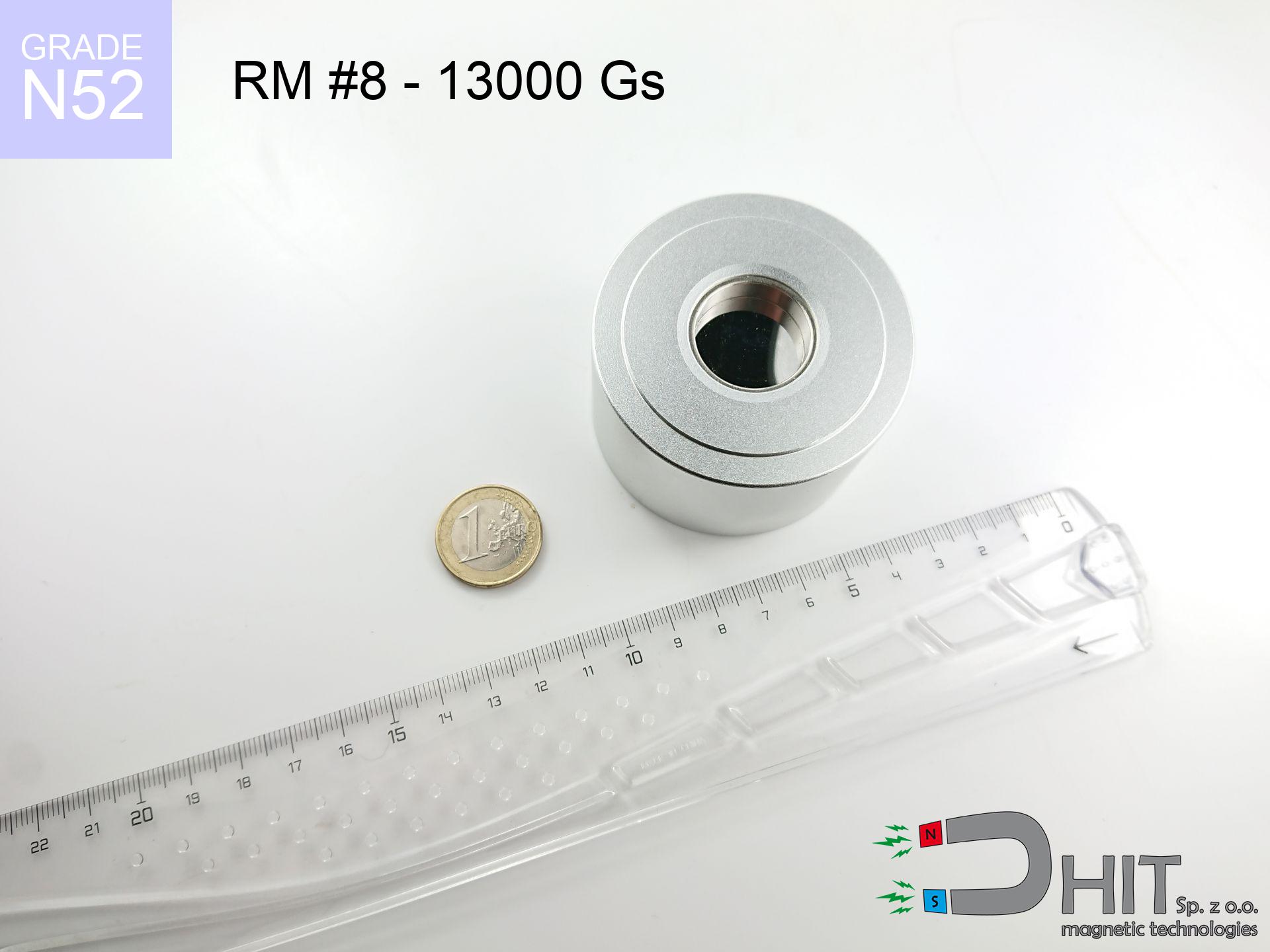
RM R8 ULTRA - 13000 Gs / N52 - magnetic distributor
magnetic distributor
Catalog no 280400
GTIN/EAN: 5906301814498
- Weight
- 382 g
- Magnetization Direction
- ↑ axial
- Coating
- [NiCuNi] Nickel
How we measure these parameters — certificates and measurements
162.60 zł net / pcs
200.00 zł with VAT (23% VAT) / pcs
bulk discounts:
Need more?Frequently asked questions
What is the difference between a 13,000 Gs and a 5,000 Gs detacher, and which one should I choose for a clothing shop?
Will one detacher open every security tag we use in the shop?
How do I fix the detacher to the counter so it does not move around or go missing?
Will the detacher damage payment cards, phones or the payment terminal next to the till?
How do I look after a detacher, and does its strength fade over time?
How many till points should we equip, and is a spare unit worth keeping?
Who are detachers sold to, and what is needed to place an order?
Guides from the knowledge base
Call us now
+48 888 99 98 98
alternatively let us know using
contact form
the contact section.
Specifications and structure of a neodymium magnet can be estimated using our
power calculator.
Order by 14:00 and we’ll ship today!
Technical specification of the product - RM R8 ULTRA - 13000 Gs / N52 - magnetic distributor
Specification / characteristics - RM R8 ULTRA - 13000 Gs / N52 - magnetic distributor
| properties | values |
|---|---|
| Cat. no. | 280400 |
| GTIN/EAN | 5906301814498 |
| Production/Distribution | Dhit sp. z o.o. |
| Country of origin | Poland / China / Germany |
| Customs code | 85059029 |
| Weight | 382 g |
| Magnetization Direction | ↑ axial |
| Coating | [NiCuNi] Nickel |
| Manufacturing Tolerance | ±1 mm |
Magnetic properties of material N52
| properties | values | units |
|---|---|---|
| Remanence Br ? | 14.2-14.7 | kGs |
| Remanence Br ? | 1420-1470 | mT |
| Coercivity bHc ? | 10.8-12.5 | kOe |
| Coercivity bHc ? | 860-995 | kA/m |
| Intrinsic coercivity iHc | ≥ 12 | kOe |
| Intrinsic coercivity iHc | ≥ 955 | kA/m |
| Energy product BHmax ? | 48-53 | BH max MGOe |
| Energy product BHmax ? | 380-422 | BH max KJ/m |
| Maximum working temperature ? | ≤ 60 | °C |
Physical properties of sintered neodymium magnets Nd2Fe14B at 20°C
| properties | values | units |
|---|---|---|
| Vickers hardness | ≥550 | Hv |
| Density | ≥7.4 | g/cm3 |
| Curie Temperature TC | 310 | °C |
| Curie Temperature TF | 590 | °F |
| Specific resistance | 150 | μΩ⋅cm |
| Bending strength | 250 | MPa |
| Compressive strength | 1000~1100 | MPa |
| Thermal expansion parallel (∥) to orientation (M) | (3-4) x 10-6 | °C-1 |
| Thermal expansion perpendicular (⊥) to orientation (M) | -(1-3) x 10-6 | °C-1 |
| Young's modulus | 1.7 x 10⁴ | kg/mm² |
Material specification
| iron (Fe) | 64% – 68% |
| neodymium (Nd) | 29% – 32% |
| boron (B) | 1.1% – 1.2% |
| dysprosium (Dy) | 0.5% – 2.0% |
| coating (Ni-Cu-Ni) | < 0.05% |
Sustainability
| recyclability (EoL) | 100% |
| recycled raw materials | ~10% (pre-cons) |
| carbon footprint | low / zredukowany |
| waste code (EWC) | 16 02 16 |
Other deals
![UMGGW 66x8.5 [M8] GW / N38 - magnetic holder rubber internal thread](https://cdn3.dhit.pl/graphics/products/umg-66x8.5-m6-gw-wud.jpg "UMGGW 66x8.5 [M8] GW / N38 - magnetic holder rubber internal thread")
Strengths as well as weaknesses of rare earth magnets.
Strengths
- They do not lose strength, even after approximately ten years – the drop in lifting capacity is only ~1% (according to tests),
- Magnets effectively resist against demagnetization caused by foreign field sources,
- The use of an metallic coating of noble metals (nickel, gold, silver) causes the element to have aesthetics,
- Magnetic induction on the working layer of the magnet is strong,
- Made from properly selected components, these magnets show impressive resistance to high heat, enabling them to function (depending on their shape) at temperatures up to 230°C and above...
- Possibility of detailed shaping as well as modifying to atypical applications,
- Versatile presence in modern industrial fields – they are commonly used in hard drives, brushless drives, precision medical tools, and technologically advanced constructions.
- Compactness – despite small sizes they provide effective action, making them ideal for precision applications
Cons
- Susceptibility to cracking is one of their disadvantages. Upon intense impact they can fracture. We advise keeping them in a special holder, which not only protects them against impacts but also increases their durability
- Do not exceed this material temperature limit: 60°C. Overheating may permanently weaken the magnet.
- They rust in a humid environment - during use outdoors we recommend using waterproof magnets e.g. in rubber, plastic
- Limited ability of creating threads in the magnet and complicated shapes - preferred is a housing - mounting mechanism.
- Health risk related to microscopic parts of magnets can be dangerous, when accidentally swallowed, which becomes key in the context of child health protection. It is also worth noting that tiny parts of these magnets are able to be problematic in diagnostics medical when they are in the body.
- Due to expensive raw materials, their price is relatively high,
Holding force characteristics
Maximum lifting capacity of the magnet – what it depends on?
- on a block made of structural steel, optimally conducting the magnetic field
- possessing a massiveness of min. 10 mm to ensure full flux closure
- with a surface free of scratches
- with total lack of distance (without paint)
- for force acting at a right angle (pull-off, not shear)
- at ambient temperature room level
What influences lifting capacity in practice
- Gap between surfaces – every millimeter of distance (caused e.g. by veneer or dirt) significantly weakens the magnet efficiency, often by half at just 0.5 mm.
- Loading method – declared lifting capacity refers to pulling vertically. When attempting to slide, the magnet exhibits significantly lower power (often approx. 20-30% of maximum force).
- Substrate thickness – for full efficiency, the steel must be sufficiently thick. Paper-thin metal limits the lifting capacity (the magnet "punches through" it).
- Steel type – mild steel gives the best results. Alloy admixtures decrease magnetic properties and lifting capacity.
- Base smoothness – the more even the plate, the better the adhesion and stronger the hold. Unevenness acts like micro-gaps.
- Thermal conditions – neodymium magnets have a negative temperature coefficient. When it is hot they lose power, and at low temperatures they can be stronger (up to a certain limit).
Lifting capacity was measured using a steel plate with a smooth surface of suitable thickness (min. 20 mm), under perpendicular detachment force, whereas under parallel forces the lifting capacity is smaller. Additionally, even a small distance between the magnet and the plate lowers the holding force.
Safe handling of neodymium magnets
Pinching danger
Pinching hazard: The pulling power is so great that it can result in blood blisters, pinching, and even bone fractures. Protective gloves are recommended.
Do not drill into magnets
Powder created during grinding of magnets is self-igniting. Avoid drilling into magnets unless you are an expert.
Precision electronics
Remember: rare earth magnets produce a field that interferes with precision electronics. Maintain a safe distance from your mobile, tablet, and GPS.
Keep away from children
Always store magnets away from children. Risk of swallowing is high, and the consequences of magnets clamping inside the body are life-threatening.
Safe distance
Data protection: Neodymium magnets can damage data carriers and sensitive devices (pacemakers, medical aids, timepieces).
Heat warning
Regular neodymium magnets (grade N) undergo demagnetization when the temperature goes above 80°C. This process is irreversible.
Handling guide
Be careful. Neodymium magnets attract from a long distance and connect with huge force, often faster than you can react.
Allergy Warning
Allergy Notice: The nickel-copper-nickel coating consists of nickel. If skin irritation happens, cease handling magnets and wear gloves.
Material brittleness
Despite metallic appearance, the material is brittle and cannot withstand shocks. Do not hit, as the magnet may crumble into sharp, dangerous pieces.
Implant safety
Medical warning: Strong magnets can turn off pacemakers and defibrillators. Stay away if you have medical devices.
Tabela kosztu i czasu dostawy
Płatność przed wysyłką:

GLS kurier
Przesyłka będzie u Ciebie za 2-3 dni
14.99 ZŁ

InPost Paczkomaty 24/7
Przesyłka będzie u Ciebie za 1-2 dni
12.30 ZŁ
Płatność przy odbiorze (pobranie):
GLS kurier
Przesyłka będzie u Ciebie za 1-2 dni
23.00 ZŁ