

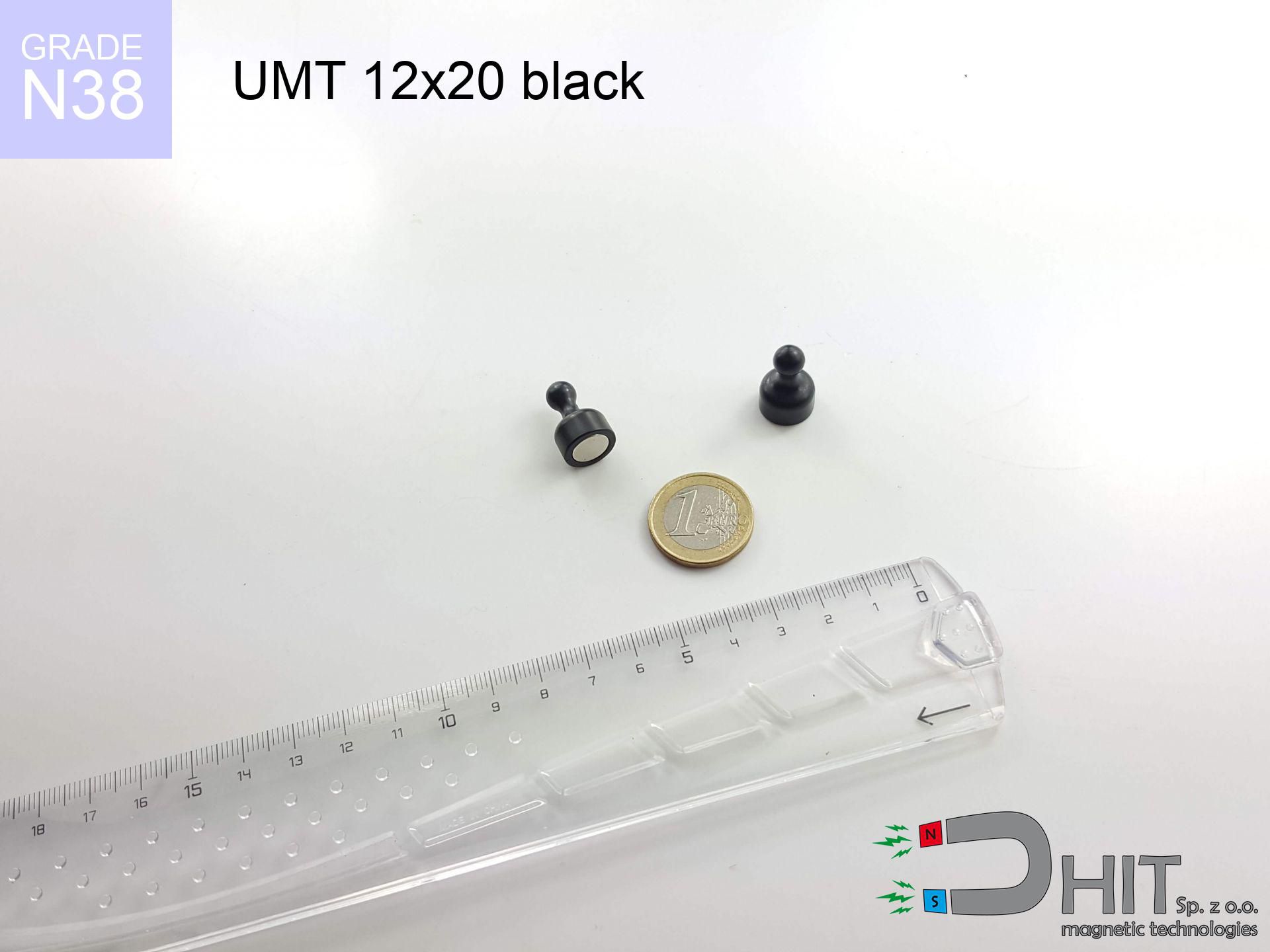
UMT 12x20 black / N38 - board holder
board holder
Catalog no 230285
GTIN/EAN: 5906301814375
- Diameter Ø
- 12 mm [±1 mm]
- Height
- 20 mm [±1 mm]
- Weight
- 3.5 g
- Coating
- [NiCuNi] Nickel
How we measure these parameters — certificates and measurements
1.540 zł net / pcs
1.894 zł with VAT (23% VAT) / pcs
bulk discounts:
Need more?Frequently asked questions
How many sheets of paper will one magnetic pin hold?
Will a magnetic pin stick to any board - whiteboard, glass, cork?
Will the magnet leave a mark or scratch the board or the fridge?
What is the difference between the 12x20 and 20x25 sizes, and which one suits an office?
Are magnetic pins suitable for large-format maps and plans?
Call us now
+48 888 99 98 98
alternatively let us know using
contact form
the contact section.
Specifications and structure of a neodymium magnet can be estimated using our
power calculator.
Order by 14:00 and we’ll ship today!
Technical - UMT 12x20 black / N38 - board holder
Specification / characteristics - UMT 12x20 black / N38 - board holder
| properties | values |
|---|---|
| Cat. no. | 230285 |
| GTIN/EAN | 5906301814375 |
| Production/Distribution | Dhit sp. z o.o. |
| Country of origin | Poland / China / Germany |
| Customs code | 85059029 |
| Diameter Ø | 12 mm [±1 mm] |
| Height | 20 mm [±1 mm] |
| Weight | 3.5 g |
| Coating | [NiCuNi] Nickel |
| Manufacturing Tolerance | ±1 mm |
Magnetic properties of material N38
| properties | values | units |
|---|---|---|
| Remanence Br ? | 12.2-12.6 | kGs |
| Remanence Br ? | 1220-1260 | mT |
| Coercivity bHc ? | 10.8-11.5 | kOe |
| Coercivity bHc ? | 860-915 | kA/m |
| Intrinsic coercivity iHc | ≥ 12 | kOe |
| Intrinsic coercivity iHc | ≥ 955 | kA/m |
| Energy product BHmax ? | 36-38 | BH max MGOe |
| Energy product BHmax ? | 287-303 | BH max KJ/m |
| Maximum working temperature ? | ≤ 80 | °C |
Physical properties of sintered neodymium magnets Nd2Fe14B at 20°C
| properties | values | units |
|---|---|---|
| Vickers hardness | ≥550 | Hv |
| Density | ≥7.4 | g/cm3 |
| Curie Temperature TC | 310 | °C |
| Curie Temperature TF | 590 | °F |
| Specific resistance | 150 | μΩ⋅cm |
| Bending strength | 250 | MPa |
| Compressive strength | 1000~1100 | MPa |
| Thermal expansion parallel (∥) to orientation (M) | (3-4) x 10-6 | °C-1 |
| Thermal expansion perpendicular (⊥) to orientation (M) | -(1-3) x 10-6 | °C-1 |
| Young's modulus | 1.7 x 10⁴ | kg/mm² |
Chemical composition
| iron (Fe) | 64% – 68% |
| neodymium (Nd) | 29% – 32% |
| boron (B) | 1.1% – 1.2% |
| dysprosium (Dy) | 0.5% – 2.0% |
| coating (Ni-Cu-Ni) | < 0.05% |
Environmental data
| recyclability (EoL) | 100% |
| recycled raw materials | ~10% (pre-cons) |
| carbon footprint | low / zredukowany |
| waste code (EWC) | 16 02 16 |
Other proposals
![UMP 75x25 [M10x3] GW F200 GOLD DUAL / N42 - search holder](https://cdn3.dhit.pl/graphics/products/ump-75x25-m10x3-gw-f200-gold-dual-xoc.jpg "UMP 75x25 [M10x3] GW F200 GOLD DUAL / N42 - search holder")
![UMGZ 20x15x7 [M4] GZ / N38 - magnetic holder external thread](https://cdn3.dhit.pl/graphics/products/um-20x15x7-m4-gz-vaf.jpg "UMGZ 20x15x7 [M4] GZ / N38 - magnetic holder external thread")
Strengths as well as weaknesses of neodymium magnets.
Pros
- They have stable power, and over nearly 10 years their attraction force decreases symbolically – ~1% (in testing),
- They show high resistance to demagnetization induced by external magnetic fields,
- The use of an shiny coating of noble metals (nickel, gold, silver) causes the element to present itself better,
- They show high magnetic induction at the operating surface, which affects their effectiveness,
- Neodymium magnets are characterized by extremely high magnetic induction on the magnet surface and are able to act (depending on the shape) even at a temperature of 230°C or more...
- Possibility of precise machining and adapting to defined conditions,
- Universal use in modern technologies – they are commonly used in HDD drives, motor assemblies, diagnostic systems, also other advanced devices.
- Compactness – despite small sizes they generate large force, making them ideal for precision applications
Disadvantages
- They are prone to damage upon too strong impacts. To avoid cracks, it is worth securing magnets in special housings. Such protection not only shields the magnet but also improves its resistance to damage
- Do not exceed this material temperature limit: 80°C. Overheating may permanently weaken the magnet.
- Due to the susceptibility of magnets to corrosion in a humid environment, we advise using waterproof magnets made of rubber, plastic or other material stable to moisture, when using outdoors
- Due to limitations in realizing nuts and complex forms in magnets, we propose using cover - magnetic mechanism.
- Potential hazard related to microscopic parts of magnets are risky, if swallowed, which is particularly important in the aspect of protecting the youngest. It is also worth noting that tiny parts of these devices are able to disrupt the diagnostic process medical when they are in the body.
- With budget limitations the cost of neodymium magnets can be a barrier,
Lifting parameters
Maximum lifting force for a neodymium magnet – what it depends on?
- with the contact of a yoke made of special test steel, guaranteeing maximum field concentration
- whose transverse dimension is min. 10 mm
- characterized by smoothness
- with total lack of distance (without impurities)
- under axial application of breakaway force (90-degree angle)
- at temperature room level
Practical aspects of lifting capacity – factors
- Space between surfaces – every millimeter of separation (caused e.g. by varnish or unevenness) diminishes the pulling force, often by half at just 0.5 mm.
- Pull-off angle – note that the magnet has greatest strength perpendicularly. Under sliding down, the holding force drops significantly, often to levels of 20-30% of the maximum value.
- Wall thickness – thin material does not allow full use of the magnet. Part of the magnetic field passes through the material instead of converting into lifting capacity.
- Material type – ideal substrate is high-permeability steel. Hardened steels may have worse magnetic properties.
- Plate texture – smooth surfaces guarantee perfect abutment, which improves field saturation. Uneven metal reduce efficiency.
- Operating temperature – NdFeB sinters have a sensitivity to temperature. When it is hot they are weaker, and at low temperatures gain strength (up to a certain limit).
Lifting capacity was measured using a steel plate with a smooth surface of suitable thickness (min. 20 mm), under perpendicular pulling force, whereas under shearing force the load capacity is reduced by as much as fivefold. Moreover, even a minimal clearance between the magnet’s surface and the plate decreases the holding force.
Warnings
Safe distance
Do not bring magnets close to a purse, computer, or TV. The magnetism can destroy these devices and wipe information from cards.
Permanent damage
Standard neodymium magnets (N-type) lose magnetization when the temperature surpasses 80°C. The loss of strength is permanent.
Precision electronics
Navigation devices and mobile phones are highly sensitive to magnetic fields. Direct contact with a strong magnet can permanently damage the sensors in your phone.
Do not underestimate power
Before use, check safety instructions. Sudden snapping can break the magnet or hurt your hand. Be predictive.
Pacemakers
Warning for patients: Powerful magnets disrupt electronics. Keep minimum 30 cm distance or ask another person to handle the magnets.
Nickel coating and allergies
It is widely known that the nickel plating (the usual finish) is a common allergen. For allergy sufferers, prevent direct skin contact and select coated magnets.
Adults only
Absolutely store magnets out of reach of children. Choking hazard is significant, and the consequences of magnets clamping inside the body are very dangerous.
Magnet fragility
Despite metallic appearance, neodymium is delicate and cannot withstand shocks. Do not hit, as the magnet may shatter into hazardous fragments.
Dust is flammable
Machining of NdFeB material carries a risk of fire risk. Magnetic powder reacts violently with oxygen and is difficult to extinguish.
Hand protection
Pinching hazard: The pulling power is so great that it can cause blood blisters, crushing, and even bone fractures. Protective gloves are recommended.
Tabela kosztu i czasu dostawy
Płatność przed wysyłką:

GLS kurier
Przesyłka będzie u Ciebie za 2-3 dni
14.99 ZŁ

InPost Paczkomaty 24/7
Przesyłka będzie u Ciebie za 1-2 dni
12.30 ZŁ
Płatność przy odbiorze (pobranie):
GLS kurier
Przesyłka będzie u Ciebie za 1-2 dni
23.00 ZŁ