

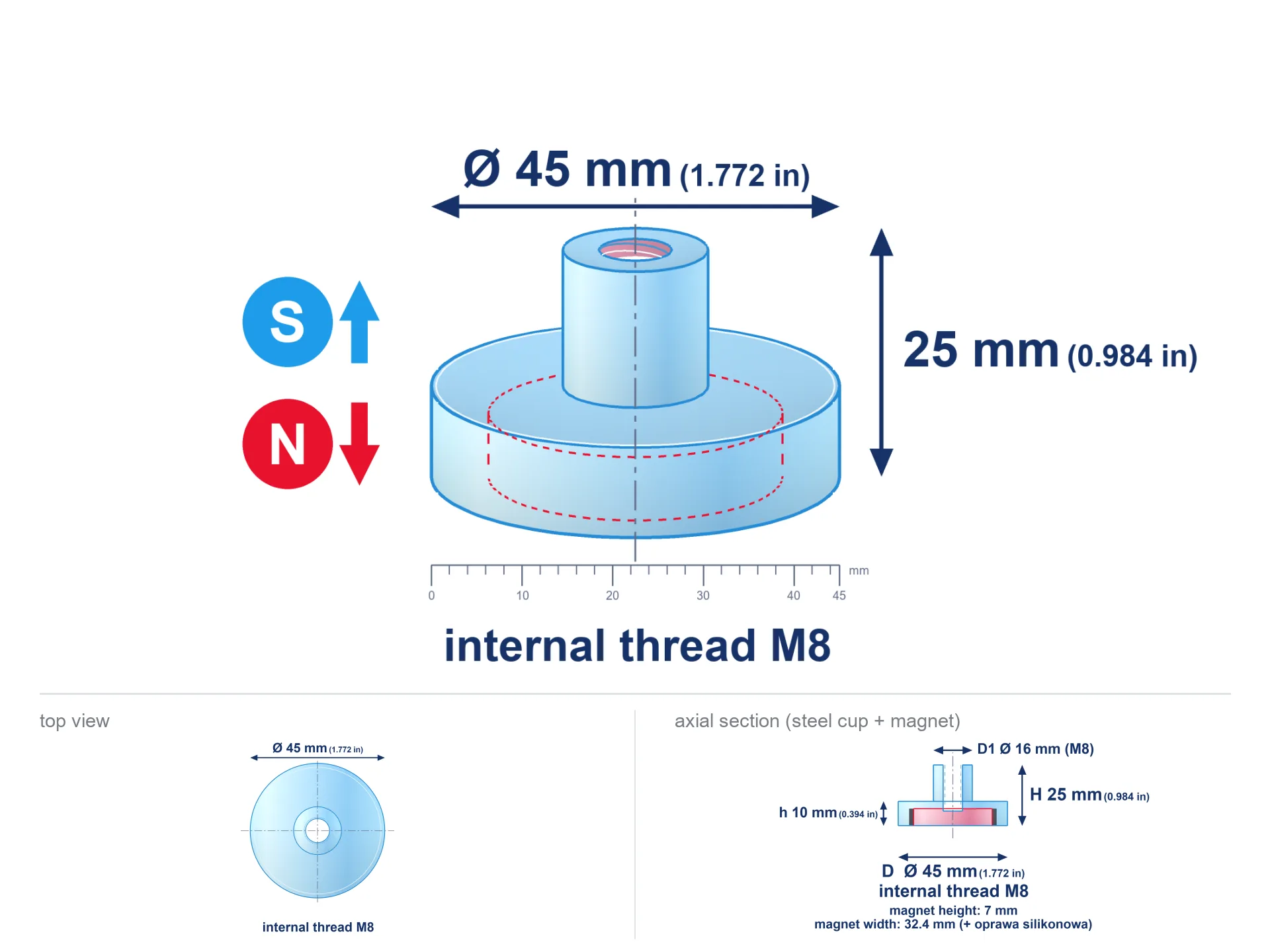
UMP 45x25 [M8] GW / N38 - search holder
search holder
Catalog no 210602
GTIN/EAN: 5906301816058
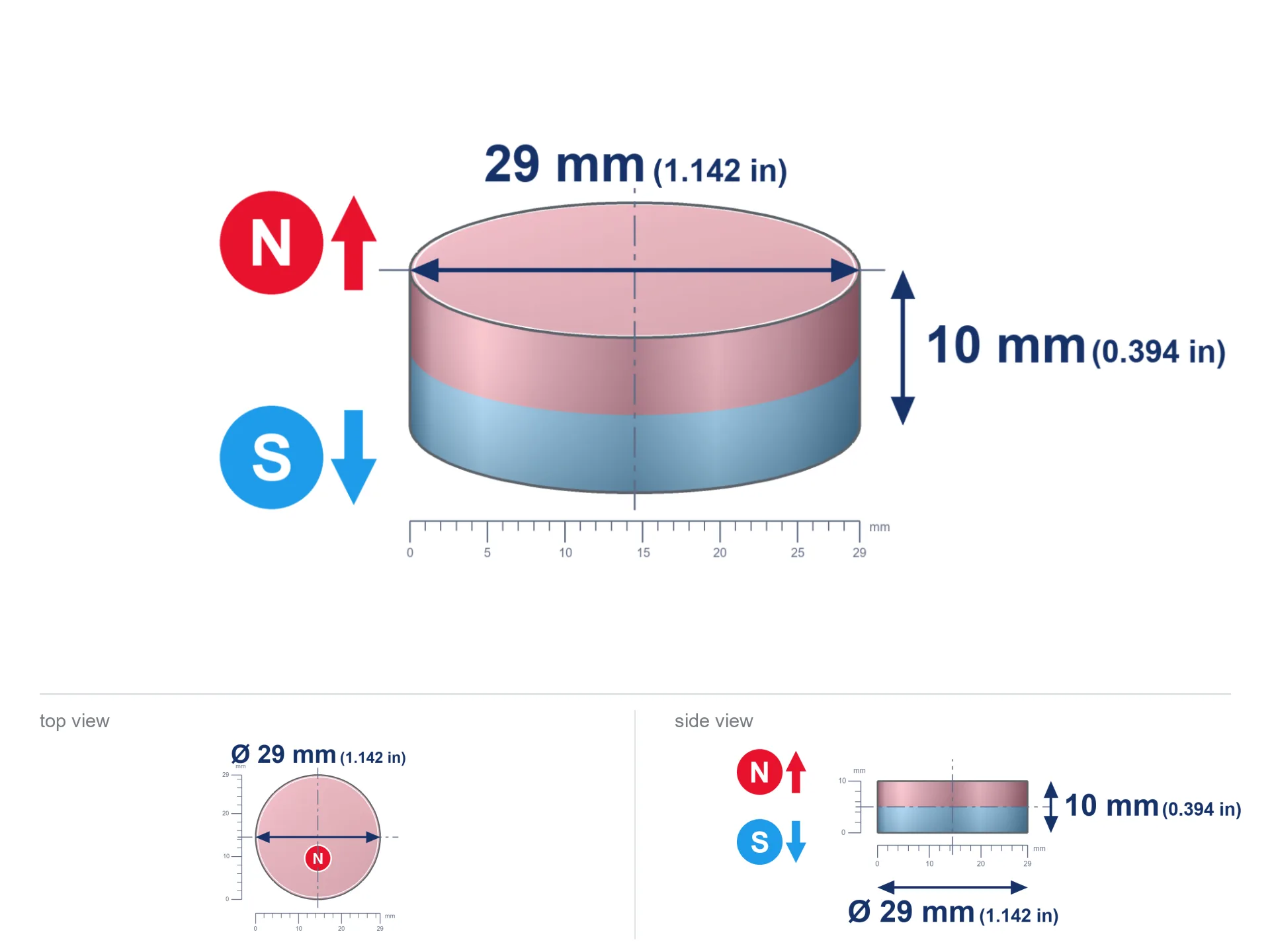
- Diameter Ø
- 45 mm [±1 mm]
- Height
- 25 mm [±1 mm]
- Coating
- [NiCuNi] Nickel
How we measure these parameters — certificates and measurements
81.30 zł net / pcs
100.00 zł with VAT (23% VAT) / pcs
bulk discounts:
Need more?Frequently asked questions
What rope length is best for deeper water?
Where should I buy a fishing magnet, and what should I check?
What pull rating is suitable for magnet fishing in a river?
Can I buy a complete starter set for magnet fishing?
Which rope can be paired with a magnet rated at several hundred kilograms?
How is a fishing magnet different from an ordinary magnetic holder?
Will the rope be the first component to fail with a heavy find?
What should I look for in a shop selling fishing magnets?
What does F mean in a model name? Does F200 mean a 200 kg pull rating?
Call us now
+48 888 99 98 98
alternatively let us know using
contact form
the contact section.
Specifications and structure of a neodymium magnet can be estimated using our
power calculator.
Order by 14:00 and we’ll ship today!
💡 Check why professionals choose Dhit over cheap substitutes
Don't be fooled by amateur online tests – go for certified quality and specific parameters that guarantee success:
- 📏 Magnet dimensions and grade – Compare the specifications of the exact model in the technical table. Thickness, material grade and geometry all affect holding force and field reach.
- 🛡️ Protective coating – Check the coating specified for the product and match it to the working environment. Water, impacts and scratches can shorten the life of an inadequately protected magnet.
- 🧲 Mounting and force direction – The mounting method affects the actual force of the assembly. Use components intended for the specific model and follow the recommendations on its product page.
- 🧶 Accessory selection – If the product is used with a rope, shackle or hook, check the load rating of every component. The weakest component determines the safety of the complete assembly.
- 🚀 Choose using comparable data: Each product page lists the magnet grade, dimensions, coating and measured holding force. Compare models using the same parameters and test conditions.
Invest in solid equipment and enjoy the results!
Technical details - UMP 45x25 [M8] GW / N38 - search holder
Specification / characteristics - UMP 45x25 [M8] GW / N38 - search holder
| properties | values |
|---|---|
| Cat. no. | 210602 |
| GTIN/EAN | 5906301816058 |
| Distributor | Dhit sp. z o.o. |
| Country of origin | Poland / China / Germany |
| Customs code | 85059029 |
| Diameter Ø | 45 mm [±1 mm] |
| Height | 25 mm [±1 mm] |
| Coating | [NiCuNi] Nickel |
| Manufacturing Tolerance | ±1 mm |
Magnetic properties of material N38
| properties | values | units |
|---|---|---|
| Remanence Br ? | 12.2-12.6 | kGs |
| Remanence Br ? | 1220-1260 | mT |
| Coercivity bHc ? | 10.8-11.5 | kOe |
| Coercivity bHc ? | 860-915 | kA/m |
| Intrinsic coercivity iHc | ≥ 12 | kOe |
| Intrinsic coercivity iHc | ≥ 955 | kA/m |
| Energy product BHmax ? | 36-38 | BH max MGOe |
| Energy product BHmax ? | 287-303 | BH max KJ/m |
| Maximum working temperature ? | ≤ 80 | °C |
Physical properties of sintered neodymium magnets Nd2Fe14B at 20°C
| properties | values | units |
|---|---|---|
| Vickers hardness | ≥550 | Hv |
| Density | ≥7.4 | g/cm3 |
| Curie Temperature TC | 310 | °C |
| Curie Temperature TF | 590 | °F |
| Specific resistance | 150 | μΩ⋅cm |
| Bending strength | 250 | MPa |
| Compressive strength | 1000~1100 | MPa |
| Thermal expansion parallel (∥) to orientation (M) | (3-4) x 10-6 | °C-1 |
| Thermal expansion perpendicular (⊥) to orientation (M) | -(1-3) x 10-6 | °C-1 |
| Young's modulus | 1.7 x 10⁴ | kg/mm² |
Elemental analysis
| iron (Fe) | 64% – 68% |
| neodymium (Nd) | 29% – 32% |
| boron (B) | 1.1% – 1.2% |
| dysprosium (Dy) | 0.5% – 2.0% |
| coating (Ni-Cu-Ni) | < 0.05% |
Sustainability
| recyclability (EoL) | 100% |
| recycled raw materials | ~10% (pre-cons) |
| carbon footprint | low / zredukowany |
| waste code (EWC) | 16 02 16 |
Other deals
Strengths as well as weaknesses of Nd2Fe14B magnets.
Strengths
- They do not lose power, even after around ten years – the drop in strength is only ~1% (based on measurements),
- They have excellent resistance to weakening of magnetic properties due to external magnetic sources,
- By using a reflective layer of nickel, the element presents an modern look,
- They show high magnetic induction at the operating surface, making them more effective,
- Due to their durability and thermal resistance, neodymium magnets are capable of operate (depending on the shape) even at high temperatures reaching 230°C or more...
- In view of the possibility of free forming and customization to individualized solutions, magnetic components can be produced in a broad palette of geometric configurations, which expands the range of possible applications,
- Universal use in future technologies – they are utilized in mass storage devices, motor assemblies, precision medical tools, and technologically advanced constructions.
- Relatively small size with high pulling force – neodymium magnets offer strong magnetic field in small dimensions, which enables their usage in miniature devices
Weaknesses
- They are fragile upon too strong impacts. To avoid cracks, it is worth securing magnets in a protective case. Such protection not only shields the magnet but also improves its resistance to damage
- Do not exceed this material temperature limit: 80°C. Overheating may permanently weaken the magnet.
- Magnets exposed to a humid environment can corrode. Therefore when using outdoors, we advise using waterproof magnets made of rubber, plastic or other material resistant to moisture
- Limited possibility of creating threads in the magnet and complex shapes - preferred is a housing - magnet mounting.
- Potential hazard related to microscopic parts of magnets pose a threat, when accidentally swallowed, which gains importance in the context of child health protection. Additionally, tiny parts of these products are able to disrupt the diagnostic process medical in case of swallowing.
- Higher cost of purchase is a significant factor to consider compared to ceramic magnets, especially in budget applications
Holding force characteristics
Maximum lifting capacity of the magnet – what it depends on?
- with the application of a yoke made of special test steel, ensuring maximum field concentration
- possessing a thickness of at least 10 mm to avoid saturation
- with an polished contact surface
- under conditions of no distance (metal-to-metal)
- under vertical force vector (90-degree angle)
- in stable room temperature
Determinants of practical lifting force of a magnet
- Gap between magnet and steel – even a fraction of a millimeter of distance (caused e.g. by veneer or dirt) drastically reduces the magnet efficiency, often by half at just 0.5 mm.
- Force direction – declared lifting capacity refers to pulling vertically. When slipping, the magnet exhibits much less (often approx. 20-30% of maximum force).
- Base massiveness – too thin plate does not accept the full field, causing part of the flux to be wasted to the other side.
- Steel grade – the best choice is pure iron steel. Stainless steels may have worse magnetic properties.
- Base smoothness – the smoother and more polished the plate, the better the adhesion and higher the lifting capacity. Roughness creates an air distance.
- Thermal factor – high temperature weakens magnetic field. Too high temperature can permanently demagnetize the magnet.
Lifting capacity was determined with the use of a polished steel plate of suitable thickness (min. 20 mm), under perpendicular detachment force, whereas under attempts to slide the magnet the lifting capacity is smaller. Additionally, even a minimal clearance between the magnet’s surface and the plate lowers the holding force.
Precautions when working with NdFeB magnets
Shattering risk
Beware of splinters. Magnets can fracture upon uncontrolled impact, ejecting shards into the air. We recommend safety glasses.
Danger to pacemakers
People with a pacemaker have to keep an safe separation from magnets. The magnetic field can disrupt the functioning of the implant.
Maximum temperature
Do not exceed the maximum operating temperature stated in the specifications of the particular product. The limit depends on the material, geometry and operating arrangement; there is no single threshold for all neodymium magnets. Overheating can permanently weaken a magnet.
Serious injuries
Big blocks can crush fingers instantly. Never put your hand betwixt two strong magnets.
Immense force
Handle magnets consciously. Their huge power can shock even experienced users. Plan your moves and respect their power.
Threat to navigation
Be aware: neodymium magnets produce a field that disrupts precision electronics. Maintain a safe distance from your mobile, tablet, and navigation systems.
Fire risk
Powder created during machining of magnets is flammable. Avoid drilling into magnets without proper cooling and knowledge.
Danger to the youngest
NdFeB magnets are not toys. Swallowing several magnets may result in them attracting across intestines, which poses a direct threat to life and requires immediate surgery.
Keep away from computers
Equipment safety: Strong magnets can damage data carriers and delicate electronics (pacemakers, medical aids, timepieces).
Warning for allergy sufferers
A percentage of the population have a hypersensitivity to nickel, which is the common plating for neodymium magnets. Prolonged contact may cause skin redness. We recommend use safety gloves.
Tabela kosztu i czasu dostawy
Płatność przed wysyłką:

GLS kurier
Przesyłka będzie u Ciebie za 2-3 dni
14.99 ZŁ

InPost Paczkomaty 24/7
Przesyłka będzie u Ciebie za 1-2 dni
12.30 ZŁ
Płatność przy odbiorze (pobranie):
GLS kurier
Przesyłka będzie u Ciebie za 1-2 dni
23.00 ZŁ