

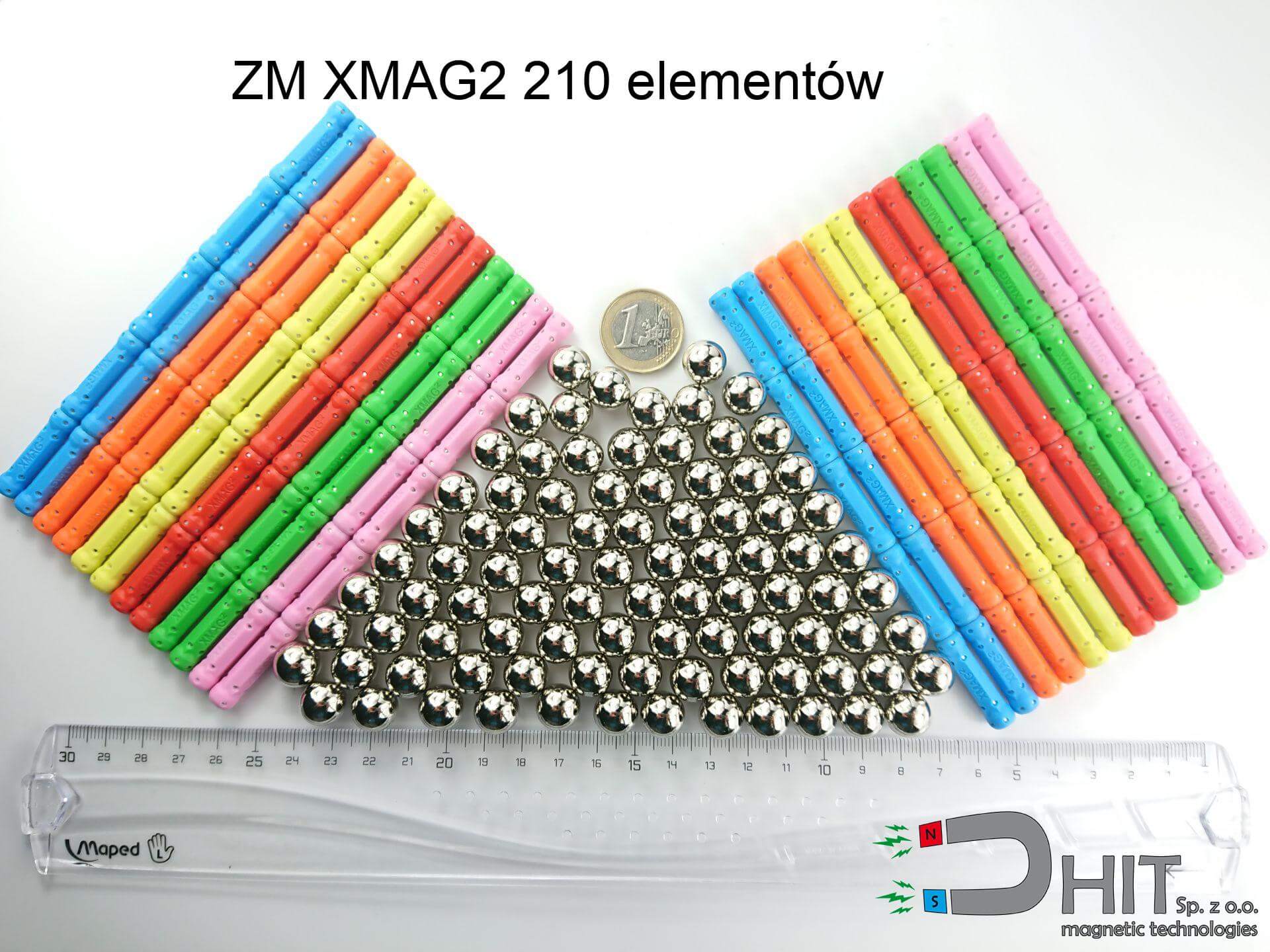
ZM XMAG2 210 elementów - magnetic toy
magnetic toy
Catalog no 040314
GTIN/EAN: 5906301812388
- Weight
- 0.03 g
How we measure these parameters — certificates and measurements
70.00 zł net / pcs
86.10 zł with VAT (23% VAT) / pcs
bulk discounts:
Need more?Frequently asked questions
Are magnets in educational construction sets safe for children?
Which NeoCube set is the most durable?
How can I distinguish an original NeoCube set from a poor-quality substitute?
Guides from the knowledge base
Call us now
+48 888 99 98 98
alternatively let us know using
contact form
the contact section.
Specifications and structure of a neodymium magnet can be estimated using our
power calculator.
Order by 14:00 and we’ll ship today!
Product card - ZM XMAG2 210 elementów - magnetic toy
Specification / characteristics - ZM XMAG2 210 elementów - magnetic toy
| properties | values |
|---|---|
| Cat. no. | 040314 |
| GTIN/EAN | 5906301812388 |
| Production/Distribution | Dhit sp. z o.o. |
| Country of origin | Poland / China / Germany |
| Customs code | 85059029 |
| Weight | 0.03 g |
| Load capacity ~ ? | 0.03 kg / 0.26 N |
| Manufacturing Tolerance | ±1 mm |
Physical properties of sintered neodymium magnets Nd2Fe14B at 20°C
| properties | values | units |
|---|---|---|
| Vickers hardness | ≥550 | Hv |
| Density | ≥7.4 | g/cm3 |
| Curie Temperature TC | 310 | °C |
| Curie Temperature TF | 590 | °F |
| Specific resistance | 150 | μΩ⋅cm |
| Bending strength | 250 | MPa |
| Compressive strength | 1000~1100 | MPa |
| Thermal expansion parallel (∥) to orientation (M) | (3-4) x 10-6 | °C-1 |
| Thermal expansion perpendicular (⊥) to orientation (M) | -(1-3) x 10-6 | °C-1 |
| Young's modulus | 1.7 x 10⁴ | kg/mm² |
Chemical composition
| iron (Fe) | 64% – 68% |
| neodymium (Nd) | 29% – 32% |
| boron (B) | 1.1% – 1.2% |
| dysprosium (Dy) | 0.5% – 2.0% |
| coating (Ni-Cu-Ni) | < 0.05% |
Ecology and recycling (GPSR)
| recyclability (EoL) | 100% |
| recycled raw materials | ~10% (pre-cons) |
| carbon footprint | low / zredukowany |
| waste code (EWC) | 16 02 16 |
View also products
![SM 28x300 [2xM8] / N52 - magnetic separator](https://cdn3.dhit.pl/graphics/products/sm-28x300-2xm8-paw.jpg "SM 28x300 [2xM8] / N52 - magnetic separator")

Advantages as well as disadvantages of rare earth magnets.
Strengths
- Their power is maintained, and after approximately ten years it drops only by ~1% (according to research),
- Neodymium magnets are exceptionally resistant to loss of magnetic properties caused by external magnetic fields,
- By covering with a shiny layer of gold, the element acquires an elegant look,
- The surface of neodymium magnets generates a unique magnetic field – this is a key feature,
- Through (appropriate) combination of ingredients, they can achieve high thermal strength, enabling operation at temperatures reaching 230°C and above...
- Possibility of exact modeling and optimizing to defined applications,
- Fundamental importance in innovative solutions – they are commonly used in computer drives, brushless drives, medical equipment, and modern systems.
- Relatively small size with high pulling force – neodymium magnets offer high power in tiny dimensions, which makes them useful in miniature devices
Weaknesses
- They are prone to damage upon heavy impacts. To avoid cracks, it is worth securing magnets in a protective case. Such protection not only protects the magnet but also increases its resistance to damage
- Heat sensitivity: observe the temperature specified for this product. Overheating may permanently weaken the magnet.
- Due to the susceptibility of magnets to corrosion in a humid environment, we suggest using waterproof magnets made of rubber, plastic or other material resistant to moisture, in case of application outdoors
- Limited possibility of creating nuts in the magnet and complex forms - preferred is casing - mounting mechanism.
- Potential hazard resulting from small fragments of magnets are risky, in case of ingestion, which is particularly important in the context of child safety. It is also worth noting that tiny parts of these devices can complicate diagnosis medical after entering the body.
- High unit price – neodymium magnets cost more than other types of magnets (e.g. ferrite), which hinders application in large quantities
Holding force characteristics
Maximum magnetic pulling force – what contributes to it?
- using a base made of low-carbon steel, serving as a circuit closing element
- whose thickness reaches at least 10 mm
- with an ground touching surface
- with direct contact (without paint)
- for force applied at a right angle (pull-off, not shear)
- at room temperature
Lifting capacity in practice – influencing factors
- Distance (betwixt the magnet and the plate), as even a microscopic distance (e.g. 0.5 mm) can cause a decrease in lifting capacity by up to 50% (this also applies to paint, corrosion or dirt).
- Force direction – declared lifting capacity refers to pulling vertically. When attempting to slide, the magnet exhibits much less (typically approx. 20-30% of nominal force).
- Wall thickness – thin material does not allow full use of the magnet. Magnetic flux passes through the material instead of converting into lifting capacity.
- Material composition – different alloys attracts identically. Alloy additives worsen the interaction with the magnet.
- Plate texture – smooth surfaces guarantee perfect abutment, which improves field saturation. Rough surfaces weaken the grip.
- Thermal environment – heating the magnet results in weakening of force. Check the maximum operating temperature for a given model.
Lifting capacity testing was carried out on a smooth plate of suitable thickness, under perpendicular forces, however under shearing force the load capacity is reduced by as much as 75%. Moreover, even a small distance between the magnet and the plate decreases the load capacity.
Warnings
Allergic reactions
Warning for allergy sufferers: The Ni-Cu-Ni coating consists of nickel. If redness occurs, immediately stop working with magnets and use protective gear.
Fire risk
Fire warning: Rare earth powder is explosive. Avoid machining magnets without safety gear as this risks ignition.
Powerful field
Handle magnets with awareness. Their huge power can surprise even experienced users. Stay alert and respect their power.
This is not a toy
Strictly keep magnets away from children. Ingestion danger is significant, and the effects of magnets connecting inside the body are life-threatening.
Serious injuries
Protect your hands. Two powerful magnets will snap together immediately with a force of several hundred kilograms, destroying everything in their path. Be careful!
Eye protection
Neodymium magnets are ceramic materials, meaning they are prone to chipping. Impact of two magnets leads to them cracking into small pieces.
Heat sensitivity
Standard neodymium magnets (grade N) lose power when the temperature surpasses 80°C. Damage is permanent.
Medical interference
Life threat: Strong magnets can deactivate heart devices and defibrillators. Stay away if you have medical devices.
Keep away from electronics
Remember: rare earth magnets produce a field that disrupts precision electronics. Keep a separation from your mobile, device, and navigation systems.
Cards and drives
Very strong magnetic fields can corrupt files on payment cards, HDDs, and other magnetic media. Keep a distance of min. 10 cm.
Tabela kosztu i czasu dostawy
Płatność przed wysyłką:

GLS kurier
Przesyłka będzie u Ciebie za 2-3 dni
14.99 ZŁ

InPost Paczkomaty 24/7
Przesyłka będzie u Ciebie za 1-2 dni
12.30 ZŁ
Płatność przy odbiorze (pobranie):
GLS kurier
Przesyłka będzie u Ciebie za 1-2 dni
23.00 ZŁ