

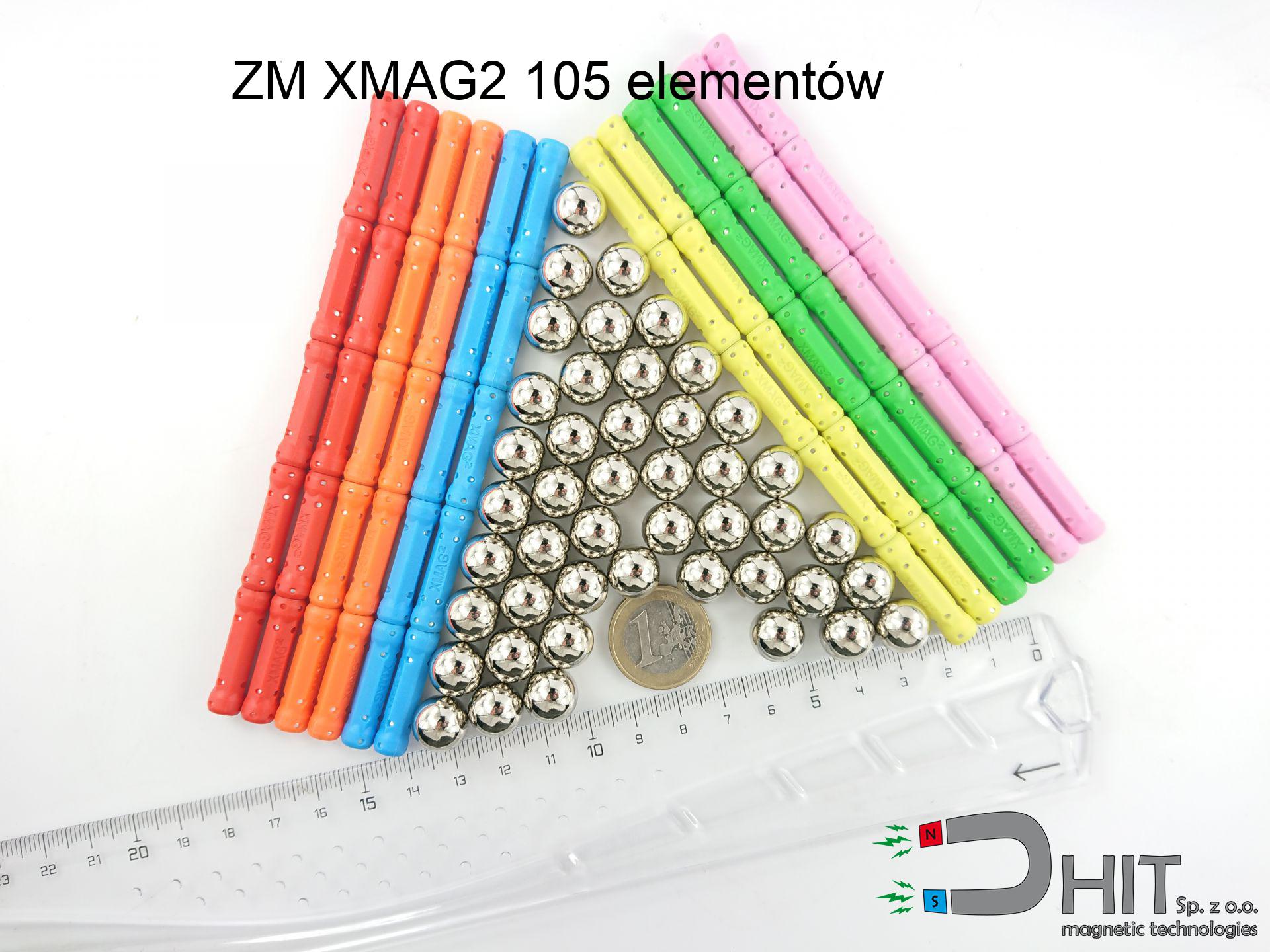
ZM XMAG2 105 elementów - magnetic toy
magnetic toy
Catalog no 040211
GTIN/EAN: 5906301812371
- Weight
- 0.03 g
How we measure these parameters — certificates and measurements
40.00 zł net / pcs
49.20 zł with VAT (23% VAT) / pcs
bulk discounts:
Need more?Frequently asked questions
Are magnets in educational construction sets safe for children?
Which NeoCube set is the most durable?
How can I distinguish an original NeoCube set from a poor-quality substitute?
Guides from the knowledge base
Call us now
+48 888 99 98 98
alternatively let us know using
contact form
the contact section.
Specifications and structure of a neodymium magnet can be estimated using our
power calculator.
Order by 14:00 and we’ll ship today!
Technical specification of the product - ZM XMAG2 105 elementów - magnetic toy
Specification / characteristics - ZM XMAG2 105 elementów - magnetic toy
| properties | values |
|---|---|
| Cat. no. | 040211 |
| GTIN/EAN | 5906301812371 |
| Production/Distribution | Dhit sp. z o.o. |
| Country of origin | Poland / China / Germany |
| Customs code | 85059029 |
| Weight | 0.03 g |
| Load capacity ~ ? | 0.03 kg / 0.26 N |
| Manufacturing Tolerance | ±1 mm |
Physical properties of sintered neodymium magnets Nd2Fe14B at 20°C
| properties | values | units |
|---|---|---|
| Vickers hardness | ≥550 | Hv |
| Density | ≥7.4 | g/cm3 |
| Curie Temperature TC | 310 | °C |
| Curie Temperature TF | 590 | °F |
| Specific resistance | 150 | μΩ⋅cm |
| Bending strength | 250 | MPa |
| Compressive strength | 1000~1100 | MPa |
| Thermal expansion parallel (∥) to orientation (M) | (3-4) x 10-6 | °C-1 |
| Thermal expansion perpendicular (⊥) to orientation (M) | -(1-3) x 10-6 | °C-1 |
| Young's modulus | 1.7 x 10⁴ | kg/mm² |
Chemical composition
| iron (Fe) | 64% – 68% |
| neodymium (Nd) | 29% – 32% |
| boron (B) | 1.1% – 1.2% |
| dysprosium (Dy) | 0.5% – 2.0% |
| coating (Ni-Cu-Ni) | < 0.05% |
Sustainability
| recyclability (EoL) | 100% |
| recycled raw materials | ~10% (pre-cons) |
| carbon footprint | low / zredukowany |
| waste code (EWC) | 16 02 16 |
Check out more deals


![UMH 60x15x69 [M8] / N38 - magnetic holder with hook](https://cdn3.dhit.pl/graphics/products/umh-60x15x69-m8-nij.jpg "UMH 60x15x69 [M8] / N38 - magnetic holder with hook")
Advantages and disadvantages of Nd2Fe14B magnets.
Benefits
- They do not lose magnetism, even over approximately ten years – the reduction in power is only ~1% (based on measurements),
- They have excellent resistance to magnetic field loss due to opposing magnetic fields,
- The use of an shiny layer of noble metals (nickel, gold, silver) causes the element to present itself better,
- Magnetic induction on the working layer of the magnet remains strong,
- Through (appropriate) combination of ingredients, they can achieve high thermal strength, allowing for functioning at temperatures reaching 230°C and above...
- Considering the option of flexible molding and customization to specialized projects, NdFeB magnets can be modeled in a broad palette of shapes and sizes, which amplifies use scope,
- Versatile presence in advanced technology sectors – they find application in data components, motor assemblies, diagnostic systems, and multitasking production systems.
- Thanks to efficiency per cm³, small magnets offer high operating force, in miniature format,
Cons
- They are fragile upon heavy impacts. To avoid cracks, it is worth securing magnets in special housings. Such protection not only protects the magnet but also improves its resistance to damage
- Heat sensitivity: observe the temperature specified for this product. Overheating may permanently weaken the magnet.
- Magnets exposed to a humid environment can rust. Therefore while using outdoors, we suggest using waterproof magnets made of rubber, plastic or other material protecting against moisture
- Due to limitations in realizing nuts and complex forms in magnets, we propose using a housing - magnetic mechanism.
- Possible danger resulting from small fragments of magnets can be dangerous, when accidentally swallowed, which gains importance in the context of child safety. Additionally, small elements of these products are able to complicate diagnosis medical when they are in the body.
- Higher cost of purchase is a significant factor to consider compared to ceramic magnets, especially in budget applications
Lifting parameters
Best holding force of the magnet in ideal parameters – what it depends on?
- with the contact of a sheet made of low-carbon steel, guaranteeing full magnetic saturation
- possessing a massiveness of min. 10 mm to ensure full flux closure
- characterized by smoothness
- with total lack of distance (no impurities)
- for force applied at a right angle (pull-off, not shear)
- at conditions approx. 20°C
Key elements affecting lifting force
- Distance – existence of any layer (rust, tape, gap) interrupts the magnetic circuit, which lowers power rapidly (even by 50% at 0.5 mm).
- Load vector – maximum parameter is obtained only during pulling at a 90° angle. The shear force of the magnet along the surface is typically several times lower (approx. 1/5 of the lifting capacity).
- Plate thickness – too thin sheet causes magnetic saturation, causing part of the power to be lost to the other side.
- Material type – ideal substrate is pure iron steel. Hardened steels may generate lower lifting capacity.
- Smoothness – ideal contact is possible only on smooth steel. Any scratches and bumps create air cushions, weakening the magnet.
- Thermal factor – high temperature reduces pulling force. Too high temperature can permanently damage the magnet.
Lifting capacity testing was conducted on a smooth plate of optimal thickness, under perpendicular forces, in contrast under attempts to slide the magnet the lifting capacity is smaller. Additionally, even a small distance between the magnet and the plate lowers the lifting capacity.
Precautions when working with NdFeB magnets
Bone fractures
Big blocks can crush fingers instantly. Do not put your hand betwixt two strong magnets.
Allergy Warning
Warning for allergy sufferers: The Ni-Cu-Ni coating consists of nickel. If an allergic reaction occurs, immediately stop handling magnets and use protective gear.
No play value
Product intended for adults. Tiny parts can be swallowed, leading to intestinal necrosis. Keep away from kids and pets.
Impact on smartphones
Be aware: rare earth magnets generate a field that confuses precision electronics. Keep a safe distance from your mobile, device, and GPS.
Dust is flammable
Mechanical processing of NdFeB material poses a fire hazard. Neodymium dust oxidizes rapidly with oxygen and is hard to extinguish.
Magnets are brittle
Beware of splinters. Magnets can explode upon violent connection, launching shards into the air. Eye protection is mandatory.
Cards and drives
Device Safety: Strong magnets can ruin payment cards and sensitive devices (pacemakers, medical aids, timepieces).
Maximum temperature
Avoid heat. Neodymium magnets are sensitive to temperature. If you require resistance above 80°C, ask us about special high-temperature series (H, SH, UH).
Implant safety
Individuals with a heart stimulator must keep an absolute distance from magnets. The magnetism can stop the operation of the implant.
Handling rules
Exercise caution. Neodymium magnets act from a long distance and connect with huge force, often faster than you can move away.
Tabela kosztu i czasu dostawy
Płatność przed wysyłką:

GLS kurier
Przesyłka będzie u Ciebie za 2-3 dni
14.99 ZŁ

InPost Paczkomaty 24/7
Przesyłka będzie u Ciebie za 1-2 dni
12.30 ZŁ
Płatność przy odbiorze (pobranie):
GLS kurier
Przesyłka będzie u Ciebie za 1-2 dni
23.00 ZŁ