

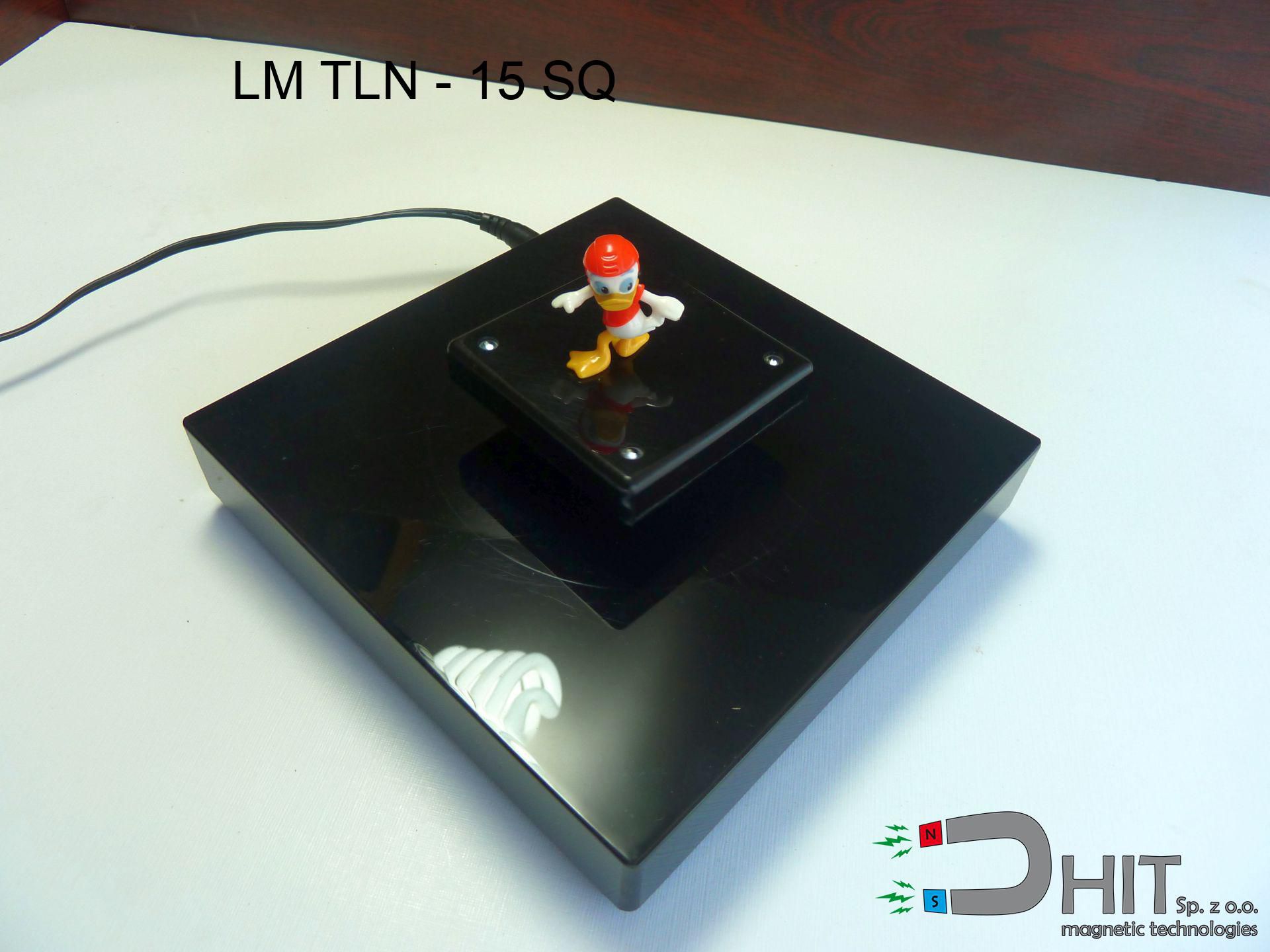
LM TLN - 15 SQ / N38 - magnetic leviton
magnetic leviton
Catalog no 290493
GTIN/EAN: 5906301814511
365.85 zł net / pcs
450.00 zł with VAT (23% VAT) / pcs
Frequently asked questions
Where can I find accessories for mounting magnets?
Can I find a technical magnet with a documented pull rating?
Where can I find magnets for a higher operating temperature?
When does an N52 magnet make sense in demanding conditions?
Guides from the knowledge base
Call us now
+48 888 99 98 98
alternatively let us know using
contact form
the contact section.
Specifications and structure of a neodymium magnet can be estimated using our
power calculator.
Order by 14:00 and we’ll ship today!
Detailed specification - LM TLN - 15 SQ / N38 - magnetic leviton
Specification / characteristics - LM TLN - 15 SQ / N38 - magnetic leviton
| properties | values |
|---|---|
| Cat. no. | 290493 |
| GTIN/EAN | 5906301814511 |
| Production/Distribution | Dhit sp. z o.o. |
| Country of origin | Poland / China / Germany |
| Customs code | 85059029 |
| Weight | 1000 g |
| Manufacturing Tolerance | ±1 mm |
Magnetic properties of material N38
| properties | values | units |
|---|---|---|
| Remanence Br ? | 12.2-12.6 | kGs |
| Remanence Br ? | 1220-1260 | mT |
| Coercivity bHc ? | 10.8-11.5 | kOe |
| Coercivity bHc ? | 860-915 | kA/m |
| Intrinsic coercivity iHc | ≥ 12 | kOe |
| Intrinsic coercivity iHc | ≥ 955 | kA/m |
| Energy product BHmax ? | 36-38 | BH max MGOe |
| Energy product BHmax ? | 287-303 | BH max KJ/m |
| Maximum working temperature ? | ≤ 80 | °C |
Physical properties of sintered neodymium magnets Nd2Fe14B at 20°C
| properties | values | units |
|---|---|---|
| Vickers hardness | ≥550 | Hv |
| Density | ≥7.4 | g/cm3 |
| Curie Temperature TC | 310 | °C |
| Curie Temperature TF | 590 | °F |
| Specific resistance | 150 | μΩ⋅cm |
| Bending strength | 250 | MPa |
| Compressive strength | 1000~1100 | MPa |
| Thermal expansion parallel (∥) to orientation (M) | (3-4) x 10-6 | °C-1 |
| Thermal expansion perpendicular (⊥) to orientation (M) | -(1-3) x 10-6 | °C-1 |
| Young's modulus | 1.7 x 10⁴ | kg/mm² |
Material specification
| iron (Fe) | 64% – 68% |
| neodymium (Nd) | 29% – 32% |
| boron (B) | 1.1% – 1.2% |
| dysprosium (Dy) | 0.5% – 2.0% |
| coating (Ni-Cu-Ni) | < 0.05% |
Environmental data
| recyclability (EoL) | 100% |
| recycled raw materials | ~10% (pre-cons) |
| carbon footprint | low / zredukowany |
| waste code (EWC) | 16 02 16 |
Other proposals
![BM 750x180x70 [4x M8] - magnetic beam](https://cdn3.dhit.pl/graphics/products/bm-750x180x70-4x-m8-zif.jpg "BM 750x180x70 [4x M8] - magnetic beam")

Advantages and disadvantages of neodymium magnets.
Strengths
- They do not lose strength, even over approximately 10 years – the reduction in lifting capacity is only ~1% (according to tests),
- They have excellent resistance to magnetism drop due to opposing magnetic fields,
- In other words, due to the shiny layer of nickel, the element gains a professional look,
- Magnetic induction on the working part of the magnet remains very high,
- Made from properly selected components, these magnets show impressive resistance to high heat, enabling them to function (depending on their shape) at temperatures up to 230°C and above...
- Possibility of precise creating as well as modifying to specific applications,
- Wide application in modern industrial fields – they are used in hard drives, electric motors, medical devices, as well as technologically advanced constructions.
- Compactness – despite small sizes they provide effective action, making them ideal for precision applications
Disadvantages
- Brittleness is one of their disadvantages. Upon intense impact they can break. We recommend keeping them in a special holder, which not only secures them against impacts but also raises their durability
- Do not exceed this material temperature limit: 80°C. Overheating may permanently weaken the magnet.
- When exposed to humidity, magnets start to rust. For applications outside, it is recommended to use protective magnets, such as magnets in rubber or plastics, which secure oxidation as well as corrosion.
- Limited possibility of producing nuts in the magnet and complex forms - preferred is cover - mounting mechanism.
- Potential hazard to health – tiny shards of magnets are risky, when accidentally swallowed, which is particularly important in the aspect of protecting the youngest. Furthermore, tiny parts of these devices can complicate diagnosis medical when they are in the body.
- With budget limitations the cost of neodymium magnets is economically unviable,
Holding force characteristics
Maximum magnetic pulling force – what it depends on?
- with the application of a sheet made of low-carbon steel, ensuring maximum field concentration
- whose transverse dimension equals approx. 10 mm
- characterized by lack of roughness
- with zero gap (no paint)
- for force applied at a right angle (pull-off, not shear)
- at temperature approx. 20 degrees Celsius
Determinants of lifting force in real conditions
- Clearance – existence of any layer (rust, dirt, gap) acts as an insulator, which reduces capacity rapidly (even by 50% at 0.5 mm).
- Force direction – catalog parameter refers to pulling vertically. When attempting to slide, the magnet holds significantly lower power (typically approx. 20-30% of nominal force).
- Steel thickness – insufficiently thick steel does not close the flux, causing part of the power to be wasted to the other side.
- Material composition – different alloys attracts identically. High carbon content weaken the attraction effect.
- Base smoothness – the smoother and more polished the surface, the larger the contact zone and higher the lifting capacity. Roughness creates an air distance.
- Thermal environment – temperature increase results in weakening of force. Check the thermal limit for a given model.
Lifting capacity was assessed with the use of a smooth steel plate of optimal thickness (min. 20 mm), under perpendicular detachment force, however under shearing force the holding force is lower. Additionally, even a minimal clearance between the magnet’s surface and the plate decreases the lifting capacity.
Safe handling of neodymium magnets
Skin irritation risks
Nickel alert: The Ni-Cu-Ni coating consists of nickel. If redness happens, immediately stop working with magnets and use protective gear.
Mechanical processing
Fire hazard: Rare earth powder is explosive. Avoid machining magnets without safety gear as this risks ignition.
Operating temperature
Control the heat. Heating the magnet to high heat will ruin its properties and strength.
Magnets are brittle
Protect your eyes. Magnets can fracture upon violent connection, ejecting shards into the air. Eye protection is mandatory.
Threat to navigation
Remember: rare earth magnets produce a field that interferes with precision electronics. Keep a separation from your phone, device, and navigation systems.
Data carriers
Do not bring magnets near a purse, computer, or screen. The magnetic field can destroy these devices and wipe information from cards.
Warning for heart patients
For implant holders: Strong magnetic fields affect electronics. Keep minimum 30 cm distance or request help to handle the magnets.
Keep away from children
Neodymium magnets are not toys. Accidental ingestion of a few magnets may result in them attracting across intestines, which poses a critical condition and necessitates urgent medical intervention.
Conscious usage
Handle magnets with awareness. Their powerful strength can shock even professionals. Stay alert and respect their force.
Bodily injuries
Large magnets can break fingers instantly. Under no circumstances place your hand betwixt two attracting surfaces.
Tabela kosztu i czasu dostawy
Płatność przed wysyłką:

GLS kurier
Przesyłka będzie u Ciebie za 2-3 dni
14.99 ZŁ

InPost Paczkomaty 24/7
Przesyłka będzie u Ciebie za 1-2 dni
12.30 ZŁ
Płatność przy odbiorze (pobranie):
GLS kurier
Przesyłka będzie u Ciebie za 1-2 dni
23.00 ZŁ