

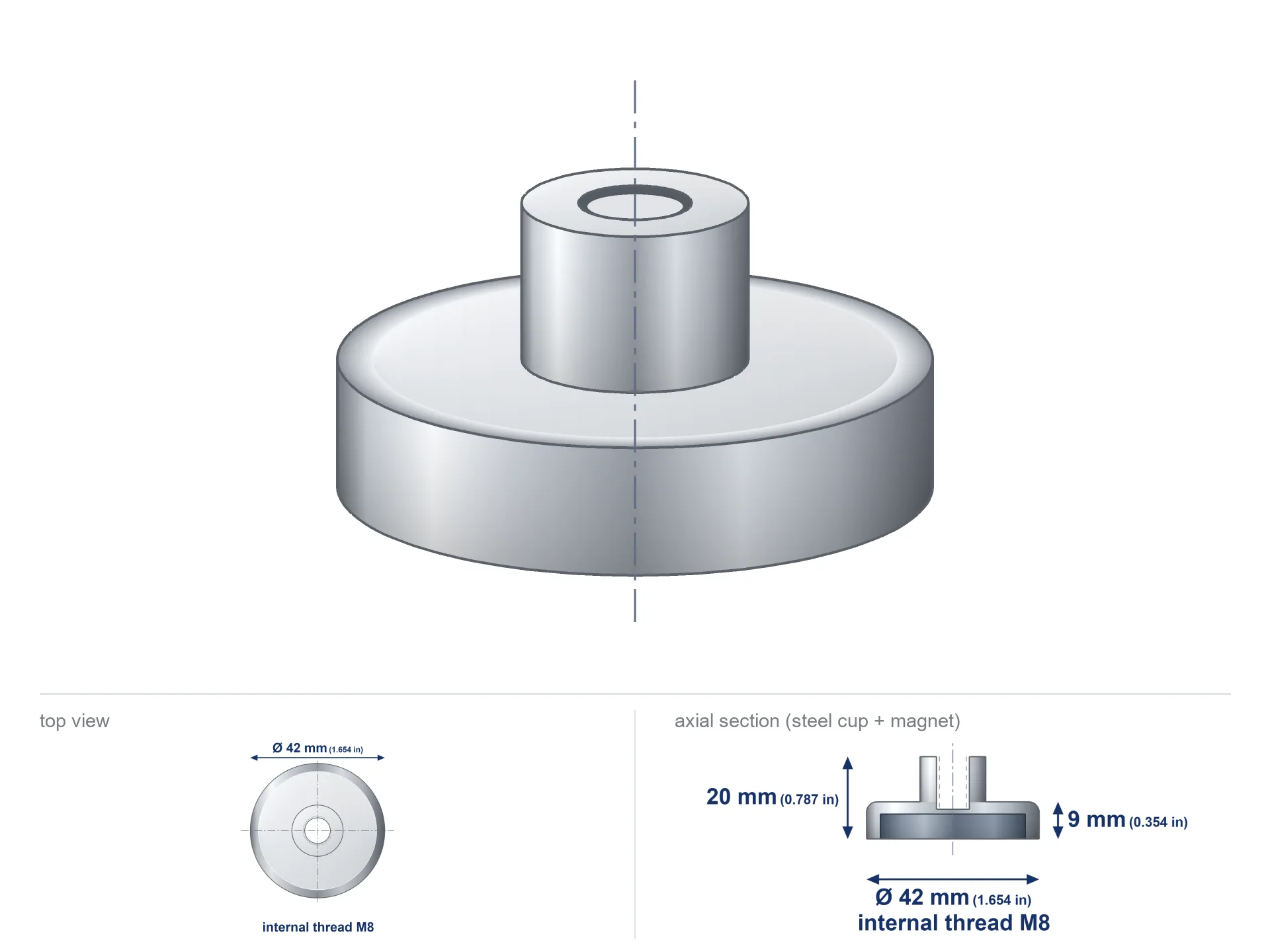
UMGW 42x20x9 [M8] GW / N38 - magnetic holder internal thread
magnetic holder internal thread
Catalog no 180591
GTIN/EAN: 5906301815853
- Diameter Ø
- 42 mm [±1 mm]
- Height
- 20 mm [±1 mm]
- Height
- 9 mm [±1 mm]
- Weight
- 78 g
- Magnetization Direction
- ↑ axial
- Coating
- [NiCuNi] Nickel
How we measure these parameters — certificates and measurements
27.60 zł net / pcs
33.95 zł with VAT (23% VAT) / pcs
bulk discounts:
Need more?Frequently asked questions
Which magnetic holder is suitable for moving metal parts in a workshop?
How do I choose a holder for hanging a heavy item and check its real grip?
Which magnetic holders can be used outdoors?
How should I choose a strong threaded holder for field work?
Call us now
+48 888 99 98 98
alternatively let us know using
contact form
the contact section.
Specifications and structure of a neodymium magnet can be estimated using our
power calculator.
Order by 14:00 and we’ll ship today!
Technical details - UMGW 42x20x9 [M8] GW / N38 - magnetic holder internal thread
Specification / characteristics - UMGW 42x20x9 [M8] GW / N38 - magnetic holder internal thread
| properties | values |
|---|---|
| Cat. no. | 180591 |
| GTIN/EAN | 5906301815853 |
| Distributor | Dhit sp. z o.o. |
| Country of origin | Poland / China / Germany |
| Customs code | 85059029 |
| Diameter Ø | 42 mm [±1 mm] |
| Height | 20 mm [±1 mm] |
| Height | 9 mm [±1 mm] |
| Weight | 78 g |
| Magnetization Direction | ↑ axial |
| Load capacity ~ ? | 66.00 kg / 647.24 N |
| Coating | [NiCuNi] Nickel |
| Manufacturing Tolerance | ±1 mm |
Magnetic properties of material N38
| properties | values | units |
|---|---|---|
| Remanence Br ? | 12.2-12.6 | kGs |
| Remanence Br ? | 1220-1260 | mT |
| Coercivity bHc ? | 10.8-11.5 | kOe |
| Coercivity bHc ? | 860-915 | kA/m |
| Intrinsic coercivity iHc | ≥ 12 | kOe |
| Intrinsic coercivity iHc | ≥ 955 | kA/m |
| Energy product BHmax ? | 36-38 | BH max MGOe |
| Energy product BHmax ? | 287-303 | BH max KJ/m |
| Maximum working temperature ? | ≤ 80 | °C |
Physical properties of sintered neodymium magnets Nd2Fe14B at 20°C
| properties | values | units |
|---|---|---|
| Vickers hardness | ≥550 | Hv |
| Density | ≥7.4 | g/cm3 |
| Curie Temperature TC | 310 | °C |
| Curie Temperature TF | 590 | °F |
| Specific resistance | 150 | μΩ⋅cm |
| Bending strength | 250 | MPa |
| Compressive strength | 1000~1100 | MPa |
| Thermal expansion parallel (∥) to orientation (M) | (3-4) x 10-6 | °C-1 |
| Thermal expansion perpendicular (⊥) to orientation (M) | -(1-3) x 10-6 | °C-1 |
| Young's modulus | 1.7 x 10⁴ | kg/mm² |
Chemical composition
| iron (Fe) | 64% – 68% |
| neodymium (Nd) | 29% – 32% |
| boron (B) | 1.1% – 1.2% |
| dysprosium (Dy) | 0.5% – 2.0% |
| coating (Ni-Cu-Ni) | < 0.05% |
Environmental data
| recyclability (EoL) | 100% |
| recycled raw materials | ~10% (pre-cons) |
| carbon footprint | low / zredukowany |
| waste code (EWC) | 16 02 16 |
Check out also deals
Pros and cons of rare earth magnets.
Pros
- Their strength is maintained, and after around ten years it drops only by ~1% (theoretically),
- They retain their magnetic properties even under external field action,
- A magnet with a shiny nickel surface has better aesthetics,
- The surface of neodymium magnets generates a intense magnetic field – this is one of their assets,
- Made from properly selected components, these magnets show impressive resistance to high heat, enabling them to function (depending on their shape) at temperatures up to 230°C and above...
- Thanks to flexibility in shaping and the ability to adapt to client solutions,
- Significant place in electronics industry – they find application in hard drives, motor assemblies, precision medical tools, also complex engineering applications.
- Relatively small size with high pulling force – neodymium magnets offer high power in compact dimensions, which enables their usage in compact constructions
Cons
- To avoid cracks under impact, we recommend using special steel housings. Such a solution secures the magnet and simultaneously improves its durability.
- Do not exceed this material temperature limit: 80°C. Overheating may permanently weaken the magnet.
- They rust in a humid environment. For use outdoors we suggest using waterproof magnets e.g. in rubber, plastic
- Limited ability of creating nuts in the magnet and complicated forms - preferred is a housing - mounting mechanism.
- Potential hazard resulting from small fragments of magnets are risky, if swallowed, which is particularly important in the context of child health protection. It is also worth noting that small elements of these products can complicate diagnosis medical in case of swallowing.
- Higher cost of purchase is one of the disadvantages compared to ceramic magnets, especially in budget applications
Lifting parameters
Highest magnetic holding force – what it depends on?
- on a plate made of structural steel, perfectly concentrating the magnetic flux
- whose thickness reaches at least 10 mm
- with an polished touching surface
- with zero gap (without paint)
- for force applied at a right angle (in the magnet axis)
- at temperature approx. 20 degrees Celsius
Key elements affecting lifting force
- Clearance – the presence of foreign body (rust, tape, air) acts as an insulator, which lowers power rapidly (even by 50% at 0.5 mm).
- Load vector – maximum parameter is obtained only during perpendicular pulling. The force required to slide of the magnet along the plate is typically many times smaller (approx. 1/5 of the lifting capacity).
- Metal thickness – thin material does not allow full use of the magnet. Magnetic flux passes through the material instead of converting into lifting capacity.
- Steel type – mild steel attracts best. Higher carbon content decrease magnetic permeability and lifting capacity.
- Surface finish – full contact is possible only on smooth steel. Any scratches and bumps create air cushions, reducing force.
- Thermal environment – heating the magnet causes a temporary drop of force. It is worth remembering the thermal limit for a given model.
Lifting capacity was determined using a polished steel plate of optimal thickness (min. 20 mm), under vertically applied force, in contrast under parallel forces the holding force is lower. Additionally, even a slight gap between the magnet’s surface and the plate reduces the load capacity.
H&S for magnets
GPS Danger
A powerful magnetic field interferes with the operation of magnetometers in phones and navigation systems. Do not bring magnets near a smartphone to prevent damaging the sensors.
Product not for children
Absolutely keep magnets away from children. Ingestion danger is significant, and the consequences of magnets connecting inside the body are fatal.
Pinching danger
Watch your fingers. Two large magnets will snap together immediately with a force of massive weight, destroying everything in their path. Be careful!
Safe distance
Intense magnetic fields can corrupt files on credit cards, hard drives, and other magnetic media. Stay away of min. 10 cm.
Caution required
Be careful. Neodymium magnets attract from a distance and connect with massive power, often faster than you can move away.
Warning for heart patients
Individuals with a ICD should keep an large gap from magnets. The magnetism can interfere with the functioning of the implant.
Beware of splinters
Despite metallic appearance, neodymium is brittle and cannot withstand shocks. Avoid impacts, as the magnet may shatter into hazardous fragments.
Permanent damage
Do not exceed the maximum operating temperature stated in the specifications of the particular product. The limit depends on the material, geometry and operating arrangement; there is no single threshold for all neodymium magnets. Overheating can permanently weaken a magnet.
Mechanical processing
Mechanical processing of NdFeB material carries a risk of fire risk. Neodymium dust reacts violently with oxygen and is hard to extinguish.
Nickel allergy
Medical facts indicate that nickel (the usual finish) is a potent allergen. If you have an allergy, prevent touching magnets with bare hands or choose coated magnets.
Tabela kosztu i czasu dostawy
Płatność przed wysyłką:

GLS kurier
Przesyłka będzie u Ciebie za 2-3 dni
14.99 ZŁ

InPost Paczkomaty 24/7
Przesyłka będzie u Ciebie za 1-2 dni
12.30 ZŁ
Płatność przy odbiorze (pobranie):
GLS kurier
Przesyłka będzie u Ciebie za 1-2 dni
23.00 ZŁ