
![Magnetic holder with internal thread UMGW 20x15x7 [M4] GW / N38](https://cdn3.dhit.pl/graphics/banners/magnet.webp "Magnetic holder with internal thread UMGW 20x15x7 [M4] GW / N38")
![UMGW 20x15x7 [M4] GW / N38 - magnetic holder internal thread](https://cdn3.dhit.pl/graphics/products/um-20x15x7-m4-gw-big.jpg)
![UMGW 20x15x7 [M4] GW / N38 - magnetic holder internal thread - ujęcie 2](https://cdn3.dhit.pl/graphics/products/umgw-20x15x7-m4-gw-sef.jpg)
UMGW 20x15x7 [M4] GW / N38 - magnetic holder internal thread
magnetic holder internal thread
Catalog no 180316
GTIN/EAN: 5906301813729
- Diameter Ø
- 20 mm [±1 mm]
- Height
- 15 mm [±1 mm]
- Height
- 7 mm [±1 mm]
- Weight
- 15.5 g
- Magnetization Direction
- ↑ axial
- Coating
- [NiCuNi] Nickel
How we measure these parameters — certificates and measurements
5.28 zł net / pcs
6.49 zł with VAT (23% VAT) / pcs
bulk discounts:
Need more?Frequently asked questions
Which magnetic holder is suitable for moving metal parts in a workshop?
How do I choose a holder for hanging a heavy item and check its real grip?
Which magnetic holders can be used outdoors?
How should I choose a strong threaded holder for field work?
Call us now
+48 888 99 98 98
alternatively let us know using
contact form
the contact section.
Specifications and structure of a neodymium magnet can be estimated using our
power calculator.
Order by 14:00 and we’ll ship today!
Technical - UMGW 20x15x7 [M4] GW / N38 - magnetic holder internal thread
Specification / characteristics - UMGW 20x15x7 [M4] GW / N38 - magnetic holder internal thread
| properties | values |
|---|---|
| Cat. no. | 180316 |
| GTIN/EAN | 5906301813729 |
| Production/Distribution | Dhit sp. z o.o. |
| Country of origin | Poland / China / Germany |
| Customs code | 85059029 |
| Diameter Ø | 20 mm [±1 mm] |
| Height | 15 mm [±1 mm] |
| Height | 7 mm [±1 mm] |
| Weight | 15.5 g |
| Magnetization Direction | ↑ axial |
| Load capacity ~ ? | 9.00 kg / 88.26 N |
| Coating | [NiCuNi] Nickel |
| Manufacturing Tolerance | ±1 mm |
Magnetic properties of material N38
| properties | values | units |
|---|---|---|
| Remanence Br ? | 12.2-12.6 | kGs |
| Remanence Br ? | 1220-1260 | mT |
| Coercivity bHc ? | 10.8-11.5 | kOe |
| Coercivity bHc ? | 860-915 | kA/m |
| Intrinsic coercivity iHc | ≥ 12 | kOe |
| Intrinsic coercivity iHc | ≥ 955 | kA/m |
| Energy product BHmax ? | 36-38 | BH max MGOe |
| Energy product BHmax ? | 287-303 | BH max KJ/m |
| Maximum working temperature ? | ≤ 80 | °C |
Physical properties of sintered neodymium magnets Nd2Fe14B at 20°C
| properties | values | units |
|---|---|---|
| Vickers hardness | ≥550 | Hv |
| Density | ≥7.4 | g/cm3 |
| Curie Temperature TC | 310 | °C |
| Curie Temperature TF | 590 | °F |
| Specific resistance | 150 | μΩ⋅cm |
| Bending strength | 250 | MPa |
| Compressive strength | 1000~1100 | MPa |
| Thermal expansion parallel (∥) to orientation (M) | (3-4) x 10-6 | °C-1 |
| Thermal expansion perpendicular (⊥) to orientation (M) | -(1-3) x 10-6 | °C-1 |
| Young's modulus | 1.7 x 10⁴ | kg/mm² |
Material specification
| iron (Fe) | 64% – 68% |
| neodymium (Nd) | 29% – 32% |
| boron (B) | 1.1% – 1.2% |
| dysprosium (Dy) | 0.5% – 2.0% |
| coating (Ni-Cu-Ni) | < 0.05% |
Sustainability
| recyclability (EoL) | 100% |
| recycled raw materials | ~10% (pre-cons) |
| carbon footprint | low / zredukowany |
| waste code (EWC) | 16 02 16 |
Other deals
![SM 32x250 [2xM8] / N52 - magnetic separator](https://cdn3.dhit.pl/graphics/products/sm-32x250-2xm8-guf.jpg "SM 32x250 [2xM8] / N52 - magnetic separator")
![BM 650x180x70 [4x M8] - magnetic beam](https://cdn3.dhit.pl/graphics/products/bm-650x180x70-4x-m8-laj.jpg "BM 650x180x70 [4x M8] - magnetic beam")
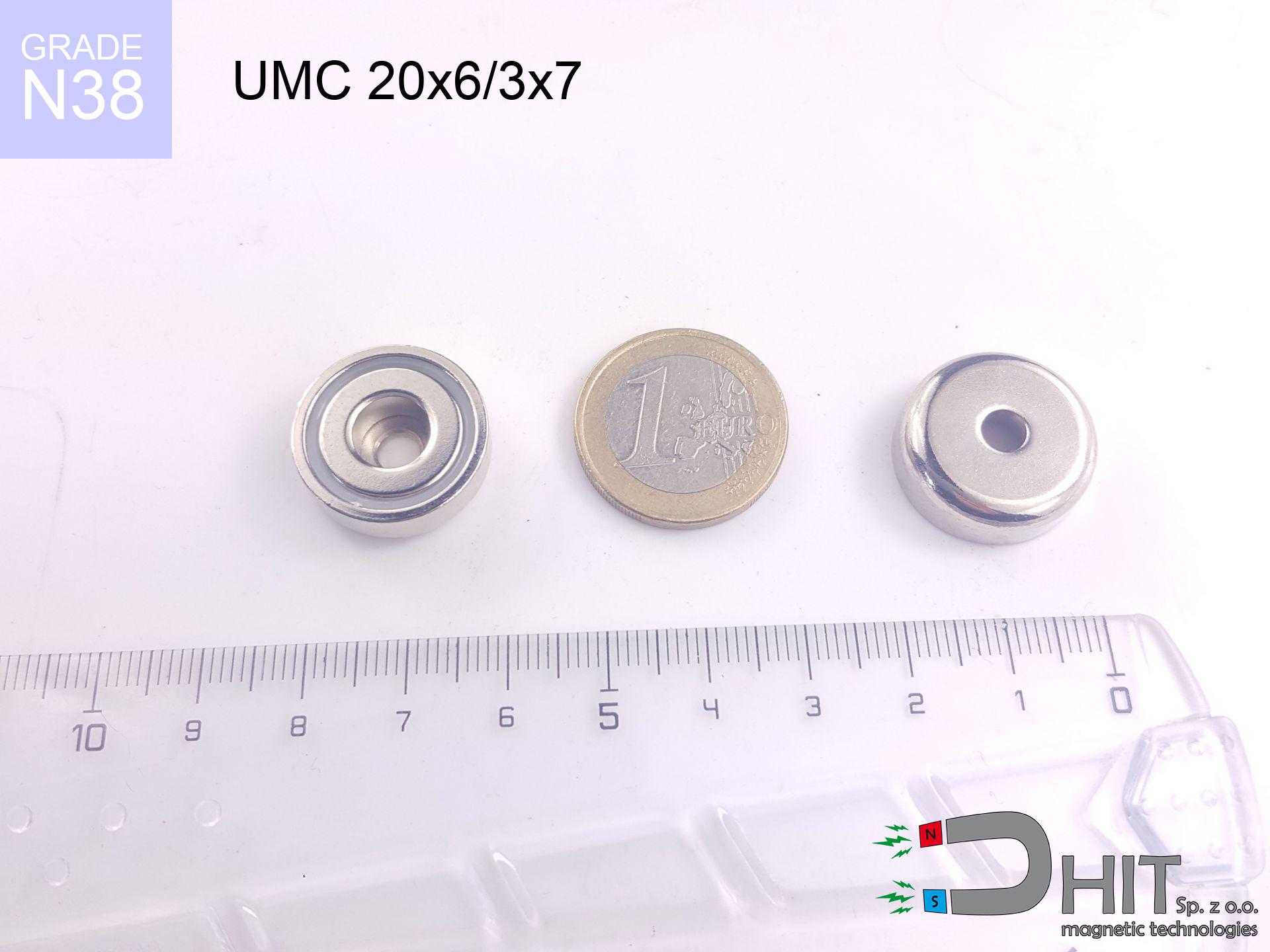
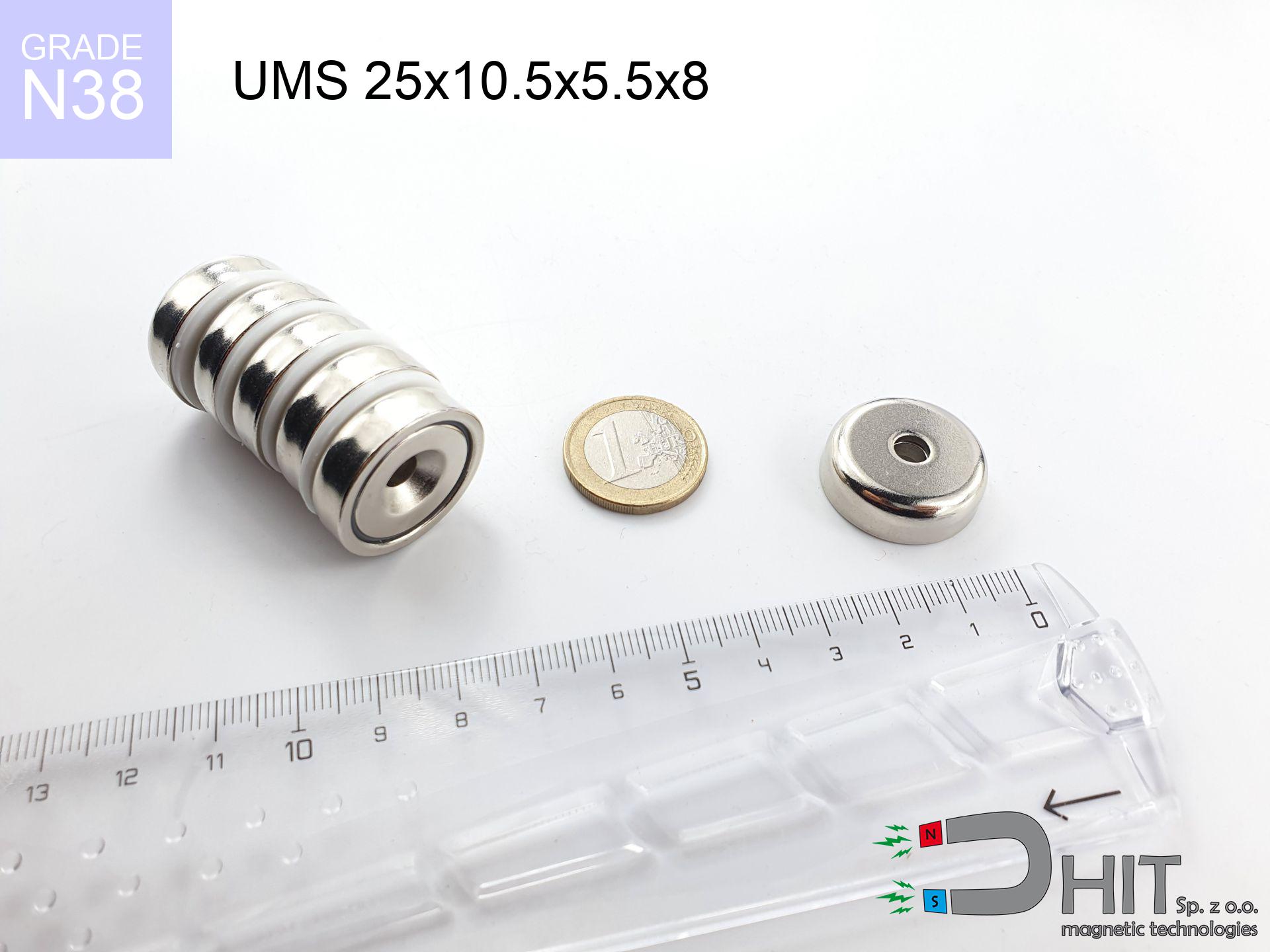
Strengths as well as weaknesses of Nd2Fe14B magnets.
Strengths
- They retain magnetic properties for around 10 years – the loss is just ~1% (based on simulations),
- Magnets perfectly protect themselves against demagnetization caused by external fields,
- A magnet with a metallic gold surface has an effective appearance,
- Neodymium magnets generate maximum magnetic induction on a small area, which ensures high operational effectiveness,
- Through (appropriate) combination of ingredients, they can achieve high thermal strength, enabling operation at temperatures reaching 230°C and above...
- Possibility of precise creating and adapting to defined applications,
- Fundamental importance in advanced technology sectors – they are utilized in computer drives, brushless drives, diagnostic systems, as well as complex engineering applications.
- Thanks to their power density, small magnets offer high operating force, in miniature format,
Limitations
- They are prone to damage upon heavy impacts. To avoid cracks, it is worth securing magnets in special housings. Such protection not only protects the magnet but also increases its resistance to damage
- Do not exceed this material temperature limit: 80°C. Overheating may permanently weaken the magnet.
- They rust in a humid environment - during use outdoors we advise using waterproof magnets e.g. in rubber, plastic
- Limited possibility of producing threads in the magnet and complex shapes - preferred is cover - mounting mechanism.
- Possible danger resulting from small fragments of magnets are risky, in case of ingestion, which gains importance in the context of child health protection. It is also worth noting that small components of these magnets can disrupt the diagnostic process medical in case of swallowing.
- Higher cost of purchase is one of the disadvantages compared to ceramic magnets, especially in budget applications
Holding force characteristics
Highest magnetic holding force – what affects it?
- on a plate made of mild steel, effectively closing the magnetic flux
- possessing a massiveness of minimum 10 mm to ensure full flux closure
- with a surface cleaned and smooth
- without the slightest clearance between the magnet and steel
- for force applied at a right angle (pull-off, not shear)
- at standard ambient temperature
Key elements affecting lifting force
- Distance – the presence of foreign body (paint, tape, air) acts as an insulator, which reduces capacity steeply (even by 50% at 0.5 mm).
- Pull-off angle – remember that the magnet has greatest strength perpendicularly. Under sliding down, the holding force drops significantly, often to levels of 20-30% of the nominal value.
- Substrate thickness – for full efficiency, the steel must be sufficiently thick. Thin sheet limits the lifting capacity (the magnet "punches through" it).
- Material type – ideal substrate is pure iron steel. Stainless steels may attract less.
- Plate texture – smooth surfaces ensure maximum contact, which increases field saturation. Rough surfaces weaken the grip.
- Temperature influence – high temperature weakens pulling force. Exceeding the limit temperature can permanently damage the magnet.
Lifting capacity was determined by applying a smooth steel plate of optimal thickness (min. 20 mm), under perpendicular pulling force, in contrast under attempts to slide the magnet the lifting capacity is smaller. Additionally, even a minimal clearance between the magnet’s surface and the plate reduces the load capacity.
Safety rules for work with neodymium magnets
Caution required
Before starting, check safety instructions. Uncontrolled attraction can destroy the magnet or injure your hand. Think ahead.
ICD Warning
Life threat: Strong magnets can deactivate heart devices and defibrillators. Stay away if you have medical devices.
No play value
Only for adults. Tiny parts pose a choking risk, leading to serious injuries. Keep away from kids and pets.
Sensitization to coating
It is widely known that the nickel plating (standard magnet coating) is a strong allergen. If your skin reacts to metals, avoid direct skin contact and choose coated magnets.
Compass and GPS
Be aware: rare earth magnets generate a field that interferes with precision electronics. Maintain a separation from your phone, tablet, and GPS.
Dust is flammable
Fire warning: Neodymium dust is explosive. Avoid machining magnets without safety gear as this risks ignition.
Fragile material
Protect your eyes. Magnets can explode upon violent connection, launching sharp fragments into the air. We recommend safety glasses.
Electronic devices
Very strong magnetic fields can corrupt files on payment cards, hard drives, and other magnetic media. Stay away of min. 10 cm.
Maximum temperature
Standard neodymium magnets (N-type) undergo demagnetization when the temperature surpasses 80°C. This process is irreversible.
Serious injuries
Pinching hazard: The attraction force is so great that it can cause hematomas, crushing, and even bone fractures. Use thick gloves.
Tabela kosztu i czasu dostawy
Płatność przed wysyłką:

GLS kurier
Przesyłka będzie u Ciebie za 2-3 dni
14.99 ZŁ

InPost Paczkomaty 24/7
Przesyłka będzie u Ciebie za 1-2 dni
12.30 ZŁ
Płatność przy odbiorze (pobranie):
GLS kurier
Przesyłka będzie u Ciebie za 1-2 dni
23.00 ZŁ