

UMH 10x5x30 [M4] / N38 - magnetic holder with hook
magnetic holder with hook
Catalog no 310601
GTIN/EAN: 5906301816041
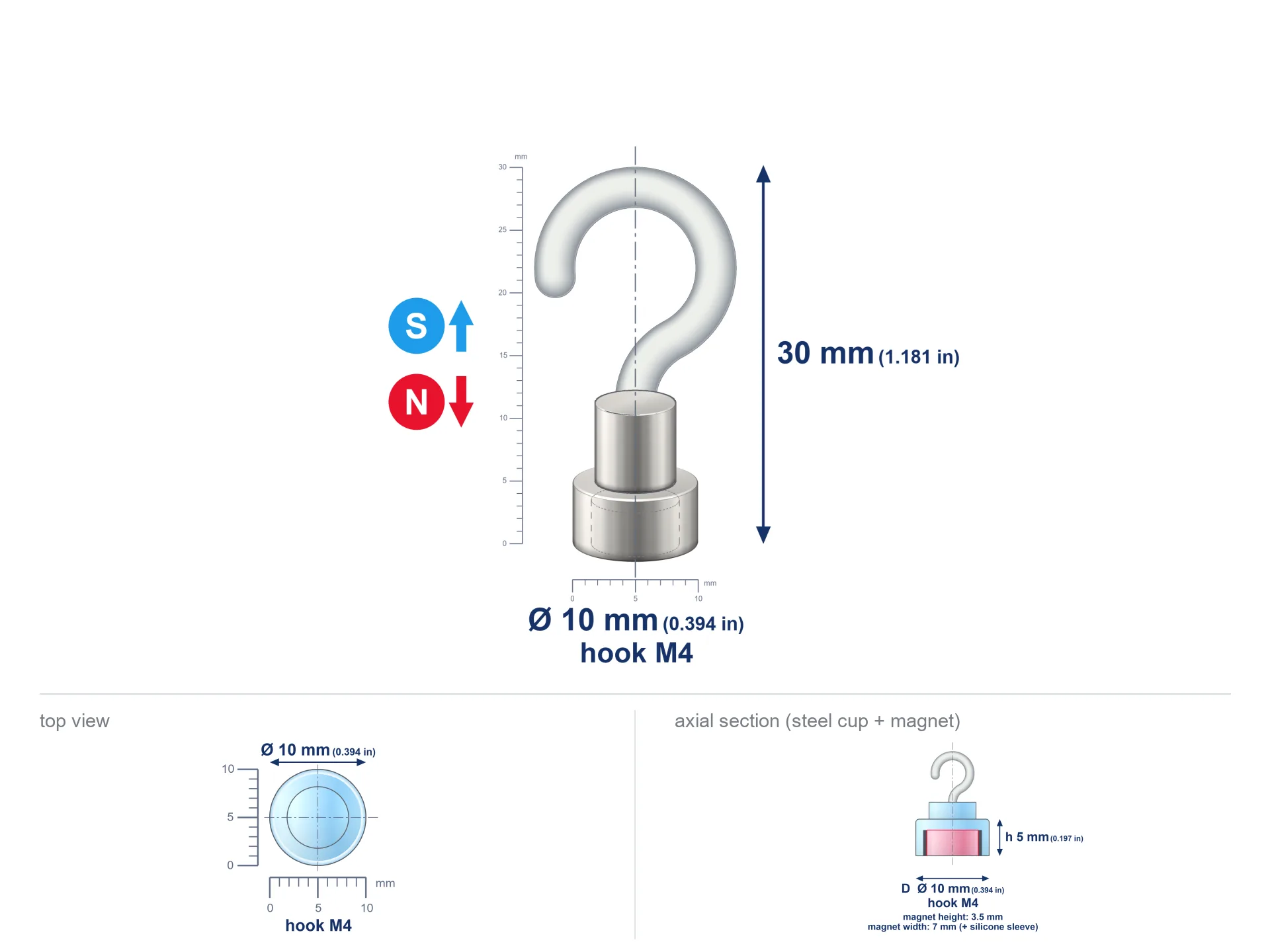
- Diameter Ø
- 10 mm [±1 mm]
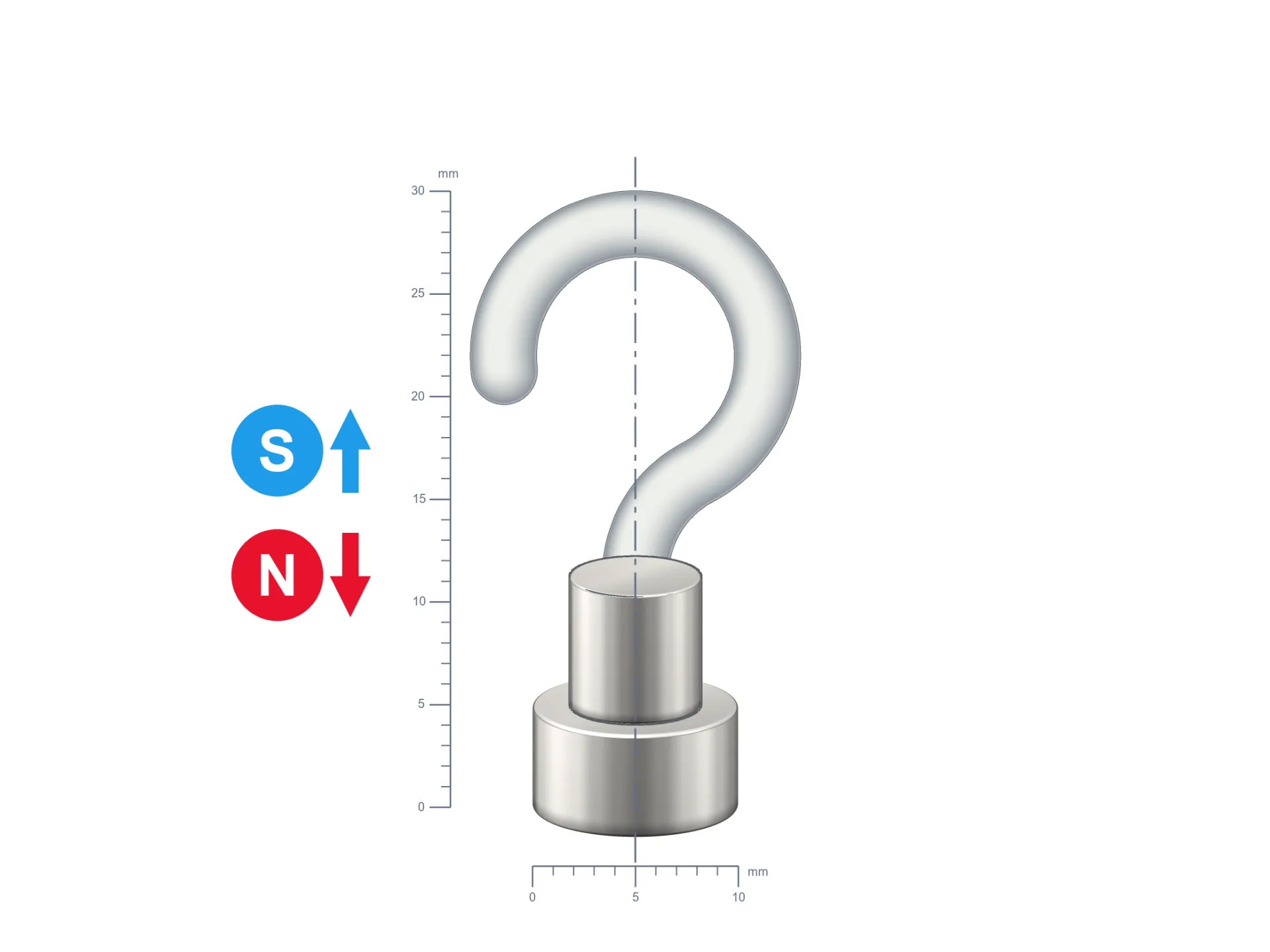
- Height
- 30 mm [±1 mm]
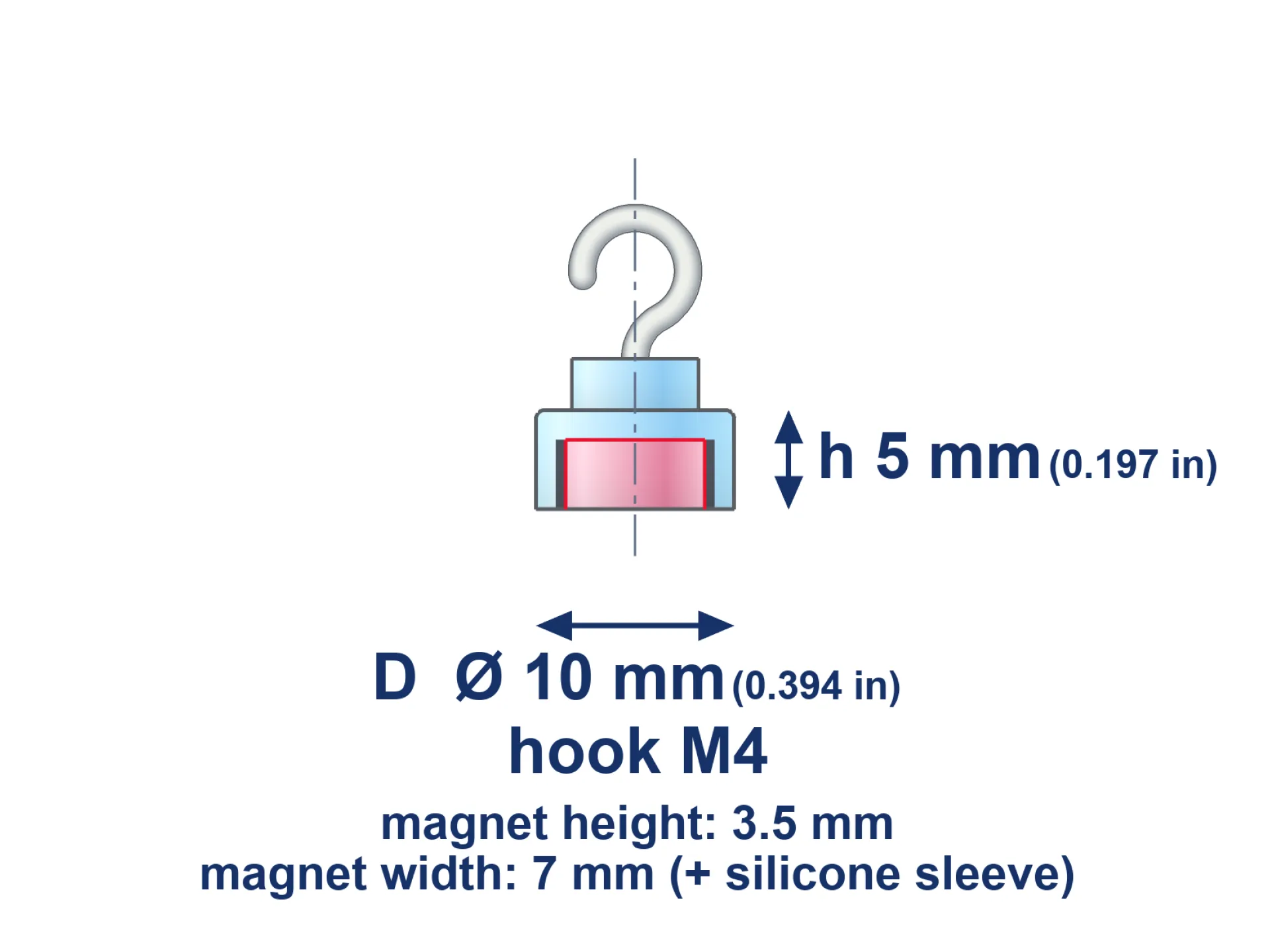
- Height
- 5 mm [±1 mm]
- Coating
- [NiCuNi] Nickel
How we measure these parameters — certificates and measurements
2.50 zł net / pcs
3.08 zł with VAT (23% VAT) / pcs
bulk discounts:
Need more?Frequently asked questions
Which magnetic holder is suitable for moving metal parts in a workshop?
How do I choose a holder for hanging a heavy item and check its real grip?
Which magnetic holders can be used outdoors?
How should I choose a strong threaded holder for field work?
Call us now
+48 888 99 98 98
alternatively let us know using
contact form
the contact section.
Specifications and structure of a neodymium magnet can be estimated using our
power calculator.
Order by 14:00 and we’ll ship today!
Technical - UMH 10x5x30 [M4] / N38 - magnetic holder with hook
Specification / characteristics - UMH 10x5x30 [M4] / N38 - magnetic holder with hook
| properties | values |
|---|---|
| Cat. no. | 310601 |
| GTIN/EAN | 5906301816041 |
| Distributor | Dhit sp. z o.o. |
| Country of origin | Poland / China / Germany |
| Customs code | 85059029 |
| Diameter Ø | 10 mm [±1 mm] |
| Height | 30 mm [±1 mm] |
| Height | 5 mm [±1 mm] |
| Coating | [NiCuNi] Nickel |
| Manufacturing Tolerance | ±1 mm |
Magnetic properties of material N38
| properties | values | units |
|---|---|---|
| Remanence Br ? | 12.2-12.6 | kGs |
| Remanence Br ? | 1220-1260 | mT |
| Coercivity bHc ? | 10.8-11.5 | kOe |
| Coercivity bHc ? | 860-915 | kA/m |
| Intrinsic coercivity iHc | ≥ 12 | kOe |
| Intrinsic coercivity iHc | ≥ 955 | kA/m |
| Energy product BHmax ? | 36-38 | BH max MGOe |
| Energy product BHmax ? | 287-303 | BH max KJ/m |
| Maximum working temperature ? | ≤ 80 | °C |
Physical properties of sintered neodymium magnets Nd2Fe14B at 20°C
| properties | values | units |
|---|---|---|
| Vickers hardness | ≥550 | Hv |
| Density | ≥7.4 | g/cm3 |
| Curie Temperature TC | 310 | °C |
| Curie Temperature TF | 590 | °F |
| Specific resistance | 150 | μΩ⋅cm |
| Bending strength | 250 | MPa |
| Compressive strength | 1000~1100 | MPa |
| Thermal expansion parallel (∥) to orientation (M) | (3-4) x 10-6 | °C-1 |
| Thermal expansion perpendicular (⊥) to orientation (M) | -(1-3) x 10-6 | °C-1 |
| Young's modulus | 1.7 x 10⁴ | kg/mm² |
Elemental analysis
| iron (Fe) | 64% – 68% |
| neodymium (Nd) | 29% – 32% |
| boron (B) | 1.1% – 1.2% |
| dysprosium (Dy) | 0.5% – 2.0% |
| coating (Ni-Cu-Ni) | < 0.05% |
Environmental data
| recyclability (EoL) | 100% |
| recycled raw materials | ~10% (pre-cons) |
| carbon footprint | low / zredukowany |
| waste code (EWC) | 16 02 16 |
Other offers
Advantages and disadvantages of Nd2Fe14B magnets.
Strengths
- They retain attractive force for around 10 years – the drop is just ~1% (based on simulations),
- They have excellent resistance to magnetic field loss as a result of external magnetic sources,
- Thanks to the metallic finish, the layer of nickel, gold-plated, or silver gives an clean appearance,
- They show high magnetic induction at the operating surface, which affects their effectiveness,
- Due to their durability and thermal resistance, neodymium magnets can operate (depending on the shape) even at high temperatures reaching 230°C or more...
- Possibility of individual shaping and adapting to precise needs,
- Key role in advanced technology sectors – they are utilized in hard drives, motor assemblies, medical devices, as well as multitasking production systems.
- Relatively small size with high pulling force – neodymium magnets offer high power in tiny dimensions, which makes them useful in small systems
Limitations
- At very strong impacts they can crack, therefore we recommend placing them in special holders. A metal housing provides additional protection against damage and increases the magnet's durability.
- Do not exceed this material temperature limit: 80°C. Overheating may permanently weaken the magnet.
- When exposed to humidity, magnets usually rust. For applications outside, it is recommended to use protective magnets, such as those in rubber or plastics, which prevent oxidation and corrosion.
- We suggest casing - magnetic mechanism, due to difficulties in realizing threads inside the magnet and complex shapes.
- Possible danger resulting from small fragments of magnets are risky, in case of ingestion, which is particularly important in the aspect of protecting the youngest. Furthermore, small elements of these devices can be problematic in diagnostics medical when they are in the body.
- With large orders the cost of neodymium magnets is a challenge,
Pull force analysis
Magnetic strength at its maximum – what contributes to it?
- with the application of a yoke made of low-carbon steel, ensuring full magnetic saturation
- with a cross-section of at least 10 mm
- with an polished touching surface
- with direct contact (without coatings)
- for force acting at a right angle (pull-off, not shear)
- at room temperature
Determinants of practical lifting force of a magnet
- Space between magnet and steel – even a fraction of a millimeter of separation (caused e.g. by varnish or unevenness) diminishes the magnet efficiency, often by half at just 0.5 mm.
- Pull-off angle – remember that the magnet has greatest strength perpendicularly. Under shear forces, the holding force drops drastically, often to levels of 20-30% of the maximum value.
- Substrate thickness – for full efficiency, the steel must be sufficiently thick. Paper-thin metal restricts the attraction force (the magnet "punches through" it).
- Plate material – mild steel gives the best results. Alloy steels decrease magnetic properties and holding force.
- Base smoothness – the more even the plate, the larger the contact zone and higher the lifting capacity. Roughness acts like micro-gaps.
- Temperature – heating the magnet causes a temporary drop of force. It is worth remembering the thermal limit for a given model.
Lifting capacity testing was performed on plates with a smooth surface of suitable thickness, under a perpendicular pulling force, however under attempts to slide the magnet the load capacity is reduced by as much as 5 times. Moreover, even a minimal clearance between the magnet’s surface and the plate reduces the lifting capacity.
Safe handling of neodymium magnets
Flammability
Fire warning: Rare earth powder is highly flammable. Avoid machining magnets in home conditions as this may cause fire.
Choking Hazard
Product intended for adults. Tiny parts pose a choking risk, causing intestinal necrosis. Store away from kids and pets.
Nickel coating and allergies
Nickel alert: The Ni-Cu-Ni coating contains nickel. If redness occurs, cease working with magnets and wear gloves.
Operating temperature
Do not exceed the maximum operating temperature stated in the specifications of the particular product. The limit depends on the material, geometry and operating arrangement; there is no single threshold for all neodymium magnets. Overheating can permanently weaken a magnet.
Respect the power
Be careful. Neodymium magnets attract from a distance and snap with massive power, often quicker than you can react.
Crushing force
Danger of trauma: The pulling power is so immense that it can cause blood blisters, crushing, and even bone fractures. Use thick gloves.
Medical implants
Medical warning: Strong magnets can deactivate pacemakers and defibrillators. Stay away if you have electronic implants.
Protect data
Powerful magnetic fields can erase data on payment cards, hard drives, and storage devices. Stay away of at least 10 cm.
Beware of splinters
NdFeB magnets are sintered ceramics, meaning they are prone to chipping. Clashing of two magnets leads to them shattering into small pieces.
Keep away from electronics
A strong magnetic field negatively affects the functioning of magnetometers in phones and navigation systems. Keep magnets near a smartphone to prevent damaging the sensors.
Tabela kosztu i czasu dostawy
Płatność przed wysyłką:

GLS kurier
Przesyłka będzie u Ciebie za 2-3 dni
14.99 ZŁ

InPost Paczkomaty 24/7
Przesyłka będzie u Ciebie za 1-2 dni
12.30 ZŁ
Płatność przy odbiorze (pobranie):
GLS kurier
Przesyłka będzie u Ciebie za 1-2 dni
23.00 ZŁ