

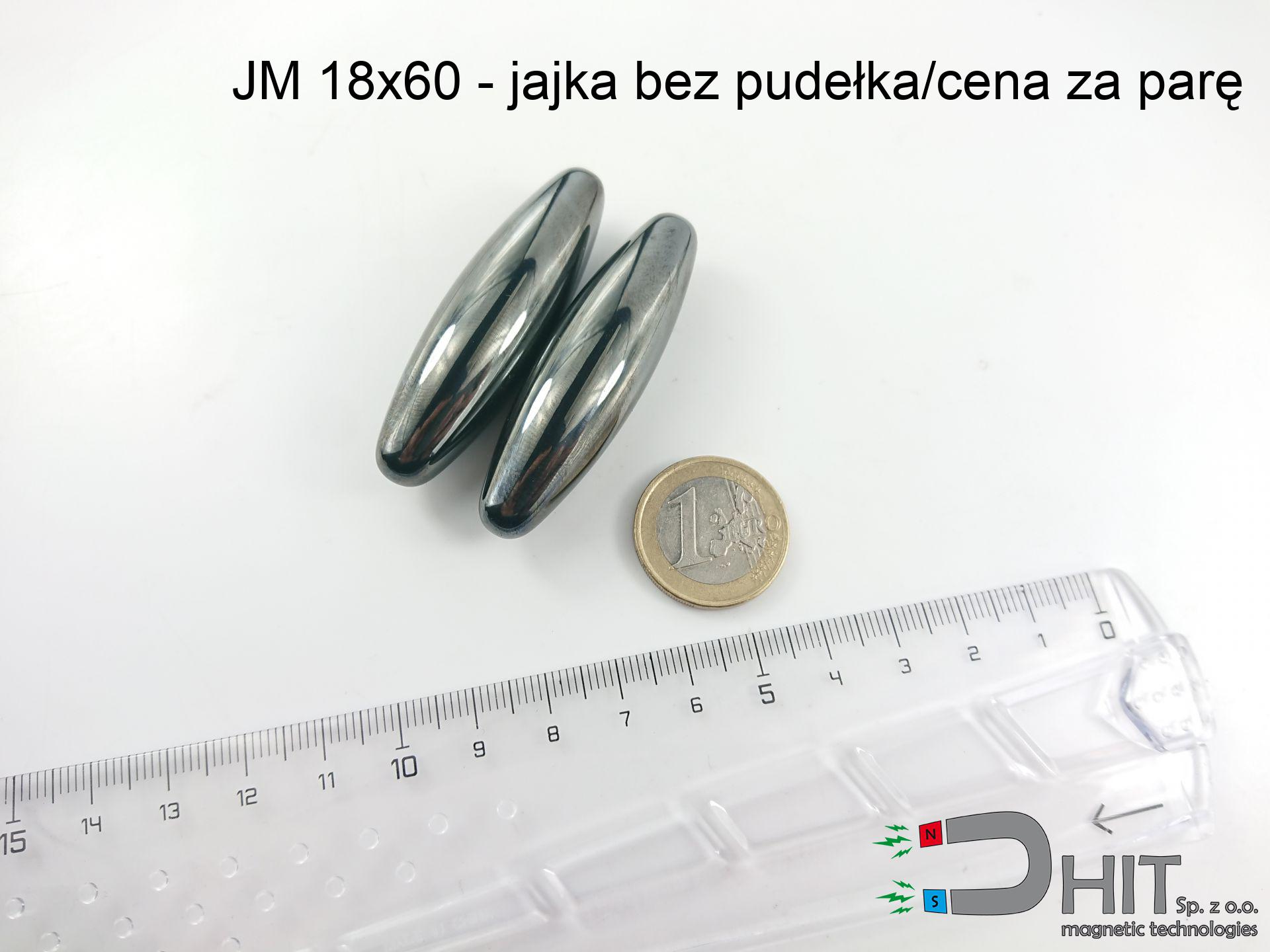
JM 18x60 - jajka bez pudełka/cena za parę - magnetic eggs
magnetic eggs
Catalog no 270213
GTIN/EAN: 5906301814412
7.31 zł net / pcs
8.99 zł with VAT (23% VAT) / pcs
bulk discounts:
Need more?Frequently asked questions
Are magnets in educational construction sets safe for children?
Which NeoCube set is the most durable?
How can I distinguish an original NeoCube set from a poor-quality substitute?
Guides from the knowledge base
Call us now
+48 888 99 98 98
alternatively let us know using
contact form
the contact section.
Specifications and structure of a neodymium magnet can be estimated using our
power calculator.
Order by 14:00 and we’ll ship today!
Technical - JM 18x60 - jajka bez pudełka/cena za parę - magnetic eggs
Specification / characteristics - JM 18x60 - jajka bez pudełka/cena za parę - magnetic eggs
| properties | values |
|---|---|
| Cat. no. | 270213 |
| GTIN/EAN | 5906301814412 |
| Production/Distribution | Dhit sp. z o.o. |
| Country of origin | Poland / China / Germany |
| Customs code | 85059029 |
| Weight | 83 g |
| Manufacturing Tolerance | ±1 mm |
Physical properties of sintered neodymium magnets Nd2Fe14B at 20°C
| properties | values | units |
|---|---|---|
| Vickers hardness | ≥550 | Hv |
| Density | ≥7.4 | g/cm3 |
| Curie Temperature TC | 310 | °C |
| Curie Temperature TF | 590 | °F |
| Specific resistance | 150 | μΩ⋅cm |
| Bending strength | 250 | MPa |
| Compressive strength | 1000~1100 | MPa |
| Thermal expansion parallel (∥) to orientation (M) | (3-4) x 10-6 | °C-1 |
| Thermal expansion perpendicular (⊥) to orientation (M) | -(1-3) x 10-6 | °C-1 |
| Young's modulus | 1.7 x 10⁴ | kg/mm² |
Material specification
| iron (Fe) | 64% – 68% |
| neodymium (Nd) | 29% – 32% |
| boron (B) | 1.1% – 1.2% |
| dysprosium (Dy) | 0.5% – 2.0% |
| coating (Ni-Cu-Ni) | < 0.05% |
Ecology and recycling (GPSR)
| recyclability (EoL) | 100% |
| recycled raw materials | ~10% (pre-cons) |
| carbon footprint | low / zredukowany |
| waste code (EWC) | 16 02 16 |
Check out also proposals

![UMGGZ 88x8.5 [M8] GZ / N38 - rubber magnetic holder external thread](https://cdn3.dhit.pl/graphics/products/umg-88x8.5-m8-gz-waf.jpg "UMGGZ 88x8.5 [M8] GZ / N38 - rubber magnetic holder external thread")
Strengths and weaknesses of rare earth magnets.
Advantages
- They retain attractive force for almost 10 years – the drop is just ~1% (according to analyses),
- Magnets very well defend themselves against demagnetization caused by ambient magnetic noise,
- In other words, due to the reflective finish of gold, the element becomes visually attractive,
- Magnetic induction on the top side of the magnet turns out to be strong,
- Through (appropriate) combination of ingredients, they can achieve high thermal resistance, allowing for functioning at temperatures reaching 230°C and above...
- Possibility of accurate shaping and optimizing to precise requirements,
- Universal use in modern industrial fields – they are used in magnetic memories, electromotive mechanisms, advanced medical instruments, and multitasking production systems.
- Thanks to efficiency per cm³, small magnets offer high operating force, occupying minimum space,
Disadvantages
- They are prone to damage upon too strong impacts. To avoid cracks, it is worth protecting magnets using a steel holder. Such protection not only shields the magnet but also improves its resistance to damage
- Heat sensitivity: observe the temperature specified for this product. Overheating may permanently weaken the magnet.
- Magnets exposed to a humid environment can rust. Therefore during using outdoors, we suggest using waterproof magnets made of rubber, plastic or other material resistant to moisture
- We recommend casing - magnetic holder, due to difficulties in realizing threads inside the magnet and complicated shapes.
- Possible danger to health – tiny shards of magnets pose a threat, in case of ingestion, which becomes key in the aspect of protecting the youngest. Additionally, small components of these devices can disrupt the diagnostic process medical in case of swallowing.
- High unit price – neodymium magnets are more expensive than other types of magnets (e.g. ferrite), which can limit application in large quantities
Pull force analysis
Maximum lifting capacity of the magnet – what contributes to it?
- on a plate made of structural steel, effectively closing the magnetic flux
- possessing a thickness of minimum 10 mm to ensure full flux closure
- characterized by lack of roughness
- without any clearance between the magnet and steel
- during detachment in a direction vertical to the plane
- at conditions approx. 20°C
Key elements affecting lifting force
- Clearance – the presence of foreign body (paint, dirt, gap) acts as an insulator, which reduces capacity steeply (even by 50% at 0.5 mm).
- Loading method – catalog parameter refers to pulling vertically. When applying parallel force, the magnet holds much less (often approx. 20-30% of maximum force).
- Base massiveness – too thin plate causes magnetic saturation, causing part of the flux to be escaped into the air.
- Material composition – not every steel attracts identically. Alloy additives weaken the interaction with the magnet.
- Plate texture – smooth surfaces guarantee perfect abutment, which improves field saturation. Uneven metal reduce efficiency.
- Thermal factor – hot environment weakens pulling force. Exceeding the limit temperature can permanently demagnetize the magnet.
Lifting capacity was measured by applying a steel plate with a smooth surface of optimal thickness (min. 20 mm), under perpendicular pulling force, in contrast under shearing force the load capacity is reduced by as much as 5 times. In addition, even a minimal clearance between the magnet’s surface and the plate decreases the load capacity.
Warnings
Permanent damage
Keep cool. Neodymium magnets are susceptible to heat. If you need operation above 80°C, look for special high-temperature series (H, SH, UH).
Choking Hazard
Only for adults. Small elements pose a choking risk, causing severe trauma. Store out of reach of children and animals.
Health Danger
Warning for patients: Strong magnetic fields disrupt medical devices. Maintain at least 30 cm distance or ask another person to work with the magnets.
Fire warning
Dust produced during machining of magnets is flammable. Avoid drilling into magnets unless you are an expert.
Handling guide
Be careful. Rare earth magnets act from a distance and snap with massive power, often faster than you can react.
Pinching danger
Big blocks can smash fingers in a fraction of a second. Do not place your hand between two strong magnets.
Beware of splinters
Despite metallic appearance, neodymium is brittle and cannot withstand shocks. Avoid impacts, as the magnet may crumble into hazardous fragments.
Keep away from electronics
GPS units and smartphones are highly susceptible to magnetic fields. Direct contact with a strong magnet can ruin the internal compass in your phone.
Allergic reactions
Studies show that nickel (standard magnet coating) is a common allergen. If you have an allergy, avoid touching magnets with bare hands or select versions in plastic housing.
Data carriers
Intense magnetic fields can destroy records on credit cards, HDDs, and storage devices. Maintain a gap of at least 10 cm.
Tabela kosztu i czasu dostawy
Płatność przed wysyłką:

GLS kurier
Przesyłka będzie u Ciebie za 2-3 dni
14.99 ZŁ

InPost Paczkomaty 24/7
Przesyłka będzie u Ciebie za 1-2 dni
12.30 ZŁ
Płatność przy odbiorze (pobranie):
GLS kurier
Przesyłka będzie u Ciebie za 1-2 dni
23.00 ZŁ