

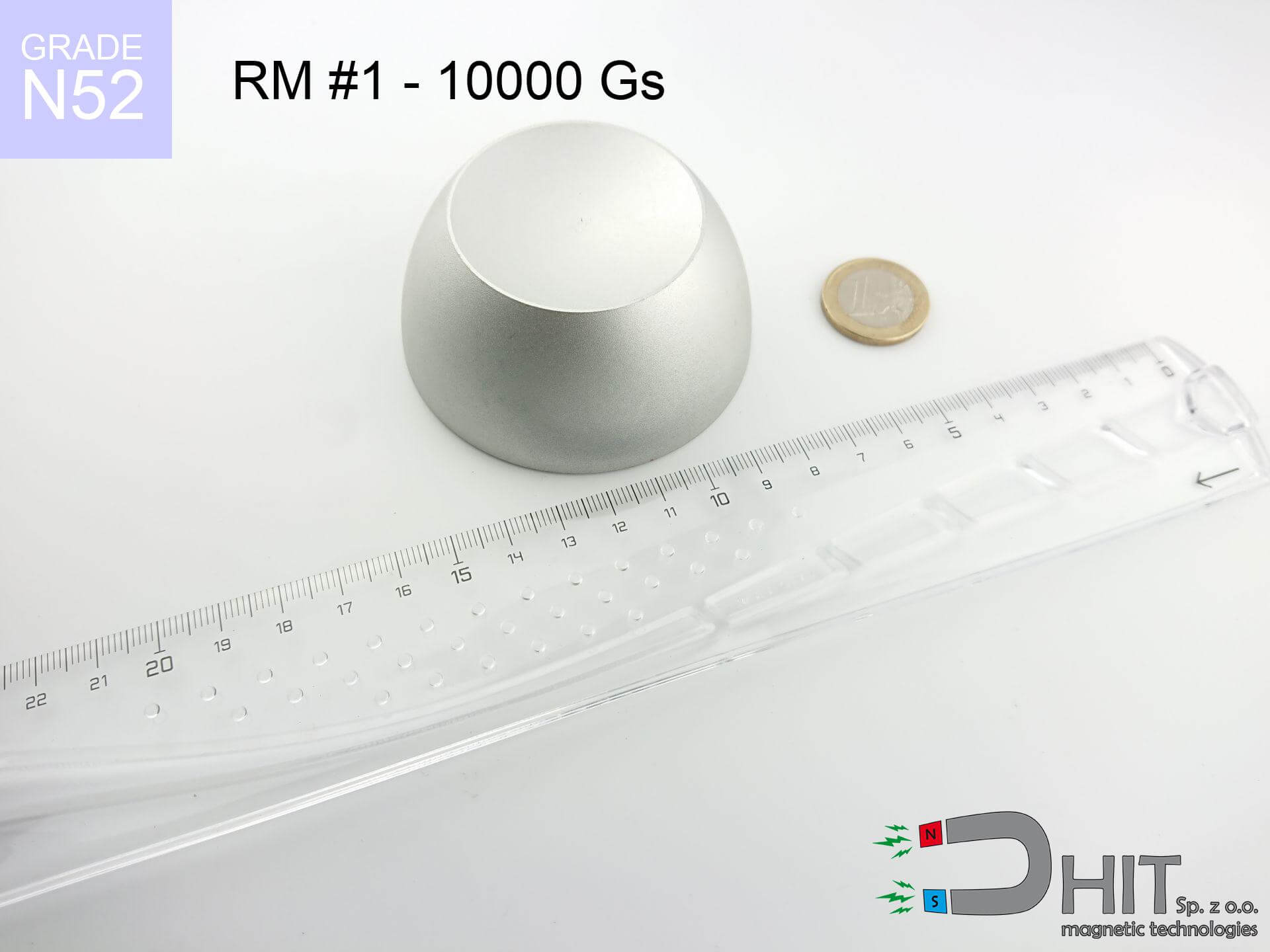
RM R1 - 10000 Gs / N52 - magnetic distributor
magnetic distributor
Catalog no 280251
GTIN/EAN: 5906301814429
- Weight
- 0.01 g
- Magnetization Direction
- ↑ axial
- Coating
- [NiCuNi] Nickel
How we measure these parameters — certificates and measurements
115.00 zł net / pcs
141.45 zł with VAT (23% VAT) / pcs
bulk discounts:
Need more?Frequently asked questions
What is the difference between a 13,000 Gs and a 5,000 Gs detacher, and which one should I choose for a clothing shop?
Will one detacher open every security tag we use in the shop?
How do I fix the detacher to the counter so it does not move around or go missing?
Will the detacher damage payment cards, phones or the payment terminal next to the till?
How do I look after a detacher, and does its strength fade over time?
How many till points should we equip, and is a spare unit worth keeping?
Who are detachers sold to, and what is needed to place an order?
Guides from the knowledge base
Call us now
+48 888 99 98 98
alternatively let us know using
contact form
the contact section.
Specifications and structure of a neodymium magnet can be estimated using our
power calculator.
Order by 14:00 and we’ll ship today!
Physical properties - RM R1 - 10000 Gs / N52 - magnetic distributor
Specification / characteristics - RM R1 - 10000 Gs / N52 - magnetic distributor
| properties | values |
|---|---|
| Cat. no. | 280251 |
| GTIN/EAN | 5906301814429 |
| Production/Distribution | Dhit sp. z o.o. |
| Country of origin | Poland / China / Germany |
| Customs code | 85059029 |
| Weight | 0.01 g |
| Magnetization Direction | ↑ axial |
| Coating | [NiCuNi] Nickel |
| Manufacturing Tolerance | ±1 mm |
Magnetic properties of material N52
| properties | values | units |
|---|---|---|
| Remanence Br ? | 14.2-14.7 | kGs |
| Remanence Br ? | 1420-1470 | mT |
| Coercivity bHc ? | 10.8-12.5 | kOe |
| Coercivity bHc ? | 860-995 | kA/m |
| Intrinsic coercivity iHc | ≥ 12 | kOe |
| Intrinsic coercivity iHc | ≥ 955 | kA/m |
| Energy product BHmax ? | 48-53 | BH max MGOe |
| Energy product BHmax ? | 380-422 | BH max KJ/m |
| Maximum working temperature ? | ≤ 60 | °C |
Physical properties of sintered neodymium magnets Nd2Fe14B at 20°C
| properties | values | units |
|---|---|---|
| Vickers hardness | ≥550 | Hv |
| Density | ≥7.4 | g/cm3 |
| Curie Temperature TC | 310 | °C |
| Curie Temperature TF | 590 | °F |
| Specific resistance | 150 | μΩ⋅cm |
| Bending strength | 250 | MPa |
| Compressive strength | 1000~1100 | MPa |
| Thermal expansion parallel (∥) to orientation (M) | (3-4) x 10-6 | °C-1 |
| Thermal expansion perpendicular (⊥) to orientation (M) | -(1-3) x 10-6 | °C-1 |
| Young's modulus | 1.7 x 10⁴ | kg/mm² |
Material specification
| iron (Fe) | 64% – 68% |
| neodymium (Nd) | 29% – 32% |
| boron (B) | 1.1% – 1.2% |
| dysprosium (Dy) | 0.5% – 2.0% |
| coating (Ni-Cu-Ni) | < 0.05% |
Ecology and recycling (GPSR)
| recyclability (EoL) | 100% |
| recycled raw materials | ~10% (pre-cons) |
| carbon footprint | low / zredukowany |
| waste code (EWC) | 16 02 16 |
Check out also products
![UMH 60x15x69 [M8] / N38 - magnetic holder with hook](https://cdn3.dhit.pl/graphics/products/umh-60x15x69-m8-nij.jpg "UMH 60x15x69 [M8] / N38 - magnetic holder with hook")


Pros as well as cons of rare earth magnets.
Pros
- They virtually do not lose strength, because even after 10 years the decline in efficiency is only ~1% (in laboratory conditions),
- They maintain their magnetic properties even under strong external field,
- The use of an elegant finish of noble metals (nickel, gold, silver) causes the element to be more visually attractive,
- They are known for high magnetic induction at the operating surface, which increases their power,
- Due to their durability and thermal resistance, neodymium magnets are capable of operate (depending on the shape) even at high temperatures reaching 230°C or more...
- Thanks to the ability of accurate forming and customization to individualized solutions, neodymium magnets can be produced in a wide range of geometric configurations, which amplifies use scope,
- Fundamental importance in modern industrial fields – they are commonly used in mass storage devices, motor assemblies, diagnostic systems, and multitasking production systems.
- Compactness – despite small sizes they offer powerful magnetic field, making them ideal for precision applications
Weaknesses
- To avoid cracks upon strong impacts, we suggest using special steel housings. Such a solution secures the magnet and simultaneously increases its durability.
- Do not exceed this material temperature limit: 60°C. Overheating may permanently weaken the magnet.
- When exposed to humidity, magnets usually rust. For applications outside, it is recommended to use protective magnets, such as those in rubber or plastics, which secure oxidation as well as corrosion.
- Limited ability of creating nuts in the magnet and complicated forms - preferred is a housing - mounting mechanism.
- Health risk related to microscopic parts of magnets are risky, if swallowed, which gains importance in the context of child safety. It is also worth noting that tiny parts of these devices are able to disrupt the diagnostic process medical when they are in the body.
- Higher cost of purchase is a significant factor to consider compared to ceramic magnets, especially in budget applications
Holding force characteristics
Detachment force of the magnet in optimal conditions – what contributes to it?
- with the contact of a sheet made of special test steel, guaranteeing maximum field concentration
- possessing a massiveness of at least 10 mm to ensure full flux closure
- characterized by smoothness
- with total lack of distance (no coatings)
- under vertical force direction (90-degree angle)
- at ambient temperature room level
Practical aspects of lifting capacity – factors
- Distance (between the magnet and the metal), since even a tiny distance (e.g. 0.5 mm) can cause a decrease in lifting capacity by up to 50% (this also applies to varnish, rust or debris).
- Loading method – declared lifting capacity refers to pulling vertically. When applying parallel force, the magnet holds significantly lower power (often approx. 20-30% of maximum force).
- Steel thickness – insufficiently thick sheet does not accept the full field, causing part of the flux to be escaped into the air.
- Metal type – different alloys attracts identically. High carbon content weaken the attraction effect.
- Surface condition – ground elements ensure maximum contact, which improves field saturation. Uneven metal weaken the grip.
- Operating temperature – neodymium magnets have a negative temperature coefficient. When it is hot they lose power, and at low temperatures they can be stronger (up to a certain limit).
Lifting capacity testing was performed on a smooth plate of optimal thickness, under a perpendicular pulling force, whereas under shearing force the lifting capacity is smaller. In addition, even a minimal clearance between the magnet’s surface and the plate lowers the holding force.
Precautions when working with NdFeB magnets
Magnetic interference
GPS units and mobile phones are highly sensitive to magnetic fields. Close proximity with a strong magnet can permanently damage the sensors in your phone.
Magnet fragility
Despite metallic appearance, neodymium is brittle and cannot withstand shocks. Do not hit, as the magnet may crumble into sharp, dangerous pieces.
Bodily injuries
Danger of trauma: The pulling power is so great that it can cause hematomas, crushing, and even bone fractures. Protective gloves are recommended.
Combustion hazard
Dust produced during cutting of magnets is self-igniting. Do not drill into magnets without proper cooling and knowledge.
Keep away from computers
Very strong magnetic fields can erase data on credit cards, hard drives, and storage devices. Keep a distance of min. 10 cm.
Medical implants
Warning for patients: Powerful magnets disrupt medical devices. Keep minimum 30 cm distance or ask another person to handle the magnets.
No play value
Product intended for adults. Tiny parts can be swallowed, leading to serious injuries. Keep away from children and animals.
Allergic reactions
Medical facts indicate that nickel (the usual finish) is a common allergen. For allergy sufferers, avoid direct skin contact and choose coated magnets.
Handling rules
Use magnets consciously. Their immense force can surprise even experienced users. Stay alert and do not underestimate their force.
Operating temperature
Do not exceed the maximum operating temperature stated in the specifications of the particular product. The limit depends on the material, geometry and operating arrangement; there is no single threshold for all neodymium magnets. Overheating can permanently weaken a magnet.
Tabela kosztu i czasu dostawy
Płatność przed wysyłką:

GLS kurier
Przesyłka będzie u Ciebie za 2-3 dni
14.99 ZŁ

InPost Paczkomaty 24/7
Przesyłka będzie u Ciebie za 1-2 dni
12.30 ZŁ
Płatność przy odbiorze (pobranie):
GLS kurier
Przesyłka będzie u Ciebie za 1-2 dni
23.00 ZŁ