
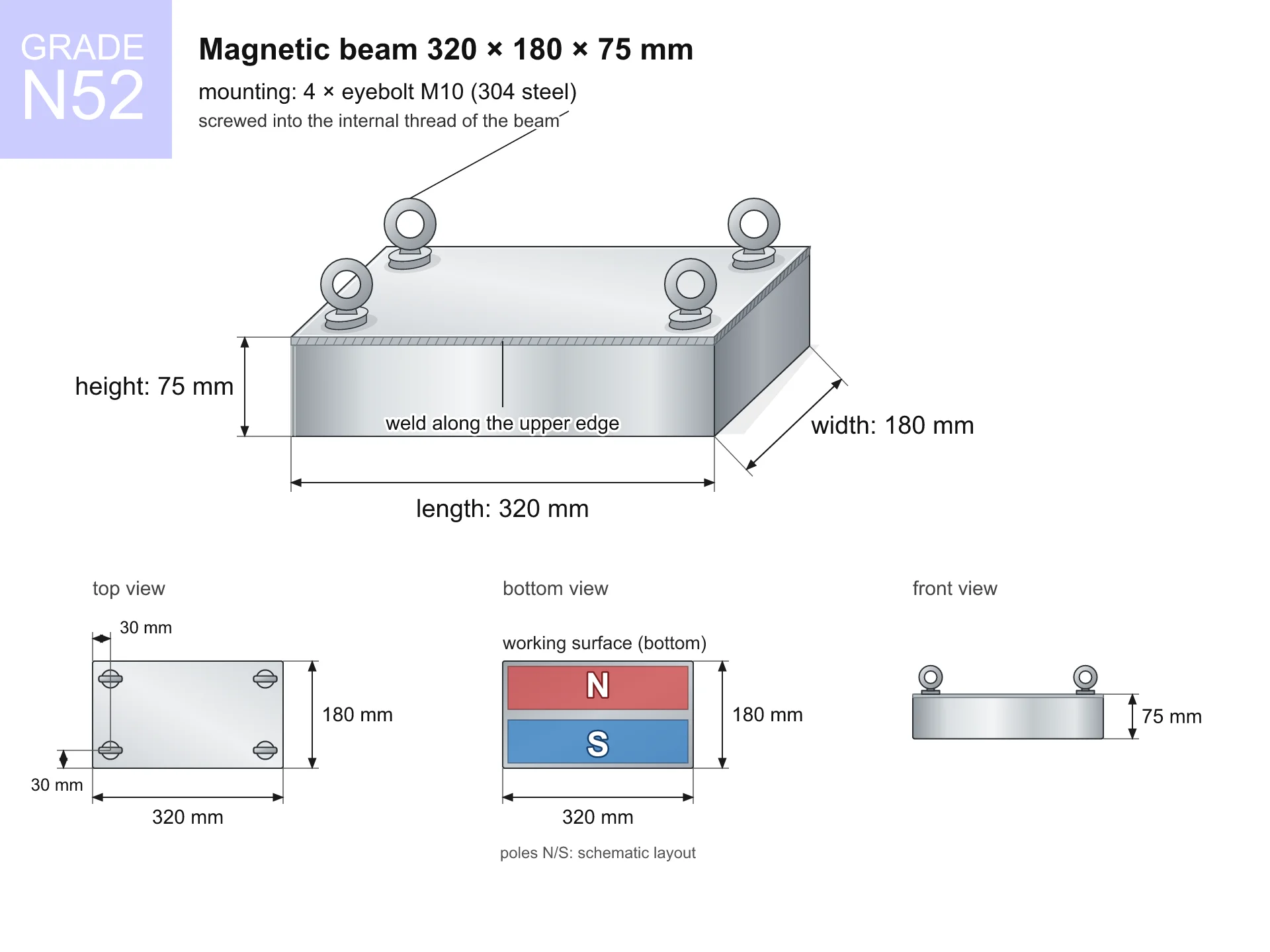
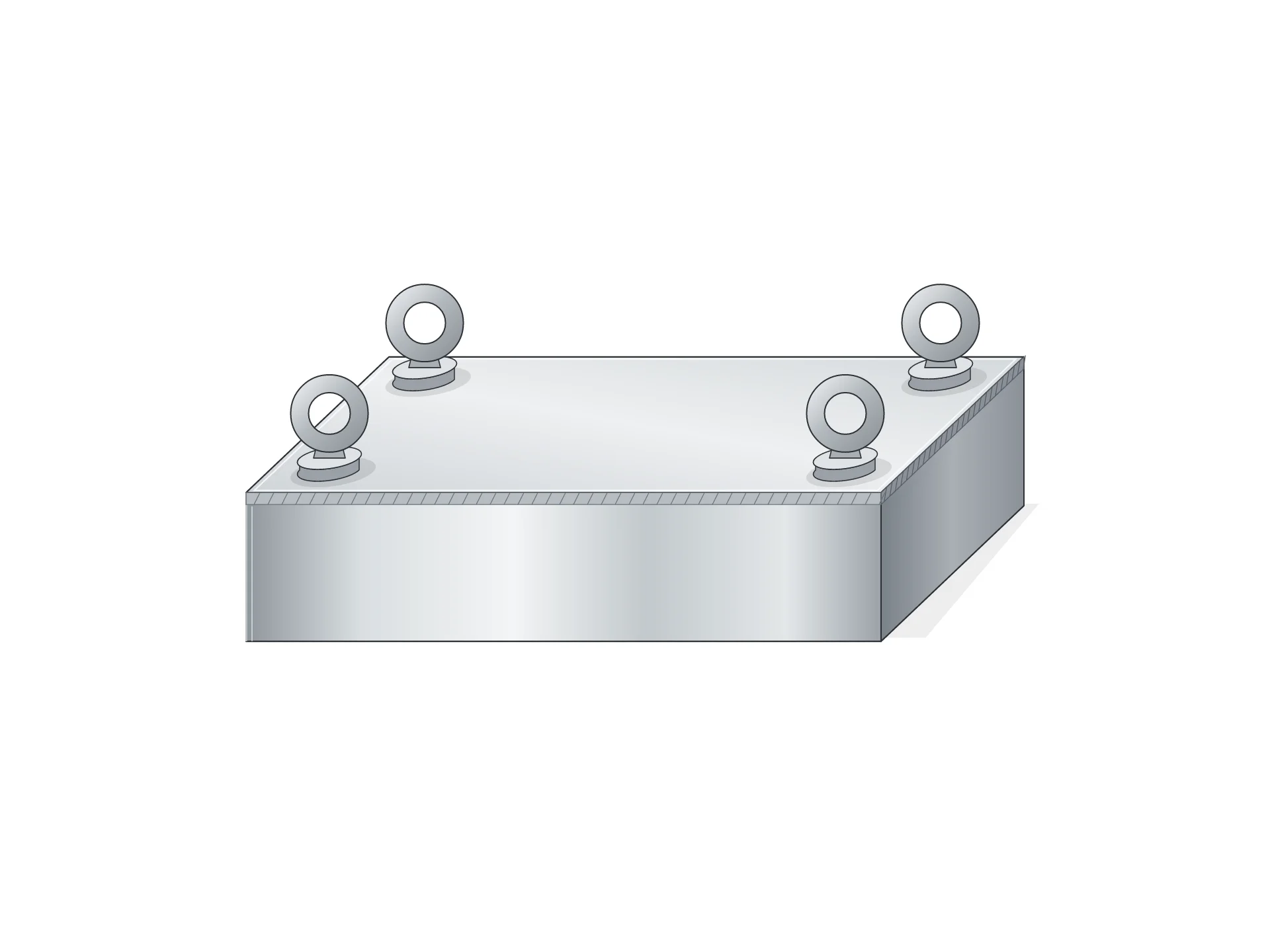
BM 320x180x75 [M10x4] - magnetic beam
magnetic beam
Catalog no 090569
GTIN/EAN: 5906301815617
- length
- 320 mm [±1 mm]
- Width
- 180 mm [±1 mm]
- Height
- 75 mm [±1 mm]
- Weight
- 22000 g
How we measure these parameters — certificates and measurements
3455.40 zł net / pcs
4250.14 zł with VAT (23% VAT) / pcs
bulk discounts:
Need more?Frequently asked questions
How do I choose a separator for fine contamination and check availability?
Where can I order a separator for a production line, and what should I check?
How can I verify a separator's declared magnetic parameters before purchase?
Can a magnetic beam withstand continuous work on a production line?
What roller design is suitable for a dusty environment?
How do I choose the size of a hand-held separator?
What is a hand-held separator for, and how is it different from a built-in rod?
Which separator type suits a small production plant?
Call us now
+48 888 99 98 98
alternatively let us know using
contact form
the contact section.
Specifications and structure of a neodymium magnet can be estimated using our
power calculator.
Order by 14:00 and we’ll ship today!
Technical specification of the product - BM 320x180x75 [M10x4] - magnetic beam
Specification / characteristics - BM 320x180x75 [M10x4] - magnetic beam
| properties | values |
|---|---|
| Cat. no. | 090569 |
| GTIN/EAN | 5906301815617 |
| Distributor | Dhit sp. z o.o. |
| Country of origin | Poland / China / Germany |
| Customs code | 85059029 |
| length | 320 mm [±1 mm] |
| Width | 180 mm [±1 mm] |
| Height | 75 mm [±1 mm] |
| Weight | 22000 g |
| Manufacturing Tolerance | ±1 mm |
Physical properties of sintered neodymium magnets Nd2Fe14B at 20°C
| properties | values | units |
|---|---|---|
| Vickers hardness | ≥550 | Hv |
| Density | ≥7.4 | g/cm3 |
| Curie Temperature TC | 310 | °C |
| Curie Temperature TF | 590 | °F |
| Specific resistance | 150 | μΩ⋅cm |
| Bending strength | 250 | MPa |
| Compressive strength | 1000~1100 | MPa |
| Thermal expansion parallel (∥) to orientation (M) | (3-4) x 10-6 | °C-1 |
| Thermal expansion perpendicular (⊥) to orientation (M) | -(1-3) x 10-6 | °C-1 |
| Young's modulus | 1.7 x 10⁴ | kg/mm² |
Chemical composition
| iron (Fe) | 64% – 68% |
| neodymium (Nd) | 29% – 32% |
| boron (B) | 1.1% – 1.2% |
| dysprosium (Dy) | 0.5% – 2.0% |
| coating (Ni-Cu-Ni) | < 0.05% |
Sustainability
| recyclability (EoL) | 100% |
| recycled raw materials | ~10% (pre-cons) |
| carbon footprint | low / zredukowany |
| waste code (EWC) | 16 02 16 |
Other deals

Pros as well as cons of rare earth magnets.
Pros
- They retain magnetic properties for nearly ten years – the drop is just ~1% (in theory),
- They feature excellent resistance to magnetic field loss when exposed to external magnetic sources,
- In other words, due to the metallic finish of nickel, the element gains a professional look,
- The surface of neodymium magnets generates a unique magnetic field – this is a distinguishing feature,
- Neodymium magnets are characterized by very high magnetic induction on the magnet surface and are able to act (depending on the shape) even at a temperature of 230°C or more...
- Possibility of exact creating as well as adapting to concrete needs,
- Huge importance in electronics industry – they are commonly used in mass storage devices, drive modules, advanced medical instruments, as well as technologically advanced constructions.
- Thanks to their power density, small magnets offer high operating force, with minimal size,
Disadvantages
- They are fragile upon heavy impacts. To avoid cracks, it is worth securing magnets using a steel holder. Such protection not only protects the magnet but also improves its resistance to damage
- Heat sensitivity: observe the temperature specified for this product. Overheating may permanently weaken the magnet.
- They oxidize in a humid environment. For use outdoors we advise using waterproof magnets e.g. in rubber, plastic
- We suggest cover - magnetic mount, due to difficulties in creating nuts inside the magnet and complex forms.
- Health risk related to microscopic parts of magnets pose a threat, when accidentally swallowed, which is particularly important in the context of child safety. It is also worth noting that small elements of these devices are able to disrupt the diagnostic process medical when they are in the body.
- High unit price – neodymium magnets cost more than other types of magnets (e.g. ferrite), which can limit application in large quantities
Pull force analysis
Detachment force of the magnet in optimal conditions – what affects it?
- on a base made of mild steel, effectively closing the magnetic field
- whose transverse dimension reaches at least 10 mm
- with a plane free of scratches
- with total lack of distance (without paint)
- during pulling in a direction vertical to the plane
- at temperature room level
Practical aspects of lifting capacity – factors
- Gap (between the magnet and the plate), since even a very small distance (e.g. 0.5 mm) can cause a reduction in force by up to 50% (this also applies to paint, corrosion or dirt).
- Direction of force – highest force is reached only during perpendicular pulling. The resistance to sliding of the magnet along the plate is usually many times smaller (approx. 1/5 of the lifting capacity).
- Substrate thickness – to utilize 100% power, the steel must be sufficiently thick. Thin sheet restricts the attraction force (the magnet "punches through" it).
- Chemical composition of the base – low-carbon steel attracts best. Alloy admixtures decrease magnetic permeability and holding force.
- Base smoothness – the smoother and more polished the plate, the larger the contact zone and higher the lifting capacity. Roughness creates an air distance.
- Operating temperature – neodymium magnets have a negative temperature coefficient. When it is hot they lose power, and in frost gain strength (up to a certain limit).
Lifting capacity was measured with the use of a polished steel plate of suitable thickness (min. 20 mm), under perpendicular pulling force, however under shearing force the holding force is lower. Moreover, even a slight gap between the magnet and the plate lowers the load capacity.
H&S for magnets
Caution required
Before starting, check safety instructions. Sudden snapping can destroy the magnet or hurt your hand. Think ahead.
Dust is flammable
Powder created during cutting of magnets is combustible. Avoid drilling into magnets unless you are an expert.
Fragile material
Despite the nickel coating, the material is delicate and not impact-resistant. Avoid impacts, as the magnet may crumble into hazardous fragments.
Data carriers
Avoid bringing magnets close to a purse, computer, or TV. The magnetic field can destroy these devices and erase data from cards.
Power loss in heat
Do not exceed the maximum operating temperature stated in the specifications of the particular product. The limit depends on the material, geometry and operating arrangement; there is no single threshold for all neodymium magnets. Overheating can permanently weaken a magnet.
Choking Hazard
Adult use only. Small elements pose a choking risk, causing severe trauma. Store out of reach of children and animals.
Life threat
Warning for patients: Strong magnetic fields affect electronics. Keep minimum 30 cm distance or request help to handle the magnets.
Crushing force
Big blocks can break fingers in a fraction of a second. Never put your hand betwixt two strong magnets.
Warning for allergy sufferers
It is widely known that the nickel plating (the usual finish) is a potent allergen. For allergy sufferers, refrain from touching magnets with bare hands or choose versions in plastic housing.
Magnetic interference
Navigation devices and smartphones are highly sensitive to magnetism. Direct contact with a strong magnet can decalibrate the sensors in your phone.
Tabela kosztu i czasu dostawy
Płatność przed wysyłką:

GLS kurier
Przesyłka będzie u Ciebie za 2-3 dni
14.99 ZŁ

InPost Paczkomaty 24/7
Przesyłka będzie u Ciebie za 1-2 dni
12.30 ZŁ
Płatność przy odbiorze (pobranie):
GLS kurier
Przesyłka będzie u Ciebie za 1-2 dni
23.00 ZŁ