

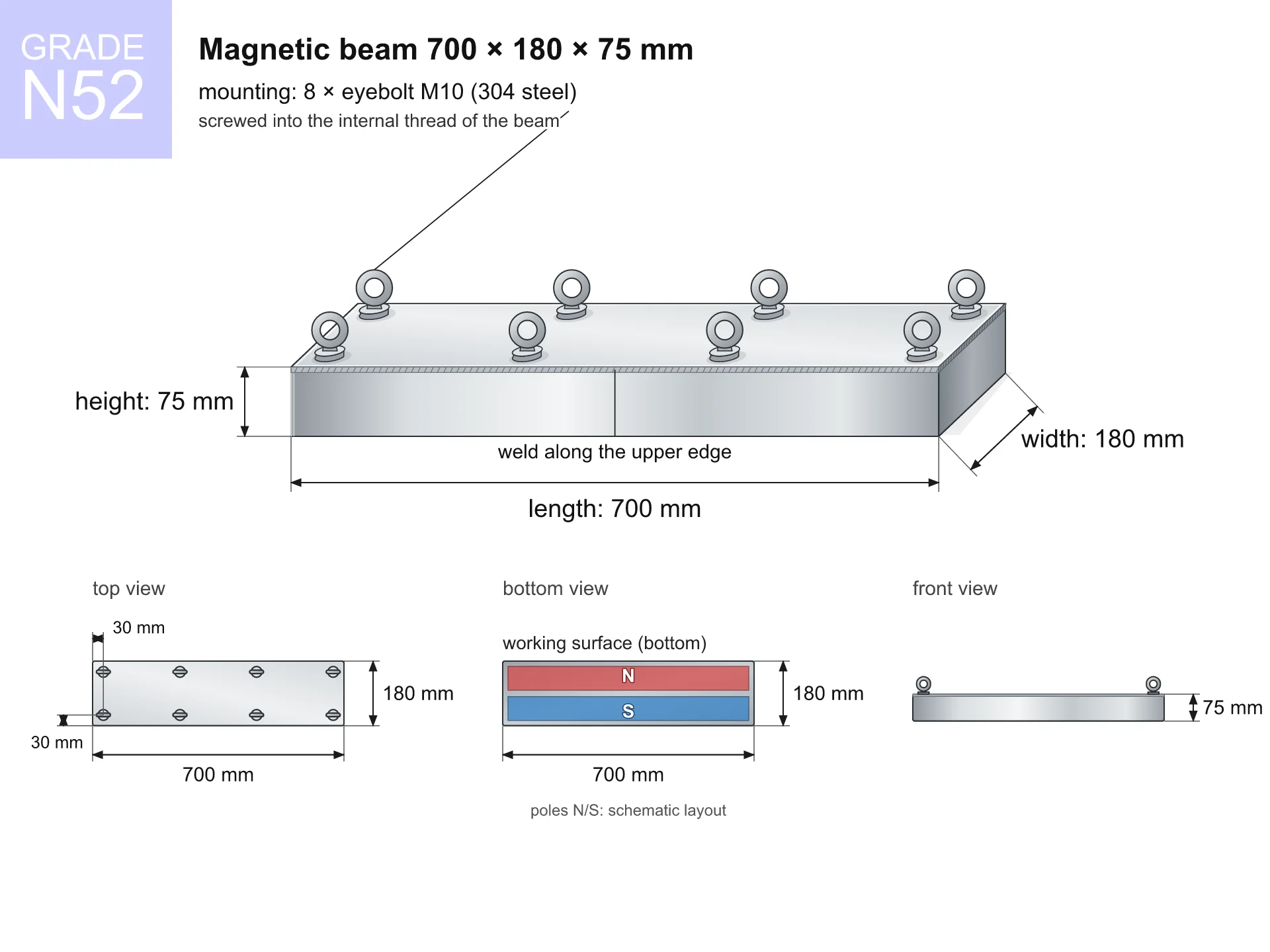
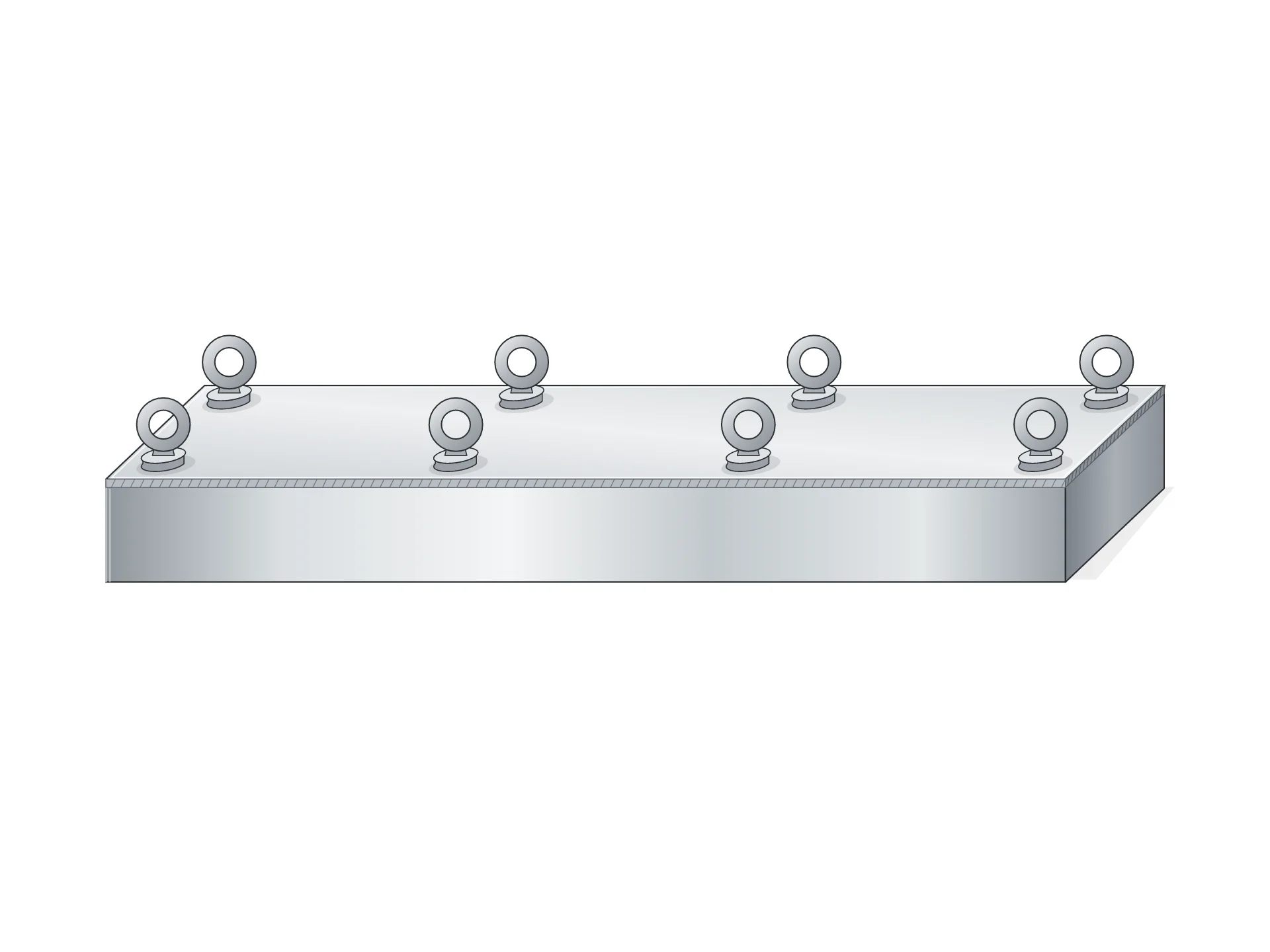
BM 700x180x75 [M10x8] - magnetic beam
magnetic beam
Catalog no 090472
GTIN/EAN: 5906301812616
- length
- 700 mm [±1 mm]
- Width
- 180 mm [±1 mm]
- Height
- 75 mm [±1 mm]
- Weight
- 35000 g
How we measure these parameters — certificates and measurements
6300.00 zł net / pcs
7749.00 zł with VAT (23% VAT) / pcs
bulk discounts:
Need more?Frequently asked questions
How do I choose a separator for fine contamination and check availability?
Where can I order a separator for a production line, and what should I check?
How can I verify a separator's declared magnetic parameters before purchase?
Can a magnetic beam withstand continuous work on a production line?
What roller design is suitable for a dusty environment?
How do I choose the size of a hand-held separator?
What is a hand-held separator for, and how is it different from a built-in rod?
Which separator type suits a small production plant?
Call us now
+48 888 99 98 98
alternatively let us know using
contact form
the contact section.
Specifications and structure of a neodymium magnet can be estimated using our
power calculator.
Order by 14:00 and we’ll ship today!
Technical - BM 700x180x75 [M10x8] - magnetic beam
Specification / characteristics - BM 700x180x75 [M10x8] - magnetic beam
| properties | values |
|---|---|
| Cat. no. | 090472 |
| GTIN/EAN | 5906301812616 |
| Distributor | Dhit sp. z o.o. |
| Country of origin | Poland / China / Germany |
| Customs code | 85059029 |
| length | 700 mm [±1 mm] |
| Width | 180 mm [±1 mm] |
| Height | 75 mm [±1 mm] |
| Weight | 35000 g |
| Manufacturing Tolerance | ±1 mm |
Physical properties of sintered neodymium magnets Nd2Fe14B at 20°C
| properties | values | units |
|---|---|---|
| Vickers hardness | ≥550 | Hv |
| Density | ≥7.4 | g/cm3 |
| Curie Temperature TC | 310 | °C |
| Curie Temperature TF | 590 | °F |
| Specific resistance | 150 | μΩ⋅cm |
| Bending strength | 250 | MPa |
| Compressive strength | 1000~1100 | MPa |
| Thermal expansion parallel (∥) to orientation (M) | (3-4) x 10-6 | °C-1 |
| Thermal expansion perpendicular (⊥) to orientation (M) | -(1-3) x 10-6 | °C-1 |
| Young's modulus | 1.7 x 10⁴ | kg/mm² |
Material specification
| iron (Fe) | 64% – 68% |
| neodymium (Nd) | 29% – 32% |
| boron (B) | 1.1% – 1.2% |
| dysprosium (Dy) | 0.5% – 2.0% |
| coating (Ni-Cu-Ni) | < 0.05% |
Ecology and recycling (GPSR)
| recyclability (EoL) | 100% |
| recycled raw materials | ~10% (pre-cons) |
| carbon footprint | low / zredukowany |
| waste code (EWC) | 16 02 16 |
View more proposals
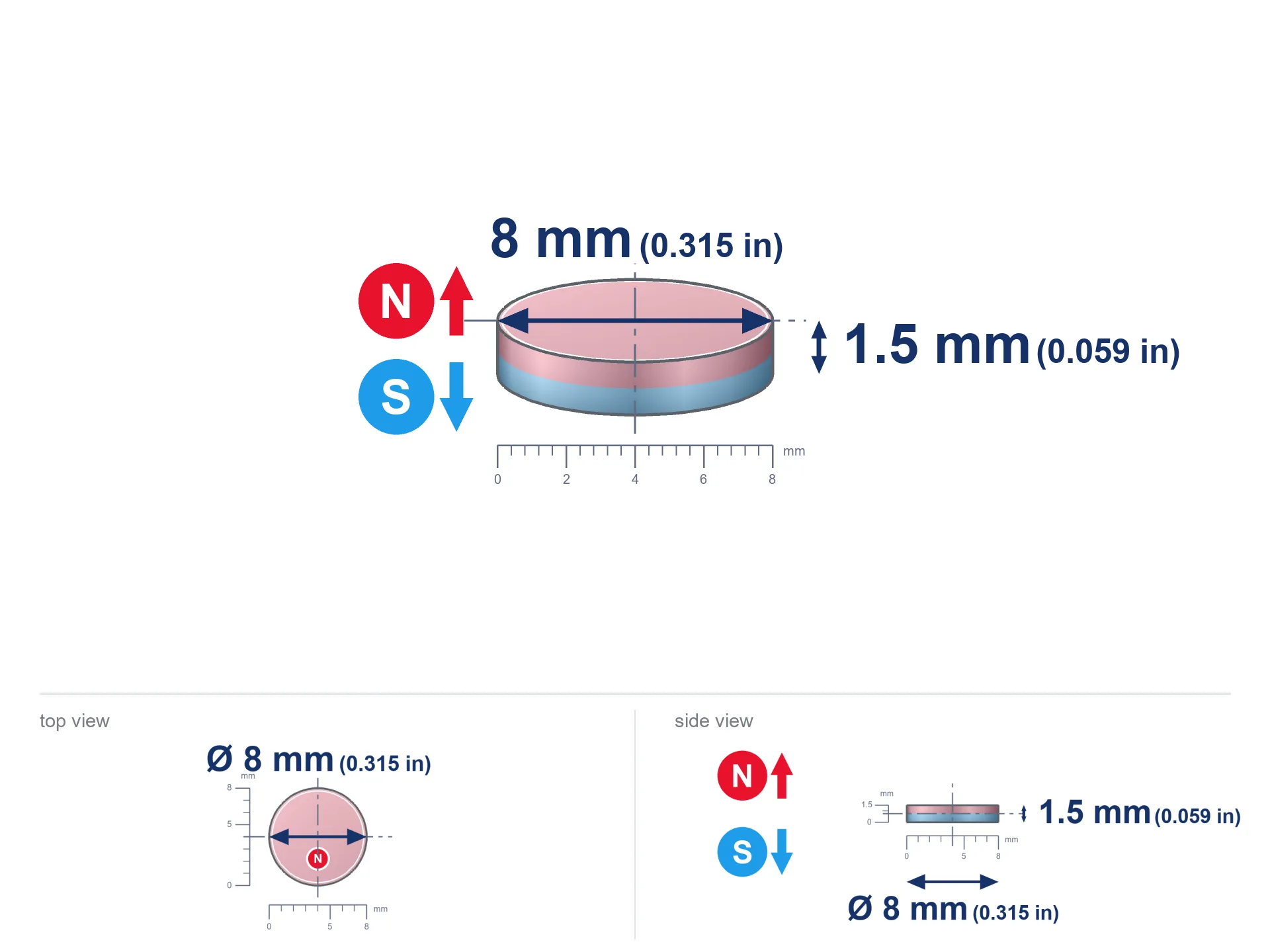
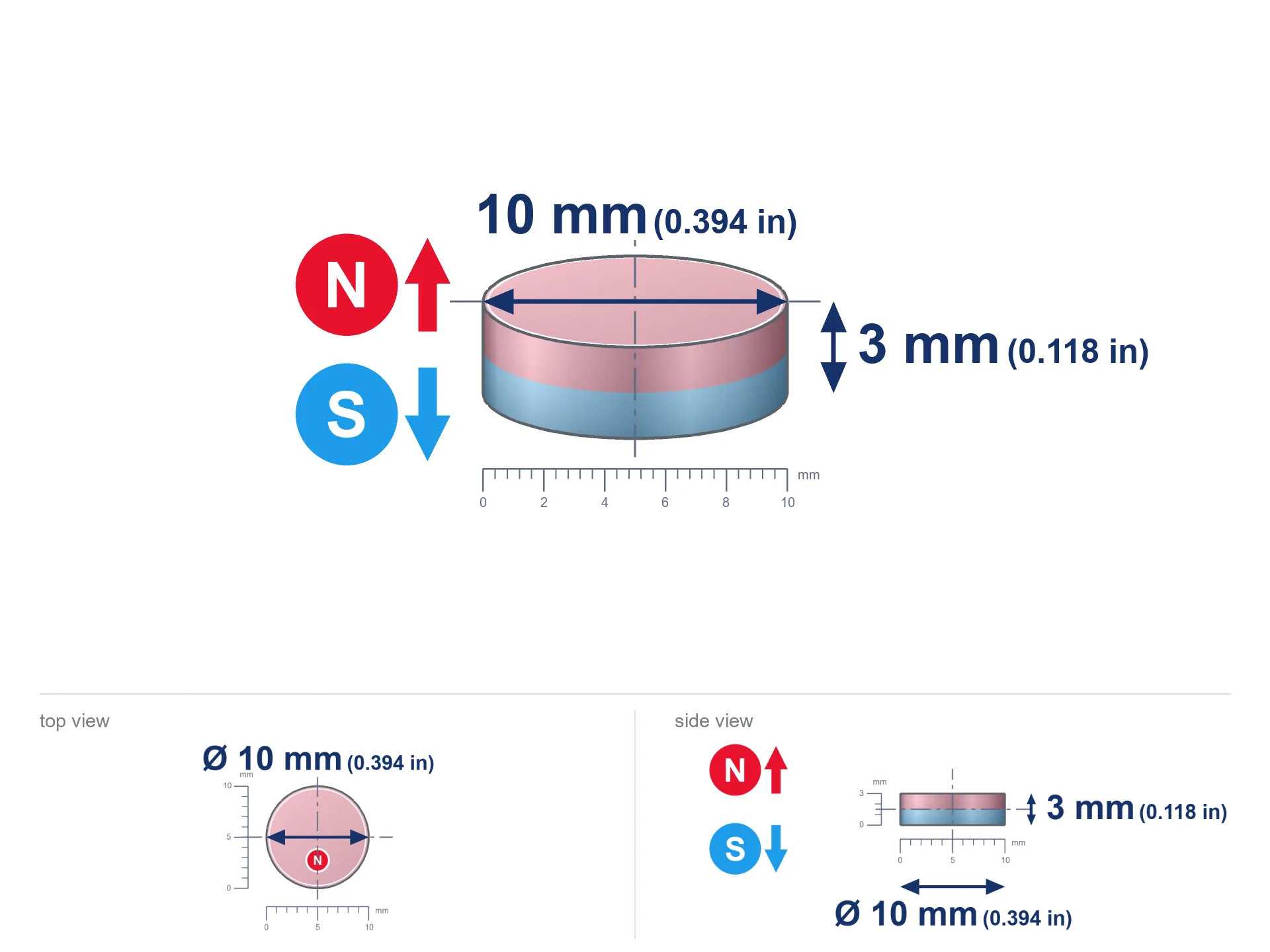
Pros and cons of neodymium magnets.
Benefits
- Their power is maintained, and after approximately ten years it decreases only by ~1% (theoretically),
- They possess excellent resistance to magnetic field loss due to external fields,
- The use of an aesthetic layer of noble metals (nickel, gold, silver) causes the element to look better,
- They are known for high magnetic induction at the operating surface, making them more effective,
- Neodymium magnets are characterized by extremely high magnetic induction on the magnet surface and can work (depending on the shape) even at a temperature of 230°C or more...
- In view of the possibility of accurate shaping and customization to specialized solutions, magnetic components can be produced in a broad palette of forms and dimensions, which increases their versatility,
- Fundamental importance in high-tech industry – they are commonly used in HDD drives, electric motors, precision medical tools, and technologically advanced constructions.
- Compactness – despite small sizes they offer powerful magnetic field, making them ideal for precision applications
Cons
- They are fragile upon heavy impacts. To avoid cracks, it is worth securing magnets using a steel holder. Such protection not only protects the magnet but also improves its resistance to damage
- Heat sensitivity: observe the temperature specified for this product. Overheating may permanently weaken the magnet.
- Due to the susceptibility of magnets to corrosion in a humid environment, we advise using waterproof magnets made of rubber, plastic or other material immune to moisture, in case of application outdoors
- We suggest cover - magnetic mount, due to difficulties in realizing threads inside the magnet and complex shapes.
- Possible danger to health – tiny shards of magnets are risky, when accidentally swallowed, which becomes key in the context of child health protection. Furthermore, small elements of these devices are able to complicate diagnosis medical in case of swallowing.
- With budget limitations the cost of neodymium magnets can be a barrier,
Pull force analysis
Maximum lifting force for a neodymium magnet – what contributes to it?
- using a sheet made of low-carbon steel, acting as a circuit closing element
- whose transverse dimension equals approx. 10 mm
- characterized by smoothness
- without any clearance between the magnet and steel
- under vertical force vector (90-degree angle)
- in neutral thermal conditions
Key elements affecting lifting force
- Space between surfaces – every millimeter of distance (caused e.g. by veneer or dirt) significantly weakens the magnet efficiency, often by half at just 0.5 mm.
- Pull-off angle – remember that the magnet holds strongest perpendicularly. Under sliding down, the holding force drops significantly, often to levels of 20-30% of the nominal value.
- Plate thickness – too thin plate does not accept the full field, causing part of the power to be lost to the other side.
- Material type – the best choice is high-permeability steel. Hardened steels may have worse magnetic properties.
- Base smoothness – the smoother and more polished the surface, the larger the contact zone and higher the lifting capacity. Unevenness creates an air distance.
- Temperature influence – high temperature weakens pulling force. Too high temperature can permanently demagnetize the magnet.
Lifting capacity testing was conducted on plates with a smooth surface of optimal thickness, under perpendicular forces, however under attempts to slide the magnet the lifting capacity is smaller. Moreover, even a slight gap between the magnet and the plate lowers the load capacity.
Safety rules for work with neodymium magnets
Skin irritation risks
Studies show that the nickel plating (the usual finish) is a potent allergen. For allergy sufferers, avoid touching magnets with bare hands and choose coated magnets.
Hand protection
Risk of injury: The attraction force is so great that it can result in blood blisters, crushing, and broken bones. Use thick gloves.
Eye protection
NdFeB magnets are ceramic materials, which means they are fragile like glass. Collision of two magnets will cause them shattering into shards.
Threat to navigation
Navigation devices and smartphones are highly susceptible to magnetism. Close proximity with a powerful NdFeB magnet can decalibrate the sensors in your phone.
Medical interference
Individuals with a pacemaker have to maintain an absolute distance from magnets. The magnetic field can stop the operation of the life-saving device.
Swallowing risk
These products are not suitable for play. Eating a few magnets may result in them pinching intestinal walls, which constitutes a severe health hazard and necessitates immediate surgery.
Handling rules
Handle magnets with awareness. Their immense force can surprise even professionals. Stay alert and respect their force.
Data carriers
Powerful magnetic fields can corrupt files on payment cards, HDDs, and other magnetic media. Stay away of at least 10 cm.
Power loss in heat
Do not exceed the maximum operating temperature stated in the specifications of the particular product. The limit depends on the material, geometry and operating arrangement; there is no single threshold for all neodymium magnets. Overheating can permanently weaken a magnet.
Machining danger
Dust generated during cutting of magnets is flammable. Avoid drilling into magnets unless you are an expert.
Tabela kosztu i czasu dostawy
Płatność przed wysyłką:

GLS kurier
Przesyłka będzie u Ciebie za 2-3 dni
14.99 ZŁ

InPost Paczkomaty 24/7
Przesyłka będzie u Ciebie za 1-2 dni
12.30 ZŁ
Płatność przy odbiorze (pobranie):
GLS kurier
Przesyłka będzie u Ciebie za 1-2 dni
23.00 ZŁ