

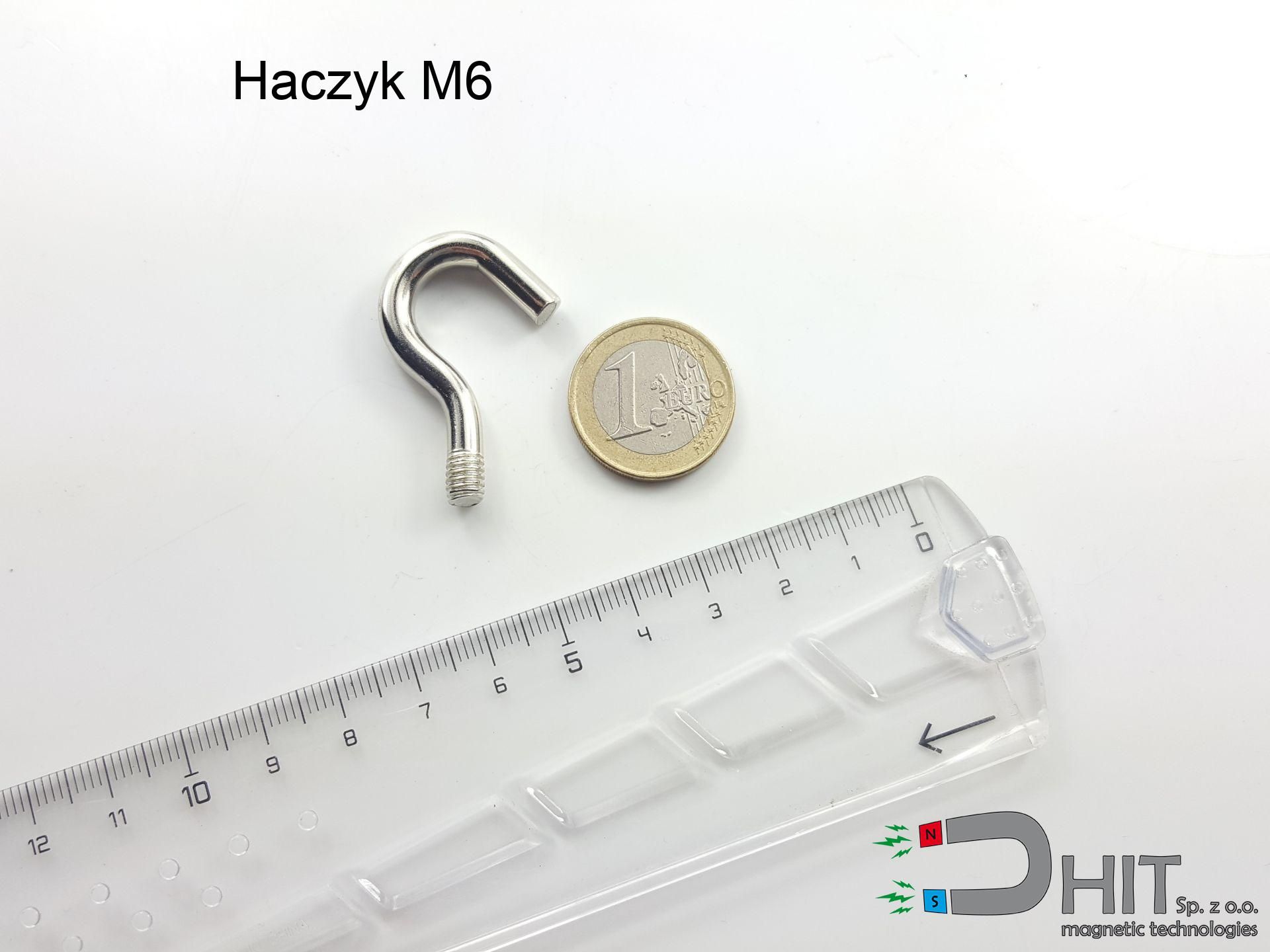
AM Haczyk M6 - magnetic accessories
magnetic accessories
Catalog no 080507
1.000 zł net / pcs
1.230 zł with VAT (23% VAT) / pcs
bulk discounts:
Need more?Frequently asked questions
Where can I find accessories for mounting magnets?
Can I find a technical magnet with a documented pull rating?
Where can I find magnets for a higher operating temperature?
When does an N52 magnet make sense in demanding conditions?
Guides from the knowledge base
Call us now
+48 888 99 98 98
alternatively let us know using
contact form
the contact section.
Specifications and structure of a neodymium magnet can be estimated using our
power calculator.
Order by 14:00 and we’ll ship today!
Technical details - AM Haczyk M6 - magnetic accessories
Specification / characteristics - AM Haczyk M6 - magnetic accessories
| properties | values |
|---|---|
| Cat. no. | 080507 |
| Production/Distribution | Dhit sp. z o.o. |
| Country of origin | Poland / China / Germany |
| Customs code | 85059029 |
| Coating | [NiCuNi] Nickel |
| Manufacturing Tolerance | ±1 mm |
Physical properties of sintered neodymium magnets Nd2Fe14B at 20°C
| properties | values | units |
|---|---|---|
| Vickers hardness | ≥550 | Hv |
| Density | ≥7.4 | g/cm3 |
| Curie Temperature TC | 310 | °C |
| Curie Temperature TF | 590 | °F |
| Specific resistance | 150 | μΩ⋅cm |
| Bending strength | 250 | MPa |
| Compressive strength | 1000~1100 | MPa |
| Thermal expansion parallel (∥) to orientation (M) | (3-4) x 10-6 | °C-1 |
| Thermal expansion perpendicular (⊥) to orientation (M) | -(1-3) x 10-6 | °C-1 |
| Young's modulus | 1.7 x 10⁴ | kg/mm² |
Material specification
| iron (Fe) | 64% – 68% |
| neodymium (Nd) | 29% – 32% |
| boron (B) | 1.1% – 1.2% |
| dysprosium (Dy) | 0.5% – 2.0% |
| coating (Ni-Cu-Ni) | < 0.05% |
Ecology and recycling (GPSR)
| recyclability (EoL) | 100% |
| recycled raw materials | ~10% (pre-cons) |
| carbon footprint | low / zredukowany |
| waste code (EWC) | 16 02 16 |
Check out also deals
![UMGW 75x33x18 [M10] GW / N38 - magnetic holder internal thread](https://cdn3.dhit.pl/graphics/products/umgw-75x33x18-m10-gw-cak.jpg "UMGW 75x33x18 [M10] GW / N38 - magnetic holder internal thread")
![BM 320x180x70 [4x M8] - magnetic beam](https://cdn3.dhit.pl/graphics/products/bm-320x180x70-4x-m8-rar.jpg "BM 320x180x70 [4x M8] - magnetic beam")

Advantages and disadvantages of Nd2Fe14B magnets.
Pros
- They have unchanged lifting capacity, and over nearly 10 years their performance decreases symbolically – ~1% (in testing),
- They are resistant to demagnetization induced by external magnetic fields,
- In other words, due to the smooth finish of gold, the element becomes visually attractive,
- They are known for high magnetic induction at the operating surface, which increases their power,
- Made from properly selected components, these magnets show impressive resistance to high heat, enabling them to function (depending on their form) at temperatures up to 230°C and above...
- In view of the option of free forming and customization to custom solutions, NdFeB magnets can be produced in a variety of forms and dimensions, which amplifies use scope,
- Universal use in modern industrial fields – they find application in computer drives, electric motors, medical equipment, and other advanced devices.
- Thanks to their power density, small magnets offer high operating force, with minimal size,
Disadvantages
- They are fragile upon heavy impacts. To avoid cracks, it is worth protecting magnets in special housings. Such protection not only protects the magnet but also increases its resistance to damage
- Heat sensitivity: observe the temperature specified for this product. Overheating may permanently weaken the magnet.
- Due to the susceptibility of magnets to corrosion in a humid environment, we recommend using waterproof magnets made of rubber, plastic or other material immune to moisture, in case of application outdoors
- Limited ability of creating nuts in the magnet and complicated forms - preferred is casing - magnetic holder.
- Possible danger resulting from small fragments of magnets are risky, in case of ingestion, which is particularly important in the aspect of protecting the youngest. Furthermore, small components of these devices are able to be problematic in diagnostics medical in case of swallowing.
- High unit price – neodymium magnets cost more than other types of magnets (e.g. ferrite), which hinders application in large quantities
Lifting parameters
Maximum holding power of the magnet – what it depends on?
- with the application of a yoke made of special test steel, ensuring full magnetic saturation
- with a thickness of at least 10 mm
- with a surface free of scratches
- under conditions of no distance (metal-to-metal)
- under vertical application of breakaway force (90-degree angle)
- at temperature room level
Key elements affecting lifting force
- Gap between surfaces – every millimeter of distance (caused e.g. by varnish or dirt) significantly weakens the pulling force, often by half at just 0.5 mm.
- Load vector – maximum parameter is reached only during perpendicular pulling. The force required to slide of the magnet along the plate is typically many times smaller (approx. 1/5 of the lifting capacity).
- Metal thickness – thin material does not allow full use of the magnet. Part of the magnetic field penetrates through instead of converting into lifting capacity.
- Material composition – different alloys attracts identically. Alloy additives worsen the attraction effect.
- Plate texture – smooth surfaces guarantee perfect abutment, which increases force. Rough surfaces reduce efficiency.
- Thermal factor – high temperature weakens pulling force. Too high temperature can permanently damage the magnet.
Holding force was measured on a smooth steel plate of 20 mm thickness, when the force acted perpendicularly, however under attempts to slide the magnet the load capacity is reduced by as much as 5 times. In addition, even a slight gap between the magnet and the plate lowers the load capacity.
Precautions when working with neodymium magnets
Keep away from children
Product intended for adults. Tiny parts pose a choking risk, leading to intestinal necrosis. Store away from children and animals.
ICD Warning
Health Alert: Strong magnets can turn off heart devices and defibrillators. Stay away if you have medical devices.
Risk of cracking
Neodymium magnets are ceramic materials, which means they are prone to chipping. Clashing of two magnets will cause them cracking into shards.
Operating temperature
Do not exceed the maximum operating temperature stated in the specifications of the particular product. The limit depends on the material, geometry and operating arrangement; there is no single threshold for all neodymium magnets. Overheating can permanently weaken a magnet.
Threat to electronics
Equipment safety: Strong magnets can damage payment cards and sensitive devices (heart implants, hearing aids, mechanical watches).
Skin irritation risks
Some people experience a contact allergy to Ni, which is the standard coating for neodymium magnets. Extended handling may cause an allergic reaction. We suggest use safety gloves.
Conscious usage
Use magnets with awareness. Their huge power can surprise even professionals. Plan your moves and do not underestimate their power.
Dust is flammable
Fire warning: Rare earth powder is explosive. Avoid machining magnets in home conditions as this risks ignition.
Finger safety
Pinching hazard: The attraction force is so immense that it can result in hematomas, pinching, and broken bones. Use thick gloves.
Impact on smartphones
Note: neodymium magnets generate a field that confuses sensitive sensors. Maintain a safe distance from your phone, tablet, and navigation systems.
Tabela kosztu i czasu dostawy
Płatność przed wysyłką:

GLS kurier
Przesyłka będzie u Ciebie za 2-3 dni
14.99 ZŁ

InPost Paczkomaty 24/7
Przesyłka będzie u Ciebie za 1-2 dni
12.30 ZŁ
Płatność przy odbiorze (pobranie):
GLS kurier
Przesyłka będzie u Ciebie za 1-2 dni
23.00 ZŁ