

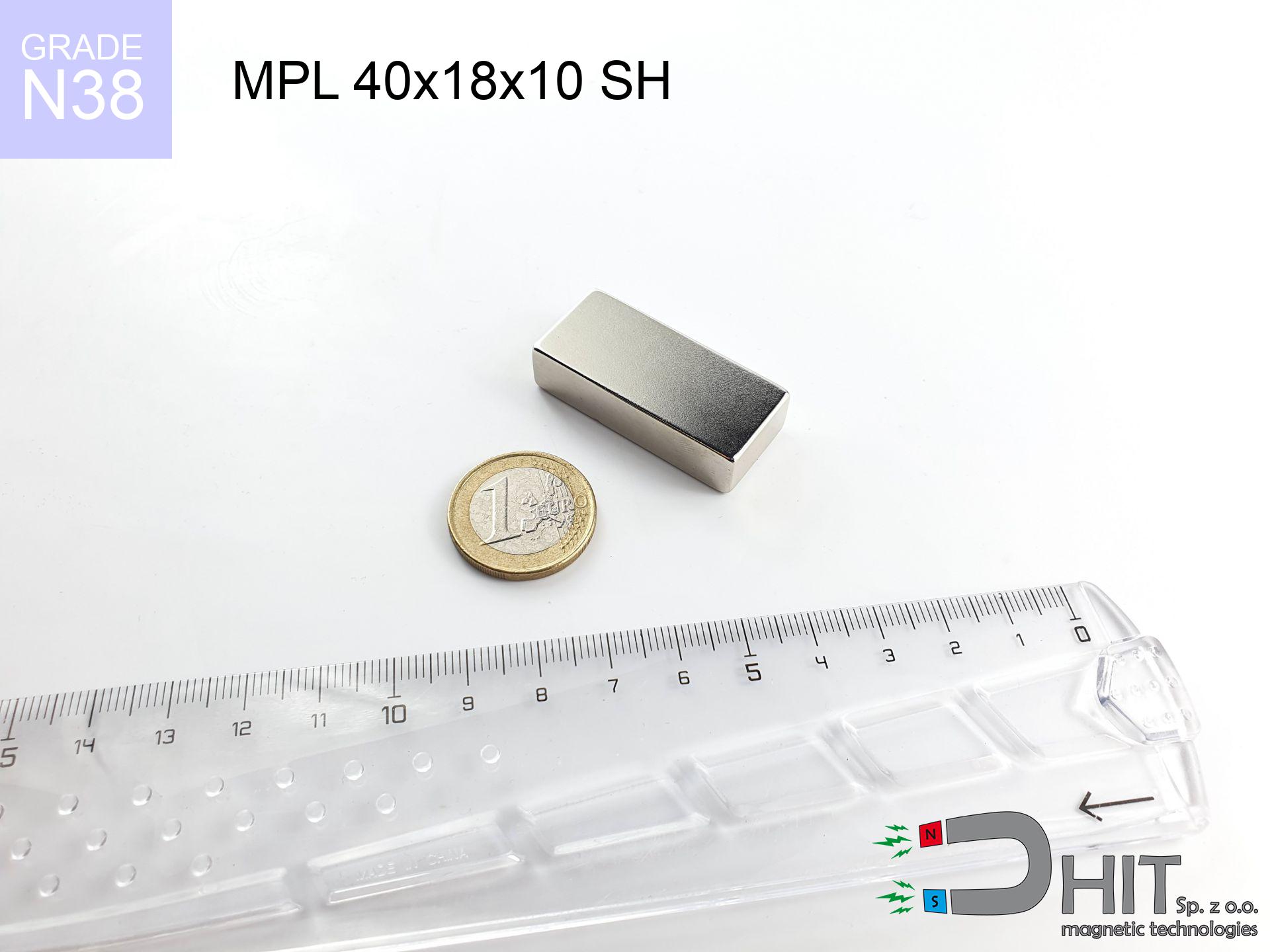
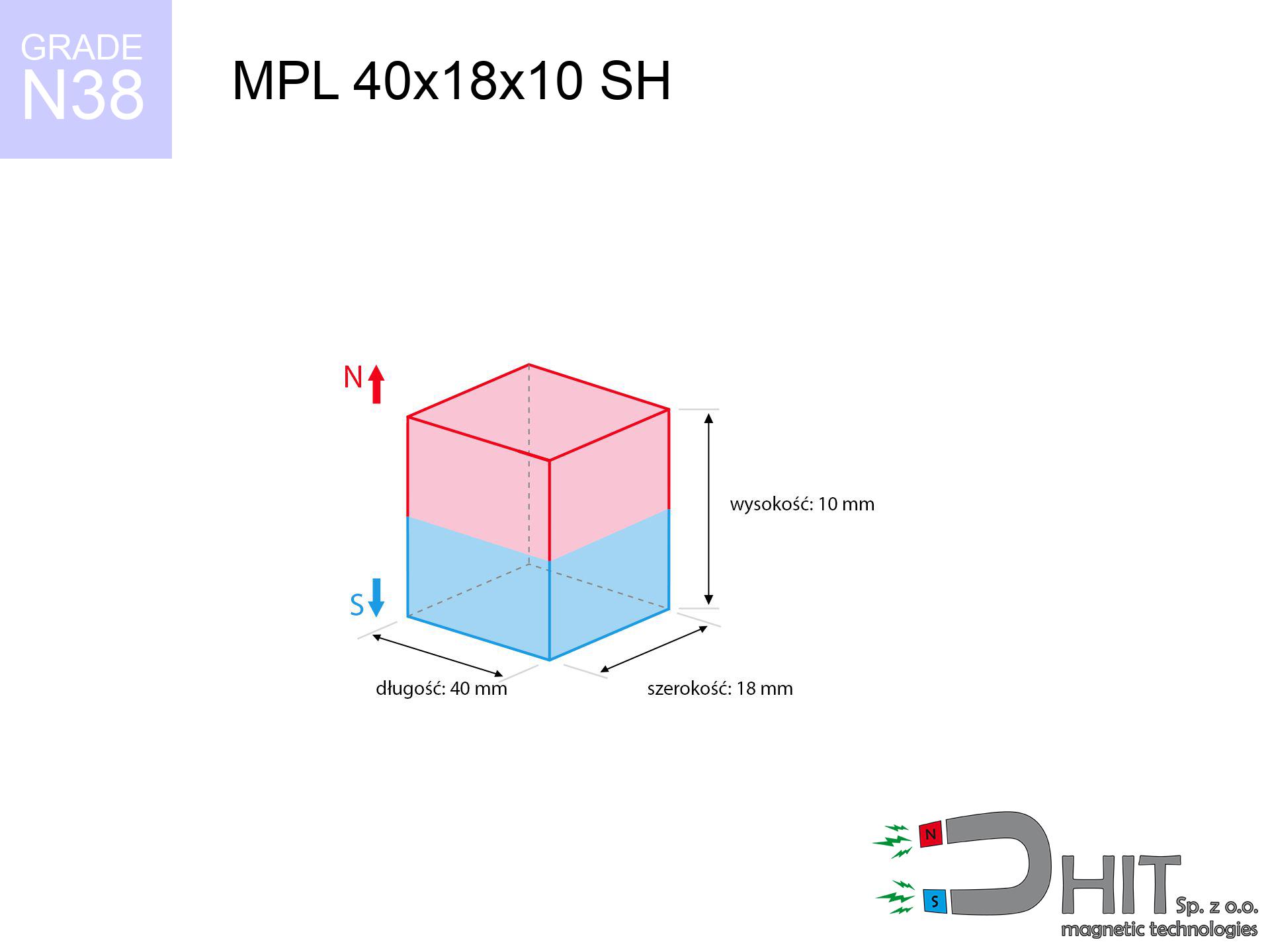
MPL 40x18x10 SH / N38 - lamellar magnet
lamellar magnet
Catalog no 020157
GTIN/EAN: 5906301811633
- length
- 40 mm [±0,1 mm]
- Width
- 18 mm [±0,1 mm]
- Height
- 10 mm [±0,1 mm]
- Weight
- 54 g
- Magnetization Direction
- ↑ axial
- Coating
- [NiCuNi] Nickel
How we measure these parameters — certificates and measurements
29.50 zł net / pcs
36.29 zł with VAT (23% VAT) / pcs
bulk discounts:
Need more?Frequently asked questions
What pull rating should I choose for a workshop block magnet?
Are block neodymium magnets available in more durable versions?
How should I choose block magnets for mounting a structure?
Engineering report for this magnet
Full PDF analysis: pull and shear force, effect of distance, temperature and plate thickness, safety distances and the demagnetization curve.
Call us now
+48 888 99 98 98
alternatively let us know using
contact form
the contact section.
Specifications and structure of a neodymium magnet can be estimated using our
power calculator.
Order by 14:00 and we’ll ship today!
Product card - MPL 40x18x10 SH / N38 - lamellar magnet
Specification / characteristics - MPL 40x18x10 SH / N38 - lamellar magnet
| properties | values |
|---|---|
| Cat. no. | 020157 |
| GTIN/EAN | 5906301811633 |
| Production/Distribution | Dhit sp. z o.o. |
| Country of origin | Poland / China / Germany |
| Customs code | 85059029 |
| length | 40 mm [±0,1 mm] |
| Width | 18 mm [±0,1 mm] |
| Height | 10 mm [±0,1 mm] |
| Weight | 54 g |
| Magnetization Direction | ↑ axial |
| Load capacity ~ ? | 23.81 kg / 233.58 N |
| Magnetic Induction ~ ? | 366.66 mT / 3667 Gs |
| Coating | [NiCuNi] Nickel |
| Manufacturing Tolerance | ±0.1 mm |
Magnetic properties of material N38
| properties | values | units |
|---|---|---|
| Remanence Br ? | 12.2-12.6 | kGs |
| Remanence Br ? | 1220-1260 | mT |
| Coercivity bHc ? | 10.8-11.5 | kOe |
| Coercivity bHc ? | 860-915 | kA/m |
| Intrinsic coercivity iHc | ≥ 12 | kOe |
| Intrinsic coercivity iHc | ≥ 955 | kA/m |
| Energy product BHmax ? | 36-38 | BH max MGOe |
| Energy product BHmax ? | 287-303 | BH max KJ/m |
| Maximum working temperature ? | ≤ 80 | °C |
Physical properties of sintered neodymium magnets Nd2Fe14B at 20°C
| properties | values | units |
|---|---|---|
| Vickers hardness | ≥550 | Hv |
| Density | ≥7.4 | g/cm3 |
| Curie Temperature TC | 310 | °C |
| Curie Temperature TF | 590 | °F |
| Specific resistance | 150 | μΩ⋅cm |
| Bending strength | 250 | MPa |
| Compressive strength | 1000~1100 | MPa |
| Thermal expansion parallel (∥) to orientation (M) | (3-4) x 10-6 | °C-1 |
| Thermal expansion perpendicular (⊥) to orientation (M) | -(1-3) x 10-6 | °C-1 |
| Young's modulus | 1.7 x 10⁴ | kg/mm² |
Technical analysis of the magnet - report
Presented data represent the direct effect of a mathematical analysis. Results were calculated on algorithms for the material Nd2Fe14B. Actual parameters may differ from theoretical values. Use these calculations as a supplementary guide for designers.
Table 1: Static force (pull vs gap) - characteristics
MPL 40x18x10 SH / N38
| Distance (mm) | Induction (Gauss) / mT | Pull Force (kg/lbs/g/N) | Risk Status |
|---|---|---|---|
| 0 mm |
3666 Gs
366.6 mT
|
23.81 kg / 52.49 pounds
23810.0 g / 233.6 N
|
dangerous! |
| 1 mm |
3399 Gs
339.9 mT
|
20.48 kg / 45.14 pounds
20476.1 g / 200.9 N
|
dangerous! |
| 2 mm |
3120 Gs
312.0 mT
|
17.25 kg / 38.02 pounds
17245.9 g / 169.2 N
|
dangerous! |
| 3 mm |
2841 Gs
284.1 mT
|
14.30 kg / 31.54 pounds
14304.1 g / 140.3 N
|
dangerous! |
| 5 mm |
2321 Gs
232.1 mT
|
9.55 kg / 21.05 pounds
9547.8 g / 93.7 N
|
strong |
| 10 mm |
1370 Gs
137.0 mT
|
3.32 kg / 7.33 pounds
3324.4 g / 32.6 N
|
strong |
| 15 mm |
833 Gs
83.3 mT
|
1.23 kg / 2.71 pounds
1229.0 g / 12.1 N
|
weak grip |
| 20 mm |
530 Gs
53.0 mT
|
0.50 kg / 1.10 pounds
498.1 g / 4.9 N
|
weak grip |
| 30 mm |
244 Gs
24.4 mT
|
0.11 kg / 0.23 pounds
105.3 g / 1.0 N
|
weak grip |
| 50 mm |
75 Gs
7.5 mT
|
0.01 kg / 0.02 pounds
9.9 g / 0.1 N
|
weak grip |
Table 2: Vertical hold (vertical surface)
MPL 40x18x10 SH / N38
| Distance (mm) | Friction coefficient | Pull Force (kg/lbs/g/N) |
|---|---|---|
| 0 mm | Stal (~0.2) |
4.76 kg / 10.50 pounds
4762.0 g / 46.7 N
|
| 1 mm | Stal (~0.2) |
4.10 kg / 9.03 pounds
4096.0 g / 40.2 N
|
| 2 mm | Stal (~0.2) |
3.45 kg / 7.61 pounds
3450.0 g / 33.8 N
|
| 3 mm | Stal (~0.2) |
2.86 kg / 6.31 pounds
2860.0 g / 28.1 N
|
| 5 mm | Stal (~0.2) |
1.91 kg / 4.21 pounds
1910.0 g / 18.7 N
|
| 10 mm | Stal (~0.2) |
0.66 kg / 1.46 pounds
664.0 g / 6.5 N
|
| 15 mm | Stal (~0.2) |
0.25 kg / 0.54 pounds
246.0 g / 2.4 N
|
| 20 mm | Stal (~0.2) |
0.10 kg / 0.22 pounds
100.0 g / 1.0 N
|
| 30 mm | Stal (~0.2) |
0.02 kg / 0.05 pounds
22.0 g / 0.2 N
|
| 50 mm | Stal (~0.2) |
0.00 kg / 0.00 pounds
2.0 g / 0.0 N
|
Table 3: Vertical assembly (sliding) - vertical pull
MPL 40x18x10 SH / N38
| Surface type | Friction coefficient / % Mocy | Max load (kg/lbs/g/N) |
|---|---|---|
| Raw steel |
µ = 0.3
30% Nominalnej Siły
|
7.14 kg / 15.75 pounds
7143.0 g / 70.1 N
|
| Painted steel (standard) |
µ = 0.2
20% Nominalnej Siły
|
4.76 kg / 10.50 pounds
4762.0 g / 46.7 N
|
| Oily/slippery steel |
µ = 0.1
10% Nominalnej Siły
|
2.38 kg / 5.25 pounds
2381.0 g / 23.4 N
|
| Magnet with anti-slip rubber |
µ = 0.5
50% Nominalnej Siły
|
11.91 kg / 26.25 pounds
11905.0 g / 116.8 N
|
Table 4: Material efficiency (substrate influence) - sheet metal selection
MPL 40x18x10 SH / N38
| Steel thickness (mm) | % power | Real pull force (kg/lbs/g/N) |
|---|---|---|
| 0.5 mm |
|
1.19 kg / 2.62 pounds
1190.5 g / 11.7 N
|
| 1 mm |
|
2.98 kg / 6.56 pounds
2976.3 g / 29.2 N
|
| 2 mm |
|
5.95 kg / 13.12 pounds
5952.5 g / 58.4 N
|
| 3 mm |
|
8.93 kg / 19.68 pounds
8928.7 g / 87.6 N
|
| 5 mm |
|
14.88 kg / 32.81 pounds
14881.3 g / 146.0 N
|
| 10 mm |
|
23.81 kg / 52.49 pounds
23810.0 g / 233.6 N
|
| 11 mm |
|
23.81 kg / 52.49 pounds
23810.0 g / 233.6 N
|
| 12 mm |
|
23.81 kg / 52.49 pounds
23810.0 g / 233.6 N
|
Table 5: Thermal stability (material behavior) - power drop
MPL 40x18x10 SH / N38
| Ambient temp. (°C) | Power loss | Remaining pull (kg/lbs/g/N) | Status |
|---|---|---|---|
| 20 °C | 0.0% |
23.81 kg / 52.49 pounds
23810.0 g / 233.6 N
|
OK |
| 40 °C | -2.2% |
23.29 kg / 51.34 pounds
23286.2 g / 228.4 N
|
OK |
| 60 °C | -4.4% |
22.76 kg / 50.18 pounds
22762.4 g / 223.3 N
|
|
| 80 °C | -6.6% |
22.24 kg / 49.03 pounds
22238.5 g / 218.2 N
|
|
| 100 °C | -28.8% |
16.95 kg / 37.37 pounds
16952.7 g / 166.3 N
|
Table 6: Two magnets (repulsion) - field collision
MPL 40x18x10 SH / N38
| Gap (mm) | Attraction (kg/lbs) (N-S) | Sliding Force (kg/lbs/g/N) | Repulsion (kg/lbs) (N-N) |
|---|---|---|---|
| 0 mm |
59.64 kg / 131.49 pounds
5 034 Gs
|
8.95 kg / 19.72 pounds
8947 g / 87.8 N
|
N/A |
| 1 mm |
55.50 kg / 122.35 pounds
7 072 Gs
|
8.32 kg / 18.35 pounds
8325 g / 81.7 N
|
49.95 kg / 110.12 pounds
~0 Gs
|
| 2 mm |
51.29 kg / 113.08 pounds
6 799 Gs
|
7.69 kg / 16.96 pounds
7694 g / 75.5 N
|
46.16 kg / 101.77 pounds
~0 Gs
|
| 3 mm |
47.18 kg / 104.01 pounds
6 520 Gs
|
7.08 kg / 15.60 pounds
7076 g / 69.4 N
|
42.46 kg / 93.61 pounds
~0 Gs
|
| 5 mm |
39.41 kg / 86.88 pounds
5 959 Gs
|
5.91 kg / 13.03 pounds
5912 g / 58.0 N
|
35.47 kg / 78.20 pounds
~0 Gs
|
| 10 mm |
23.92 kg / 52.73 pounds
4 643 Gs
|
3.59 kg / 7.91 pounds
3588 g / 35.2 N
|
21.53 kg / 47.46 pounds
~0 Gs
|
| 20 mm |
8.33 kg / 18.36 pounds
2 739 Gs
|
1.25 kg / 2.75 pounds
1249 g / 12.3 N
|
7.49 kg / 16.52 pounds
~0 Gs
|
| 50 mm |
0.55 kg / 1.22 pounds
705 Gs
|
0.08 kg / 0.18 pounds
83 g / 0.8 N
|
0.50 kg / 1.09 pounds
~0 Gs
|
| 60 mm |
0.26 kg / 0.58 pounds
487 Gs
|
0.04 kg / 0.09 pounds
40 g / 0.4 N
|
0.24 kg / 0.52 pounds
~0 Gs
|
| 70 mm |
0.13 kg / 0.30 pounds
348 Gs
|
0.02 kg / 0.04 pounds
20 g / 0.2 N
|
0.12 kg / 0.27 pounds
~0 Gs
|
| 80 mm |
0.07 kg / 0.16 pounds
256 Gs
|
0.01 kg / 0.02 pounds
11 g / 0.1 N
|
0.07 kg / 0.14 pounds
~0 Gs
|
| 90 mm |
0.04 kg / 0.09 pounds
194 Gs
|
0.01 kg / 0.01 pounds
6 g / 0.1 N
|
0.04 kg / 0.08 pounds
~0 Gs
|
| 100 mm |
0.02 kg / 0.05 pounds
149 Gs
|
0.00 kg / 0.01 pounds
4 g / 0.0 N
|
0.02 kg / 0.05 pounds
~0 Gs
|
Table 7: Safety (HSE) (electronics) - warnings
MPL 40x18x10 SH / N38
| Object / Device | Limit (Gauss) / mT | Safe distance |
|---|---|---|
| Pacemaker | 5 Gs (0.5 mT) | 14.0 cm |
| Hearing aid | 10 Gs (1.0 mT) | 11.0 cm |
| Mechanical watch | 20 Gs (2.0 mT) | 8.5 cm |
| Mobile device | 40 Gs (4.0 mT) | 6.5 cm |
| Car key | 50 Gs (5.0 mT) | 6.0 cm |
| Payment card | 400 Gs (40.0 mT) | 2.5 cm |
| HDD hard drive | 600 Gs (60.0 mT) | 2.0 cm |
Table 8: Collisions (cracking risk) - collision effects
MPL 40x18x10 SH / N38
| Start from (mm) | Speed (km/h) | Energy (J) | Predicted outcome |
|---|---|---|---|
| 10 mm |
22.75 km/h
(6.32 m/s)
|
1.08 J | |
| 30 mm |
24.44 km/h
(6.79 m/s)
|
1.24 J | |
| 50 mm |
24.51 km/h
(6.81 m/s)
|
1.25 J | |
| 100 mm |
24.52 km/h
(6.81 m/s)
|
1.25 J |
Table 9: Anti-corrosion coating durability
MPL 40x18x10 SH / N38
| Technical parameter | Value / Description |
|---|---|
| Coating type | [NiCuNi] Nickel |
| Layer structure | Nickel - Copper - Nickel |
| Layer thickness | 10-20 µm |
| Salt spray test (SST) ? | 24 h |
| Recommended environment | Indoors only (dry) |
Table 10: Construction data (Pc)
MPL 40x18x10 SH / N38
| Parameter | Value | SI Unit / Description |
|---|---|---|
| Magnetic Flux | 26 060 Mx | 260.6 µWb |
| Pc Coefficient | 0.43 | Low (Flat) |
Table 11: Physics of underwater searching
MPL 40x18x10 SH / N38
| Environment | Effective steel pull | Effect |
|---|---|---|
| Air (land) | 23.81 kg | Standard |
| Water (riverbed) |
27.26 kg
(+3.45 kg buoyancy gain)
|
+14.5% |
1. Sliding resistance
*Caution: On a vertical wall, the magnet retains only approx. 20-30% of its nominal pull.
2. Steel thickness impact
*Thin steel (e.g. 0.5mm PC case) severely limits the holding force.
3. Temperature resistance
N38: the maximum material working temperature is 80°C. Permitted conditions also depend on the shape and magnetic circuit.
4. Demagnetization curve and operating point (B-H)
chart generated for the permeance coefficient Pc (Permeance Coefficient) = 0.43
The chart above illustrates the magnetic characteristics of the material within the second quadrant of the hysteresis loop. The solid red line represents the demagnetization curve (material potential), while the dashed blue line is the load line based on the magnet's geometry. The Pc (Permeance Coefficient), also known as the load line slope, is a dimensionless value that describes the relationship between the magnet's shape and its magnetic stability. The intersection of these two lines (the black dot) is the operating point — it determines the actual magnetic flux density generated by the magnet in this specific configuration. A higher Pc value means the magnet is more 'slender' (tall relative to its area), resulting in a higher operating point and better resistance to irreversible demagnetization caused by external fields or temperature. A value of 0.42 is relatively low (typical for flat magnets), meaning the operating point is closer to the 'knee' of the curve — caution is advised when operating at temperatures near the maximum limit to avoid strength loss.
Material specification
| iron (Fe) | 64% – 68% |
| neodymium (Nd) | 29% – 32% |
| boron (B) | 1.1% – 1.2% |
| dysprosium (Dy) | 0.5% – 2.0% |
| coating (Ni-Cu-Ni) | < 0.05% |
Ecology and recycling (GPSR)
| recyclability (EoL) | 100% |
| recycled raw materials | ~10% (pre-cons) |
| carbon footprint | low / zredukowany |
| waste code (EWC) | 16 02 16 |
Other deals
![UMGGZ 88x8.5 [M8] GZ / N38 - rubber magnetic holder external thread](https://cdn3.dhit.pl/graphics/products/umg-88x8.5-m8-gz-waf.jpg "UMGGZ 88x8.5 [M8] GZ / N38 - rubber magnetic holder external thread")
![SM 25x150 [2xM8] / N42 - magnetic separator](https://cdn3.dhit.pl/graphics/products/sm-25x150-2xm8-cim.jpg "SM 25x150 [2xM8] / N42 - magnetic separator")
Pros and cons of Nd2Fe14B magnets.
Strengths
- Their strength remains stable, and after around 10 years it decreases only by ~1% (according to research),
- They possess excellent resistance to magnetic field loss due to external magnetic sources,
- In other words, due to the aesthetic layer of silver, the element is aesthetically pleasing,
- They show high magnetic induction at the operating surface, which improves attraction properties,
- Neodymium magnets are characterized by very high magnetic induction on the magnet surface and can work (depending on the form) even at a temperature of 230°C or more...
- Considering the option of free molding and customization to specialized projects, magnetic components can be modeled in a wide range of geometric configurations, which expands the range of possible applications,
- Versatile presence in modern technologies – they find application in data components, drive modules, medical equipment, also industrial machines.
- Thanks to efficiency per cm³, small magnets offer high operating force, with minimal size,
Cons
- Susceptibility to cracking is one of their disadvantages. Upon intense impact they can fracture. We recommend keeping them in a steel housing, which not only protects them against impacts but also increases their durability
- Do not exceed this material temperature limit: 80°C. Overheating may permanently weaken the magnet.
- When exposed to humidity, magnets usually rust. For applications outside, it is recommended to use protective magnets, such as magnets in rubber or plastics, which secure oxidation as well as corrosion.
- We suggest cover - magnetic mount, due to difficulties in producing threads inside the magnet and complex shapes.
- Possible danger to health – tiny shards of magnets are risky, in case of ingestion, which gains importance in the aspect of protecting the youngest. Additionally, tiny parts of these products are able to complicate diagnosis medical after entering the body.
- Higher cost of purchase is a significant factor to consider compared to ceramic magnets, especially in budget applications
Pull force analysis
Optimal lifting capacity of a neodymium magnet – what it depends on?
- with the application of a yoke made of special test steel, guaranteeing full magnetic saturation
- possessing a massiveness of minimum 10 mm to avoid saturation
- characterized by lack of roughness
- under conditions of gap-free contact (metal-to-metal)
- for force applied at a right angle (pull-off, not shear)
- at conditions approx. 20°C
Magnet lifting force in use – key factors
- Distance – existence of any layer (rust, tape, air) interrupts the magnetic circuit, which reduces capacity rapidly (even by 50% at 0.5 mm).
- Angle of force application – maximum parameter is obtained only during pulling at a 90° angle. The resistance to sliding of the magnet along the plate is typically several times smaller (approx. 1/5 of the lifting capacity).
- Wall thickness – the thinner the sheet, the weaker the hold. Part of the magnetic field passes through the material instead of generating force.
- Chemical composition of the base – mild steel attracts best. Alloy steels lower magnetic properties and holding force.
- Surface quality – the smoother and more polished the plate, the better the adhesion and stronger the hold. Roughness creates an air distance.
- Operating temperature – NdFeB sinters have a negative temperature coefficient. When it is hot they are weaker, and at low temperatures gain strength (up to a certain limit).
Lifting capacity was assessed with the use of a polished steel plate of suitable thickness (min. 20 mm), under perpendicular pulling force, whereas under attempts to slide the magnet the holding force is lower. Additionally, even a slight gap between the magnet and the plate lowers the lifting capacity.
Safety rules for work with NdFeB magnets
Physical harm
Large magnets can smash fingers in a fraction of a second. Do not place your hand betwixt two attracting surfaces.
Mechanical processing
Fire warning: Rare earth powder is highly flammable. Avoid machining magnets in home conditions as this risks ignition.
Skin irritation risks
It is widely known that the nickel plating (standard magnet coating) is a common allergen. If you have an allergy, refrain from direct skin contact and opt for versions in plastic housing.
Electronic hazard
Intense magnetic fields can erase data on payment cards, hard drives, and storage devices. Keep a distance of min. 10 cm.
Powerful field
Handle magnets consciously. Their powerful strength can surprise even professionals. Be vigilant and respect their power.
Impact on smartphones
Remember: neodymium magnets generate a field that confuses precision electronics. Keep a safe distance from your phone, device, and GPS.
Material brittleness
Despite metallic appearance, the material is brittle and not impact-resistant. Do not hit, as the magnet may shatter into sharp, dangerous pieces.
Demagnetization risk
Control the heat. Heating the magnet above 80 degrees Celsius will permanently weaken its properties and pulling force.
Choking Hazard
Always keep magnets away from children. Ingestion danger is high, and the consequences of magnets clamping inside the body are tragic.
Implant safety
For implant holders: Powerful magnets disrupt electronics. Keep at least 30 cm distance or ask another person to work with the magnets.
Tabela kosztu i czasu dostawy
Płatność przed wysyłką:

GLS kurier
Przesyłka będzie u Ciebie za 2-3 dni
14.99 ZŁ

InPost Paczkomaty 24/7
Przesyłka będzie u Ciebie za 1-2 dni
12.30 ZŁ
Płatność przy odbiorze (pobranie):
GLS kurier
Przesyłka będzie u Ciebie za 1-2 dni
23.00 ZŁ