

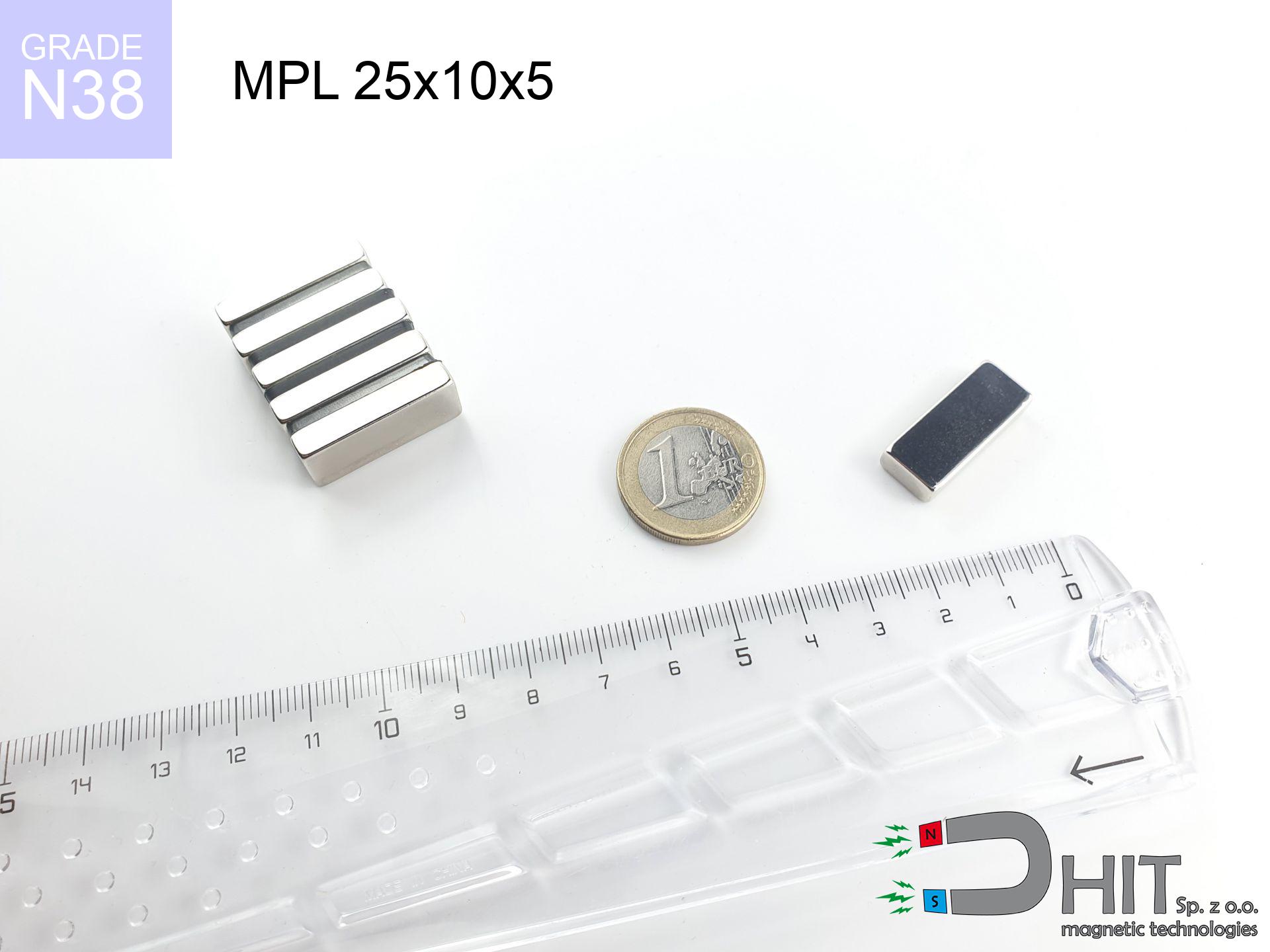
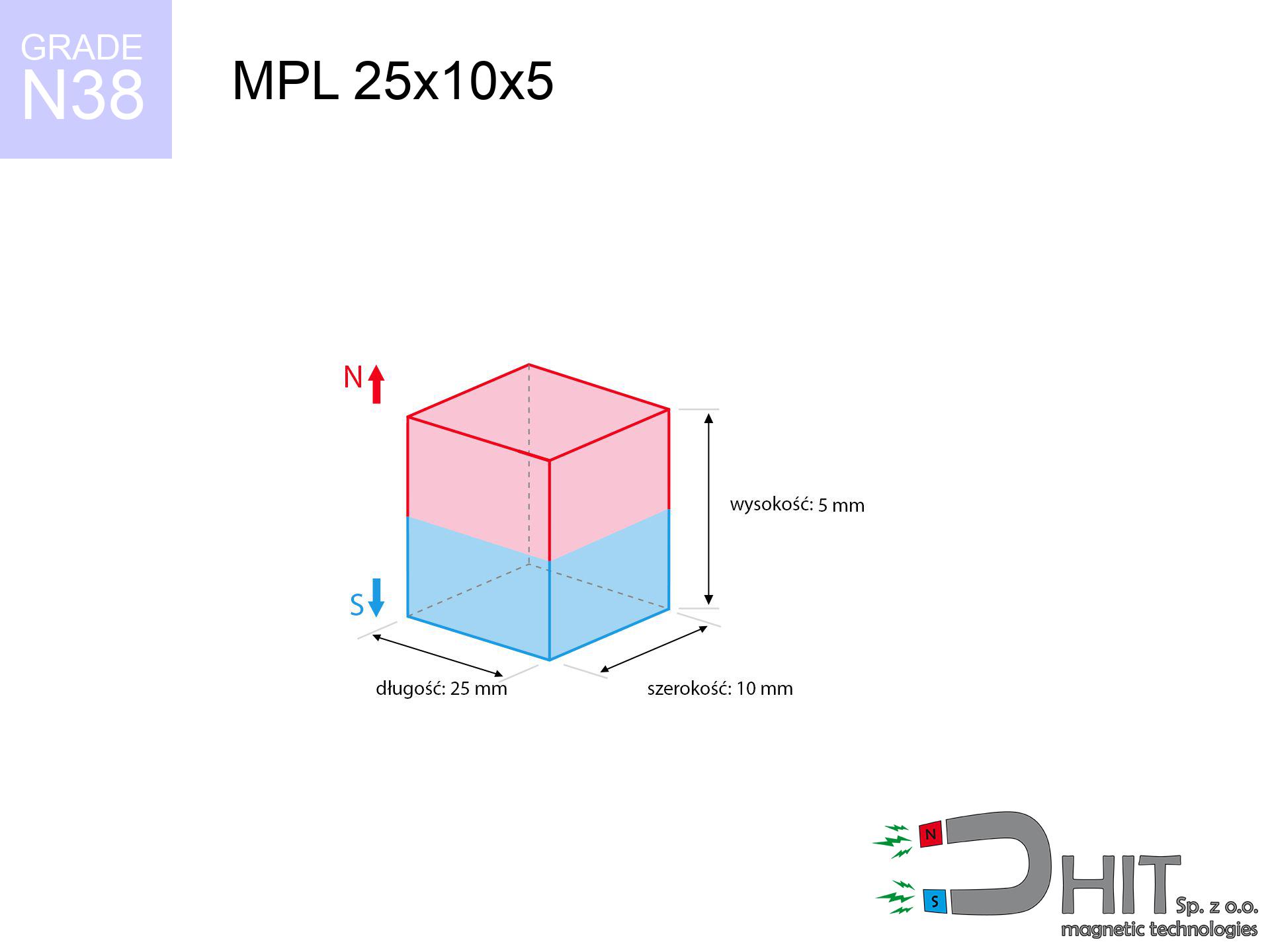
MPL 25x10x5 / N38 - lamellar magnet
lamellar magnet
Catalog no 020135
GTIN/EAN: 5906301811411
- length
- 25 mm [±0,1 mm]
- Width
- 10 mm [±0,1 mm]
- Height
- 5 mm [±0,1 mm]
- Weight
- 9.38 g
- Magnetization Direction
- ↑ axial
- Coating
- [NiCuNi] Nickel
How we measure these parameters — certificates and measurements
3.79 zł net / pcs
4.66 zł with VAT (23% VAT) / pcs
bulk discounts:
Need more?Frequently asked questions
What pull rating should I choose for a workshop block magnet?
Are block neodymium magnets available in more durable versions?
How should I choose block magnets for mounting a structure?
Engineering report for this magnet
Full PDF analysis: pull and shear force, effect of distance, temperature and plate thickness, safety distances and the demagnetization curve.
Call us now
+48 888 99 98 98
alternatively let us know using
contact form
the contact section.
Specifications and structure of a neodymium magnet can be estimated using our
power calculator.
Order by 14:00 and we’ll ship today!
Physical properties - MPL 25x10x5 / N38 - lamellar magnet
Specification / characteristics - MPL 25x10x5 / N38 - lamellar magnet
| properties | values |
|---|---|
| Cat. no. | 020135 |
| GTIN/EAN | 5906301811411 |
| Production/Distribution | Dhit sp. z o.o. |
| Country of origin | Poland / China / Germany |
| Customs code | 85059029 |
| length | 25 mm [±0,1 mm] |
| Width | 10 mm [±0,1 mm] |
| Height | 5 mm [±0,1 mm] |
| Weight | 9.38 g |
| Magnetization Direction | ↑ axial |
| Load capacity ~ ? | 7.49 kg / 73.45 N |
| Magnetic Induction ~ ? | 337.05 mT / 3371 Gs |
| Coating | [NiCuNi] Nickel |
| Manufacturing Tolerance | ±0.1 mm |
Magnetic properties of material N38
| properties | values | units |
|---|---|---|
| Remanence Br ? | 12.2-12.6 | kGs |
| Remanence Br ? | 1220-1260 | mT |
| Coercivity bHc ? | 10.8-11.5 | kOe |
| Coercivity bHc ? | 860-915 | kA/m |
| Intrinsic coercivity iHc | ≥ 12 | kOe |
| Intrinsic coercivity iHc | ≥ 955 | kA/m |
| Energy product BHmax ? | 36-38 | BH max MGOe |
| Energy product BHmax ? | 287-303 | BH max KJ/m |
| Maximum working temperature ? | ≤ 80 | °C |
Physical properties of sintered neodymium magnets Nd2Fe14B at 20°C
| properties | values | units |
|---|---|---|
| Vickers hardness | ≥550 | Hv |
| Density | ≥7.4 | g/cm3 |
| Curie Temperature TC | 310 | °C |
| Curie Temperature TF | 590 | °F |
| Specific resistance | 150 | μΩ⋅cm |
| Bending strength | 250 | MPa |
| Compressive strength | 1000~1100 | MPa |
| Thermal expansion parallel (∥) to orientation (M) | (3-4) x 10-6 | °C-1 |
| Thermal expansion perpendicular (⊥) to orientation (M) | -(1-3) x 10-6 | °C-1 |
| Young's modulus | 1.7 x 10⁴ | kg/mm² |
Engineering simulation of the magnet - technical parameters
These information are the direct effect of a mathematical calculation. Values rely on algorithms for the class Nd2Fe14B. Actual conditions might slightly differ from theoretical values. Please consider these calculations as a supplementary guide for designers.
Table 1: Static force (pull vs gap) - power drop
MPL 25x10x5 / N38
| Distance (mm) | Induction (Gauss) / mT | Pull Force (kg/lbs/g/N) | Risk Status |
|---|---|---|---|
| 0 mm |
3369 Gs
336.9 mT
|
7.49 kg / 16.51 pounds
7490.0 g / 73.5 N
|
warning |
| 1 mm |
2932 Gs
293.2 mT
|
5.67 kg / 12.51 pounds
5673.2 g / 55.7 N
|
warning |
| 2 mm |
2479 Gs
247.9 mT
|
4.06 kg / 8.94 pounds
4056.9 g / 39.8 N
|
warning |
| 3 mm |
2065 Gs
206.5 mT
|
2.81 kg / 6.21 pounds
2814.7 g / 27.6 N
|
warning |
| 5 mm |
1419 Gs
141.9 mT
|
1.33 kg / 2.93 pounds
1328.6 g / 13.0 N
|
low risk |
| 10 mm |
603 Gs
60.3 mT
|
0.24 kg / 0.53 pounds
240.3 g / 2.4 N
|
low risk |
| 15 mm |
296 Gs
29.6 mT
|
0.06 kg / 0.13 pounds
57.8 g / 0.6 N
|
low risk |
| 20 mm |
162 Gs
16.2 mT
|
0.02 kg / 0.04 pounds
17.4 g / 0.2 N
|
low risk |
| 30 mm |
62 Gs
6.2 mT
|
0.00 kg / 0.01 pounds
2.5 g / 0.0 N
|
low risk |
| 50 mm |
16 Gs
1.6 mT
|
0.00 kg / 0.00 pounds
0.2 g / 0.0 N
|
low risk |
Table 2: Vertical load (wall)
MPL 25x10x5 / N38
| Distance (mm) | Friction coefficient | Pull Force (kg/lbs/g/N) |
|---|---|---|
| 0 mm | Stal (~0.2) |
1.50 kg / 3.30 pounds
1498.0 g / 14.7 N
|
| 1 mm | Stal (~0.2) |
1.13 kg / 2.50 pounds
1134.0 g / 11.1 N
|
| 2 mm | Stal (~0.2) |
0.81 kg / 1.79 pounds
812.0 g / 8.0 N
|
| 3 mm | Stal (~0.2) |
0.56 kg / 1.24 pounds
562.0 g / 5.5 N
|
| 5 mm | Stal (~0.2) |
0.27 kg / 0.59 pounds
266.0 g / 2.6 N
|
| 10 mm | Stal (~0.2) |
0.05 kg / 0.11 pounds
48.0 g / 0.5 N
|
| 15 mm | Stal (~0.2) |
0.01 kg / 0.03 pounds
12.0 g / 0.1 N
|
| 20 mm | Stal (~0.2) |
0.00 kg / 0.01 pounds
4.0 g / 0.0 N
|
| 30 mm | Stal (~0.2) |
0.00 kg / 0.00 pounds
0.0 g / 0.0 N
|
| 50 mm | Stal (~0.2) |
0.00 kg / 0.00 pounds
0.0 g / 0.0 N
|
Table 3: Vertical assembly (shearing) - behavior on slippery surfaces
MPL 25x10x5 / N38
| Surface type | Friction coefficient / % Mocy | Max load (kg/lbs/g/N) |
|---|---|---|
| Raw steel |
µ = 0.3
30% Nominalnej Siły
|
2.25 kg / 4.95 pounds
2247.0 g / 22.0 N
|
| Painted steel (standard) |
µ = 0.2
20% Nominalnej Siły
|
1.50 kg / 3.30 pounds
1498.0 g / 14.7 N
|
| Oily/slippery steel |
µ = 0.1
10% Nominalnej Siły
|
0.75 kg / 1.65 pounds
749.0 g / 7.3 N
|
| Magnet with anti-slip rubber |
µ = 0.5
50% Nominalnej Siły
|
3.75 kg / 8.26 pounds
3745.0 g / 36.7 N
|
Table 4: Steel thickness (substrate influence) - sheet metal selection
MPL 25x10x5 / N38
| Steel thickness (mm) | % power | Real pull force (kg/lbs/g/N) |
|---|---|---|
| 0.5 mm |
|
0.75 kg / 1.65 pounds
749.0 g / 7.3 N
|
| 1 mm |
|
1.87 kg / 4.13 pounds
1872.5 g / 18.4 N
|
| 2 mm |
|
3.75 kg / 8.26 pounds
3745.0 g / 36.7 N
|
| 3 mm |
|
5.62 kg / 12.38 pounds
5617.5 g / 55.1 N
|
| 5 mm |
|
7.49 kg / 16.51 pounds
7490.0 g / 73.5 N
|
| 10 mm |
|
7.49 kg / 16.51 pounds
7490.0 g / 73.5 N
|
| 11 mm |
|
7.49 kg / 16.51 pounds
7490.0 g / 73.5 N
|
| 12 mm |
|
7.49 kg / 16.51 pounds
7490.0 g / 73.5 N
|
Table 5: Working in heat (material behavior) - power drop
MPL 25x10x5 / N38
| Ambient temp. (°C) | Power loss | Remaining pull (kg/lbs/g/N) | Status |
|---|---|---|---|
| 20 °C | 0.0% |
7.49 kg / 16.51 pounds
7490.0 g / 73.5 N
|
OK |
| 40 °C | -2.2% |
7.33 kg / 16.15 pounds
7325.2 g / 71.9 N
|
OK |
| 60 °C | -4.4% |
7.16 kg / 15.79 pounds
7160.4 g / 70.2 N
|
|
| 80 °C | -6.6% |
7.00 kg / 15.42 pounds
6995.7 g / 68.6 N
|
|
| 100 °C | -28.8% |
5.33 kg / 11.76 pounds
5332.9 g / 52.3 N
|
Table 6: Two magnets (attraction) - field range
MPL 25x10x5 / N38
| Gap (mm) | Attraction (kg/lbs) (N-S) | Sliding Force (kg/lbs/g/N) | Repulsion (kg/lbs) (N-N) |
|---|---|---|---|
| 0 mm |
17.49 kg / 38.57 pounds
4 785 Gs
|
2.62 kg / 5.78 pounds
2624 g / 25.7 N
|
N/A |
| 1 mm |
15.37 kg / 33.89 pounds
6 316 Gs
|
2.31 kg / 5.08 pounds
2306 g / 22.6 N
|
13.84 kg / 30.50 pounds
~0 Gs
|
| 2 mm |
13.25 kg / 29.21 pounds
5 864 Gs
|
1.99 kg / 4.38 pounds
1987 g / 19.5 N
|
11.92 kg / 26.29 pounds
~0 Gs
|
| 3 mm |
11.26 kg / 24.83 pounds
5 407 Gs
|
1.69 kg / 3.72 pounds
1690 g / 16.6 N
|
10.14 kg / 22.35 pounds
~0 Gs
|
| 5 mm |
7.91 kg / 17.44 pounds
4 531 Gs
|
1.19 kg / 2.62 pounds
1187 g / 11.6 N
|
7.12 kg / 15.70 pounds
~0 Gs
|
| 10 mm |
3.10 kg / 6.84 pounds
2 838 Gs
|
0.47 kg / 1.03 pounds
465 g / 4.6 N
|
2.79 kg / 6.16 pounds
~0 Gs
|
| 20 mm |
0.56 kg / 1.24 pounds
1 207 Gs
|
0.08 kg / 0.19 pounds
84 g / 0.8 N
|
0.51 kg / 1.11 pounds
~0 Gs
|
| 50 mm |
0.01 kg / 0.03 pounds
194 Gs
|
0.00 kg / 0.00 pounds
2 g / 0.0 N
|
0.01 kg / 0.03 pounds
~0 Gs
|
| 60 mm |
0.01 kg / 0.01 pounds
124 Gs
|
0.00 kg / 0.00 pounds
1 g / 0.0 N
|
0.00 kg / 0.00 pounds
~0 Gs
|
| 70 mm |
0.00 kg / 0.01 pounds
84 Gs
|
0.00 kg / 0.00 pounds
0 g / 0.0 N
|
0.00 kg / 0.00 pounds
~0 Gs
|
| 80 mm |
0.00 kg / 0.00 pounds
59 Gs
|
0.00 kg / 0.00 pounds
0 g / 0.0 N
|
0.00 kg / 0.00 pounds
~0 Gs
|
| 90 mm |
0.00 kg / 0.00 pounds
43 Gs
|
0.00 kg / 0.00 pounds
0 g / 0.0 N
|
0.00 kg / 0.00 pounds
~0 Gs
|
| 100 mm |
0.00 kg / 0.00 pounds
32 Gs
|
0.00 kg / 0.00 pounds
0 g / 0.0 N
|
0.00 kg / 0.00 pounds
~0 Gs
|
Table 7: Safety (HSE) (implants) - precautionary measures
MPL 25x10x5 / N38
| Object / Device | Limit (Gauss) / mT | Safe distance |
|---|---|---|
| Pacemaker | 5 Gs (0.5 mT) | 8.0 cm |
| Hearing aid | 10 Gs (1.0 mT) | 6.0 cm |
| Mechanical watch | 20 Gs (2.0 mT) | 5.0 cm |
| Mobile device | 40 Gs (4.0 mT) | 4.0 cm |
| Remote | 50 Gs (5.0 mT) | 3.5 cm |
| Payment card | 400 Gs (40.0 mT) | 1.5 cm |
| HDD hard drive | 600 Gs (60.0 mT) | 1.5 cm |
Table 8: Dynamics (cracking risk) - warning
MPL 25x10x5 / N38
| Start from (mm) | Speed (km/h) | Energy (J) | Predicted outcome |
|---|---|---|---|
| 10 mm |
24.37 km/h
(6.77 m/s)
|
0.21 J | |
| 30 mm |
24.85 km/h
(6.90 m/s)
|
0.22 J | |
| 50 mm |
24.85 km/h
(6.90 m/s)
|
0.22 J | |
| 100 mm |
24.86 km/h
(6.91 m/s)
|
0.22 J |
Table 9: Anti-corrosion coating durability
MPL 25x10x5 / N38
| Technical parameter | Value / Description |
|---|---|
| Coating type | [NiCuNi] Nickel |
| Layer structure | Nickel - Copper - Nickel |
| Layer thickness | 10-20 µm |
| Salt spray test (SST) ? | 24 h |
| Recommended environment | Indoors only (dry) |
Table 10: Electrical data (Flux)
MPL 25x10x5 / N38
| Parameter | Value | SI Unit / Description |
|---|---|---|
| Magnetic Flux | 8 245 Mx | 82.5 µWb |
| Pc Coefficient | 0.38 | Low (Flat) |
Table 11: Physics of underwater searching
MPL 25x10x5 / N38
| Environment | Effective steel pull | Effect |
|---|---|---|
| Air (land) | 7.49 kg | Standard |
| Water (riverbed) |
8.58 kg
(+1.09 kg buoyancy gain)
|
+14.5% |
1. Shear force
*Note: On a vertical wall, the magnet holds merely ~20% of its nominal pull.
2. Steel thickness impact
*Thin metal sheet (e.g. computer case) drastically limits the holding force.
3. Heat tolerance
N38: the maximum material working temperature is 80°C. Permitted conditions also depend on the shape and magnetic circuit.
4. Demagnetization curve and operating point (B-H)
chart generated for the permeance coefficient Pc (Permeance Coefficient) = 0.38
The chart above illustrates the magnetic characteristics of the material within the second quadrant of the hysteresis loop. The solid red line represents the demagnetization curve (material potential), while the dashed blue line is the load line based on the magnet's geometry. The Pc (Permeance Coefficient), also known as the load line slope, is a dimensionless value that describes the relationship between the magnet's shape and its magnetic stability. The intersection of these two lines (the black dot) is the operating point — it determines the actual magnetic flux density generated by the magnet in this specific configuration. A higher Pc value means the magnet is more 'slender' (tall relative to its area), resulting in a higher operating point and better resistance to irreversible demagnetization caused by external fields or temperature. A value of 0.42 is relatively low (typical for flat magnets), meaning the operating point is closer to the 'knee' of the curve — caution is advised when operating at temperatures near the maximum limit to avoid strength loss.
Chemical composition
| iron (Fe) | 64% – 68% |
| neodymium (Nd) | 29% – 32% |
| boron (B) | 1.1% – 1.2% |
| dysprosium (Dy) | 0.5% – 2.0% |
| coating (Ni-Cu-Ni) | < 0.05% |
Environmental data
| recyclability (EoL) | 100% |
| recycled raw materials | ~10% (pre-cons) |
| carbon footprint | low / zredukowany |
| waste code (EWC) | 16 02 16 |
See more proposals

![AM szekla [M10] - magnetic accessories](https://cdn3.dhit.pl/graphics/products/am-szekla-m10-zeh.jpg "AM szekla [M10] - magnetic accessories")
![UMGGW 22x6 [M4] GW / N38 - magnetic holder rubber internal thread](https://cdn3.dhit.pl/graphics/products/umg-22x6-m4-gw-jek.jpg "UMGGW 22x6 [M4] GW / N38 - magnetic holder rubber internal thread")
Pros and cons of neodymium magnets.
Pros
- They have constant strength, and over more than 10 years their attraction force decreases symbolically – ~1% (in testing),
- They possess excellent resistance to weakening of magnetic properties as a result of opposing magnetic fields,
- A magnet with a smooth gold surface looks better,
- Magnets are distinguished by exceptionally strong magnetic induction on the active area,
- Made from properly selected components, these magnets show impressive resistance to high heat, enabling them to function (depending on their shape) at temperatures up to 230°C and above...
- Possibility of individual machining and optimizing to specific applications,
- Fundamental importance in electronics industry – they are utilized in computer drives, drive modules, medical equipment, and modern systems.
- Thanks to efficiency per cm³, small magnets offer high operating force, occupying minimum space,
Cons
- They are prone to damage upon too strong impacts. To avoid cracks, it is worth protecting magnets in special housings. Such protection not only shields the magnet but also increases its resistance to damage
- Do not exceed this material temperature limit: 80°C. Overheating may permanently weaken the magnet.
- Magnets exposed to a humid environment can corrode. Therefore when using outdoors, we suggest using water-impermeable magnets made of rubber, plastic or other material protecting against moisture
- We suggest a housing - magnetic mechanism, due to difficulties in producing threads inside the magnet and complicated shapes.
- Potential hazard to health – tiny shards of magnets are risky, if swallowed, which becomes key in the context of child health protection. Furthermore, small elements of these devices are able to complicate diagnosis medical when they are in the body.
- With budget limitations the cost of neodymium magnets can be a barrier,
Lifting parameters
Highest magnetic holding force – what contributes to it?
- on a base made of structural steel, optimally conducting the magnetic field
- with a thickness no less than 10 mm
- characterized by smoothness
- with zero gap (no impurities)
- during detachment in a direction vertical to the plane
- at temperature approx. 20 degrees Celsius
Magnet lifting force in use – key factors
- Space between magnet and steel – every millimeter of distance (caused e.g. by varnish or dirt) diminishes the magnet efficiency, often by half at just 0.5 mm.
- Direction of force – highest force is available only during perpendicular pulling. The force required to slide of the magnet along the surface is standardly many times lower (approx. 1/5 of the lifting capacity).
- Element thickness – to utilize 100% power, the steel must be adequately massive. Paper-thin metal restricts the attraction force (the magnet "punches through" it).
- Metal type – different alloys reacts the same. High carbon content weaken the attraction effect.
- Surface condition – ground elements ensure maximum contact, which improves field saturation. Uneven metal reduce efficiency.
- Temperature influence – high temperature weakens pulling force. Exceeding the limit temperature can permanently demagnetize the magnet.
Holding force was checked on a smooth steel plate of 20 mm thickness, when a perpendicular force was applied, whereas under parallel forces the lifting capacity is smaller. Moreover, even a minimal clearance between the magnet’s surface and the plate reduces the holding force.
H&S for magnets
Keep away from electronics
An intense magnetic field interferes with the functioning of magnetometers in phones and navigation systems. Maintain magnets close to a device to avoid breaking the sensors.
Do not underestimate power
Be careful. Rare earth magnets act from a distance and snap with huge force, often quicker than you can react.
Do not drill into magnets
Fire hazard: Rare earth powder is explosive. Avoid machining magnets without safety gear as this may cause fire.
Heat warning
Watch the temperature. Exposing the magnet above 80 degrees Celsius will destroy its properties and strength.
Skin irritation risks
Allergy Notice: The Ni-Cu-Ni coating contains nickel. If an allergic reaction happens, cease handling magnets and wear gloves.
Keep away from computers
Device Safety: Neodymium magnets can damage data carriers and sensitive devices (heart implants, hearing aids, mechanical watches).
Bodily injuries
Large magnets can break fingers instantly. Do not place your hand betwixt two attracting surfaces.
Magnets are brittle
Despite the nickel coating, neodymium is delicate and cannot withstand shocks. Avoid impacts, as the magnet may crumble into sharp, dangerous pieces.
Swallowing risk
Strictly store magnets away from children. Ingestion danger is high, and the consequences of magnets clamping inside the body are fatal.
Life threat
Medical warning: Neodymium magnets can turn off pacemakers and defibrillators. Stay away if you have medical devices.
Tabela kosztu i czasu dostawy
Płatność przed wysyłką:

GLS kurier
Przesyłka będzie u Ciebie za 2-3 dni
14.99 ZŁ

InPost Paczkomaty 24/7
Przesyłka będzie u Ciebie za 1-2 dni
12.30 ZŁ
Płatność przy odbiorze (pobranie):
GLS kurier
Przesyłka będzie u Ciebie za 1-2 dni
23.00 ZŁ