

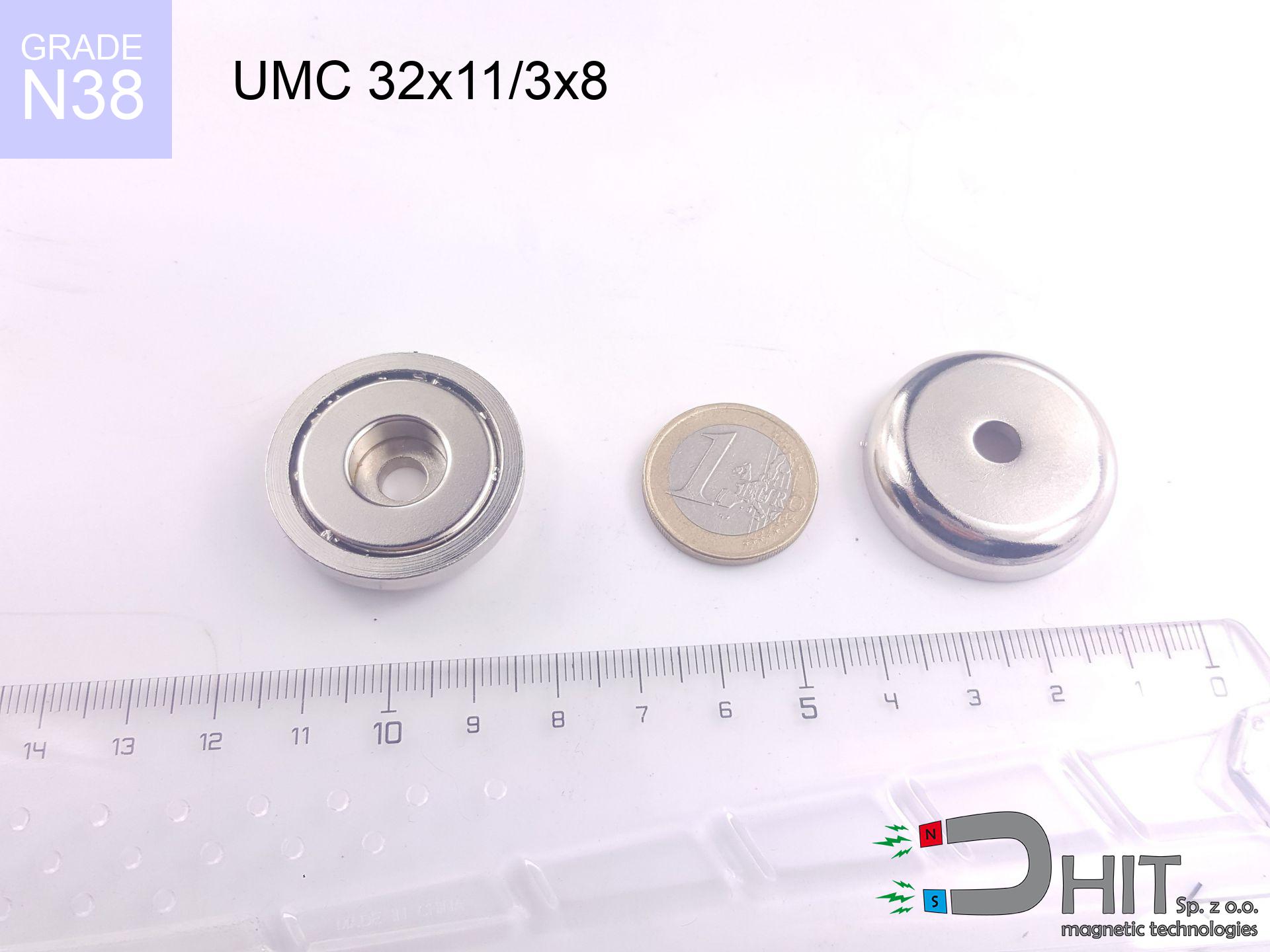
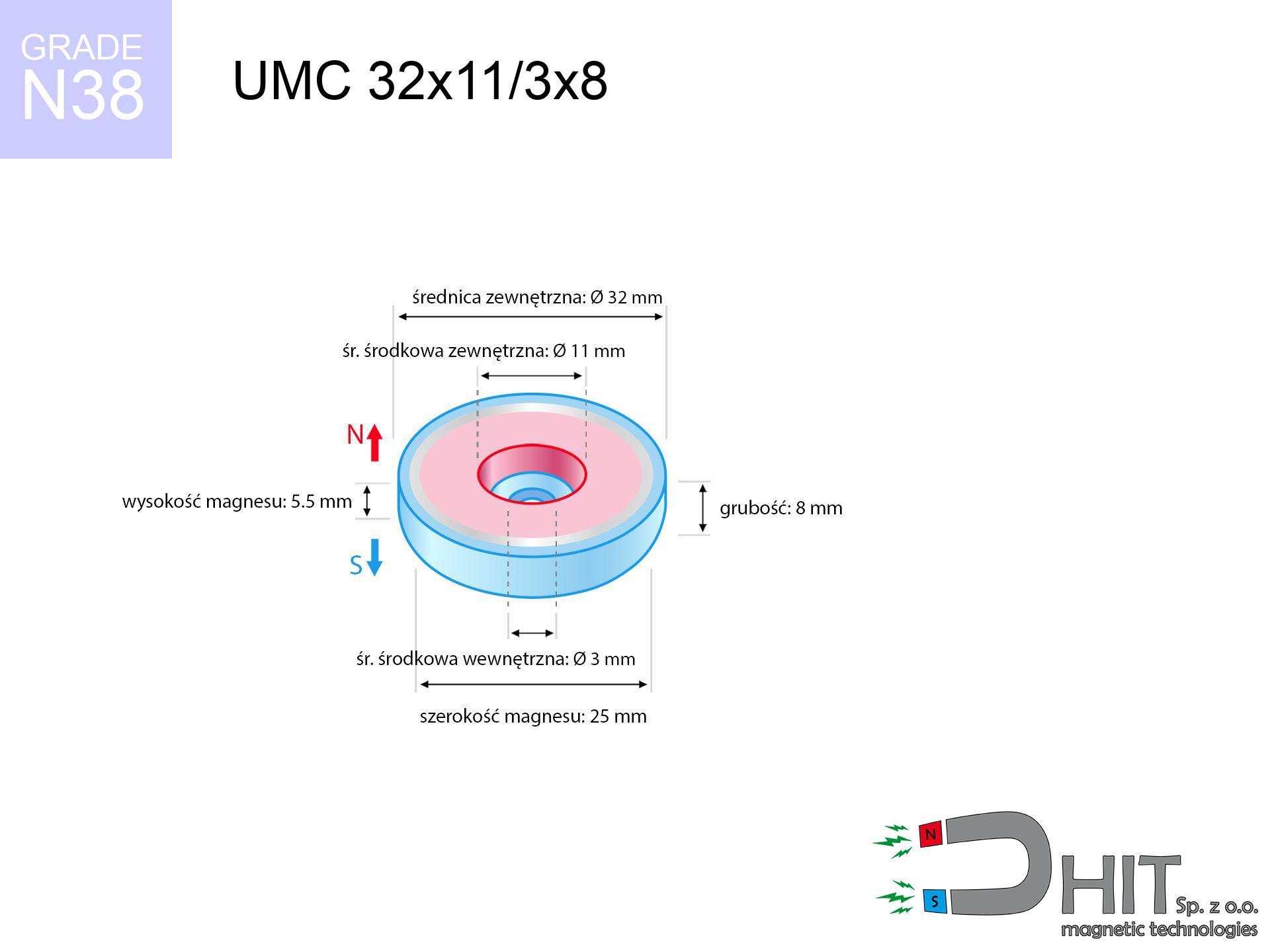
UMC 32x11/3x8 / N38 - cylindrical magnetic holder
cylindrical magnetic holder
Catalog no 320409
GTIN/EAN: 5906301814658
- Diameter
- 32 mm [±1 mm]
- internal diameter Ø
- 11/3 mm [±1 mm]
- Height
- 8 mm [±1 mm]
- Weight
- 36 g
- Magnetization Direction
- ↑ axial
- Coating
- [NiCuNi] Nickel
How we measure these parameters — certificates and measurements
14.62 zł net / pcs
17.98 zł with VAT (23% VAT) / pcs
bulk discounts:
Need more?Frequently asked questions
Which magnetic holder is suitable for moving metal parts in a workshop?
How do I choose a holder for hanging a heavy item and check its real grip?
Which magnetic holders can be used outdoors?
How should I choose a strong threaded holder for field work?
Call us now
+48 888 99 98 98
alternatively let us know using
contact form
the contact section.
Specifications and structure of a neodymium magnet can be estimated using our
power calculator.
Order by 14:00 and we’ll ship today!
Technical details - UMC 32x11/3x8 / N38 - cylindrical magnetic holder
Specification / characteristics - UMC 32x11/3x8 / N38 - cylindrical magnetic holder
| properties | values |
|---|---|
| Cat. no. | 320409 |
| GTIN/EAN | 5906301814658 |
| Production/Distribution | Dhit sp. z o.o. |
| Country of origin | Poland / China / Germany |
| Customs code | 85059029 |
| Diameter | 32 mm [±1 mm] |
| internal diameter Ø | 11/3 mm [±1 mm] |
| Height | 8 mm [±1 mm] |
| Weight | 36 g |
| Magnetization Direction | ↑ axial |
| Load capacity ~ ? | 23.00 kg / 225.55 N |
| Coating | [NiCuNi] Nickel |
| Manufacturing Tolerance | ±1 mm |
Magnetic properties of material N38
| properties | values | units |
|---|---|---|
| Remanence Br ? | 12.2-12.6 | kGs |
| Remanence Br ? | 1220-1260 | mT |
| Coercivity bHc ? | 10.8-11.5 | kOe |
| Coercivity bHc ? | 860-915 | kA/m |
| Intrinsic coercivity iHc | ≥ 12 | kOe |
| Intrinsic coercivity iHc | ≥ 955 | kA/m |
| Energy product BHmax ? | 36-38 | BH max MGOe |
| Energy product BHmax ? | 287-303 | BH max KJ/m |
| Maximum working temperature ? | ≤ 80 | °C |
Physical properties of sintered neodymium magnets Nd2Fe14B at 20°C
| properties | values | units |
|---|---|---|
| Vickers hardness | ≥550 | Hv |
| Density | ≥7.4 | g/cm3 |
| Curie Temperature TC | 310 | °C |
| Curie Temperature TF | 590 | °F |
| Specific resistance | 150 | μΩ⋅cm |
| Bending strength | 250 | MPa |
| Compressive strength | 1000~1100 | MPa |
| Thermal expansion parallel (∥) to orientation (M) | (3-4) x 10-6 | °C-1 |
| Thermal expansion perpendicular (⊥) to orientation (M) | -(1-3) x 10-6 | °C-1 |
| Young's modulus | 1.7 x 10⁴ | kg/mm² |
Elemental analysis
| iron (Fe) | 64% – 68% |
| neodymium (Nd) | 29% – 32% |
| boron (B) | 1.1% – 1.2% |
| dysprosium (Dy) | 0.5% – 2.0% |
| coating (Ni-Cu-Ni) | < 0.05% |
Environmental data
| recyclability (EoL) | 100% |
| recycled raw materials | ~10% (pre-cons) |
| carbon footprint | low / zredukowany |
| waste code (EWC) | 16 02 16 |
Check out also offers
![SM 32x475 [2xM8] / N42 - magnetic separator](https://cdn3.dhit.pl/graphics/products/sm-32x475-2xm8-jot.jpg "SM 32x475 [2xM8] / N42 - magnetic separator")

![UMGGW 43x6 [M4] GW / N38 - magnetic holder rubber internal thread](https://cdn3.dhit.pl/graphics/products/umg-43x6-m6-gw-hel.jpg "UMGGW 43x6 [M4] GW / N38 - magnetic holder rubber internal thread")
Strengths and weaknesses of Nd2Fe14B magnets.
Advantages
- Their strength remains stable, and after around ten years it decreases only by ~1% (according to research),
- They show high resistance to demagnetization induced by external magnetic fields,
- In other words, due to the shiny surface of silver, the element is aesthetically pleasing,
- They feature high magnetic induction at the operating surface, which increases their power,
- Due to their durability and thermal resistance, neodymium magnets can operate (depending on the form) even at high temperatures reaching 230°C or more...
- Thanks to flexibility in designing and the ability to modify to unusual requirements,
- Huge importance in advanced technology sectors – they find application in HDD drives, drive modules, medical equipment, also modern systems.
- Compactness – despite small sizes they provide effective action, making them ideal for precision applications
Limitations
- To avoid cracks upon strong impacts, we recommend using special steel housings. Such a solution secures the magnet and simultaneously improves its durability.
- Do not exceed this material temperature limit: 80°C. Overheating may permanently weaken the magnet.
- Due to the susceptibility of magnets to corrosion in a humid environment, we suggest using waterproof magnets made of rubber, plastic or other material immune to moisture, when using outdoors
- Limited ability of producing threads in the magnet and complicated shapes - recommended is cover - magnet mounting.
- Potential hazard related to microscopic parts of magnets pose a threat, when accidentally swallowed, which is particularly important in the aspect of protecting the youngest. Additionally, small elements of these products can be problematic in diagnostics medical after entering the body.
- Higher cost of purchase is one of the disadvantages compared to ceramic magnets, especially in budget applications
Holding force characteristics
Magnetic strength at its maximum – what affects it?
- on a block made of structural steel, perfectly concentrating the magnetic flux
- whose transverse dimension equals approx. 10 mm
- with an ground touching surface
- without the slightest clearance between the magnet and steel
- for force acting at a right angle (in the magnet axis)
- at temperature approx. 20 degrees Celsius
Lifting capacity in practice – influencing factors
- Distance – the presence of foreign body (paint, dirt, gap) interrupts the magnetic circuit, which lowers power rapidly (even by 50% at 0.5 mm).
- Force direction – remember that the magnet has greatest strength perpendicularly. Under shear forces, the holding force drops drastically, often to levels of 20-30% of the maximum value.
- Metal thickness – the thinner the sheet, the weaker the hold. Magnetic flux passes through the material instead of generating force.
- Plate material – mild steel attracts best. Alloy steels decrease magnetic permeability and lifting capacity.
- Plate texture – smooth surfaces ensure maximum contact, which increases field saturation. Uneven metal reduce efficiency.
- Thermal factor – hot environment reduces magnetic field. Too high temperature can permanently damage the magnet.
Lifting capacity testing was performed on plates with a smooth surface of suitable thickness, under perpendicular forces, whereas under shearing force the load capacity is reduced by as much as 75%. Additionally, even a minimal clearance between the magnet and the plate decreases the lifting capacity.
Precautions when working with NdFeB magnets
Health Danger
Individuals with a ICD should keep an large gap from magnets. The magnetism can disrupt the functioning of the life-saving device.
Sensitization to coating
Some people experience a hypersensitivity to nickel, which is the common plating for neodymium magnets. Prolonged contact may cause skin redness. It is best to wear safety gloves.
Threat to navigation
GPS units and mobile phones are extremely susceptible to magnetic fields. Direct contact with a strong magnet can permanently damage the internal compass in your phone.
Cards and drives
Do not bring magnets close to a purse, computer, or screen. The magnetism can permanently damage these devices and wipe information from cards.
Mechanical processing
Dust generated during cutting of magnets is self-igniting. Avoid drilling into magnets without proper cooling and knowledge.
Serious injuries
Big blocks can crush fingers instantly. Under no circumstances put your hand betwixt two attracting surfaces.
Powerful field
Before use, check safety instructions. Sudden snapping can break the magnet or injure your hand. Be predictive.
This is not a toy
Always store magnets out of reach of children. Choking hazard is high, and the consequences of magnets connecting inside the body are tragic.
Protective goggles
Protect your eyes. Magnets can fracture upon violent connection, launching sharp fragments into the air. Eye protection is mandatory.
Heat sensitivity
Do not overheat. Neodymium magnets are susceptible to heat. If you require operation above 80°C, look for HT versions (H, SH, UH).
Tabela kosztu i czasu dostawy
Płatność przed wysyłką:

GLS kurier
Przesyłka będzie u Ciebie za 2-3 dni
14.99 ZŁ

InPost Paczkomaty 24/7
Przesyłka będzie u Ciebie za 1-2 dni
12.30 ZŁ
Płatność przy odbiorze (pobranie):
GLS kurier
Przesyłka będzie u Ciebie za 1-2 dni
23.00 ZŁ