


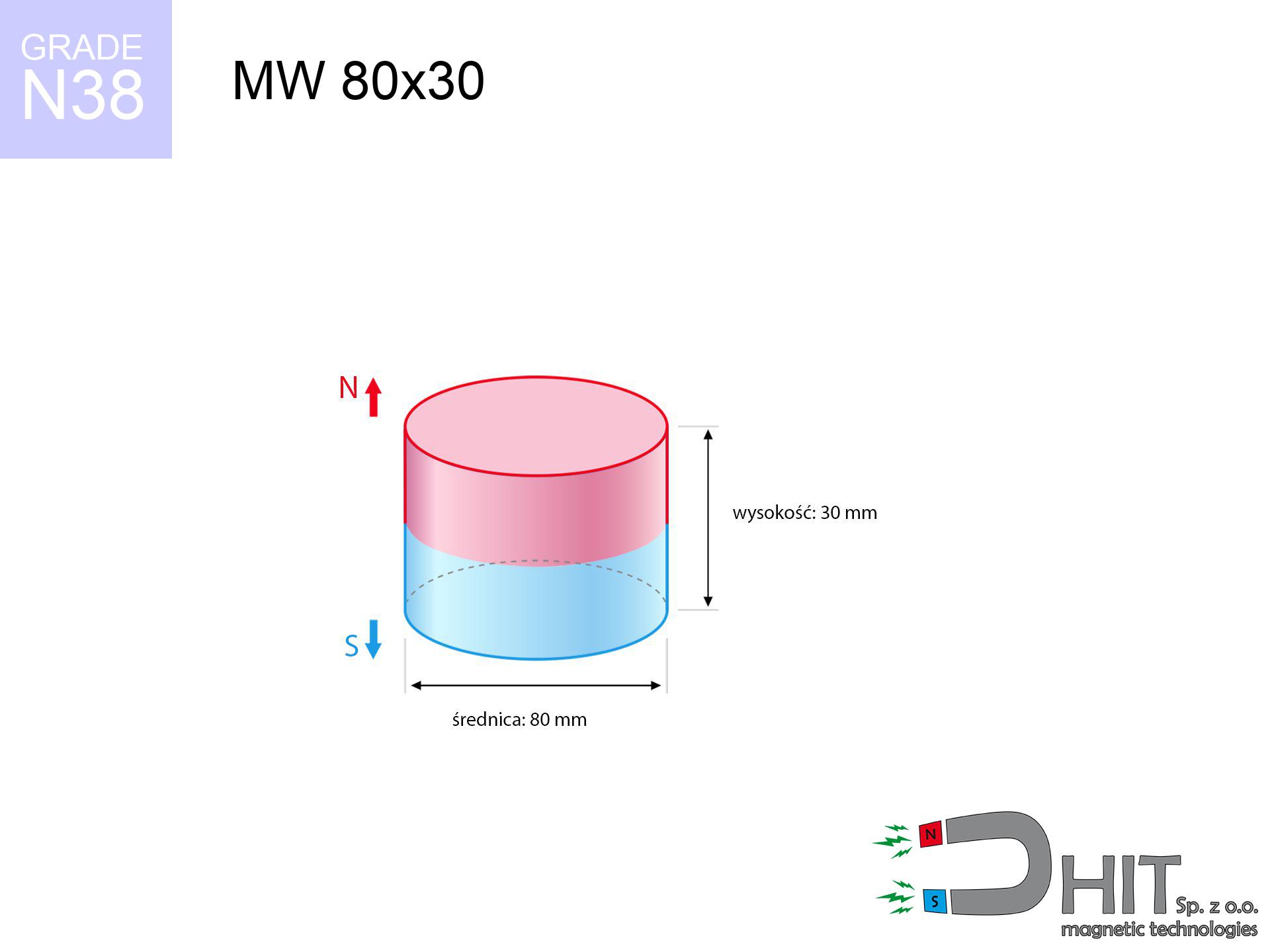
MW 80x30 / N38 - cylindrical magnet
cylindrical magnet
Catalog no 010100
GTIN/EAN: 5906301810995
- Diameter Ø
- 80 mm [±0,1 mm]
- Height
- 30 mm [±0,1 mm]
- Weight
- 1130.97 g
- Magnetization Direction
- ↑ axial
- Coating
- [NiCuNi] Nickel
How we measure these parameters — certificates and measurements
337.40 zł net / pcs
415.00 zł with VAT (23% VAT) / pcs
bulk discounts:
Need more?Frequently asked questions
Where can I buy strong cylindrical neodymium magnets?
Can a small cylindrical magnet provide a strong grip for precise workshop work?
Which cylindrical magnet can work at a higher temperature?
Engineering report for this magnet
Full PDF analysis: pull and shear force, effect of distance, temperature and plate thickness, safety distances and the demagnetization curve.
Call us now
+48 888 99 98 98
alternatively let us know using
contact form
the contact section.
Specifications and structure of a neodymium magnet can be estimated using our
power calculator.
Order by 14:00 and we’ll ship today!
Product card - MW 80x30 / N38 - cylindrical magnet
Specification / characteristics - MW 80x30 / N38 - cylindrical magnet
| properties | values |
|---|---|
| Cat. no. | 010100 |
| GTIN/EAN | 5906301810995 |
| Production/Distribution | Dhit sp. z o.o. |
| Country of origin | Poland / China / Germany |
| Customs code | 85059029 |
| Diameter Ø | 80 mm [±0,1 mm] |
| Height | 30 mm [±0,1 mm] |
| Weight | 1130.97 g |
| Magnetization Direction | ↑ axial |
| Load capacity ~ ? | 170.64 kg / 1673.99 N |
| Magnetic Induction ~ ? | 371.95 mT / 3720 Gs |
| Coating | [NiCuNi] Nickel |
| Manufacturing Tolerance | ±0.1 mm |
Magnetic properties of material N38
| properties | values | units |
|---|---|---|
| Remanence Br ? | 12.2-12.6 | kGs |
| Remanence Br ? | 1220-1260 | mT |
| Coercivity bHc ? | 10.8-11.5 | kOe |
| Coercivity bHc ? | 860-915 | kA/m |
| Intrinsic coercivity iHc | ≥ 12 | kOe |
| Intrinsic coercivity iHc | ≥ 955 | kA/m |
| Energy product BHmax ? | 36-38 | BH max MGOe |
| Energy product BHmax ? | 287-303 | BH max KJ/m |
| Maximum working temperature ? | ≤ 80 | °C |
Physical properties of sintered neodymium magnets Nd2Fe14B at 20°C
| properties | values | units |
|---|---|---|
| Vickers hardness | ≥550 | Hv |
| Density | ≥7.4 | g/cm3 |
| Curie Temperature TC | 310 | °C |
| Curie Temperature TF | 590 | °F |
| Specific resistance | 150 | μΩ⋅cm |
| Bending strength | 250 | MPa |
| Compressive strength | 1000~1100 | MPa |
| Thermal expansion parallel (∥) to orientation (M) | (3-4) x 10-6 | °C-1 |
| Thermal expansion perpendicular (⊥) to orientation (M) | -(1-3) x 10-6 | °C-1 |
| Young's modulus | 1.7 x 10⁴ | kg/mm² |
Technical modeling of the product - report
These information are the outcome of a engineering calculation. Values were calculated on algorithms for the material Nd2Fe14B. Operational parameters may differ. Treat these calculations as a preliminary roadmap during assembly planning.
Table 1: Static force (force vs gap) - characteristics
MW 80x30 / N38
| Distance (mm) | Induction (Gauss) / mT | Pull Force (kg/lbs/g/N) | Risk Status |
|---|---|---|---|
| 0 mm |
3719 Gs
371.9 mT
|
170.64 kg / 376.20 pounds
170640.0 g / 1674.0 N
|
critical level |
| 1 mm |
3643 Gs
364.3 mT
|
163.71 kg / 360.93 pounds
163714.9 g / 1606.0 N
|
critical level |
| 2 mm |
3563 Gs
356.3 mT
|
156.65 kg / 345.35 pounds
156647.8 g / 1536.7 N
|
critical level |
| 3 mm |
3482 Gs
348.2 mT
|
149.55 kg / 329.71 pounds
149554.1 g / 1467.1 N
|
critical level |
| 5 mm |
3314 Gs
331.4 mT
|
135.46 kg / 298.63 pounds
135457.0 g / 1328.8 N
|
critical level |
| 10 mm |
2880 Gs
288.0 mT
|
102.34 kg / 225.63 pounds
102343.3 g / 1004.0 N
|
critical level |
| 15 mm |
2457 Gs
245.7 mT
|
74.47 kg / 164.17 pounds
74468.4 g / 730.5 N
|
critical level |
| 20 mm |
2069 Gs
206.9 mT
|
52.79 kg / 116.38 pounds
52789.9 g / 517.9 N
|
critical level |
| 30 mm |
1439 Gs
143.9 mT
|
25.53 kg / 56.29 pounds
25534.0 g / 250.5 N
|
critical level |
| 50 mm |
704 Gs
70.4 mT
|
6.11 kg / 13.48 pounds
6115.0 g / 60.0 N
|
strong |
Table 2: Vertical hold (vertical surface)
MW 80x30 / N38
| Distance (mm) | Friction coefficient | Pull Force (kg/lbs/g/N) |
|---|---|---|
| 0 mm | Stal (~0.2) |
34.13 kg / 75.24 pounds
34128.0 g / 334.8 N
|
| 1 mm | Stal (~0.2) |
32.74 kg / 72.18 pounds
32742.0 g / 321.2 N
|
| 2 mm | Stal (~0.2) |
31.33 kg / 69.07 pounds
31330.0 g / 307.3 N
|
| 3 mm | Stal (~0.2) |
29.91 kg / 65.94 pounds
29910.0 g / 293.4 N
|
| 5 mm | Stal (~0.2) |
27.09 kg / 59.73 pounds
27092.0 g / 265.8 N
|
| 10 mm | Stal (~0.2) |
20.47 kg / 45.12 pounds
20468.0 g / 200.8 N
|
| 15 mm | Stal (~0.2) |
14.89 kg / 32.84 pounds
14894.0 g / 146.1 N
|
| 20 mm | Stal (~0.2) |
10.56 kg / 23.28 pounds
10558.0 g / 103.6 N
|
| 30 mm | Stal (~0.2) |
5.11 kg / 11.26 pounds
5106.0 g / 50.1 N
|
| 50 mm | Stal (~0.2) |
1.22 kg / 2.69 pounds
1222.0 g / 12.0 N
|
Table 3: Vertical assembly (shearing) - vertical pull
MW 80x30 / N38
| Surface type | Friction coefficient / % Mocy | Max load (kg/lbs/g/N) |
|---|---|---|
| Raw steel |
µ = 0.3
30% Nominalnej Siły
|
51.19 kg / 112.86 pounds
51192.0 g / 502.2 N
|
| Painted steel (standard) |
µ = 0.2
20% Nominalnej Siły
|
34.13 kg / 75.24 pounds
34128.0 g / 334.8 N
|
| Oily/slippery steel |
µ = 0.1
10% Nominalnej Siły
|
17.06 kg / 37.62 pounds
17064.0 g / 167.4 N
|
| Magnet with anti-slip rubber |
µ = 0.5
50% Nominalnej Siły
|
85.32 kg / 188.10 pounds
85320.0 g / 837.0 N
|
Table 4: Steel thickness (saturation) - power losses
MW 80x30 / N38
| Steel thickness (mm) | % power | Real pull force (kg/lbs/g/N) |
|---|---|---|
| 0.5 mm |
|
5.69 kg / 12.54 pounds
5688.0 g / 55.8 N
|
| 1 mm |
|
14.22 kg / 31.35 pounds
14220.0 g / 139.5 N
|
| 2 mm |
|
28.44 kg / 62.70 pounds
28440.0 g / 279.0 N
|
| 3 mm |
|
42.66 kg / 94.05 pounds
42660.0 g / 418.5 N
|
| 5 mm |
|
71.10 kg / 156.75 pounds
71100.0 g / 697.5 N
|
| 10 mm |
|
142.20 kg / 313.50 pounds
142200.0 g / 1395.0 N
|
| 11 mm |
|
156.42 kg / 344.85 pounds
156420.0 g / 1534.5 N
|
| 12 mm |
|
170.64 kg / 376.20 pounds
170640.0 g / 1674.0 N
|
Table 5: Working in heat (material behavior) - resistance threshold
MW 80x30 / N38
| Ambient temp. (°C) | Power loss | Remaining pull (kg/lbs/g/N) | Status |
|---|---|---|---|
| 20 °C | 0.0% |
170.64 kg / 376.20 pounds
170640.0 g / 1674.0 N
|
OK |
| 40 °C | -2.2% |
166.89 kg / 367.92 pounds
166885.9 g / 1637.2 N
|
OK |
| 60 °C | -4.4% |
163.13 kg / 359.64 pounds
163131.8 g / 1600.3 N
|
|
| 80 °C | -6.6% |
159.38 kg / 351.37 pounds
159377.8 g / 1563.5 N
|
|
| 100 °C | -28.8% |
121.50 kg / 267.85 pounds
121495.7 g / 1191.9 N
|
Table 6: Magnet-Magnet interaction (repulsion) - field range
MW 80x30 / N38
| Gap (mm) | Attraction (kg/lbs) (N-S) | Shear Strength (kg/lbs/g/N) | Repulsion (kg/lbs) (N-N) |
|---|---|---|---|
| 0 mm |
428.66 kg / 945.03 pounds
5 157 Gs
|
64.30 kg / 141.76 pounds
64299 g / 630.8 N
|
N/A |
| 1 mm |
420.08 kg / 926.12 pounds
7 364 Gs
|
63.01 kg / 138.92 pounds
63012 g / 618.1 N
|
378.07 kg / 833.51 pounds
~0 Gs
|
| 2 mm |
411.26 kg / 906.68 pounds
7 286 Gs
|
61.69 kg / 136.00 pounds
61690 g / 605.2 N
|
370.14 kg / 816.01 pounds
~0 Gs
|
| 3 mm |
402.40 kg / 887.15 pounds
7 207 Gs
|
60.36 kg / 133.07 pounds
60360 g / 592.1 N
|
362.16 kg / 798.43 pounds
~0 Gs
|
| 5 mm |
384.60 kg / 847.90 pounds
7 046 Gs
|
57.69 kg / 127.19 pounds
57690 g / 565.9 N
|
346.14 kg / 763.11 pounds
~0 Gs
|
| 10 mm |
340.28 kg / 750.18 pounds
6 627 Gs
|
51.04 kg / 112.53 pounds
51042 g / 500.7 N
|
306.25 kg / 675.17 pounds
~0 Gs
|
| 20 mm |
257.09 kg / 566.80 pounds
5 761 Gs
|
38.56 kg / 85.02 pounds
38564 g / 378.3 N
|
231.38 kg / 510.12 pounds
~0 Gs
|
| 50 mm |
92.55 kg / 204.04 pounds
3 456 Gs
|
13.88 kg / 30.61 pounds
13883 g / 136.2 N
|
83.30 kg / 183.63 pounds
~0 Gs
|
| 60 mm |
64.14 kg / 141.41 pounds
2 877 Gs
|
9.62 kg / 21.21 pounds
9622 g / 94.4 N
|
57.73 kg / 127.27 pounds
~0 Gs
|
| 70 mm |
44.44 kg / 97.98 pounds
2 395 Gs
|
6.67 kg / 14.70 pounds
6666 g / 65.4 N
|
40.00 kg / 88.18 pounds
~0 Gs
|
| 80 mm |
30.93 kg / 68.19 pounds
1 998 Gs
|
4.64 kg / 10.23 pounds
4639 g / 45.5 N
|
27.84 kg / 61.37 pounds
~0 Gs
|
| 90 mm |
21.69 kg / 47.82 pounds
1 673 Gs
|
3.25 kg / 7.17 pounds
3254 g / 31.9 N
|
19.52 kg / 43.04 pounds
~0 Gs
|
| 100 mm |
15.36 kg / 33.87 pounds
1 408 Gs
|
2.30 kg / 5.08 pounds
2304 g / 22.6 N
|
13.83 kg / 30.48 pounds
~0 Gs
|
Table 7: Hazards (implants) - precautionary measures
MW 80x30 / N38
| Object / Device | Limit (Gauss) / mT | Safe distance |
|---|---|---|
| Pacemaker | 5 Gs (0.5 mT) | 37.5 cm |
| Hearing aid | 10 Gs (1.0 mT) | 29.5 cm |
| Mechanical watch | 20 Gs (2.0 mT) | 23.0 cm |
| Mobile device | 40 Gs (4.0 mT) | 18.0 cm |
| Remote | 50 Gs (5.0 mT) | 16.5 cm |
| Payment card | 400 Gs (40.0 mT) | 7.0 cm |
| HDD hard drive | 600 Gs (60.0 mT) | 5.5 cm |
Table 8: Dynamics (cracking risk) - warning
MW 80x30 / N38
| Start from (mm) | Speed (km/h) | Energy (J) | Predicted outcome |
|---|---|---|---|
| 10 mm |
17.48 km/h
(4.85 m/s)
|
13.32 J | |
| 30 mm |
23.66 km/h
(6.57 m/s)
|
24.42 J | |
| 50 mm |
24.91 km/h
(6.92 m/s)
|
27.06 J | |
| 100 mm |
25.32 km/h
(7.03 m/s)
|
27.98 J |
Table 9: Surface protection spec
MW 80x30 / N38
| Technical parameter | Value / Description |
|---|---|
| Coating type | [NiCuNi] Nickel |
| Layer structure | Nickel - Copper - Nickel |
| Layer thickness | 10-20 µm |
| Salt spray test (SST) ? | 24 h |
| Recommended environment | Indoors only (dry) |
Table 10: Construction data (Flux)
MW 80x30 / N38
| Parameter | Value | SI Unit / Description |
|---|---|---|
| Magnetic Flux | 194 600 Mx | 1946.0 µWb |
| Pc Coefficient | 0.48 | Low (Flat) |
Table 11: Submerged application
MW 80x30 / N38
| Environment | Effective steel pull | Effect |
|---|---|---|
| Air (land) | 170.64 kg | Standard |
| Water (riverbed) |
195.38 kg
(+24.74 kg buoyancy gain)
|
+14.5% |
1. Shear force
*Warning: On a vertical surface, the magnet retains only a fraction of its max power.
2. Steel thickness impact
*Thin metal sheet (e.g. computer case) drastically limits the holding force.
3. Heat tolerance
N38: the maximum material working temperature is 80°C. Permitted conditions also depend on the shape and magnetic circuit.
4. Demagnetization curve and operating point (B-H)
chart generated for the permeance coefficient Pc (Permeance Coefficient) = 0.48
This simulation demonstrates the magnetic stability of the selected magnet under specific geometric conditions. The solid red line represents the demagnetization curve (material potential), while the dashed blue line is the load line based on the magnet's geometry. The Pc (Permeance Coefficient), also known as the load line slope, is a dimensionless value that describes the relationship between the magnet's shape and its magnetic stability. The intersection of these two lines (the black dot) is the operating point — it determines the actual magnetic flux density generated by the magnet in this specific configuration. A higher Pc value means the magnet is more 'slender' (tall relative to its area), resulting in a higher operating point and better resistance to irreversible demagnetization caused by external fields or temperature. A value of 0.42 is relatively low (typical for flat magnets), meaning the operating point is closer to the 'knee' of the curve — caution is advised when operating at temperatures near the maximum limit to avoid strength loss.
Elemental analysis
| iron (Fe) | 64% – 68% |
| neodymium (Nd) | 29% – 32% |
| boron (B) | 1.1% – 1.2% |
| dysprosium (Dy) | 0.5% – 2.0% |
| coating (Ni-Cu-Ni) | < 0.05% |
Environmental data
| recyclability (EoL) | 100% |
| recycled raw materials | ~10% (pre-cons) |
| carbon footprint | low / zredukowany |
| waste code (EWC) | 16 02 16 |
Other products
![UMP 135x40 [M10+M12] GW F600 Lina / N38 - search holder](https://cdn3.dhit.pl/graphics/products/ump-135x40-m10+m12-gw-f600-+lina-sej.jpg "UMP 135x40 [M10+M12] GW F600 Lina / N38 - search holder")
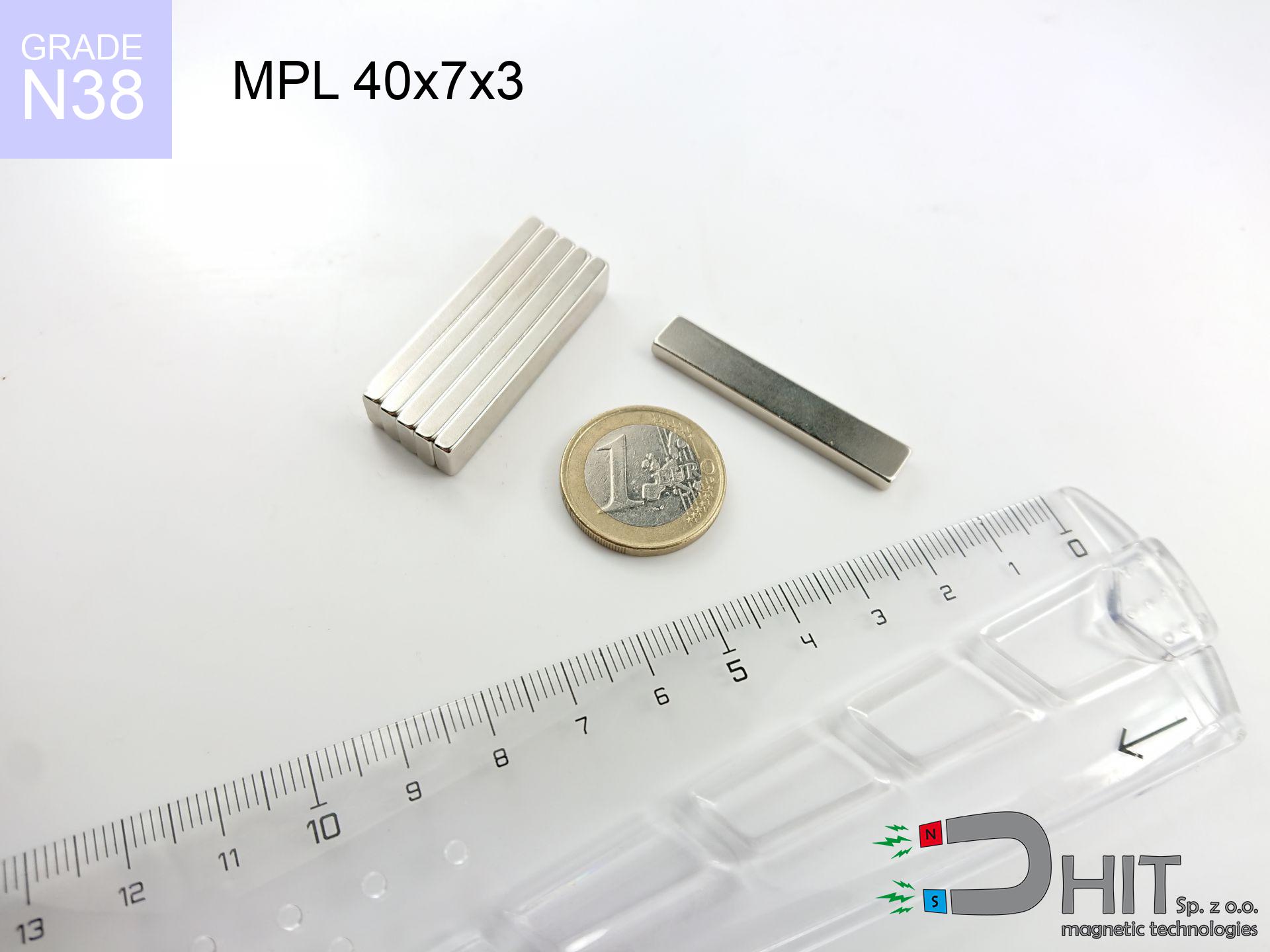
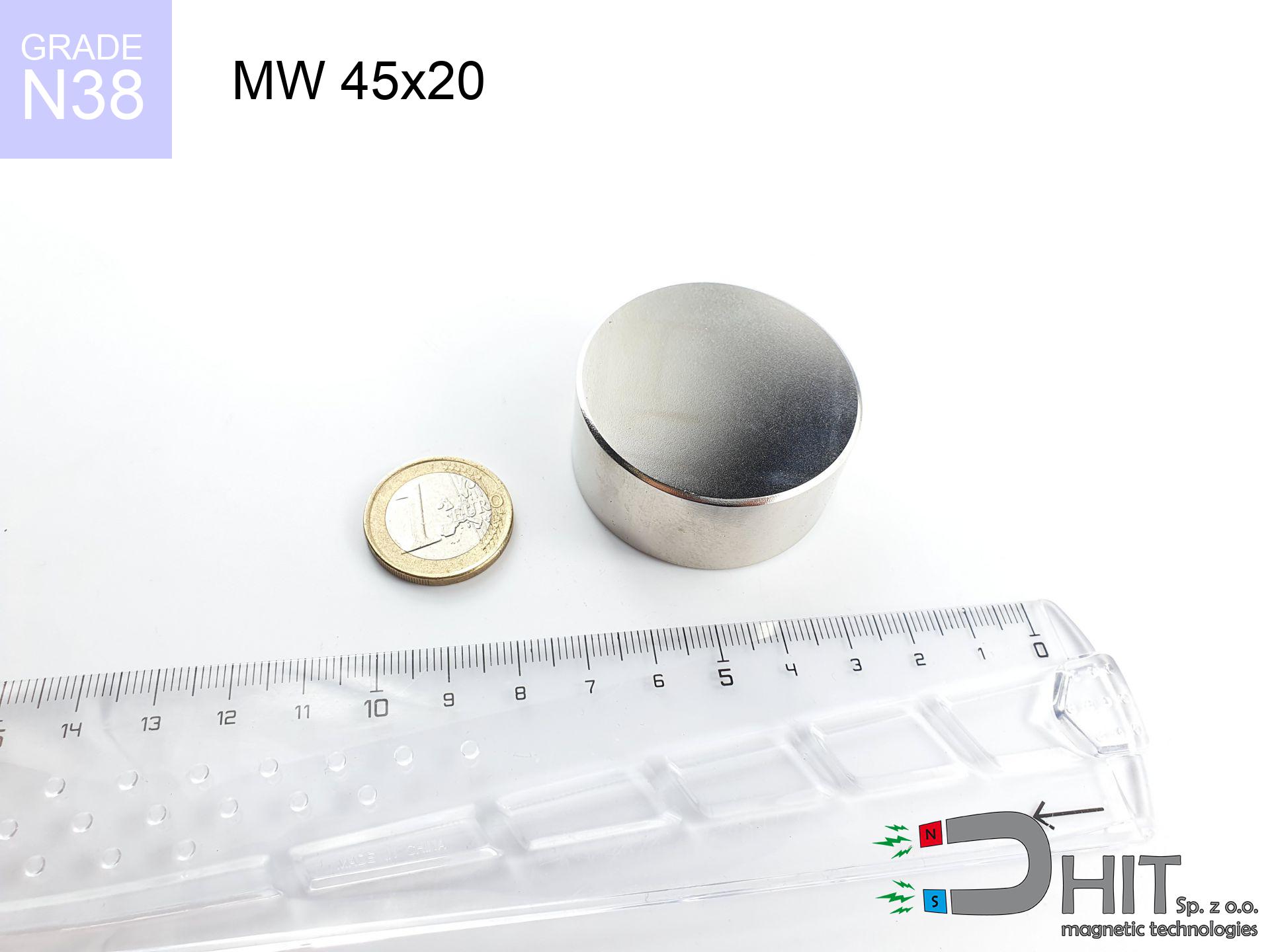
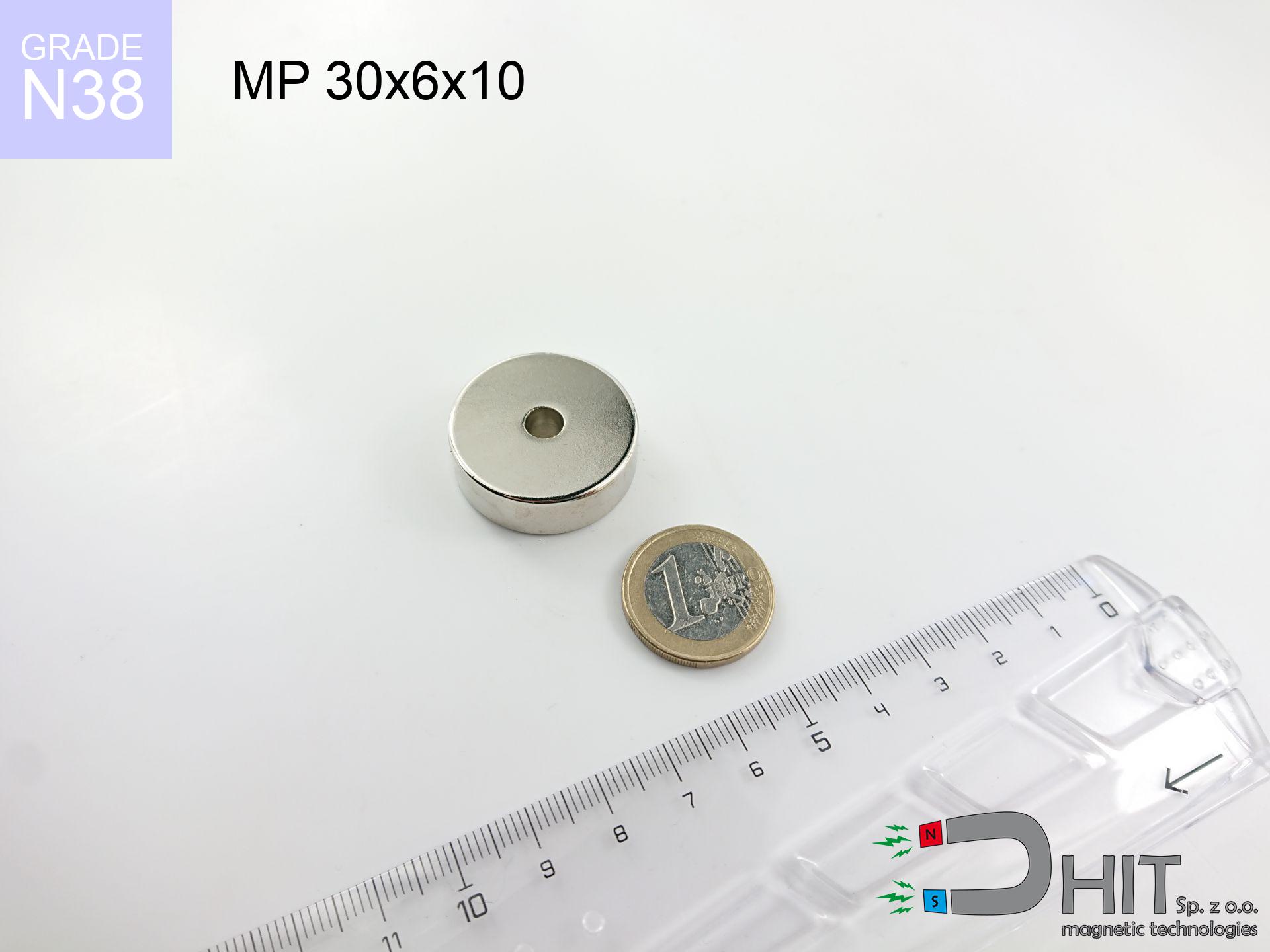
Pros and cons of rare earth magnets.
Benefits
- They retain attractive force for almost 10 years – the drop is just ~1% (according to analyses),
- They are noted for resistance to demagnetization induced by external field influence,
- By applying a decorative layer of gold, the element presents an professional look,
- They are known for high magnetic induction at the operating surface, which affects their effectiveness,
- Thanks to resistance to high temperature, they can operate (depending on the form) even at temperatures up to 230°C and higher...
- Considering the possibility of accurate molding and customization to specialized solutions, neodymium magnets can be produced in a variety of geometric configurations, which increases their versatility,
- Universal use in electronics industry – they are used in data components, electromotive mechanisms, precision medical tools, also industrial machines.
- Relatively small size with high pulling force – neodymium magnets offer strong magnetic field in small dimensions, which makes them useful in small systems
Cons
- They are fragile upon too strong impacts. To avoid cracks, it is worth securing magnets using a steel holder. Such protection not only shields the magnet but also increases its resistance to damage
- Do not exceed this material temperature limit: 80°C. Overheating may permanently weaken the magnet.
- They rust in a humid environment - during use outdoors we suggest using waterproof magnets e.g. in rubber, plastic
- We recommend casing - magnetic holder, due to difficulties in creating nuts inside the magnet and complex forms.
- Health risk resulting from small fragments of magnets pose a threat, if swallowed, which gains importance in the context of child health protection. It is also worth noting that tiny parts of these devices are able to disrupt the diagnostic process medical when they are in the body.
- With budget limitations the cost of neodymium magnets is economically unviable,
Holding force characteristics
Maximum holding power of the magnet – what affects it?
- using a plate made of high-permeability steel, functioning as a ideal flux conductor
- possessing a thickness of at least 10 mm to avoid saturation
- with a surface perfectly flat
- under conditions of ideal adhesion (metal-to-metal)
- during pulling in a direction perpendicular to the mounting surface
- at ambient temperature approx. 20 degrees Celsius
Lifting capacity in practice – influencing factors
- Air gap (between the magnet and the plate), as even a tiny clearance (e.g. 0.5 mm) results in a drastic drop in force by up to 50% (this also applies to varnish, rust or dirt).
- Direction of force – highest force is reached only during perpendicular pulling. The force required to slide of the magnet along the surface is usually many times lower (approx. 1/5 of the lifting capacity).
- Wall thickness – thin material does not allow full use of the magnet. Magnetic flux penetrates through instead of converting into lifting capacity.
- Material type – the best choice is pure iron steel. Stainless steels may attract less.
- Surface condition – ground elements guarantee perfect abutment, which increases force. Uneven metal weaken the grip.
- Thermal factor – high temperature weakens pulling force. Too high temperature can permanently damage the magnet.
Holding force was checked on the plate surface of 20 mm thickness, when a perpendicular force was applied, in contrast under attempts to slide the magnet the holding force is lower. In addition, even a minimal clearance between the magnet’s surface and the plate lowers the load capacity.
Precautions when working with neodymium magnets
ICD Warning
For implant holders: Strong magnetic fields affect medical devices. Maintain minimum 30 cm distance or ask another person to handle the magnets.
Bodily injuries
Mind your fingers. Two powerful magnets will snap together instantly with a force of massive weight, destroying everything in their path. Be careful!
Thermal limits
Regular neodymium magnets (grade N) lose power when the temperature surpasses 80°C. Damage is permanent.
Nickel coating and allergies
Certain individuals experience a contact allergy to Ni, which is the standard coating for neodymium magnets. Frequent touching might lead to dermatitis. We strongly advise wear safety gloves.
Beware of splinters
Beware of splinters. Magnets can explode upon uncontrolled impact, launching shards into the air. We recommend safety glasses.
Flammability
Combustion risk: Neodymium dust is explosive. Avoid machining magnets without safety gear as this may cause fire.
Do not give to children
These products are not intended for children. Accidental ingestion of a few magnets may result in them connecting inside the digestive tract, which poses a severe health hazard and necessitates immediate surgery.
Conscious usage
Use magnets with awareness. Their powerful strength can surprise even experienced users. Be vigilant and respect their force.
Magnetic media
Avoid bringing magnets close to a wallet, laptop, or screen. The magnetic field can permanently damage these devices and erase data from cards.
Keep away from electronics
Remember: neodymium magnets generate a field that disrupts precision electronics. Maintain a safe distance from your phone, tablet, and navigation systems.
Tabela kosztu i czasu dostawy
Płatność przed wysyłką:

GLS kurier
Przesyłka będzie u Ciebie za 2-3 dni
14.99 ZŁ

InPost Paczkomaty 24/7
Przesyłka będzie u Ciebie za 1-2 dni
12.30 ZŁ
Płatność przy odbiorze (pobranie):
GLS kurier
Przesyłka będzie u Ciebie za 1-2 dni
23.00 ZŁ