


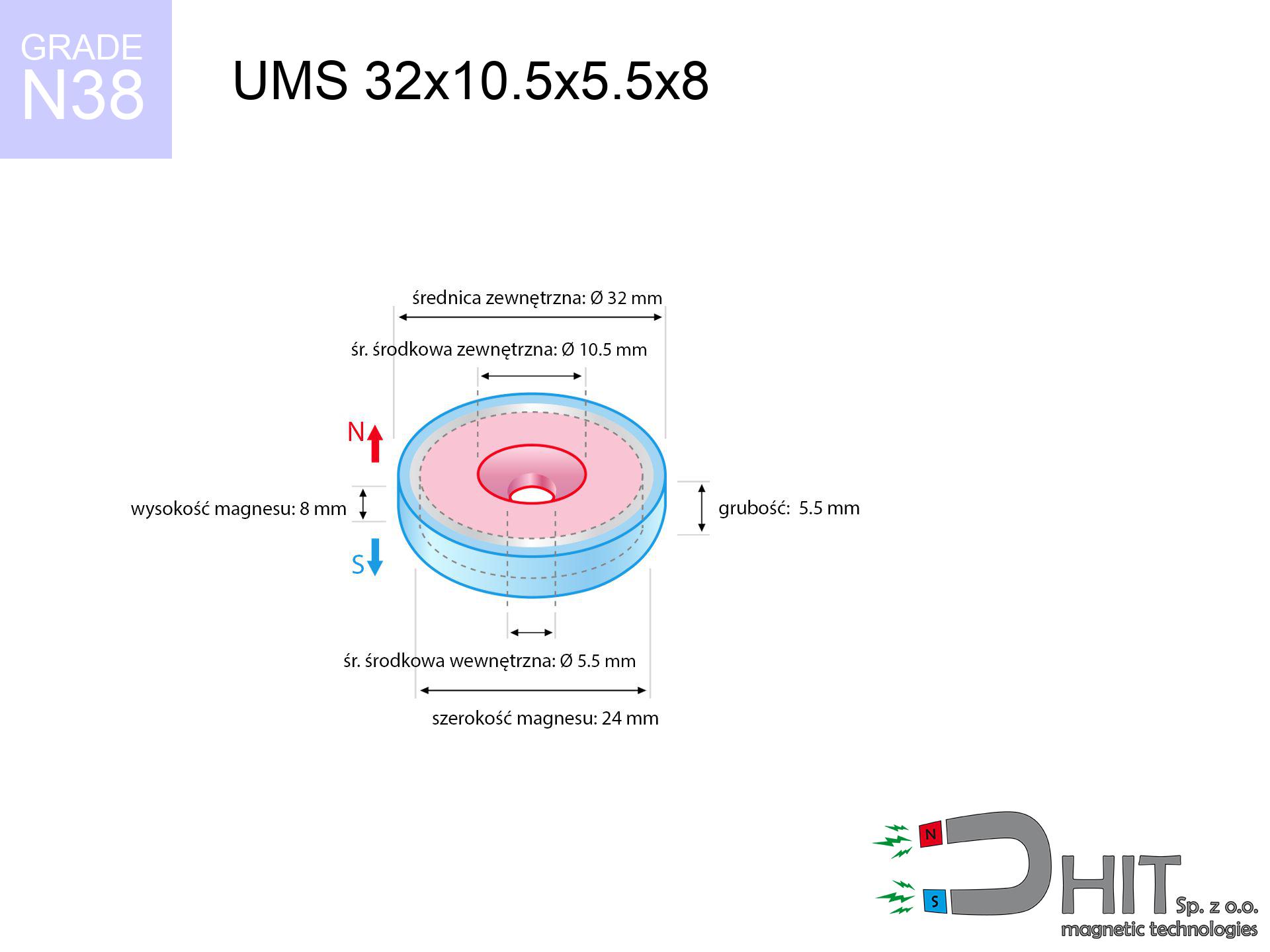
UMS 32x10.5x5.5x8 / N38 - conical magnetic holder
conical magnetic holder
Catalog no 220329
GTIN/EAN: 5906301814191
- Diameter Ø
- 32 mm [±1 mm]
- cone dimension Ø
- 10.5x5.5 mm [±1 mm]
- Height
- 8 mm [±1 mm]
- Weight
- 37 g
- Magnetization Direction
- ↑ axial
- Coating
- [NiCuNi] Nickel
How we measure these parameters — certificates and measurements
9.83 zł net / pcs
12.09 zł with VAT (23% VAT) / pcs
bulk discounts:
Need more?Frequently asked questions
Which magnetic holder is suitable for moving metal parts in a workshop?
How do I choose a holder for hanging a heavy item and check its real grip?
Which magnetic holders can be used outdoors?
How should I choose a strong threaded holder for field work?
Call us now
+48 888 99 98 98
alternatively let us know using
contact form
the contact section.
Specifications and structure of a neodymium magnet can be estimated using our
power calculator.
Order by 14:00 and we’ll ship today!
Technical of the product - UMS 32x10.5x5.5x8 / N38 - conical magnetic holder
Specification / characteristics - UMS 32x10.5x5.5x8 / N38 - conical magnetic holder
| properties | values |
|---|---|
| Cat. no. | 220329 |
| GTIN/EAN | 5906301814191 |
| Production/Distribution | Dhit sp. z o.o. |
| Country of origin | Poland / China / Germany |
| Customs code | 85059029 |
| Diameter Ø | 32 mm [±1 mm] |
| cone dimension Ø | 10.5x5.5 mm [±1 mm] |
| Height | 8 mm [±1 mm] |
| Weight | 37 g |
| Magnetization Direction | ↑ axial |
| Load capacity ~ ? | 25.00 kg / 245.17 N |
| Coating | [NiCuNi] Nickel |
| Manufacturing Tolerance | ±1 mm |
Magnetic properties of material N38
| properties | values | units |
|---|---|---|
| Remanence Br ? | 12.2-12.6 | kGs |
| Remanence Br ? | 1220-1260 | mT |
| Coercivity bHc ? | 10.8-11.5 | kOe |
| Coercivity bHc ? | 860-915 | kA/m |
| Intrinsic coercivity iHc | ≥ 12 | kOe |
| Intrinsic coercivity iHc | ≥ 955 | kA/m |
| Energy product BHmax ? | 36-38 | BH max MGOe |
| Energy product BHmax ? | 287-303 | BH max KJ/m |
| Maximum working temperature ? | ≤ 80 | °C |
Physical properties of sintered neodymium magnets Nd2Fe14B at 20°C
| properties | values | units |
|---|---|---|
| Vickers hardness | ≥550 | Hv |
| Density | ≥7.4 | g/cm3 |
| Curie Temperature TC | 310 | °C |
| Curie Temperature TF | 590 | °F |
| Specific resistance | 150 | μΩ⋅cm |
| Bending strength | 250 | MPa |
| Compressive strength | 1000~1100 | MPa |
| Thermal expansion parallel (∥) to orientation (M) | (3-4) x 10-6 | °C-1 |
| Thermal expansion perpendicular (⊥) to orientation (M) | -(1-3) x 10-6 | °C-1 |
| Young's modulus | 1.7 x 10⁴ | kg/mm² |
Elemental analysis
| iron (Fe) | 64% – 68% |
| neodymium (Nd) | 29% – 32% |
| boron (B) | 1.1% – 1.2% |
| dysprosium (Dy) | 0.5% – 2.0% |
| coating (Ni-Cu-Ni) | < 0.05% |
Sustainability
| recyclability (EoL) | 100% |
| recycled raw materials | ~10% (pre-cons) |
| carbon footprint | low / zredukowany |
| waste code (EWC) | 16 02 16 |
Other deals
![UI 17.5x5 [C310] / N38 - badge holder](https://cdn3.dhit.pl/graphics/products/ui17.5x5-c310-rud.jpg "UI 17.5x5 [C310] / N38 - badge holder")
![SM 28x250 [2xM8] / N52 - magnetic separator](https://cdn3.dhit.pl/graphics/products/sm-28x250-2xm8-zap.jpg "SM 28x250 [2xM8] / N52 - magnetic separator")
![SM 32x200 [2xM8] / N52 - magnetic separator](https://cdn3.dhit.pl/graphics/products/sm-32x200-2xm8-tus.jpg "SM 32x200 [2xM8] / N52 - magnetic separator")

Strengths and weaknesses of Nd2Fe14B magnets.
Advantages
- They do not lose strength, even over nearly ten years – the decrease in lifting capacity is only ~1% (according to tests),
- They feature excellent resistance to magnetic field loss when exposed to external fields,
- The use of an shiny layer of noble metals (nickel, gold, silver) causes the element to present itself better,
- Magnetic induction on the top side of the magnet is exceptional,
- Thanks to resistance to high temperature, they are capable of working (depending on the form) even at temperatures up to 230°C and higher...
- Possibility of precise machining as well as optimizing to precise requirements,
- Universal use in modern industrial fields – they are used in magnetic memories, motor assemblies, medical devices, as well as industrial machines.
- Compactness – despite small sizes they provide effective action, making them ideal for precision applications
Limitations
- Brittleness is one of their disadvantages. Upon intense impact they can break. We advise keeping them in a special holder, which not only secures them against impacts but also raises their durability
- Do not exceed this material temperature limit: 80°C. Overheating may permanently weaken the magnet.
- When exposed to humidity, magnets start to rust. To use them in conditions outside, it is recommended to use protective magnets, such as magnets in rubber or plastics, which secure oxidation as well as corrosion.
- Due to limitations in creating threads and complex shapes in magnets, we propose using cover - magnetic mechanism.
- Potential hazard to health – tiny shards of magnets can be dangerous, if swallowed, which becomes key in the context of child safety. Additionally, small elements of these magnets can complicate diagnosis medical after entering the body.
- Higher cost of purchase is one of the disadvantages compared to ceramic magnets, especially in budget applications
Pull force analysis
Detachment force of the magnet in optimal conditions – what affects it?
- on a base made of mild steel, optimally conducting the magnetic field
- whose thickness equals approx. 10 mm
- characterized by lack of roughness
- with zero gap (no coatings)
- for force applied at a right angle (in the magnet axis)
- at standard ambient temperature
Lifting capacity in real conditions – factors
- Gap between surfaces – even a fraction of a millimeter of separation (caused e.g. by veneer or dirt) significantly weakens the magnet efficiency, often by half at just 0.5 mm.
- Direction of force – highest force is available only during perpendicular pulling. The force required to slide of the magnet along the surface is standardly several times lower (approx. 1/5 of the lifting capacity).
- Substrate thickness – to utilize 100% power, the steel must be sufficiently thick. Thin sheet restricts the lifting capacity (the magnet "punches through" it).
- Material type – the best choice is high-permeability steel. Hardened steels may attract less.
- Surface structure – the smoother and more polished the surface, the larger the contact zone and higher the lifting capacity. Unevenness creates an air distance.
- Operating temperature – neodymium magnets have a negative temperature coefficient. When it is hot they lose power, and in frost gain strength (up to a certain limit).
Lifting capacity testing was carried out on a smooth plate of suitable thickness, under a perpendicular pulling force, whereas under parallel forces the holding force is lower. Moreover, even a slight gap between the magnet’s surface and the plate reduces the holding force.
Safe handling of NdFeB magnets
Magnetic media
Powerful magnetic fields can erase data on payment cards, HDDs, and storage devices. Keep a distance of min. 10 cm.
Do not overheat magnets
Do not exceed the maximum operating temperature stated in the specifications of the particular product. The limit depends on the material, geometry and operating arrangement; there is no single threshold for all neodymium magnets. Overheating can permanently weaken a magnet.
Keep away from electronics
Navigation devices and mobile phones are extremely susceptible to magnetism. Close proximity with a strong magnet can decalibrate the internal compass in your phone.
ICD Warning
Medical warning: Neodymium magnets can deactivate pacemakers and defibrillators. Stay away if you have electronic implants.
Finger safety
Pinching hazard: The pulling power is so great that it can result in blood blisters, pinching, and even bone fractures. Use thick gloves.
Fragile material
Despite metallic appearance, the material is delicate and not impact-resistant. Do not hit, as the magnet may crumble into hazardous fragments.
Adults only
Product intended for adults. Tiny parts pose a choking risk, leading to serious injuries. Keep away from children and animals.
Metal Allergy
Certain individuals experience a sensitization to nickel, which is the standard coating for neodymium magnets. Extended handling might lead to a rash. We suggest wear safety gloves.
Fire warning
Mechanical processing of NdFeB material poses a fire hazard. Neodymium dust reacts violently with oxygen and is difficult to extinguish.
Powerful field
Use magnets with awareness. Their huge power can shock even experienced users. Plan your moves and respect their force.
Tabela kosztu i czasu dostawy
Płatność przed wysyłką:

GLS kurier
Przesyłka będzie u Ciebie za 2-3 dni
14.99 ZŁ

InPost Paczkomaty 24/7
Przesyłka będzie u Ciebie za 1-2 dni
12.30 ZŁ
Płatność przy odbiorze (pobranie):
GLS kurier
Przesyłka będzie u Ciebie za 1-2 dni
23.00 ZŁ