

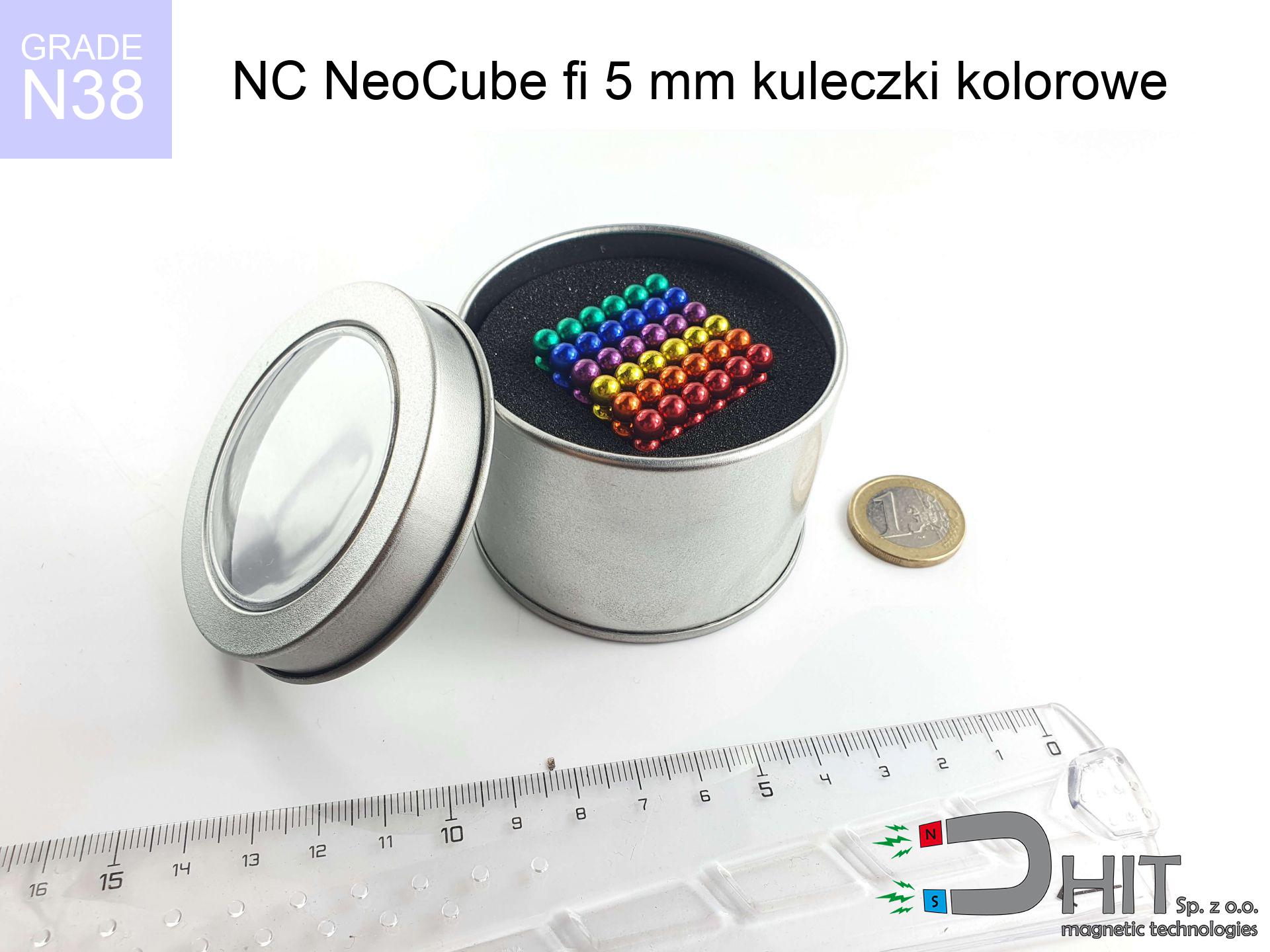
NC NeoCube fi 5 mm kuleczki kolorowe / N38 - neocube
neocube
Catalog no 120229
GTIN/EAN: 5906301812685
- Weight
- 145 g
- Magnetization Direction
- ↑ axial
- Coating
- [NiCuNi] Nickel
How we measure these parameters — certificates and measurements
40.64 zł net / pcs
49.99 zł with VAT (23% VAT) / pcs
bulk discounts:
Need more?Frequently asked questions
Are magnets in educational construction sets safe for children?
Which NeoCube set is the most durable?
How can I distinguish an original NeoCube set from a poor-quality substitute?
Guides from the knowledge base
Call us now
+48 888 99 98 98
alternatively let us know using
contact form
the contact section.
Specifications and structure of a neodymium magnet can be estimated using our
power calculator.
Order by 14:00 and we’ll ship today!
Product card - NC NeoCube fi 5 mm kuleczki kolorowe / N38 - neocube
Specification / characteristics - NC NeoCube fi 5 mm kuleczki kolorowe / N38 - neocube
| properties | values |
|---|---|
| Cat. no. | 120229 |
| GTIN/EAN | 5906301812685 |
| Production/Distribution | Dhit sp. z o.o. |
| Country of origin | Poland / China / Germany |
| Customs code | 85059029 |
| Weight | 145 g |
| Magnetization Direction | ↑ axial |
| Coating | [NiCuNi] Nickel |
| Manufacturing Tolerance | ±1 mm |
Magnetic properties of material N38
| properties | values | units |
|---|---|---|
| Remanence Br ? | 12.2-12.6 | kGs |
| Remanence Br ? | 1220-1260 | mT |
| Coercivity bHc ? | 10.8-11.5 | kOe |
| Coercivity bHc ? | 860-915 | kA/m |
| Intrinsic coercivity iHc | ≥ 12 | kOe |
| Intrinsic coercivity iHc | ≥ 955 | kA/m |
| Energy product BHmax ? | 36-38 | BH max MGOe |
| Energy product BHmax ? | 287-303 | BH max KJ/m |
| Maximum working temperature ? | ≤ 80 | °C |
Physical properties of sintered neodymium magnets Nd2Fe14B at 20°C
| properties | values | units |
|---|---|---|
| Vickers hardness | ≥550 | Hv |
| Density | ≥7.4 | g/cm3 |
| Curie Temperature TC | 310 | °C |
| Curie Temperature TF | 590 | °F |
| Specific resistance | 150 | μΩ⋅cm |
| Bending strength | 250 | MPa |
| Compressive strength | 1000~1100 | MPa |
| Thermal expansion parallel (∥) to orientation (M) | (3-4) x 10-6 | °C-1 |
| Thermal expansion perpendicular (⊥) to orientation (M) | -(1-3) x 10-6 | °C-1 |
| Young's modulus | 1.7 x 10⁴ | kg/mm² |
Elemental analysis
| iron (Fe) | 64% – 68% |
| neodymium (Nd) | 29% – 32% |
| boron (B) | 1.1% – 1.2% |
| dysprosium (Dy) | 0.5% – 2.0% |
| coating (Ni-Cu-Ni) | < 0.05% |
Environmental data
| recyclability (EoL) | 100% |
| recycled raw materials | ~10% (pre-cons) |
| carbon footprint | low / zredukowany |
| waste code (EWC) | 16 02 16 |
Other deals
![UMGGW 34x8 [M4] GW / N38 - magnetic holder rubber internal thread](https://cdn3.dhit.pl/graphics/products/umg-34x8-m4-gw-kek.jpg "UMGGW 34x8 [M4] GW / N38 - magnetic holder rubber internal thread")

Strengths as well as weaknesses of rare earth magnets.
Pros
- They have stable power, and over more than 10 years their attraction force decreases symbolically – ~1% (according to theory),
- They possess excellent resistance to weakening of magnetic properties due to external fields,
- By applying a lustrous layer of gold, the element presents an modern look,
- Magnets have very high magnetic induction on the surface,
- Neodymium magnets are characterized by very high magnetic induction on the magnet surface and are able to act (depending on the form) even at a temperature of 230°C or more...
- Thanks to versatility in designing and the capacity to modify to client solutions,
- Huge importance in innovative solutions – they are utilized in HDD drives, drive modules, diagnostic systems, also industrial machines.
- Compactness – despite small sizes they provide effective action, making them ideal for precision applications
Limitations
- They are fragile upon heavy impacts. To avoid cracks, it is worth securing magnets in a protective case. Such protection not only protects the magnet but also increases its resistance to damage
- Do not exceed this material temperature limit: 80°C. Overheating may permanently weaken the magnet.
- They rust in a humid environment - during use outdoors we advise using waterproof magnets e.g. in rubber, plastic
- Due to limitations in producing threads and complex shapes in magnets, we recommend using casing - magnetic mount.
- Possible danger related to microscopic parts of magnets pose a threat, when accidentally swallowed, which is particularly important in the aspect of protecting the youngest. It is also worth noting that small components of these products are able to disrupt the diagnostic process medical after entering the body.
- With large orders the cost of neodymium magnets can be a barrier,
Pull force analysis
Detachment force of the magnet in optimal conditions – what it depends on?
- with the use of a sheet made of low-carbon steel, guaranteeing full magnetic saturation
- whose thickness reaches at least 10 mm
- with an polished contact surface
- without the slightest clearance between the magnet and steel
- under axial force vector (90-degree angle)
- in stable room temperature
Magnet lifting force in use – key factors
- Gap (between the magnet and the plate), because even a very small clearance (e.g. 0.5 mm) can cause a reduction in force by up to 50% (this also applies to varnish, rust or dirt).
- Direction of force – highest force is reached only during pulling at a 90° angle. The resistance to sliding of the magnet along the surface is typically several times lower (approx. 1/5 of the lifting capacity).
- Base massiveness – insufficiently thick steel causes magnetic saturation, causing part of the flux to be lost to the other side.
- Metal type – different alloys reacts the same. Alloy additives weaken the interaction with the magnet.
- Base smoothness – the more even the surface, the larger the contact zone and stronger the hold. Roughness acts like micro-gaps.
- Heat – neodymium magnets have a sensitivity to temperature. At higher temperatures they lose power, and in frost they can be stronger (up to a certain limit).
Lifting capacity testing was conducted on a smooth plate of optimal thickness, under perpendicular forces, in contrast under attempts to slide the magnet the load capacity is reduced by as much as 5 times. In addition, even a slight gap between the magnet and the plate decreases the load capacity.
H&S for magnets
Metal Allergy
Warning for allergy sufferers: The nickel-copper-nickel coating consists of nickel. If skin irritation appears, immediately stop handling magnets and wear gloves.
Powerful field
Handle with care. Neodymium magnets act from a long distance and snap with huge force, often faster than you can react.
Cards and drives
Avoid bringing magnets close to a wallet, laptop, or screen. The magnetic field can permanently damage these devices and erase data from cards.
Magnetic interference
Navigation devices and smartphones are extremely susceptible to magnetism. Close proximity with a powerful NdFeB magnet can permanently damage the sensors in your phone.
Product not for children
NdFeB magnets are not intended for children. Swallowing several magnets may result in them connecting inside the digestive tract, which constitutes a severe health hazard and necessitates immediate surgery.
Eye protection
Despite metallic appearance, the material is brittle and cannot withstand shocks. Do not hit, as the magnet may crumble into hazardous fragments.
Pacemakers
Medical warning: Neodymium magnets can turn off pacemakers and defibrillators. Stay away if you have electronic implants.
Fire risk
Fire hazard: Neodymium dust is explosive. Avoid machining magnets without safety gear as this may cause fire.
Bone fractures
Mind your fingers. Two powerful magnets will join instantly with a force of several hundred kilograms, crushing anything in their path. Be careful!
Permanent damage
Watch the temperature. Heating the magnet to high heat will destroy its magnetic structure and strength.
Tabela kosztu i czasu dostawy
Płatność przed wysyłką:

GLS kurier
Przesyłka będzie u Ciebie za 2-3 dni
14.99 ZŁ

InPost Paczkomaty 24/7
Przesyłka będzie u Ciebie za 1-2 dni
12.30 ZŁ
Płatność przy odbiorze (pobranie):
GLS kurier
Przesyłka będzie u Ciebie za 1-2 dni
23.00 ZŁ