

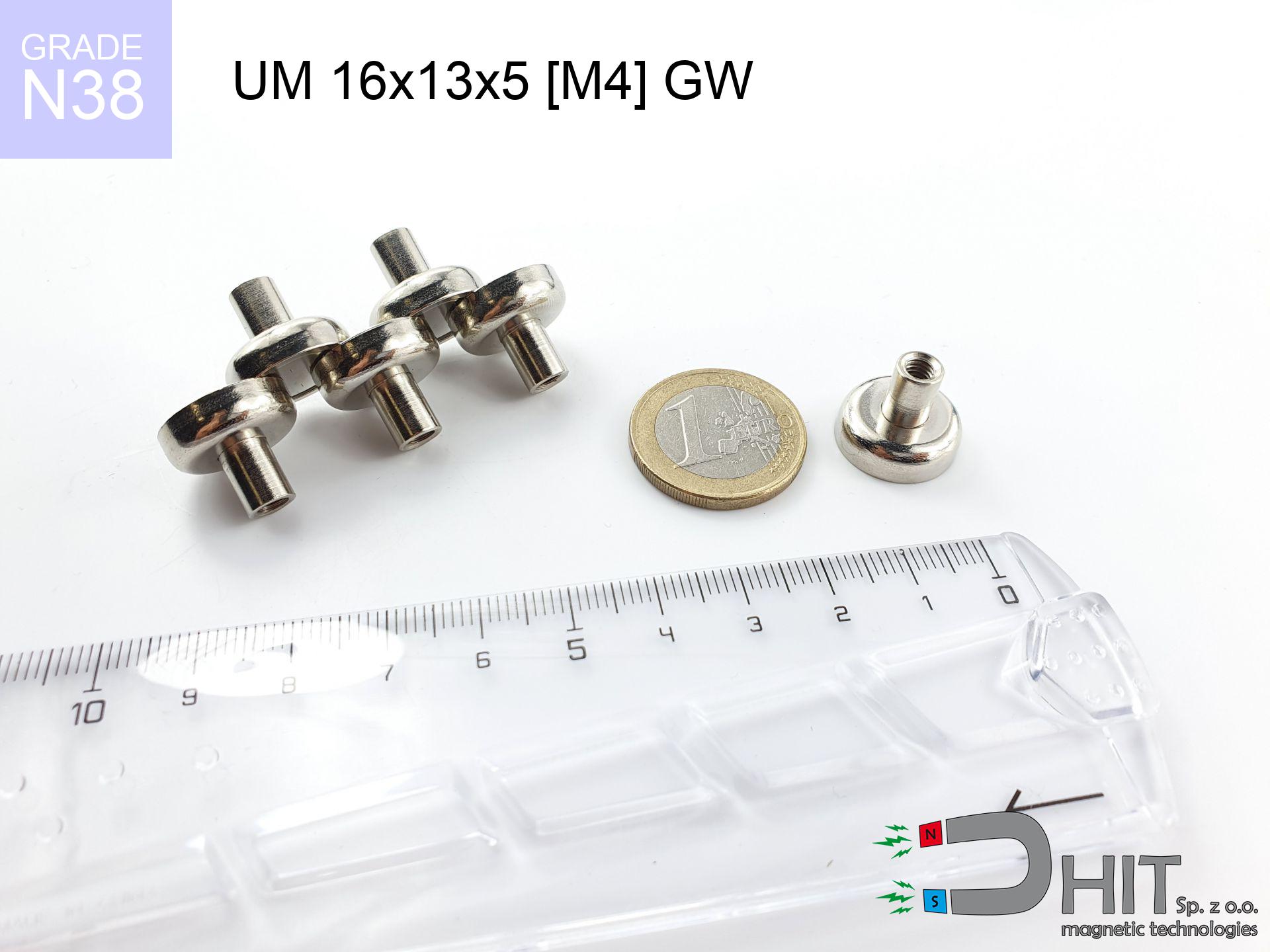
UMGW 20x15x7 [M4] GW zestaw 4 szt. / N38 - magnetic holder internal thread
magnetic holder internal thread
Catalog no 180551
GTIN/EAN: 5906301815433
- Diameter Ø
- 20 mm [±1 mm]
- Height
- 15 mm [±1 mm]
- Height
- 7 mm [±1 mm]
- Weight
- 62 g
- Magnetization Direction
- ↑ axial
- Coating
- [NiCuNi] Nickel
How we measure these parameters — certificates and measurements
20.32 zł net / pcs
24.99 zł with VAT (23% VAT) / pcs
bulk discounts:
Need more?Frequently asked questions
Which magnetic holder is suitable for moving metal parts in a workshop?
How do I choose a holder for hanging a heavy item and check its real grip?
Which magnetic holders can be used outdoors?
How should I choose a strong threaded holder for field work?
Call us now
+48 888 99 98 98
alternatively let us know using
contact form
the contact section.
Specifications and structure of a neodymium magnet can be estimated using our
power calculator.
Order by 14:00 and we’ll ship today!
Product card - UMGW 20x15x7 [M4] GW zestaw 4 szt. / N38 - magnetic holder internal thread
Specification / characteristics - UMGW 20x15x7 [M4] GW zestaw 4 szt. / N38 - magnetic holder internal thread
| properties | values |
|---|---|
| Cat. no. | 180551 |
| GTIN/EAN | 5906301815433 |
| Distributor | Dhit sp. z o.o. |
| Country of origin | Poland / China / Germany |
| Customs code | 85059029 |
| Diameter Ø | 20 mm [±1 mm] |
| Height | 15 mm [±1 mm] |
| Height | 7 mm [±1 mm] |
| Weight | 62 g |
| Magnetization Direction | ↑ axial |
| Load capacity ~ ? | 9.00 kg / 88.26 N |
| Coating | [NiCuNi] Nickel |
| Manufacturing Tolerance | ±1 mm |
Magnetic properties of material N38
| properties | values | units |
|---|---|---|
| Remanence Br ? | 12.2-12.6 | kGs |
| Remanence Br ? | 1220-1260 | mT |
| Coercivity bHc ? | 10.8-11.5 | kOe |
| Coercivity bHc ? | 860-915 | kA/m |
| Intrinsic coercivity iHc | ≥ 12 | kOe |
| Intrinsic coercivity iHc | ≥ 955 | kA/m |
| Energy product BHmax ? | 36-38 | BH max MGOe |
| Energy product BHmax ? | 287-303 | BH max KJ/m |
| Maximum working temperature ? | ≤ 80 | °C |
Physical properties of sintered neodymium magnets Nd2Fe14B at 20°C
| properties | values | units |
|---|---|---|
| Vickers hardness | ≥550 | Hv |
| Density | ≥7.4 | g/cm3 |
| Curie Temperature TC | 310 | °C |
| Curie Temperature TF | 590 | °F |
| Specific resistance | 150 | μΩ⋅cm |
| Bending strength | 250 | MPa |
| Compressive strength | 1000~1100 | MPa |
| Thermal expansion parallel (∥) to orientation (M) | (3-4) x 10-6 | °C-1 |
| Thermal expansion perpendicular (⊥) to orientation (M) | -(1-3) x 10-6 | °C-1 |
| Young's modulus | 1.7 x 10⁴ | kg/mm² |
Chemical composition
| iron (Fe) | 64% – 68% |
| neodymium (Nd) | 29% – 32% |
| boron (B) | 1.1% – 1.2% |
| dysprosium (Dy) | 0.5% – 2.0% |
| coating (Ni-Cu-Ni) | < 0.05% |
Sustainability
| recyclability (EoL) | 100% |
| recycled raw materials | ~10% (pre-cons) |
| carbon footprint | low / zredukowany |
| waste code (EWC) | 16 02 16 |
See more deals

Advantages as well as disadvantages of Nd2Fe14B magnets.
Benefits
- Their magnetic field remains stable, and after around 10 years it drops only by ~1% (according to research),
- Neodymium magnets remain remarkably resistant to magnetic field loss caused by external magnetic fields,
- In other words, due to the metallic finish of gold, the element gains visual value,
- Neodymium magnets deliver maximum magnetic induction on a small surface, which ensures high operational effectiveness,
- Thanks to resistance to high temperature, they are able to function (depending on the form) even at temperatures up to 230°C and higher...
- Considering the option of accurate shaping and customization to specialized projects, neodymium magnets can be modeled in a variety of shapes and sizes, which increases their versatility,
- Key role in modern industrial fields – they serve a role in mass storage devices, electric motors, diagnostic systems, as well as multitasking production systems.
- Relatively small size with high pulling force – neodymium magnets offer impressive pulling force in tiny dimensions, which allows their use in small systems
Cons
- They are fragile upon too strong impacts. To avoid cracks, it is worth protecting magnets in special housings. Such protection not only shields the magnet but also improves its resistance to damage
- Do not exceed this material temperature limit: 80°C. Overheating may permanently weaken the magnet.
- When exposed to humidity, magnets usually rust. For applications outside, it is recommended to use protective magnets, such as magnets in rubber or plastics, which prevent oxidation and corrosion.
- We suggest casing - magnetic mount, due to difficulties in producing nuts inside the magnet and complicated forms.
- Possible danger related to microscopic parts of magnets pose a threat, if swallowed, which is particularly important in the context of child safety. Furthermore, small elements of these magnets are able to complicate diagnosis medical after entering the body.
- With large orders the cost of neodymium magnets can be a barrier,
Lifting parameters
Detachment force of the magnet in optimal conditions – what affects it?
- on a plate made of structural steel, effectively closing the magnetic field
- with a thickness no less than 10 mm
- characterized by smoothness
- without any air gap between the magnet and steel
- under vertical application of breakaway force (90-degree angle)
- in stable room temperature
Impact of factors on magnetic holding capacity in practice
- Distance – existence of any layer (rust, tape, gap) interrupts the magnetic circuit, which reduces capacity steeply (even by 50% at 0.5 mm).
- Force direction – note that the magnet has greatest strength perpendicularly. Under shear forces, the capacity drops drastically, often to levels of 20-30% of the nominal value.
- Metal thickness – the thinner the sheet, the weaker the hold. Part of the magnetic field penetrates through instead of generating force.
- Chemical composition of the base – mild steel attracts best. Alloy steels reduce magnetic properties and lifting capacity.
- Surface condition – ground elements ensure maximum contact, which increases force. Uneven metal weaken the grip.
- Thermal conditions – neodymium magnets have a sensitivity to temperature. When it is hot they lose power, and at low temperatures gain strength (up to a certain limit).
Holding force was tested on a smooth steel plate of 20 mm thickness, when a perpendicular force was applied, in contrast under attempts to slide the magnet the lifting capacity is smaller. In addition, even a slight gap between the magnet’s surface and the plate decreases the load capacity.
H&S for magnets
Do not give to children
Neodymium magnets are not suitable for play. Accidental ingestion of a few magnets may result in them pinching intestinal walls, which constitutes a direct threat to life and requires immediate surgery.
Data carriers
Equipment safety: Strong magnets can damage data carriers and delicate electronics (pacemakers, medical aids, timepieces).
Power loss in heat
Do not exceed the maximum operating temperature stated in the specifications of the particular product. The limit depends on the material, geometry and operating arrangement; there is no single threshold for all neodymium magnets. Overheating can permanently weaken a magnet.
Physical harm
Danger of trauma: The pulling power is so great that it can result in blood blisters, pinching, and even bone fractures. Protective gloves are recommended.
Risk of cracking
Watch out for shards. Magnets can explode upon uncontrolled impact, launching shards into the air. Wear goggles.
Skin irritation risks
Warning for allergy sufferers: The Ni-Cu-Ni coating contains nickel. If redness occurs, cease handling magnets and use protective gear.
Warning for heart patients
Individuals with a heart stimulator must maintain an safe separation from magnets. The magnetic field can stop the functioning of the implant.
Precision electronics
Note: neodymium magnets generate a field that disrupts precision electronics. Maintain a safe distance from your phone, tablet, and GPS.
Do not underestimate power
Be careful. Rare earth magnets act from a long distance and snap with huge force, often faster than you can move away.
Dust explosion hazard
Dust created during grinding of magnets is flammable. Avoid drilling into magnets unless you are an expert.
Tabela kosztu i czasu dostawy
Płatność przed wysyłką:

GLS kurier
Przesyłka będzie u Ciebie za 2-3 dni
14.99 ZŁ

InPost Paczkomaty 24/7
Przesyłka będzie u Ciebie za 1-2 dni
12.30 ZŁ
Płatność przy odbiorze (pobranie):
GLS kurier
Przesyłka będzie u Ciebie za 1-2 dni
23.00 ZŁ