

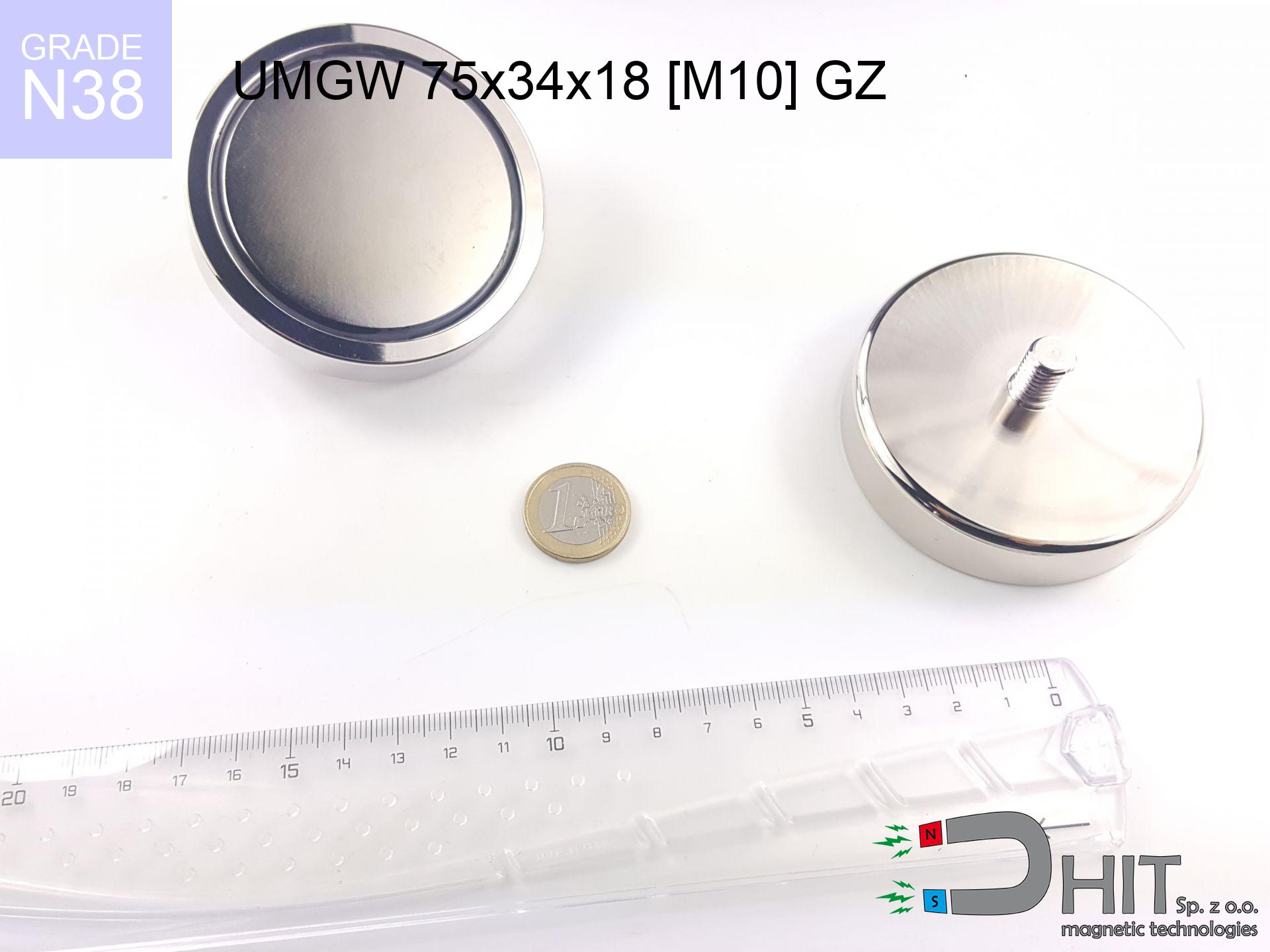
UMGZ 75x34x18 [M10] GZ / N38 - magnetic holder external thread
magnetic holder external thread
Catalog no 190417
GTIN/EAN: 5906301813880
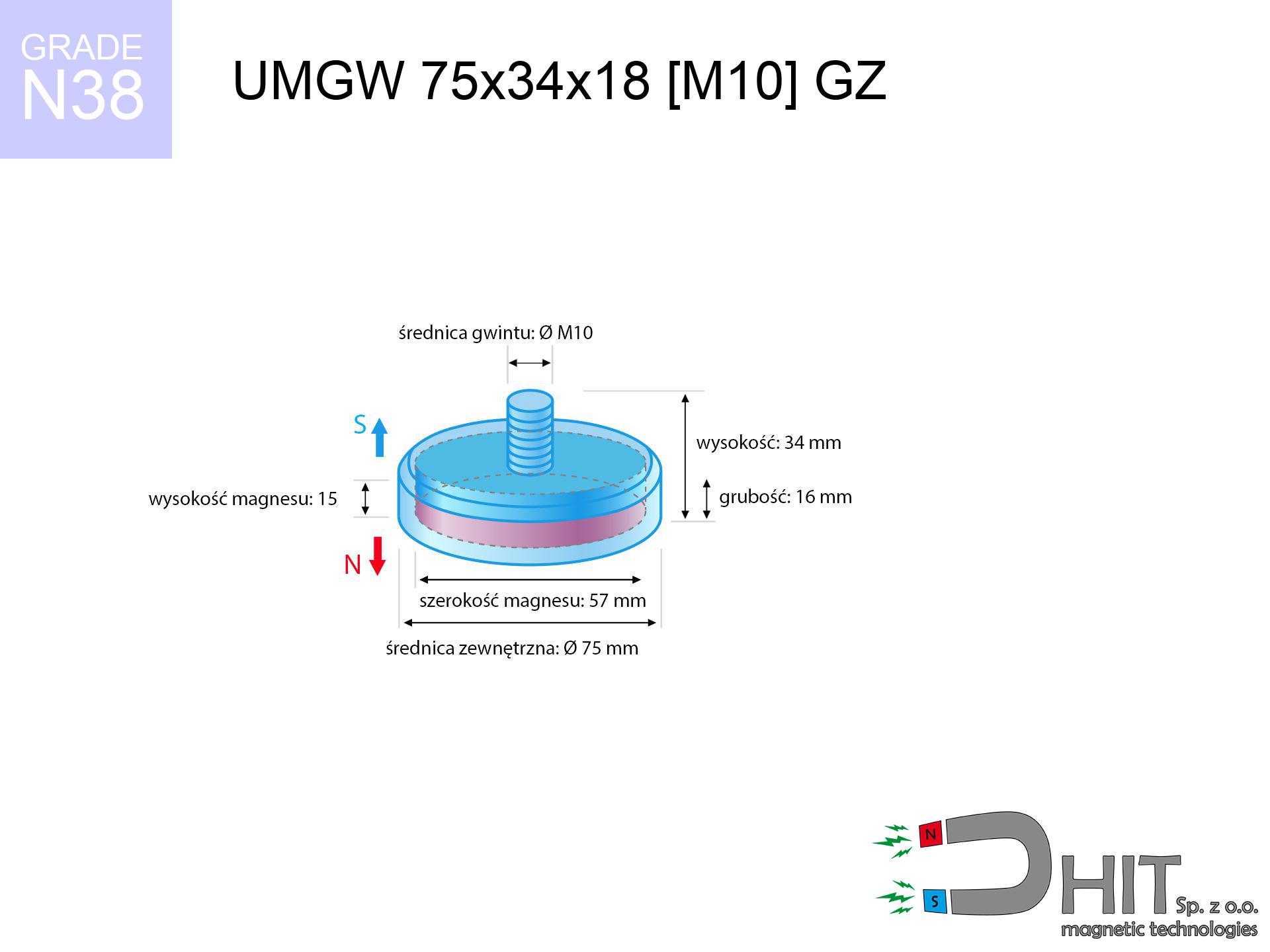
- Diameter Ø
- 75 mm [±1 mm]
- Height
- 34 mm [±1 mm]
- Height
- 18 mm [±1 mm]
- Weight
- 475 g
- Magnetization Direction
- ↑ axial
- Coating
- [NiCuNi] Nickel
How we measure these parameters — certificates and measurements
154.00 zł net / pcs
189.42 zł with VAT (23% VAT) / pcs
bulk discounts:
Need more?Frequently asked questions
Which magnetic holder is suitable for moving metal parts in a workshop?
How do I choose a holder for hanging a heavy item and check its real grip?
Which magnetic holders can be used outdoors?
How should I choose a strong threaded holder for field work?
Call us now
+48 888 99 98 98
alternatively let us know using
contact form
the contact section.
Specifications and structure of a neodymium magnet can be estimated using our
power calculator.
Order by 14:00 and we’ll ship today!
Physical properties - UMGZ 75x34x18 [M10] GZ / N38 - magnetic holder external thread
Specification / characteristics - UMGZ 75x34x18 [M10] GZ / N38 - magnetic holder external thread
| properties | values |
|---|---|
| Cat. no. | 190417 |
| GTIN/EAN | 5906301813880 |
| Distributor | Dhit sp. z o.o. |
| Country of origin | Poland / China / Germany |
| Customs code | 85059029 |
| Diameter Ø | 75 mm [±1 mm] |
| Height | 34 mm [±1 mm] |
| Height | 18 mm [±1 mm] |
| Weight | 475 g |
| Magnetization Direction | ↑ axial |
| Load capacity ~ ? | 162.00 kg / 1588.68 N |
| Coating | [NiCuNi] Nickel |
| Manufacturing Tolerance | ±1 mm |
Magnetic properties of material N38
| properties | values | units |
|---|---|---|
| Remanence Br ? | 12.2-12.6 | kGs |
| Remanence Br ? | 1220-1260 | mT |
| Coercivity bHc ? | 10.8-11.5 | kOe |
| Coercivity bHc ? | 860-915 | kA/m |
| Intrinsic coercivity iHc | ≥ 12 | kOe |
| Intrinsic coercivity iHc | ≥ 955 | kA/m |
| Energy product BHmax ? | 36-38 | BH max MGOe |
| Energy product BHmax ? | 287-303 | BH max KJ/m |
| Maximum working temperature ? | ≤ 80 | °C |
Physical properties of sintered neodymium magnets Nd2Fe14B at 20°C
| properties | values | units |
|---|---|---|
| Vickers hardness | ≥550 | Hv |
| Density | ≥7.4 | g/cm3 |
| Curie Temperature TC | 310 | °C |
| Curie Temperature TF | 590 | °F |
| Specific resistance | 150 | μΩ⋅cm |
| Bending strength | 250 | MPa |
| Compressive strength | 1000~1100 | MPa |
| Thermal expansion parallel (∥) to orientation (M) | (3-4) x 10-6 | °C-1 |
| Thermal expansion perpendicular (⊥) to orientation (M) | -(1-3) x 10-6 | °C-1 |
| Young's modulus | 1.7 x 10⁴ | kg/mm² |
Chemical composition
| iron (Fe) | 64% – 68% |
| neodymium (Nd) | 29% – 32% |
| boron (B) | 1.1% – 1.2% |
| dysprosium (Dy) | 0.5% – 2.0% |
| coating (Ni-Cu-Ni) | < 0.05% |
Environmental data
| recyclability (EoL) | 100% |
| recycled raw materials | ~10% (pre-cons) |
| carbon footprint | low / zredukowany |
| waste code (EWC) | 16 02 16 |
Other offers
Advantages and disadvantages of Nd2Fe14B magnets.
Strengths
- They do not lose power, even after around 10 years – the drop in lifting capacity is only ~1% (according to tests),
- They feature excellent resistance to magnetism drop as a result of external fields,
- By using a smooth coating of nickel, the element gains an elegant look,
- Magnets possess maximum magnetic induction on the outer side,
- Thanks to resistance to high temperature, they are capable of working (depending on the form) even at temperatures up to 230°C and higher...
- Thanks to versatility in constructing and the capacity to adapt to unusual requirements,
- Universal use in modern technologies – they are used in computer drives, brushless drives, diagnostic systems, also industrial machines.
- Relatively small size with high pulling force – neodymium magnets offer strong magnetic field in compact dimensions, which makes them useful in compact constructions
Cons
- To avoid cracks under impact, we suggest using special steel housings. Such a solution secures the magnet and simultaneously improves its durability.
- Do not exceed this material temperature limit: 80°C. Overheating may permanently weaken the magnet.
- Magnets exposed to a humid environment can corrode. Therefore when using outdoors, we recommend using waterproof magnets made of rubber, plastic or other material protecting against moisture
- Due to limitations in realizing nuts and complicated forms in magnets, we recommend using cover - magnetic mount.
- Potential hazard to health – tiny shards of magnets are risky, if swallowed, which becomes key in the aspect of protecting the youngest. Furthermore, tiny parts of these products can disrupt the diagnostic process medical after entering the body.
- With large orders the cost of neodymium magnets can be a barrier,
Holding force characteristics
Maximum holding power of the magnet – what contributes to it?
- on a block made of structural steel, optimally conducting the magnetic field
- with a cross-section minimum 10 mm
- with an ground contact surface
- without the slightest air gap between the magnet and steel
- during detachment in a direction perpendicular to the mounting surface
- at ambient temperature room level
What influences lifting capacity in practice
- Space between surfaces – every millimeter of distance (caused e.g. by varnish or dirt) diminishes the magnet efficiency, often by half at just 0.5 mm.
- Load vector – highest force is obtained only during pulling at a 90° angle. The shear force of the magnet along the plate is usually several times smaller (approx. 1/5 of the lifting capacity).
- Substrate thickness – for full efficiency, the steel must be sufficiently thick. Paper-thin metal restricts the lifting capacity (the magnet "punches through" it).
- Metal type – different alloys attracts identically. High carbon content worsen the interaction with the magnet.
- Surface quality – the more even the plate, the larger the contact zone and stronger the hold. Roughness acts like micro-gaps.
- Temperature – heating the magnet causes a temporary drop of induction. It is worth remembering the thermal limit for a given model.
Lifting capacity was measured using a steel plate with a smooth surface of optimal thickness (min. 20 mm), under perpendicular detachment force, however under parallel forces the lifting capacity is smaller. In addition, even a slight gap between the magnet’s surface and the plate decreases the load capacity.
Precautions when working with neodymium magnets
Metal Allergy
Studies show that nickel (standard magnet coating) is a common allergen. If you have an allergy, avoid touching magnets with bare hands or choose coated magnets.
Adults only
Product intended for adults. Tiny parts pose a choking risk, leading to serious injuries. Keep away from kids and pets.
Fire risk
Powder created during machining of magnets is self-igniting. Avoid drilling into magnets without proper cooling and knowledge.
Hand protection
Pinching hazard: The pulling power is so great that it can cause blood blisters, pinching, and even bone fractures. Use thick gloves.
Implant safety
Life threat: Strong magnets can deactivate pacemakers and defibrillators. Stay away if you have medical devices.
Thermal limits
Do not exceed the maximum operating temperature stated in the specifications of the particular product. The limit depends on the material, geometry and operating arrangement; there is no single threshold for all neodymium magnets. Overheating can permanently weaken a magnet.
Data carriers
Equipment safety: Strong magnets can damage data carriers and sensitive devices (pacemakers, medical aids, timepieces).
Threat to navigation
An intense magnetic field interferes with the operation of compasses in phones and navigation systems. Maintain magnets close to a device to avoid breaking the sensors.
Powerful field
Handle magnets with awareness. Their huge power can shock even experienced users. Plan your moves and do not underestimate their power.
Fragile material
NdFeB magnets are sintered ceramics, which means they are prone to chipping. Collision of two magnets will cause them cracking into shards.
Tabela kosztu i czasu dostawy
Płatność przed wysyłką:

GLS kurier
Przesyłka będzie u Ciebie za 2-3 dni
14.99 ZŁ

InPost Paczkomaty 24/7
Przesyłka będzie u Ciebie za 1-2 dni
12.30 ZŁ
Płatność przy odbiorze (pobranie):
GLS kurier
Przesyłka będzie u Ciebie za 1-2 dni
23.00 ZŁ