

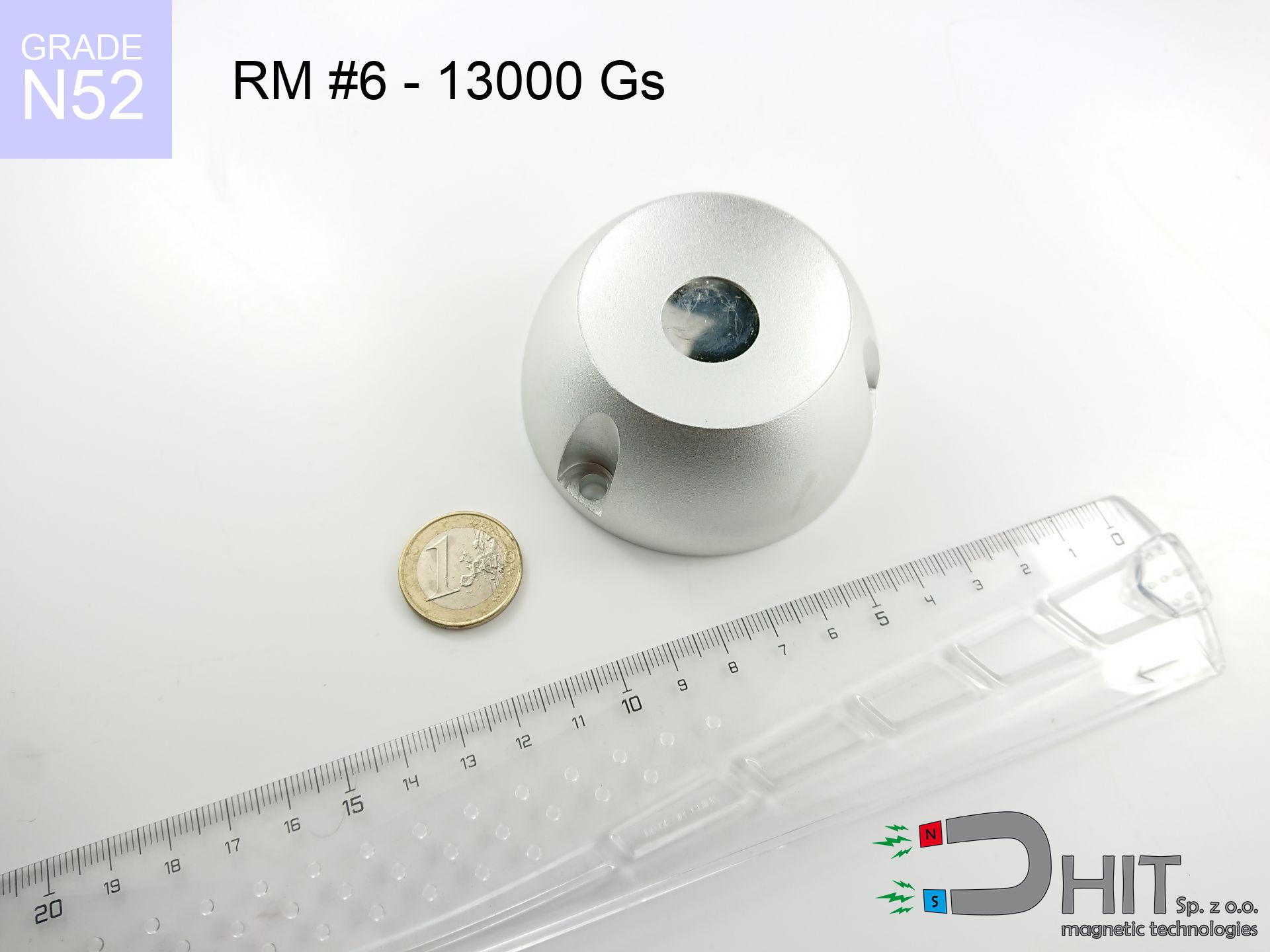
RM R6 GOLF - 13000 Gs / N52 - magnetic distributor
magnetic distributor
Catalog no 280398
GTIN/EAN: 5906301814474
- Weight
- 343 g
- Magnetization Direction
- ↑ axial
- Coating
- [NiCuNi] Nickel
How we measure these parameters — certificates and measurements
121.95 zł net / pcs
150.00 zł with VAT (23% VAT) / pcs
bulk discounts:
Need more?Frequently asked questions
What is the difference between a 13,000 Gs and a 5,000 Gs detacher, and which one should I choose for a clothing shop?
Will one detacher open every security tag we use in the shop?
How do I fix the detacher to the counter so it does not move around or go missing?
Will the detacher damage payment cards, phones or the payment terminal next to the till?
How do I look after a detacher, and does its strength fade over time?
How many till points should we equip, and is a spare unit worth keeping?
Who are detachers sold to, and what is needed to place an order?
Guides from the knowledge base
Call us now
+48 888 99 98 98
alternatively let us know using
contact form
the contact section.
Specifications and structure of a neodymium magnet can be estimated using our
power calculator.
Order by 14:00 and we’ll ship today!
Detailed specification - RM R6 GOLF - 13000 Gs / N52 - magnetic distributor
Specification / characteristics - RM R6 GOLF - 13000 Gs / N52 - magnetic distributor
| properties | values |
|---|---|
| Cat. no. | 280398 |
| GTIN/EAN | 5906301814474 |
| Production/Distribution | Dhit sp. z o.o. |
| Country of origin | Poland / China / Germany |
| Customs code | 85059029 |
| Weight | 343 g |
| Magnetization Direction | ↑ axial |
| Coating | [NiCuNi] Nickel |
| Manufacturing Tolerance | ±1 mm |
Magnetic properties of material N52
| properties | values | units |
|---|---|---|
| Remanence Br ? | 14.2-14.7 | kGs |
| Remanence Br ? | 1420-1470 | mT |
| Coercivity bHc ? | 10.8-12.5 | kOe |
| Coercivity bHc ? | 860-995 | kA/m |
| Intrinsic coercivity iHc | ≥ 12 | kOe |
| Intrinsic coercivity iHc | ≥ 955 | kA/m |
| Energy product BHmax ? | 48-53 | BH max MGOe |
| Energy product BHmax ? | 380-422 | BH max KJ/m |
| Maximum working temperature ? | ≤ 60 | °C |
Physical properties of sintered neodymium magnets Nd2Fe14B at 20°C
| properties | values | units |
|---|---|---|
| Vickers hardness | ≥550 | Hv |
| Density | ≥7.4 | g/cm3 |
| Curie Temperature TC | 310 | °C |
| Curie Temperature TF | 590 | °F |
| Specific resistance | 150 | μΩ⋅cm |
| Bending strength | 250 | MPa |
| Compressive strength | 1000~1100 | MPa |
| Thermal expansion parallel (∥) to orientation (M) | (3-4) x 10-6 | °C-1 |
| Thermal expansion perpendicular (⊥) to orientation (M) | -(1-3) x 10-6 | °C-1 |
| Young's modulus | 1.7 x 10⁴ | kg/mm² |
Chemical composition
| iron (Fe) | 64% – 68% |
| neodymium (Nd) | 29% – 32% |
| boron (B) | 1.1% – 1.2% |
| dysprosium (Dy) | 0.5% – 2.0% |
| coating (Ni-Cu-Ni) | < 0.05% |
Ecology and recycling (GPSR)
| recyclability (EoL) | 100% |
| recycled raw materials | ~10% (pre-cons) |
| carbon footprint | low / zredukowany |
| waste code (EWC) | 16 02 16 |
Other proposals
![UI 45x13x5 [M301] / N38 - badge holder](https://cdn3.dhit.pl/graphics/products/ui45x13x5-m301-vud.jpg "UI 45x13x5 [M301] / N38 - badge holder")
![SM 25x250 [2xM8] / N42 - magnetic separator](https://cdn3.dhit.pl/graphics/products/sm-25x250-2xm8-ker.jpg "SM 25x250 [2xM8] / N42 - magnetic separator")
Pros and cons of neodymium magnets.
Advantages
- They virtually do not lose power, because even after 10 years the performance loss is only ~1% (based on calculations),
- They do not lose their magnetic properties even under external field action,
- A magnet with a shiny gold surface has an effective appearance,
- Magnets are characterized by extremely high magnetic induction on the outer side,
- Through (adequate) combination of ingredients, they can achieve high thermal resistance, allowing for action at temperatures approaching 230°C and above...
- In view of the option of flexible molding and adaptation to unique needs, NdFeB magnets can be manufactured in a wide range of forms and dimensions, which makes them more universal,
- Huge importance in modern industrial fields – they find application in mass storage devices, drive modules, precision medical tools, also industrial machines.
- Thanks to concentrated force, small magnets offer high operating force, in miniature format,
Limitations
- At very strong impacts they can break, therefore we recommend placing them in steel cases. A metal housing provides additional protection against damage and increases the magnet's durability.
- Do not exceed this material temperature limit: 60°C. Overheating may permanently weaken the magnet.
- They oxidize in a humid environment - during use outdoors we recommend using waterproof magnets e.g. in rubber, plastic
- Due to limitations in realizing nuts and complex forms in magnets, we recommend using cover - magnetic mount.
- Possible danger to health – tiny shards of magnets pose a threat, in case of ingestion, which is particularly important in the context of child health protection. Furthermore, small components of these devices are able to complicate diagnosis medical when they are in the body.
- Higher cost of purchase is one of the disadvantages compared to ceramic magnets, especially in budget applications
Pull force analysis
Maximum lifting force for a neodymium magnet – what contributes to it?
- using a base made of high-permeability steel, functioning as a circuit closing element
- possessing a thickness of min. 10 mm to avoid saturation
- with a surface cleaned and smooth
- without the slightest clearance between the magnet and steel
- under perpendicular application of breakaway force (90-degree angle)
- at ambient temperature approx. 20 degrees Celsius
Determinants of lifting force in real conditions
- Space between magnet and steel – even a fraction of a millimeter of separation (caused e.g. by varnish or unevenness) drastically reduces the pulling force, often by half at just 0.5 mm.
- Pull-off angle – note that the magnet holds strongest perpendicularly. Under shear forces, the capacity drops drastically, often to levels of 20-30% of the maximum value.
- Plate thickness – too thin plate does not close the flux, causing part of the flux to be wasted to the other side.
- Steel grade – ideal substrate is pure iron steel. Cast iron may generate lower lifting capacity.
- Surface quality – the smoother and more polished the surface, the better the adhesion and stronger the hold. Roughness creates an air distance.
- Thermal environment – heating the magnet results in weakening of force. It is worth remembering the maximum operating temperature for a given model.
Holding force was measured on the plate surface of 20 mm thickness, when a perpendicular force was applied, whereas under attempts to slide the magnet the load capacity is reduced by as much as 75%. Additionally, even a slight gap between the magnet’s surface and the plate decreases the load capacity.
Warnings
Shattering risk
Neodymium magnets are sintered ceramics, meaning they are prone to chipping. Collision of two magnets leads to them breaking into small pieces.
Keep away from electronics
An intense magnetic field negatively affects the operation of magnetometers in phones and navigation systems. Do not bring magnets near a smartphone to prevent damaging the sensors.
Allergic reactions
Certain individuals experience a sensitization to Ni, which is the typical protective layer for neodymium magnets. Frequent touching might lead to dermatitis. We suggest wear safety gloves.
Maximum temperature
Do not exceed the maximum operating temperature stated in the specifications of the particular product. The limit depends on the material, geometry and operating arrangement; there is no single threshold for all neodymium magnets. Overheating can permanently weaken a magnet.
Choking Hazard
Only for adults. Small elements can be swallowed, causing serious injuries. Store out of reach of children and animals.
Handling guide
Handle magnets consciously. Their immense force can surprise even professionals. Be vigilant and respect their force.
ICD Warning
For implant holders: Strong magnetic fields affect medical devices. Keep minimum 30 cm distance or request help to handle the magnets.
Flammability
Drilling and cutting of neodymium magnets carries a risk of fire hazard. Magnetic powder reacts violently with oxygen and is hard to extinguish.
Magnetic media
Do not bring magnets close to a wallet, computer, or screen. The magnetism can permanently damage these devices and wipe information from cards.
Finger safety
Pinching hazard: The pulling power is so immense that it can cause blood blisters, pinching, and broken bones. Protective gloves are recommended.
Tabela kosztu i czasu dostawy
Płatność przed wysyłką:

GLS kurier
Przesyłka będzie u Ciebie za 2-3 dni
14.99 ZŁ

InPost Paczkomaty 24/7
Przesyłka będzie u Ciebie za 1-2 dni
12.30 ZŁ
Płatność przy odbiorze (pobranie):
GLS kurier
Przesyłka będzie u Ciebie za 1-2 dni
23.00 ZŁ