

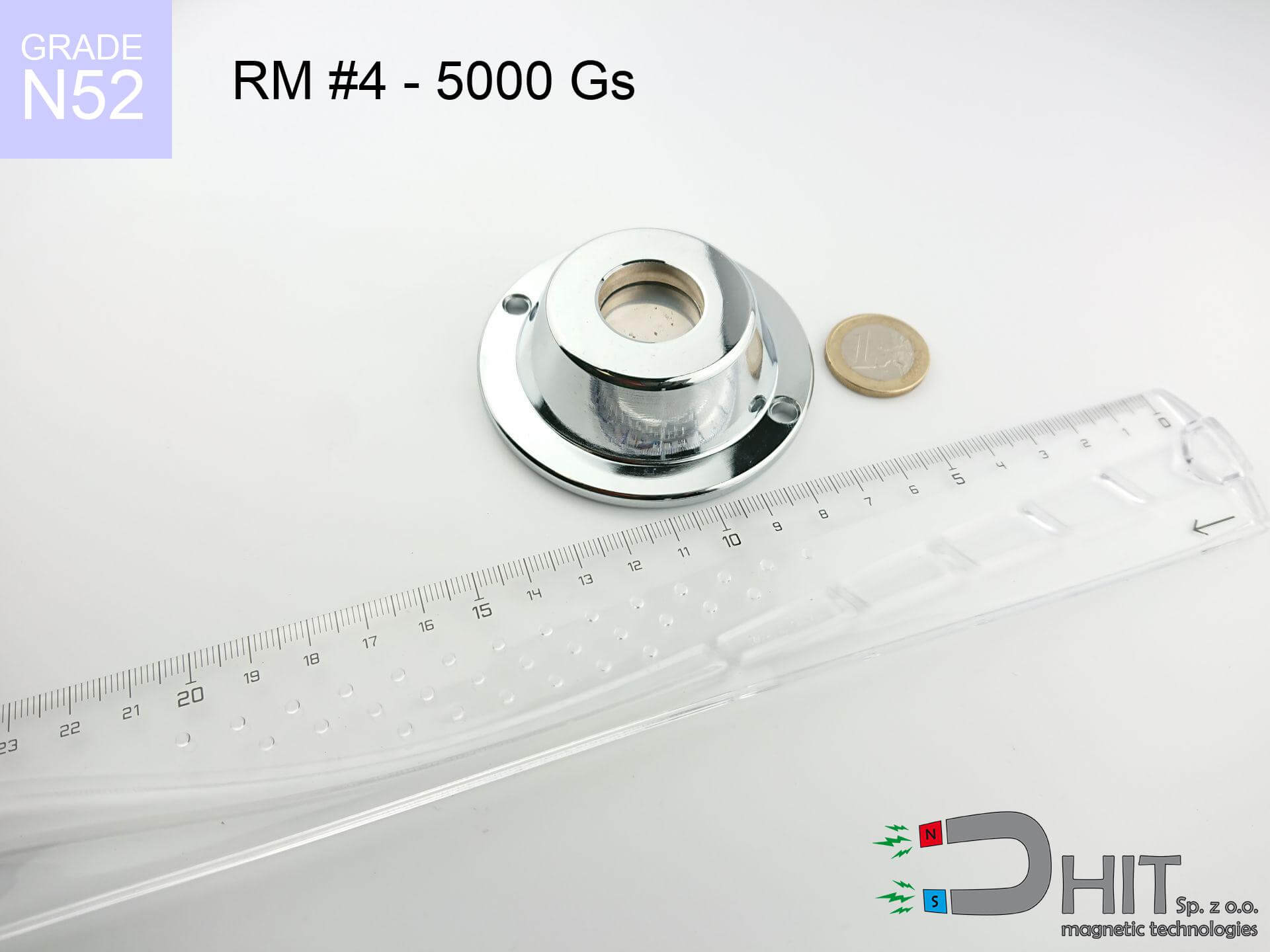
RM R4 - 5000 Gs / N52 - magnetic distributor
magnetic distributor
Catalog no 280254
GTIN/EAN: 5906301814450
- Weight
- 0.01 g
- Magnetization Direction
- ↑ axial
- Coating
- [NiCuNi] Nickel
How we measure these parameters — certificates and measurements
54.00 zł net / pcs
66.42 zł with VAT (23% VAT) / pcs
bulk discounts:
Need more?Frequently asked questions
What is the difference between a 13,000 Gs and a 5,000 Gs detacher, and which one should I choose for a clothing shop?
Will one detacher open every security tag we use in the shop?
How do I fix the detacher to the counter so it does not move around or go missing?
Will the detacher damage payment cards, phones or the payment terminal next to the till?
How do I look after a detacher, and does its strength fade over time?
How many till points should we equip, and is a spare unit worth keeping?
Who are detachers sold to, and what is needed to place an order?
Guides from the knowledge base
Call us now
+48 888 99 98 98
alternatively let us know using
contact form
the contact section.
Specifications and structure of a neodymium magnet can be estimated using our
power calculator.
Order by 14:00 and we’ll ship today!
Physical properties - RM R4 - 5000 Gs / N52 - magnetic distributor
Specification / characteristics - RM R4 - 5000 Gs / N52 - magnetic distributor
| properties | values |
|---|---|
| Cat. no. | 280254 |
| GTIN/EAN | 5906301814450 |
| Production/Distribution | Dhit sp. z o.o. |
| Country of origin | Poland / China / Germany |
| Customs code | 85059029 |
| Weight | 0.01 g |
| Magnetization Direction | ↑ axial |
| Coating | [NiCuNi] Nickel |
| Manufacturing Tolerance | ±1 mm |
Magnetic properties of material N52
| properties | values | units |
|---|---|---|
| Remanence Br ? | 14.2-14.7 | kGs |
| Remanence Br ? | 1420-1470 | mT |
| Coercivity bHc ? | 10.8-12.5 | kOe |
| Coercivity bHc ? | 860-995 | kA/m |
| Intrinsic coercivity iHc | ≥ 12 | kOe |
| Intrinsic coercivity iHc | ≥ 955 | kA/m |
| Energy product BHmax ? | 48-53 | BH max MGOe |
| Energy product BHmax ? | 380-422 | BH max KJ/m |
| Maximum working temperature ? | ≤ 60 | °C |
Physical properties of sintered neodymium magnets Nd2Fe14B at 20°C
| properties | values | units |
|---|---|---|
| Vickers hardness | ≥550 | Hv |
| Density | ≥7.4 | g/cm3 |
| Curie Temperature TC | 310 | °C |
| Curie Temperature TF | 590 | °F |
| Specific resistance | 150 | μΩ⋅cm |
| Bending strength | 250 | MPa |
| Compressive strength | 1000~1100 | MPa |
| Thermal expansion parallel (∥) to orientation (M) | (3-4) x 10-6 | °C-1 |
| Thermal expansion perpendicular (⊥) to orientation (M) | -(1-3) x 10-6 | °C-1 |
| Young's modulus | 1.7 x 10⁴ | kg/mm² |
Chemical composition
| iron (Fe) | 64% – 68% |
| neodymium (Nd) | 29% – 32% |
| boron (B) | 1.1% – 1.2% |
| dysprosium (Dy) | 0.5% – 2.0% |
| coating (Ni-Cu-Ni) | < 0.05% |
Environmental data
| recyclability (EoL) | 100% |
| recycled raw materials | ~10% (pre-cons) |
| carbon footprint | low / zredukowany |
| waste code (EWC) | 16 02 16 |
Other offers
![SM 28x125 [2xM8] / N52 - magnetic separator](https://cdn3.dhit.pl/graphics/products/sm-28x125-2xm8-pof.jpg "SM 28x125 [2xM8] / N52 - magnetic separator")
Pros as well as cons of rare earth magnets.
Benefits
- Their magnetic field is durable, and after approximately 10 years it decreases only by ~1% (theoretically),
- They have excellent resistance to magnetic field loss due to opposing magnetic fields,
- By covering with a smooth layer of nickel, the element acquires an elegant look,
- Magnetic induction on the top side of the magnet turns out to be maximum,
- Neodymium magnets are characterized by extremely high magnetic induction on the magnet surface and are able to act (depending on the shape) even at a temperature of 230°C or more...
- Due to the option of precise shaping and customization to unique projects, magnetic components can be modeled in a variety of forms and dimensions, which increases their versatility,
- Fundamental importance in future technologies – they are used in computer drives, electromotive mechanisms, advanced medical instruments, also other advanced devices.
- Relatively small size with high pulling force – neodymium magnets offer strong magnetic field in compact dimensions, which makes them useful in compact constructions
Limitations
- They are prone to damage upon too strong impacts. To avoid cracks, it is worth securing magnets using a steel holder. Such protection not only shields the magnet but also increases its resistance to damage
- Do not exceed this material temperature limit: 60°C. Overheating may permanently weaken the magnet.
- When exposed to humidity, magnets usually rust. To use them in conditions outside, it is recommended to use protective magnets, such as magnets in rubber or plastics, which secure oxidation as well as corrosion.
- We recommend a housing - magnetic mechanism, due to difficulties in producing threads inside the magnet and complex shapes.
- Health risk resulting from small fragments of magnets can be dangerous, if swallowed, which is particularly important in the context of child health protection. Furthermore, tiny parts of these magnets can be problematic in diagnostics medical when they are in the body.
- High unit price – neodymium magnets are more expensive than other types of magnets (e.g. ferrite), which hinders application in large quantities
Pull force analysis
Maximum lifting capacity of the magnet – what contributes to it?
- using a sheet made of mild steel, acting as a magnetic yoke
- possessing a massiveness of min. 10 mm to ensure full flux closure
- with an polished touching surface
- with zero gap (without paint)
- for force applied at a right angle (pull-off, not shear)
- at standard ambient temperature
Lifting capacity in real conditions – factors
- Space between surfaces – even a fraction of a millimeter of separation (caused e.g. by varnish or dirt) drastically reduces the magnet efficiency, often by half at just 0.5 mm.
- Direction of force – highest force is obtained only during pulling at a 90° angle. The shear force of the magnet along the plate is usually several times smaller (approx. 1/5 of the lifting capacity).
- Steel thickness – insufficiently thick steel causes magnetic saturation, causing part of the flux to be escaped to the other side.
- Metal type – different alloys attracts identically. Alloy additives worsen the interaction with the magnet.
- Smoothness – full contact is obtained only on polished steel. Rough texture reduce the real contact area, weakening the magnet.
- Thermal factor – high temperature weakens pulling force. Exceeding the limit temperature can permanently demagnetize the magnet.
Holding force was measured on the plate surface of 20 mm thickness, when a perpendicular force was applied, however under shearing force the load capacity is reduced by as much as 5 times. Moreover, even a slight gap between the magnet’s surface and the plate decreases the lifting capacity.
Warnings
Electronic hazard
Avoid bringing magnets near a wallet, computer, or TV. The magnetic field can permanently damage these devices and erase data from cards.
Health Danger
Individuals with a heart stimulator have to maintain an large gap from magnets. The magnetic field can disrupt the operation of the implant.
No play value
Strictly keep magnets away from children. Risk of swallowing is high, and the consequences of magnets connecting inside the body are very dangerous.
Fire warning
Powder created during machining of magnets is self-igniting. Do not drill into magnets without proper cooling and knowledge.
Nickel coating and allergies
Allergy Notice: The nickel-copper-nickel coating consists of nickel. If skin irritation appears, cease working with magnets and use protective gear.
Risk of cracking
NdFeB magnets are ceramic materials, meaning they are prone to chipping. Collision of two magnets leads to them cracking into small pieces.
Threat to navigation
Note: rare earth magnets produce a field that confuses precision electronics. Maintain a separation from your phone, tablet, and GPS.
Caution required
Handle magnets with awareness. Their powerful strength can surprise even experienced users. Stay alert and respect their power.
Physical harm
Danger of trauma: The attraction force is so great that it can result in hematomas, crushing, and broken bones. Protective gloves are recommended.
Maximum temperature
Avoid heat. NdFeB magnets are susceptible to heat. If you need operation above 80°C, ask us about HT versions (H, SH, UH).
Tabela kosztu i czasu dostawy
Płatność przed wysyłką:

GLS kurier
Przesyłka będzie u Ciebie za 2-3 dni
14.99 ZŁ

InPost Paczkomaty 24/7
Przesyłka będzie u Ciebie za 1-2 dni
12.30 ZŁ
Płatność przy odbiorze (pobranie):
GLS kurier
Przesyłka będzie u Ciebie za 1-2 dni
23.00 ZŁ