
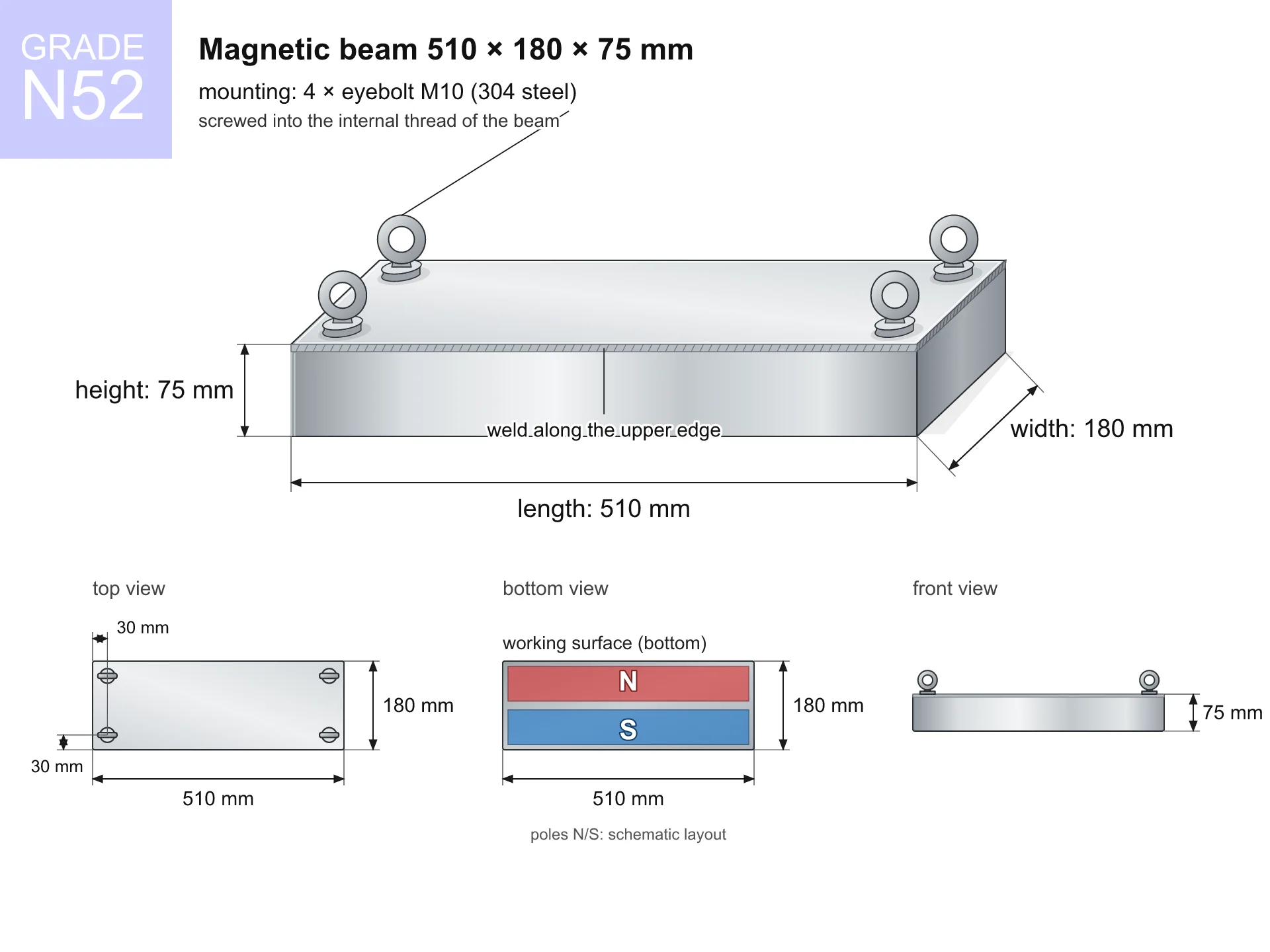
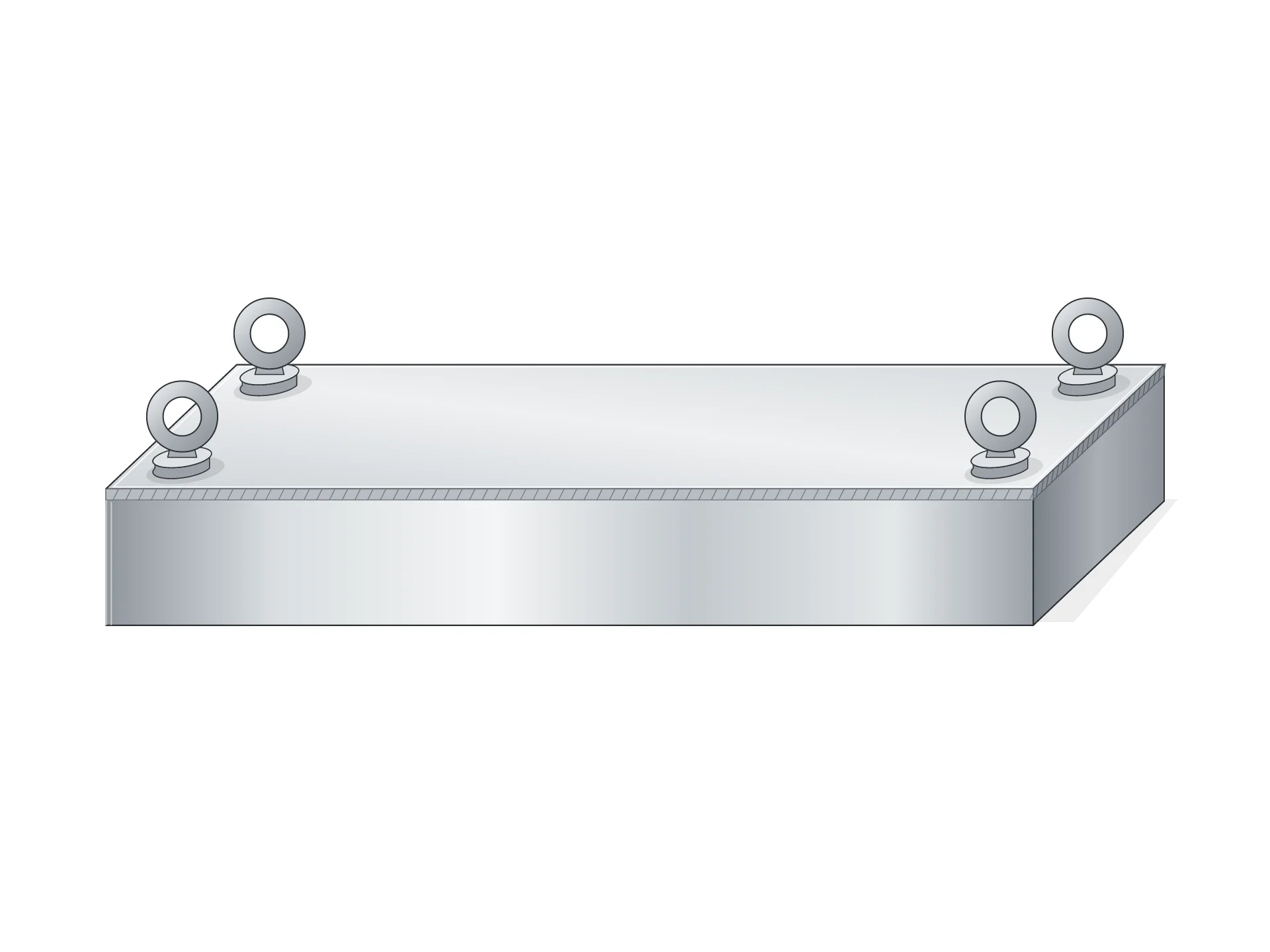
BM 510x180x75 [M10x4] - magnetic beam
magnetic beam
Catalog no 090572
GTIN/EAN: 5906301815648
- length
- 510 mm [±1 mm]
- Width
- 180 mm [±1 mm]
- Height
- 75 mm [±1 mm]
- Weight
- 35100 g
How we measure these parameters — certificates and measurements
4270.90 zł net / pcs
5253.21 zł with VAT (23% VAT) / pcs
bulk discounts:
Need more?Frequently asked questions
How do I choose a separator for fine contamination and check availability?
Where can I order a separator for a production line, and what should I check?
How can I verify a separator's declared magnetic parameters before purchase?
Can a magnetic beam withstand continuous work on a production line?
What roller design is suitable for a dusty environment?
How do I choose the size of a hand-held separator?
What is a hand-held separator for, and how is it different from a built-in rod?
Which separator type suits a small production plant?
Call us now
+48 888 99 98 98
alternatively let us know using
contact form
the contact section.
Specifications and structure of a neodymium magnet can be estimated using our
power calculator.
Order by 14:00 and we’ll ship today!
Physical properties - BM 510x180x75 [M10x4] - magnetic beam
Specification / characteristics - BM 510x180x75 [M10x4] - magnetic beam
| properties | values |
|---|---|
| Cat. no. | 090572 |
| GTIN/EAN | 5906301815648 |
| Distributor | Dhit sp. z o.o. |
| Country of origin | Poland / China / Germany |
| Customs code | 85059029 |
| length | 510 mm [±1 mm] |
| Width | 180 mm [±1 mm] |
| Height | 75 mm [±1 mm] |
| Weight | 35100 g |
| Manufacturing Tolerance | ±1 mm |
Physical properties of sintered neodymium magnets Nd2Fe14B at 20°C
| properties | values | units |
|---|---|---|
| Vickers hardness | ≥550 | Hv |
| Density | ≥7.4 | g/cm3 |
| Curie Temperature TC | 310 | °C |
| Curie Temperature TF | 590 | °F |
| Specific resistance | 150 | μΩ⋅cm |
| Bending strength | 250 | MPa |
| Compressive strength | 1000~1100 | MPa |
| Thermal expansion parallel (∥) to orientation (M) | (3-4) x 10-6 | °C-1 |
| Thermal expansion perpendicular (⊥) to orientation (M) | -(1-3) x 10-6 | °C-1 |
| Young's modulus | 1.7 x 10⁴ | kg/mm² |
Material specification
| iron (Fe) | 64% – 68% |
| neodymium (Nd) | 29% – 32% |
| boron (B) | 1.1% – 1.2% |
| dysprosium (Dy) | 0.5% – 2.0% |
| coating (Ni-Cu-Ni) | < 0.05% |
Environmental data
| recyclability (EoL) | 100% |
| recycled raw materials | ~10% (pre-cons) |
| carbon footprint | low / zredukowany |
| waste code (EWC) | 16 02 16 |
Check out more deals
Strengths and weaknesses of rare earth magnets.
Pros
- Their magnetic field remains stable, and after around ten years it decreases only by ~1% (theoretically),
- They do not lose their magnetic properties even under external field action,
- By using a decorative layer of gold, the element gains an aesthetic look,
- Magnets are characterized by exceptionally strong magnetic induction on the surface,
- Due to their durability and thermal resistance, neodymium magnets are capable of operate (depending on the form) even at high temperatures reaching 230°C or more...
- Considering the ability of free forming and adaptation to specialized solutions, neodymium magnets can be produced in a wide range of shapes and sizes, which expands the range of possible applications,
- Huge importance in modern industrial fields – they are commonly used in mass storage devices, electromotive mechanisms, medical equipment, and industrial machines.
- Thanks to their power density, small magnets offer high operating force, in miniature format,
Cons
- To avoid cracks under impact, we suggest using special steel housings. Such a solution secures the magnet and simultaneously increases its durability.
- Heat sensitivity: observe the temperature specified for this product. Overheating may permanently weaken the magnet.
- Magnets exposed to a humid environment can corrode. Therefore while using outdoors, we recommend using water-impermeable magnets made of rubber, plastic or other material protecting against moisture
- We recommend cover - magnetic mount, due to difficulties in realizing threads inside the magnet and complicated shapes.
- Health risk to health – tiny shards of magnets pose a threat, if swallowed, which gains importance in the context of child safety. It is also worth noting that small components of these magnets are able to be problematic in diagnostics medical in case of swallowing.
- Higher cost of purchase is a significant factor to consider compared to ceramic magnets, especially in budget applications
Lifting parameters
Breakaway strength of the magnet in ideal conditions – what affects it?
- on a block made of structural steel, effectively closing the magnetic field
- whose thickness equals approx. 10 mm
- characterized by even structure
- with direct contact (without coatings)
- for force acting at a right angle (in the magnet axis)
- in neutral thermal conditions
Determinants of lifting force in real conditions
- Gap between magnet and steel – every millimeter of separation (caused e.g. by veneer or unevenness) significantly weakens the magnet efficiency, often by half at just 0.5 mm.
- Force direction – remember that the magnet has greatest strength perpendicularly. Under shear forces, the holding force drops drastically, often to levels of 20-30% of the maximum value.
- Substrate thickness – to utilize 100% power, the steel must be sufficiently thick. Paper-thin metal restricts the lifting capacity (the magnet "punches through" it).
- Plate material – mild steel attracts best. Alloy admixtures reduce magnetic permeability and lifting capacity.
- Surface finish – ideal contact is obtained only on smooth steel. Any scratches and bumps create air cushions, reducing force.
- Temperature – temperature increase causes a temporary drop of force. Check the thermal limit for a given model.
Lifting capacity was determined with the use of a polished steel plate of suitable thickness (min. 20 mm), under perpendicular pulling force, however under shearing force the lifting capacity is smaller. In addition, even a small distance between the magnet’s surface and the plate decreases the holding force.
Safety rules for work with neodymium magnets
Life threat
Individuals with a pacemaker should keep an safe separation from magnets. The magnetic field can stop the functioning of the implant.
Magnet fragility
NdFeB magnets are sintered ceramics, meaning they are fragile like glass. Impact of two magnets leads to them cracking into small pieces.
Operating temperature
Do not exceed the maximum operating temperature stated in the specifications of the particular product. The limit depends on the material, geometry and operating arrangement; there is no single threshold for all neodymium magnets. Overheating can permanently weaken a magnet.
Threat to electronics
Device Safety: Strong magnets can ruin data carriers and sensitive devices (heart implants, hearing aids, timepieces).
Respect the power
Exercise caution. Rare earth magnets attract from a distance and connect with huge force, often quicker than you can react.
Do not drill into magnets
Powder created during grinding of magnets is combustible. Do not drill into magnets unless you are an expert.
GPS and phone interference
A strong magnetic field interferes with the functioning of magnetometers in phones and navigation systems. Do not bring magnets near a smartphone to prevent damaging the sensors.
Danger to the youngest
Adult use only. Small elements pose a choking risk, causing intestinal necrosis. Store out of reach of children and animals.
Sensitization to coating
Nickel alert: The nickel-copper-nickel coating contains nickel. If redness occurs, cease handling magnets and use protective gear.
Serious injuries
Protect your hands. Two large magnets will join instantly with a force of massive weight, destroying everything in their path. Exercise extreme caution!
Tabela kosztu i czasu dostawy
Płatność przed wysyłką:

GLS kurier
Przesyłka będzie u Ciebie za 2-3 dni
14.99 ZŁ

InPost Paczkomaty 24/7
Przesyłka będzie u Ciebie za 1-2 dni
12.30 ZŁ
Płatność przy odbiorze (pobranie):
GLS kurier
Przesyłka będzie u Ciebie za 1-2 dni
23.00 ZŁ